July 18, 2026
The Hidden Metal Inside Every Modern Weapon System, Smartphone, and 5G Tower
Most people have never heard of gallium. It doesn't trade on commodity exchanges with the same fanfare as gold or lithium. It doesn't appear in mainstream financial media. Yet this obscure, silvery metal sits at the absolute centre of some of the most strategically sensitive supply chains on the planet, and its concentration in the hands of a single nation has quietly become one of the defining industrial policy challenges of the 2020s.
Understanding why the Alcoa WA gallium plant represents a genuine inflection point requires starting not with the project itself, but with the material it produces and the structural vulnerability that its absence from Western supply chains has created.
When big ASX news breaks, our subscribers know first
Gallium: The Metal You Cannot Substitute and Cannot Ignore
Gallium occupies a peculiar position in the periodic table and in global industry. It is soft enough to melt in the palm of a human hand, yet its compound forms are among the hardest-working materials in modern electronics. Gallium arsenide (GaAs) and gallium nitride (GaN) semiconductors are the enabling materials behind 5G base stations, military radar arrays, satellite communications, and high-efficiency power electronics.
Unlike silicon, which dominates general computing, gallium-based compounds excel in high-frequency, high-power, and high-temperature environments where silicon simply cannot perform. This is not a matter of preference. It is a material science constraint. The electron mobility characteristics of GaN and GaAs make them irreplaceable in specific applications, and no commercially viable substitute currently exists at scale.
That technical reality transforms gallium supply security from an economic inconvenience into a defence and industrial imperative for allied nations. Furthermore, the gallium critical mineral deposits that do exist are structurally tied to alumina refining infrastructure, amplifying the supply challenge considerably.
Why China's 2023 Export Restrictions Changed the Strategic Calculus
China controls an estimated 80% or more of global gallium refining capacity. In mid-2023, Beijing introduced export licensing requirements for gallium, citing national security grounds. The immediate effect was a sharp reminder to allied governments that their semiconductor manufacturing pipelines, defence electronics supply chains, and 5G rollout programmes were structurally dependent on a single geopolitical actor with demonstrated willingness to use resource access as leverage.
The response across Washington, Tokyo, Brussels, and Canberra was not panic, but it was urgent. Critical mineral strategies were accelerated, bilateral and multilateral frameworks were activated, and the search for viable alternative gallium production nodes outside China moved from theoretical planning into concrete project development. These export controls impact extends well beyond gallium alone, reshaping how allied nations approach critical mineral procurement across the board.
"Gallium is not simply a commodity with an inconvenient geographic distribution. It is a chokepoint material, and China's 2023 licensing restrictions demonstrated precisely how that chokepoint can be activated."
The Geological Peculiarity That Makes Alumina Refineries the Only Logical Answer
Here is the fact that most coverage of gallium supply chains fails to adequately explain: gallium cannot be mined. It has no economically recoverable primary deposits. It exists as a trace element within bauxite ore, typically at concentrations of 50 to 80 parts per million, and it only becomes extractable during the alumina refining process.
The Bayer process, which converts bauxite into alumina through a series of caustic digestion and precipitation steps, naturally concentrates gallium within the process liquor that circulates through the refinery. Without intervention, this liquor is processed and recycled with the gallium remaining unrecovered. The insight that drives the Alcoa WA gallium plant is elegantly simple: the gallium is already there. It has always been there.
The question was never whether to mine it. The question was whether to capture it before it cycles back through the system. This bauxite production overview helps contextualise just how significant Australia's refinery network is as a latent gallium resource. This geological and process chemistry reality means that alumina refineries are, by definition, the world's gallium production platforms.
What the Alcoa WA Gallium Plant Actually Is and How It Functions
Co-Location at Wagerup: Infrastructure Intelligence in Practice
The Alcoa WA gallium plant is being developed at the Wagerup Alumina Refinery, located approximately 120 kilometres south-east of Perth in Western Australia. Wagerup is one of the largest alumina refineries in the southern hemisphere, processing bauxite sourced from the Darling Range into alumina for export. The refinery already operates within an established industrial footprint, with all of the primary infrastructure, power, water, chemical handling, and logistics connectivity that a new extraction facility would otherwise need to develop from scratch.
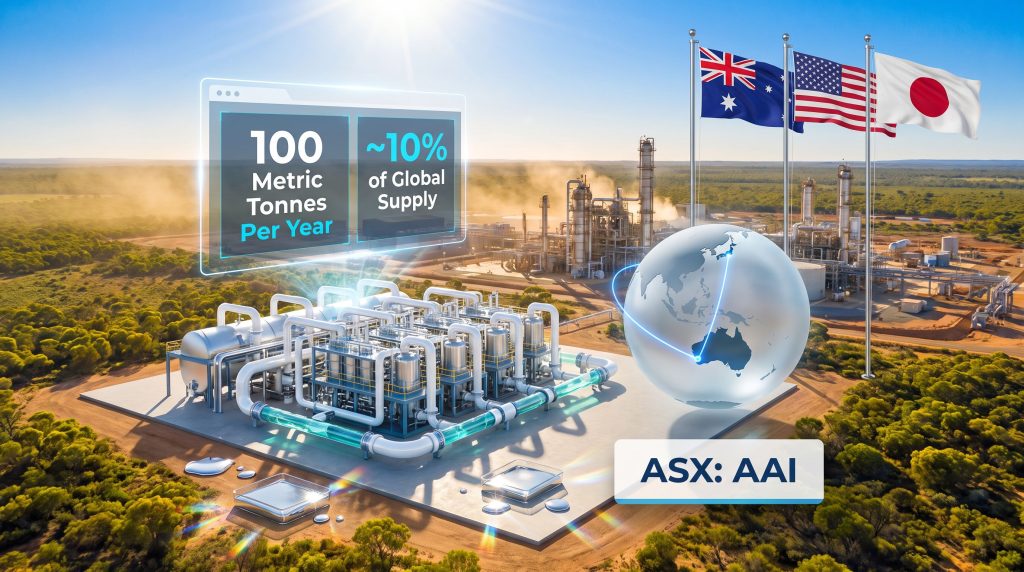
The gallium plant will occupy approximately 3 hectares of already-cleared land within the refinery boundary, representing less than 2% of the total site footprint. Five dedicated production trains will operate in parallel, each applying ion exchange technology to selectively capture gallium from the refinery's existing process liquor stream. No new bauxite mining is required. The resource, in effect, is the refinery itself.
According to Alcoa's project factsheet, the Wagerup co-location model was specifically selected for its ability to leverage existing infrastructure while minimising environmental and capital footprint.
Ion Exchange Technology: A Primer for Non-Technical Readers
Ion exchange is a well-established industrial separation technology that exploits the selective affinity of specialised resin materials for particular ions in solution. In the context of gallium recovery from alumina refinery liquor, the process works as follows:
- Process liquor from the Bayer refining cycle, which contains dissolved gallium ions alongside other aluminium chemistry, is directed through the ion exchange system.
- The gallium ions selectively bind to the resin material as the liquor passes through, while other dissolved species pass through relatively unimpeded.
- Once the resin is saturated with gallium, a stripping solution is used to release the captured gallium in concentrated form.
- The concentrated gallium solution is then processed through purification and reduction steps to produce refined gallium metal at commercially usable grades.
- The primary alumina production process continues uninterrupted throughout, with the gallium plant functioning as a parallel extraction loop rather than a disruption to the core operation.
The preference for ion exchange over alternative extraction methods reflects its compatibility with existing refinery chemistry, its relatively low reagent consumption, and its proven scalability across multiple parallel production trains.
"The elegance of this approach lies in what it does not require: no new mine, no new tailings facility, no new chemical plant from the ground up. The infrastructure host already exists and already operates."
The Joint Venture Architecture Behind the Project
A Tri-National Partnership With Distinct Roles
The ownership and governance structure of the Alcoa WA gallium plant reflects the geopolitical character of the project as much as its commercial logic. The primary joint venture entity is Japan Australia Gallium Associates (JAGA), which holds the lead ownership position and coordinates offtake arrangements. Alcoa (ASX: AAI) holds approximately 5% equity in the Special Purpose Vehicle (SPV) established for the project, with its contribution being site access, operational integration, and refinery infrastructure rather than capital deployment.
The involvement of the Australian, United States, and Japanese governments in the project structure underscores that this is not a conventional commercial venture. It is a strategically motivated industrial development designed to address a shared supply chain vulnerability across three allied economies. Indeed, the strategic supply chain importance of securing non-Chinese sources for materials like gallium has become a central pillar of allied industrial policy.
| Partner Category | Entity | Primary Contribution |
|---|---|---|
| Operating Host | Alcoa (ASX: AAI) | Site access, refinery integration, ~5% SPV equity |
| Lead JV Entity | Japan Australia Gallium Associates (JAGA) | Primary ownership, offtake coordination |
| Strategic Partner | Australian Government | Approvals facilitation, strategic alignment |
| Strategic Partner | United States Government | Allied supply chain security mandate |
| Strategic Partner | Japanese Government | End-market security, semiconductor and defence supply |
Japan's role as the primary end-market anchor is particularly significant. Japan is among the world's largest consumers of gallium-based compound semiconductors, with its electronics and defence industries deeply integrated into GaN and GaAs supply chains. Japan's acute exposure to Chinese supply restrictions gives its government a direct and urgent interest in securing alternative supply nodes.
The Final Investment Decision: What It Really Signals
A Final Investment Decision is the point at which a project crosses from feasibility and planning into committed capital expenditure. It is the hardest gate in any industrial development lifecycle because it requires all major stakeholders to simultaneously validate the project's technical viability, financial structure, and strategic rationale.
The FID for the Alcoa WA gallium plant was reached in July 2026, confirming that all partners have collectively endorsed the project across all three dimensions. The Works Approval for construction has already been granted by the Western Australian Department of Water and Environmental Regulation, removing what is typically a significant regulatory risk factor from the project's critical path.
Production Scale and What 100 Metric Tonnes Per Year Actually Means
Contextualising the Output Target
The plant is designed to produce 100 metric tonnes of gallium per year, a target representing approximately 10% of current global gallium supply. Global annual gallium production has historically ranged between 300 and 500 metric tonnes, with China accounting for the dominant share of that refined output.
A single 100-tonne facility does not rebalance the global gallium market overnight. However, it does something arguably more important in the near term: it creates a credible, geopolitically secure supply node that allied manufacturers and governments can anchor procurement contracts around. The strategic value of that anchor is not purely volumetric.
The broader critical minerals demand surge across the allied world is, furthermore, creating the commercial conditions necessary to support multiple such facilities in parallel, rather than sequentially.
"Scenario Projection: If three to four equivalent facilities were to be developed across allied nations over the next decade, including sites in Canada, Europe, and additional Australian locations, combined Western-aligned output could approach a threshold where China's effective market control falls below 50%. At that level, the supply chain leverage dynamic shifts meaningfully."
Comparing the Project's Footprint to Other Critical Mineral Developments
One of the underappreciated attributes of the Alcoa WA gallium plant is its compact operational profile relative to the strategic significance of its output.
| Metric | Alcoa WA Gallium Plant | Typical Lithium Hydroxide Plant | Rare Earth Separation Facility |
|---|---|---|---|
| Annual Output Target | 100 metric tonnes | 10,000 to 50,000 tonnes LHM | 2,000 to 10,000 tonnes REO |
| Land Footprint | ~3 hectares | 20 to 100+ hectares | 10 to 50+ hectares |
| New Mining Required | No | Yes | Yes |
| Construction Workforce | ~200 | 500 to 2,000+ | 300 to 1,000+ |
| Operational Workforce | ~20 | 100 to 500+ | 50 to 200+ |
The relatively small direct operational workforce of approximately 20 permanent roles is a function of the high degree of process automation inherent in ion exchange systems. This is not a labour-intensive operation. It is a capital and technology-intensive one, where the primary value driver is the chemistry and the engineering rather than the headcount. The ~200 construction roles represent a meaningful short-term contribution to the Wagerup region and surrounding communities during the build phase.
Timeline, Execution Risk, and the Compressed Development Schedule
End-of-2026 Production Target: Ambitious by Industrial Standards
With FID confirmed in July 2026 and a production commencement target set for the end of the same calendar year, the project is operating on a development timeline that is compressed by the standards of any industrial construction programme. This pace is deliberate. The geopolitical urgency driving the project, particularly the ongoing existence of China's gallium export licensing regime, means that allied partners are treating this as a near-term supply chain response rather than a long-horizon infrastructure investment.
The Works Approval already granted by the WA Department of Water and Environmental Regulation eliminates what is typically among the most time-consuming risk factors in any new industrial development. Site preparation activities are expected to precede formal construction, further compressing the effective build timeline. Governments have formally announced support for the project, underscoring the tri-national commitment to accelerating its delivery.
Where Execution Risk Actually Sits
The primary technical execution risk for the Alcoa WA gallium plant is not the ion exchange technology itself, which is mature and well-understood in industrial chemistry, but rather the integration of that technology with Wagerup's specific process chemistry. Every alumina refinery has a unique chemical fingerprint, shaped by the bauxite source, the refinery design, and decades of operational practice. Calibrating the ion exchange system to perform optimally within Wagerup's particular liquor chemistry will be the defining engineering challenge of the build phase.
Secondary risk factors worth monitoring include:
- Offtake finalisation: Long-term supply agreements anchored by Japanese government-backed entities are understood to be either in place or in advanced stages, but commercial terms remain a variable.
- Reagent supply chains: Ion exchange systems require ongoing supply of stripping and regeneration chemicals, and any disruption to those inputs could affect production continuity.
- Geopolitical escalation: Any hardening of China's export restriction posture could simultaneously increase the strategic value of the plant and accelerate pressure for timeline compression.
The next major ASX story will hit our subscribers first
Australia's Alumina Refinery Network as a Critical Mineral Platform
The Replication Argument: WA's Latent Gallium Capacity
Western Australia hosts one of the most significant concentrations of alumina refining capacity outside China, with multiple large-scale refineries operating along the Darling Range processing bauxite from some of the world's largest deposits. If the Wagerup gallium recovery model proves technically and commercially successful, every one of those refineries becomes a candidate for a similar co-location project.
This is the model's most significant long-term implication. The question shifts from whether gallium can be recovered from WA's refinery network to how quickly the replication can be executed and financed. From a policy standpoint, Australia's existing industrial base may already contain far more latent critical mineral production capacity than current valuations and strategic assessments have recognised.
Beyond Gallium: Trace Elements Awaiting Activation
Alumina refinery process streams contain more than gallium. Vanadium, scandium, and other trace elements are present in varying concentrations within the Bayer process liquor and red mud residue streams of WA refineries. The Wagerup model, if successful, creates a governance and commercial template that could be applied to those materials as well. The concept of the refinery as a multi-product critical mineral platform, rather than a single-output alumina producer, represents a fundamental rethinking of what existing industrial infrastructure is actually worth.
"The strategic insight here is that allied nations may not need to build entirely new critical mineral supply chains from the ground up. In many cases, the infrastructure already exists. The missing element has been the investment framework and the geopolitical urgency to activate it."
Frequently Asked Questions
What makes gallium strategically critical compared to other metals?
Gallium's criticality stems from two converging factors: its irreplaceability in specific high-performance semiconductor applications, and its extreme geographic concentration in refining. Unlike many commodities where supply can be developed relatively quickly across multiple jurisdictions, gallium recovery is structurally dependent on alumina refining infrastructure, which itself is heavily concentrated. The combination of technical non-substitutability and geographic supply concentration creates a vulnerability profile that places gallium in a category alongside rare earths and lithium in allied critical mineral strategies.
Why is Alcoa's equity stake so small if the refinery is its asset?
Alcoa's approximately 5% equity position in the SPV reflects the nature of its contribution. The company is providing what is arguably the most valuable input to the project, being the refinery infrastructure, site access, and operational integration, but it is not the primary capital provider or offtake holder. The financial and strategic risk is being carried primarily by JAGA and the participating governments. Alcoa's modest equity position insulates its core alumina business from the commercial risk of the gallium operation while still providing alignment incentives.
Could this project template be applied to other Australian refineries?
In principle, yes. Any alumina refinery using the Bayer process and processing bauxite with meaningful gallium concentrations is a candidate for a similar co-location facility. The practicalities vary by refinery, including bauxite source chemistry, existing infrastructure layout, and proximity to logistics networks, but the Wagerup project is explicitly being watched as a proof-of-concept for the broader WA refinery network. Success here creates the operational and commercial data needed to make the replication case to investors and governments.
What happens to the gallium once it is produced?
Refined gallium metal produced at Wagerup would be expected to flow primarily into the Japanese electronics and semiconductor supply chain, given JAGA's role as the lead JV entity and Japan's position as a major GaN and GaAs consumer. From Japan, processed gallium compounds would feed into the global semiconductor manufacturing network, ultimately reaching applications in 5G infrastructure, defence electronics, electric vehicle power systems, and consumer electronics.
Key Takeaways for Industry Stakeholders
| Stakeholder Group | Core Strategic Implication |
|---|---|
| Semiconductor Manufacturers | A new non-Chinese gallium supply source with structured long-term offtake potential |
| Australian Refining Sector | Validation of the refinery-as-critical-mineral-platform model with clear replication upside |
| WA Regional Economy | Approximately 200 construction roles and 20 permanent operational positions, plus supply chain activity |
| Policy Architects | A working proof-of-concept for allied co-investment in critical mineral processing using existing industrial assets |
| Capital Markets | A technology-intensive, low-footprint critical mineral project with tri-lateral strategic backing and a distinct risk profile from conventional greenfield mining |
Disclaimer: This article is intended for informational purposes only and does not constitute financial or investment advice. Forward-looking statements regarding production targets, timelines, and strategic outcomes involve inherent uncertainty and should not be relied upon as guarantees of future performance. Readers should conduct their own due diligence and consult qualified professional advisers before making any investment decisions.
Want to Stay Ahead of the Next Major Critical Mineral Discovery?
Discovery Alert's proprietary Discovery IQ model scans ASX announcements in real time, instantly identifying significant mineral discoveries across gallium, rare earths, and over 30 other commodities — turning complex data into clear, actionable opportunities for investors at every level. Explore how historic discoveries have delivered extraordinary returns on Discovery Alert's dedicated discoveries page, and begin your 14-day free trial today to position yourself ahead of the broader market.