July 18, 2026
The Hormuz Chokepoint Crisis Forcing a Rethink of Global Oil Architecture
For decades, the Strait of Hormuz has functioned as the single most consequential 21 miles in global energy markets. Roughly 20% of the world's oil supply passes through this narrow Persian Gulf passage, creating a structural vulnerability that producers, traders, and governments have long acknowledged but rarely acted upon with urgency. That calculation is changing rapidly, driven by a combination of military conflict, production collapse, and the Iraq and Syria oil pipeline agreement signed in Washington in July 2026.
The deal is not simply a bilateral infrastructure contract. It sits at the intersection of energy security strategy, regional geopolitics, and post-conflict reconstruction economics, and its implications extend well beyond the two countries whose signatures appear on the page.
When big ASX news breaks, our subscribers know first
Understanding the Kirkuk–Baniyas Corridor: A Cold War Relic with Modern Relevance
The Pipeline's Forgotten History
The Kirkuk–Baniyas pipeline is one of the Middle East's oldest energy infrastructure assets, originally constructed during the Cold War era to connect Iraq's prolific northern oil fields to the Syrian Mediterranean coastline. Its route runs from the Kirkuk basin in northern Iraq westward through Syrian territory to the port of Baniyas, offering access to European and Mediterranean markets that bypasses the Persian Gulf entirely.
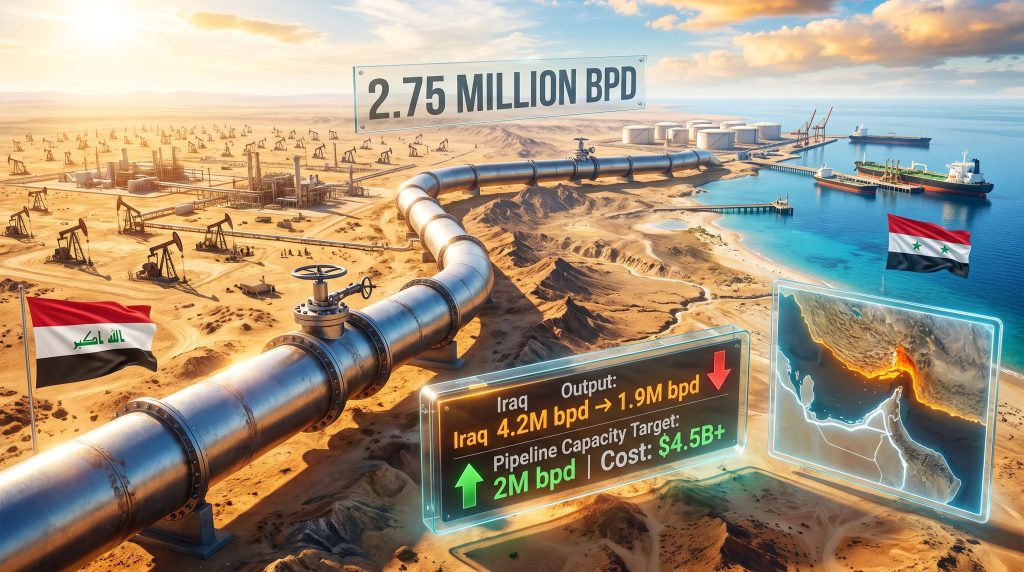
According to the U.S. Energy Information Administration, the pipeline carries a nameplate capacity of 700,000 barrels per day in its current configuration. However, engineering plans associated with the 2026 restoration agreement target an initial operational capacity of 2 million bpd, with long-term parallel pipeline additions potentially lifting combined throughput to 2.75 million bpd.
The pipeline suffered significant damage during the U.S. military invasion of Iraq in 2003 and has remained non-operational since. Rehabilitation attempts between 2007 and 2010 failed to gain traction, collapsing under a combination of insufficient financing commitments and unresolved technical complexities along the corridor's ageing infrastructure.
The pipeline's two-decade dormancy makes its current revival one of the most consequential energy infrastructure restorations the Middle East has seen in the post-Gulf War reconstruction period.
The 2026 Agreement: What Was Signed and by Whom
The agreement was formalised at a Chamber of Commerce investment summit in Washington, D.C., with U.S. Energy Secretary Chris Wright presiding over the ceremony. The signing parties were the chief executives of Iraq's Basra Oil Company and Syria's national petroleum company.
The deal's commercial and structural parameters are substantial:
| Agreement Component | Detail |
|---|---|
| Signing Location | Washington, D.C. |
| U.S. Oversight Role | Energy Secretary Chris Wright presided |
| Primary Contractor | Chevron-led international consortium |
| Estimated Reconstruction Cost | Exceeds $4.5 billion |
| Projected Construction Timeline | Approximately 36 months |
| Initial Export Capacity Target | 2 million bpd |
| Long-Term Expansion Potential | Up to 2.75 million bpd |
Iraq's Prime Minister Ali al-Zaidi was in Washington during the signing week, having met with President Trump at the White House earlier in the same visit. The diplomatic timing underscores that the Iraq and Syria oil pipeline agreement did not emerge in isolation from broader U.S.-Iraq relations.
How Iraq's Production Crisis Created the Political Catalyst
A 50% Production Collapse in Under Five Months
Iraq's vulnerability to Hormuz disruption has long been theoretical. In 2026, it became viscerally real. When U.S. and Israeli military operations against Iran disrupted tanker traffic through the Strait of Hormuz, Iraq found itself with almost no export alternatives. The country's near-total reliance on the southern port city of Basra and Persian Gulf shipping routes created a single-point-of-failure that proved catastrophic.
OPEC data captures the scale of the damage with striking clarity:
| Time Period | Iraqi Oil Production |
|---|---|
| February 2026 (pre-conflict baseline) | ~4.2 million bpd |
| June 2026 (post-disruption) | ~1.9 million bpd |
| Net Production Decline | More than 50% contraction |
For context, Iraq is OPEC's second-largest oil producer. A contraction of this scale is not a regional inconvenience — it is a global supply-side shock with direct implications for current crude oil prices, import markets in Asia and Europe, and the fiscal stability of the Iraqi state itself.
Iraq's economy is heavily dependent on oil revenues to fund public sector wages, infrastructure investment, and social services. A 50%-plus production drop within a single quarter generates a fiscal crisis that compounds the physical infrastructure damage, creating urgent political pressure to secure export diversification that had previously been treated as a long-term ambition.
The production collapse from 4.2 million bpd to 1.9 million bpd in under five months represents one of the most severe short-cycle output contractions for an OPEC member in recent decades, and it is this crisis that injected the political urgency necessary to revive a pipeline deal that had been stalled for over twenty years.
Trial Runs Before Bricks and Mortar
Notably, trial deliveries via overland tanker trucks along the Syria-facing route began in April 2026, providing early commercial validation of the corridor before full pipeline construction commences. This operational proof-of-concept reduces the investment risk embedded in the larger reconstruction programme and signals that the commercial logic of the route is sound even ahead of infrastructure upgrades.
Strategic Scenarios: What the Pipeline Unlocks Across Multiple Dimensions
The Mediterranean Export Pivot
A fully operational Kirkuk–Baniyas corridor would fundamentally restructure Iraq's export geography. Northern Iraqi crude could bypass the Persian Gulf entirely, flowing instead through Syrian territory to Mediterranean terminals at Baniyas and Tartus. This creates a direct supply channel to European buyers and positions Iraq as a more reliable and geographically diversified supplier.
Beyond the Kirkuk fields, there is a longer-term scenario in which Basra crude is redirected through Syrian terminals as well, extending the export diversification logic to Iraq's largest production base in the south. That outcome is speculative at present but represents the strategic ceiling of the agreement's ambitions.
The Gulf-Wide Infrastructure Race
The Iraq and Syria oil pipeline agreement is not an isolated development. It reflects a broader regional consensus among major producers that Hormuz dependency must be structurally reduced. Furthermore, the geopolitical risk landscape across the region is reshaping how governments approach long-term infrastructure investment decisions. Three concurrent pipeline initiatives are reshaping the region's export architecture simultaneously:
| Country | Pipeline Initiative | Capacity Addition |
|---|---|---|
| Iraq | Kirkuk–Baniyas pipeline restoration | Up to 2.75 million bpd |
| United Arab Emirates | Second pipeline to Port of Fujairah | Doubles export capacity outside Hormuz |
| Saudi Arabia | Red Sea pipeline expansion (under consideration as of July 2026) | Up to +2 million bpd |
Reuters reported on 7 July 2026 that Saudi Arabia is actively evaluating a Red Sea pipeline expansion of up to 2 million bpd, citing people close to the matter. Taken together, these three initiatives represent a structural reorientation of Gulf energy export infrastructure, designed to reduce Iran's leverage over global supply through the implicit threat of Hormuz interdiction.
U.S. Commercial and Strategic Positioning
Chevron's designation as the primary contractor does more than allocate construction work. It embeds U.S. commercial interests directly into an infrastructure corridor that links Iraq to Syria to the Mediterranean. The Washington signing ceremony, presided over by the Energy Secretary, establishes a template for American energy diplomacy that goes beyond policy advocacy into direct project facilitation.
This model — where U.S. government engagement underpins major infrastructure contracts awarded to American companies in strategically significant regions — mirrors historical post-conflict reconstruction frameworks but is now applied with an explicit energy security overlay. In addition, the global trade tensions of recent years have further motivated Washington to secure tangible strategic footholds through commercial agreements of this kind.
The Critical Limitation: Pipelines Are Not Conflict Insurance
Why Infrastructure Hedges Have Boundaries
The most important corrective to pipeline optimism comes from energy security analysts who caution that overland infrastructure does not resolve the underlying threat — it merely redistributes it. Bob McNally, founder of energy advisory firm Rapidan Energy, made this point directly to CNBC, arguing that the core problem is not the waterway itself but Iran's demonstrated capability to target physical energy infrastructure, including loading terminals, pumping stations, end facilities, and storage units, using missiles and drone systems.
This analysis applies directly to the Kirkuk–Baniyas corridor. The pipeline traverses northern Iraq and Syria, both of which carry histories of insurgent activity, competing armed factions, and complex territorial politics. The infrastructure nodes that make the pipeline commercially viable are precisely the assets that a hostile actor would target in a conflict scenario.
Risk Comparison: Strait of Hormuz vs. Pipeline Corridor
| Risk Dimension | Strait of Hormuz | Kirkuk–Baniyas Pipeline |
|---|---|---|
| Iranian Interdiction Threat | High (naval, missile) | Moderate (terminal strikes) |
| Non-State Actor Risk | Low | Moderate to High |
| Capacity Scalability | Limited | High (to 2.75M bpd) |
| Recovery Time Post-Disruption | Days to weeks | Weeks to months |
| U.S. Strategic Influence | Indirect | Direct |
The honest assessment is that pipelines can reduce volume dependency on a single chokepoint, lower long-term shipping costs, attract foreign investment into transit economies, and provide export continuity during maritime disruptions. However, they cannot neutralise the threat of targeted infrastructure attacks, resolve the regional tensions driving Hormuz risk, or guarantee flow continuity through politically unstable transit corridors.
Economic Ripple Effects: Iraq, Syria, and Global Supply Markets
Iraq's Path Back to Fiscal Stability
Restoring even a meaningful fraction of the 2.3 million bpd production gap would generate substantial government revenue at prevailing oil prices. Beyond the volume economics, pipeline diversification reduces the commodity price impacts associated with geopolitical risk premiums embedded in Iraqi crude pricing, which could consequently improve the country's terms of trade with its primary buyers in Asia and Europe.
The $4.5 billion-plus investment led by Chevron and the U.S.-backed consortium also injects significant construction and development capital into both the Iraqi and Syrian economies during their respective recovery phases.
Syria's Transit Economy Opportunity
Syria's participation transforms the country from a conflict-affected economy into a critical energy transit node. Transit fee revenues from Iraqi crude passing through Syrian territory to Baniyas and Tartus could provide meaningful economic support during Damascus's reconstruction period. Port infrastructure upgrades at both terminals would themselves represent significant capital investment with long-term commercial value.
Global Supply Considerations
A restoration of Iraqi production toward its pre-conflict baseline of 4.2 million bpd would represent a material supply addition to global markets. The timing of that restoration relative to OPEC's global influence and its production management decisions will shape whether recovered Iraqi volumes tighten markets or complicate the cartel's output coordination. European importers seeking alternatives to Russian pipeline dependency represent a natural demand base for Mediterranean-delivered Iraqi crude, adding a further geopolitical dimension to the commercial calculus.
The next major ASX story will hit our subscribers first
Projected Timeline to Operational Status
Full operational capacity remains several years away. The realistic milestones based on the 36-month construction timeline and the July 2026 signing date are as follows:
| Milestone | Projected Timing |
|---|---|
| Agreement signed | July 2026 |
| Engineering finalisation and assessment | Q3–Q4 2026 |
| Construction commencement | Early 2027 (estimated) |
| Partial operational capacity | Mid-2028 (estimated) |
| Full capacity at 2 million bpd | Late 2029 (estimated) |
| Long-term expansion to 2.75 million bpd | Post-2030 |
This timeline means that near-term Iraqi energy security remains dependent on diplomatic resolution of the underlying Iran conflict rather than physical infrastructure. The Iraq and Syria oil pipeline agreement is, consequently, a long-term structural solution to a problem that requires immediate geopolitical management as well.
Furthermore, independent analysts have raised questions about whether the commercial and security conditions necessary to sustain a project of this scale can be maintained across a multi-year construction window. Early assessments of the pipeline's feasibility suggest that financing certainty, political stability in both transit countries, and sustained U.S. engagement will all be required to carry the project through to completion.
Frequently Asked Questions: Iraq–Syria Oil Pipeline Agreement
What is the Kirkuk–Baniyas pipeline?
The Kirkuk–Baniyas pipeline connects Iraq's northern Kirkuk oil fields to the Syrian Mediterranean port of Baniyas. Targeted for restoration to an initial capacity of 2 million bpd, it offers Iraq a direct export route to Mediterranean and European markets that bypasses the Strait of Hormuz entirely.
Why did previous restoration attempts fail?
Rehabilitation efforts between 2007 and 2010 collapsed due to insufficient financing and unresolved technical challenges. The current agreement, with Chevron as primary contractor and U.S. oversight of the signing process, represents the most credible and well-resourced restoration attempt to date. Details of the latest pipeline restoration deal outline the key commercial and diplomatic frameworks now in place to address these longstanding obstacles.
How much will reconstruction cost and how long will it take?
Total investment is estimated to exceed $4.5 billion, with a construction timeline of approximately 36 months from commencement.
Does the pipeline eliminate Hormuz risk?
No. Energy security analysts emphasise that while pipeline infrastructure reduces volume dependency on the strait, Iran retains the capability to strike pipeline terminals, pumping stations, and storage facilities — meaning the hedge is meaningful but not comprehensive.
How severe was Iraq's production collapse?
Iraqi output fell from approximately 4.2 million bpd in February 2026 to around 1.9 million bpd in June 2026, a contraction exceeding 50% in under five months, based on OPEC data. This ranks among the most severe short-cycle output contractions for any OPEC member in recent decades.
Disclaimer: This article contains forward-looking projections, including production restoration timelines, capacity targets, and construction schedules. These projections are based on publicly available information and third-party analysis as of the time of writing and are subject to change based on geopolitical, financial, and operational developments. Nothing in this article constitutes investment advice.
Want to Stay Ahead of the Next Major Resource Discovery Reshaping Global Markets?
As geopolitical shifts rewrite global energy and commodity supply chains, Discovery Alert's proprietary Discovery IQ model instantly identifies significant ASX mineral discoveries, delivering real-time alerts that turn complex market signals into actionable investment opportunities — explore historic discoveries and their remarkable returns, then begin your 14-day free trial to position yourself ahead of the market.