July 18, 2026
The Refinery Is the Real Resource: Understanding Who Profits From Critical Minerals
There is a persistent assumption embedded in how the world discusses mineral wealth: that the country sitting atop the largest reserves holds the strategic advantage. History, and the structural economics of global supply chains, tells a more complicated story. From colonial-era commodity extraction to the twentieth-century oil booms, resource-rich nations have repeatedly discovered that geological abundance does not automatically translate into economic power. The Latin America critical minerals control debate is now repeating this pattern with new actors, new technologies, and far higher geopolitical stakes.
The question of who controls critical minerals is not answered by looking at a geological map. It is answered by identifying who controls the infrastructure that transforms raw ore into battery-grade material. That infrastructure sits, overwhelmingly, in China. Furthermore, Latin America, despite holding some of the planet's most significant deposits of lithium, copper, cobalt, and graphite, currently occupies the least profitable position in the value chain that feeds the global energy transition.
When big ASX news breaks, our subscribers know first
From Ground to Grid: The Value Chain That Determines Everything
Understanding the Latin America critical minerals control problem requires a clear-eyed look at how value accumulates along the supply chain. The critical minerals demand journey from extraction to end use follows four broad stages:
- Extraction – Mining raw ore from the earth, the most geographically fixed stage
- Concentration – Physical processing to separate valuable mineral content from waste rock
- Refining and chemical conversion – Converting concentrates into battery-grade or industrial-grade materials, the highest-margin stage
- Manufacturing – Integrating refined materials into cathodes, anodes, battery cells, and ultimately finished products
According to International Energy Agency analysis, raw mineral extraction typically captures only 5 to 20 percent of the total value embedded in clean energy technologies, depending on the mineral and the complexity of downstream components. The cost of raw lithium-bearing material, for example, represents only a fraction of a finished battery pack's price. Cathode production, cell assembly, and module integration account for the significant majority of added value.
This distribution is not accidental. Refining and chemical conversion are technically complex, capital-intensive, and heavily dependent on accumulated industrial knowledge. They are the chokepoints of global supply chains, and the actor that controls these chokepoints captures the majority of economic rent, regardless of where the raw material originates.
Owning the world's largest mineral reserves does not translate to controlling the supply chain. Processing infrastructure, concentrated thousands of kilometres away, is where the real economic leverage resides.
The concept sometimes described as a resource curse 2.0 captures this dynamic precisely. Latin American nations are not simply exporting raw materials and missing out on manufacturing profits. They are exporting economic sovereignty, allowing the transformation of their geological endowment to occur under different legal systems, different pricing mechanisms, and different industrial strategies, with the economic surplus retained elsewhere.
Chinese Refinery Dominance: What the Numbers Actually Reveal
The scale of China's processing capacity across critical minerals is not widely appreciated outside specialist circles. The following breakdown illustrates the structural reality that shapes Latin America critical minerals control debates globally:
| Critical Mineral | China's Share of Global Refining or Processing Capacity |
|---|---|
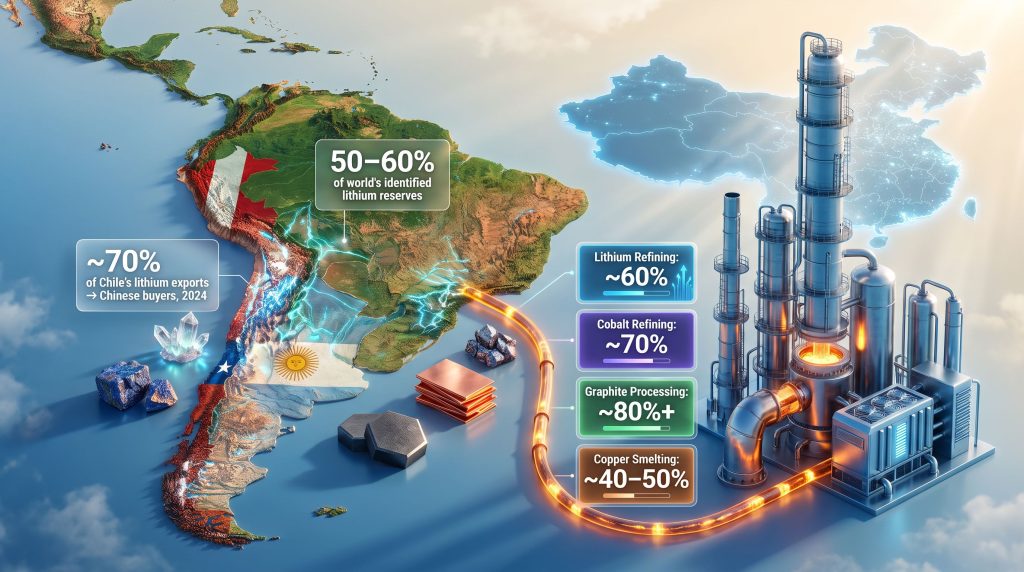
| Lithium | ~60% of global refining capacity |
| Cobalt | ~70% of global refining capacity |
| Copper smelting | ~40-50% of global smelting capacity |
| Graphite (processed) | 80%+ of global output |
| Nickel (Class I) | Significant and growing share |
What is less commonly understood is what refining capacity means in practical terms. Converting lithium brine processing or spodumene concentrate into battery-grade lithium carbonate or lithium hydroxide involves multi-stage chemical processing, precise temperature and pressure controls, and quality standards that directly determine whether a material can be used in high-performance lithium-ion cells.
The same principle applies across cobalt, nickel, and graphite: high-purity, specification-grade output commands premium pricing that raw ore exports fundamentally cannot capture. Chinese state-backed enterprises built this processing infrastructure systematically over approximately three decades, beginning in the late 1990s when Western economies were not prioritising these supply chains.
That early-mover advantage, compounded by scale economics and state financing, has produced market positions that are structurally difficult for competitors to replicate quickly. The investment footprint in Latin America reflects this strategy explicitly. More than $137 billion in state-backed Chinese financing has been deployed into Latin American resource sectors since 2005, according to the China-Latin America Finance Database.
The structural pattern is consistent: secure equity positions in upstream mining operations, then channel raw material flows toward domestic Chinese refineries. Recent examples include expanded equity stakes in Peru's Las Bambas copper mine and acquisition activity targeting Brazilian copper processing assets. These transactions differ fundamentally from conventional foreign direct investment because they are not primarily motivated by financial returns on the individual asset. Their strategic purpose is to maintain raw material throughput for downstream Chinese processing infrastructure.
The Lithium Triangle: Geological Supremacy Without Processing Control
The World's Deepest Lithium Reserves and Their Structural Vulnerability
The overlapping brine-rich salt flat regions of Argentina, Chile, and Bolivia, collectively described as the Lithium Triangle, hold an estimated 50 to 60 percent of the world's identified lithium reserves. This is the single most strategically significant lithium geography on the planet for the global energy transition, and yet its nations occupy a structurally subordinate position in the value chain that uses their resources.
Each jurisdiction has a distinct reserve and policy profile:
- Chile hosts world-class Atacama brine operations characterised by exceptionally high lithium concentrations and low-cost production economics, but approximately 70% of its lithium exports were directed to Chinese buyers in 2024, according to Chilean government trade data
- Argentina holds extensive Puna plateau deposits across multiple projects at varying development stages, with its RIGI (Large Investment Incentive Regime) creating new conditions for foreign capital inflows while simultaneously raising questions about downstream value retention
- Bolivia sits atop the Salar de Uyuni, the world's largest single lithium deposit by volume, yet has struggled to convert geological supremacy into production at scale, partly due to high magnesium-to-lithium ratios in the brine that complicate conventional processing methods, an important and often overlooked technical barrier
The Pricing Paradox That Defines Chile's Position
Chile's situation illustrates the pricing paradox that sits at the heart of the Latin America critical minerals control problem. Chilean producers sell lithium carbonate and lithium hydroxide at prevailing market prices. Chinese processors convert those products into battery-grade specifications and cathode precursor materials, capturing the spread between commodity-grade pricing and performance-grade pricing.
The margin between these two price points represents value that flows out of South America permanently. Chile's National Lithium Strategy, announced in 2023, articulates ambitions to develop domestic value-added processing and require strategic partnerships rather than simple offtake agreements. However, the barriers to executing this ambition are substantial: domestic processing facilities require significant capital investment, access to proprietary chemical processing technology, skilled technical workforces, and established relationships with battery cell manufacturers willing to qualify new supply sources. None of these can be assembled quickly.
Copper's Hidden Control Problem
Why Production Leadership Does Not Equal Supply Chain Control
Chile and Peru together account for a commanding share of global mined copper output. Chile alone represents approximately 27 percent of global copper mine production. Yet this production leadership does not translate into equivalent leverage over the downstream supply chain, a pattern consistent with broader copper supply trends observed across the region.
China absorbed more than 50 percent of Chile's copper exports in 2024, according to Chilean customs data. More critically, Chinese smelting and refining infrastructure processes copper concentrates into the specialty forms required for grid-scale electrical infrastructure, EV motor windings, and high-efficiency transformer technology. Even where Latin American producers output copper cathode, the most refined form of bulk copper, specialty applications still depend on Chinese processing for higher-grade products.
The Las Bambas mine in Peru represents the most transparent case study in integrated value chain control. Chinese ownership of this major copper asset, combined with Chinese refinery dominance over downstream copper processing, creates a vertically integrated strategic structure in which a single national actor controls both the upstream resource and the downstream conversion.
The economic benefits to Peru from this arrangement, in terms of royalties, taxes, and employment, are real but structurally limited compared to the value captured further along the chain. Copper's strategic importance compounds with time, as it is irreplaceable in EV motors, grid infrastructure, wind turbines, and solar installations. As electrification accelerates through the 2030s, control over copper processing capacity carries compounding strategic value that current pricing does not fully reflect.
Geopolitical Strategy or Market Efficiency? The Diagnostic Question That Matters
There are two fundamentally different interpretations of Chinese refinery dominance, and the distinction carries enormous consequences for policy design. China's trade strategy in critical minerals adds a further layer of complexity to this debate.
The first interpretation frames China's processing position as the outcome of deliberate, state-coordinated industrial policy: a going out strategy that combined concessional lending, state-owned enterprise investment mandates, and domestic industrial policy to systematically acquire control over critical mineral supply chains ahead of the energy transition demand wave.
The second interpretation emphasises market rationality and first-mover advantage. China invested in processing infrastructure when Western capital was either uninterested or directing capital elsewhere. Labour costs, energy costs, and regulatory environments historically made China an economically logical location for processing facilities. Latin American governments' own policy choices, including export-oriented raw commodity frameworks and limited incentives for downstream investment, contributed significantly to the current imbalance.
The distinction between strategic capture and market leadership matters enormously for policy responses. Misdiagnosing the mechanism leads to ineffective countermeasures.
The reality is likely a combination of both: market rationality reinforced by state strategy, creating an outcome that is simultaneously the product of economic logic and deliberate industrial policy. This nuance is critical for governments designing responses.
The next major ASX story will hit our subscribers first
Competing Powers and the Rebalancing Race
Western Frameworks and Their Structural Limitations
The United States Inflation Reduction Act creates financial incentives for electric vehicles and batteries using critical minerals sourced and processed outside China, generating a policy-driven demand signal for alternative supply chains. Bilateral mineral security dialogues with Chile, Argentina, and Peru have advanced this agenda diplomatically. The Defence Production Act provides additional investment tools for critical mineral supply chain development.
The fundamental limitation is temporal. Capital deployment speed in democratic, market-based systems competes against China's decade-long structural head start and the continued availability of state-backed Chinese financing for new projects across Latin America. The European raw materials strategy sets domestic processing capacity targets for 2030, and EU-Latin America strategic partnership frameworks include mineral security dimensions.
Japan's JOGMEC and South Korea's KOMIR offer technology-for-access models that differ meaningfully from both Chinese state financing and Western market-rate capital. Japanese and Korean investment in Chilean and Argentine lithium projects has introduced joint processing agreements and technology transfer components that represent a differentiated competitive approach. According to CSIS analysis on de-risking critical mineral supply chains, Latin America's role in rebalancing Western supply chains is growing but remains contingent on sustained political commitment and capital mobilisation.
What Latin American Governments Can Actually Do
The policy levers available to Latin American governments are more powerful than current practice suggests:
- Export taxes and royalty structures calibrated to incentivise in-country processing over raw ore export, making it economically rational to add processing steps domestically
- Concession conditions requiring technology transfer and domestic processing commitments as prerequisites for mining rights
- Regional processing hubs coordinated through Mercosur or the Pacific Alliance framework, enabling shared refinery infrastructure that no single nation could justify at current production scales
- Sovereign wealth fund models that capture a portion of mineral royalty revenues and reinvest systematically in downstream processing capacity
Mexico's lithium nationalisation illustrates the execution risks of resource nationalism without industrial capability. Chile's state participation model through CODELCO and the National Lithium Strategy represents a more structured approach, though outcomes remain contingent on execution. Argentina's open investment framework attracts capital but risks replicating the structural imbalance in a new project cycle.
Three Scenarios for How This Resolves
The trajectory of Latin America critical minerals control over the next decade is not predetermined. Three plausible scenarios frame the range of outcomes:
Scenario 1: Incremental Reform (Most Likely Near-Term)
Latin American nations attract diversified foreign capital for basic processing facilities. Partial value-add is captured domestically, while China retains dominant advanced refining share. Timeline of 5 to 10 years for meaningful but incomplete rebalancing.
Scenario 2: Accelerated Western Realignment (Conditional)
The US and EU deploy concessional financing at a scale comparable to Chinese state-backed investment. Technology transfer agreements unlock battery-grade processing in Chile and Argentina. Timeline of 10 to 15 years, dependent on sustained political will and capital mobilisation that has not yet been demonstrated.
Scenario 3: Structural Entrenchment (Risk Scenario)
Chinese capital continues to dominate new project financing across the region. Latin American processing ambitions remain aspirational. Chinese refineries consolidate control over 2030s battery supply chains as demand accelerates.
Disclaimer: The scenarios above represent analytical frameworks based on current trends and structural factors. They are not forecasts or investment advice. Future outcomes will depend on policy decisions, capital flows, and geopolitical developments that cannot be predicted with certainty.
Key Takeaways
The strategic calculus of Latin America critical minerals control resolves into several structurally important conclusions:
- Reserves do not equal control. Geological wealth without processing infrastructure is upstream exposure, not supply chain leverage
- The refinery is the actual chokepoint. Roughly 60% of lithium refining, 70% of cobalt refining, and 40 to 50% of copper smelting capacity sits within China's processing ecosystem
- $137 billion in Chinese financing across Latin America is structurally designed to maintain raw material flows toward domestic Chinese refineries, not to develop Latin American processing capacity
- Graphite's 80%+ Chinese processing share is the least-discussed but arguably most concentrated vulnerability across the entire battery supply chain
- Competing powers are mobilising, but face a significant structural and temporal deficit relative to China's entrenched processing position
- Latin American governments hold more leverage than they currently exercise, particularly through export policy design, concession conditions, and the as-yet-unrealised potential of regional processing coordination
The energy transition's mineral demands are projected to grow substantially through 2030 and beyond. The nations that position themselves at the processing stage of those supply chains will capture compounding economic and strategic value. For Latin America, the geological endowment is already in place. The industrial infrastructure to profit from it fully remains, in most cases, yet to be built. As Global Finance Magazine notes, the region's ability to translate reserve wealth into processing capability will define its economic trajectory through the coming decade.
Readers seeking regional business intelligence on Latin America's mining and energy transition sectors may find value in exploring related analysis published by BNamericas at bnamericas.com, which covers investment trends and project developments across the region.
Want to Know When the Next Major Mineral Discovery Hits the ASX?
Discovery Alert's proprietary Discovery IQ model delivers real-time alerts on significant ASX mineral discoveries across critical minerals including lithium, copper, and graphite — instantly translating complex geological data into actionable investment insights before the broader market reacts. Explore historic examples of major discoveries and their market returns, then start your 14-day free trial to position yourself at the forefront of the next significant find.