
June 25, 2026
How Physical Aluminium Benchmarks Actually Work — And Why Transaction Size Matters More Than Most Buyers Realise
Most participants in global commodity markets focus on the headline price — the London Metal Exchange aluminium cash price that flashes across trading terminals in real time. What receives far less attention is the layered cost structure that sits on top of that exchange price, particularly for import-dependent economies like Japan. Understanding how physical delivery premiums are constructed, and why the rules governing their calculation matter enormously, is essential for anyone operating in the aluminium supply chain.
The aluminium P1020A spot premium CIF Japan — published under price code MB-AL-0343 — is one of the most closely watched regional physical premiums in the global aluminium market. A recent amendment to the minimum tonnage specification for this benchmark, effective June 25, 2026, has reshaped how qualifying transactions are defined and raises important questions about benchmark integrity, market representativeness, and the downstream cost implications for Japanese buyers.
When big ASX news breaks, our subscribers know first
The Architecture of Physical Aluminium Pricing in Japan
Why Japan Needs a Dedicated Premium Benchmark
Japan occupies a structurally unique position in the global aluminium market. Unlike major producing nations such as China, Australia, or Russia, Japan has virtually no domestic primary aluminium smelting capacity. Every tonne of P1020A-grade primary aluminium consumed by Japanese automotive plants, packaging manufacturers, and electronics producers must be imported — making the cost of physical delivery a first-order concern rather than a secondary consideration.
The CIF Japan premium exists precisely because importing aluminium into Japan involves real costs beyond the LME price: ocean freight, marine insurance, port handling, and the supply-demand dynamics specific to the Japanese import market. These costs are captured in a single number expressed in USD per tonne, layered on top of the LME aluminium cash price to produce the all-in delivered cost for Japanese buyers.
The three designated delivery ports — Yokohama, Nagoya, and Osaka — reflect Japan's major industrial and port centres. Yokohama serves the greater Tokyo manufacturing corridor, Nagoya is the heart of Japan's automotive industry, and Osaka anchors the Kansai industrial region.
Breaking Down the Price Components
To understand what Japanese buyers actually pay for primary aluminium, it helps to decompose the cost structure:
| Component | What It Measures | Unit | Frequency |
|---|---|---|---|
| LME Aluminium Cash Price | Global exchange-traded aluminium value | USD/tonne | Continuous |
| P1020A CIF Japan Spot Premium | Regional physical delivery cost above LME | USD/tonne | Daily |
| All-in Delivered Price | Total cost to Japanese buyer | USD/tonne | Derived |
The P1020A grade specification itself is worth understanding in detail. The designation requires a minimum aluminium purity of 99.7%, with silicon content capped at 0.10% and iron content capped at 0.20% — parameters that align with LME delivery specifications. These thresholds are not arbitrary; they reflect the quality tolerances of downstream aluminium fabrication processes, particularly in automotive sheet and aerospace applications where impurity levels directly affect mechanical properties.
Acceptable physical forms under the specification include ingot, T-bar, and sow — each representing different physical configurations of primary aluminium suited to different downstream melting and casting operations.
The Minimum Tonnage Amendment: What Changed and Why
From 100 Tonnes to 500 Tonnes — The Operational Logic
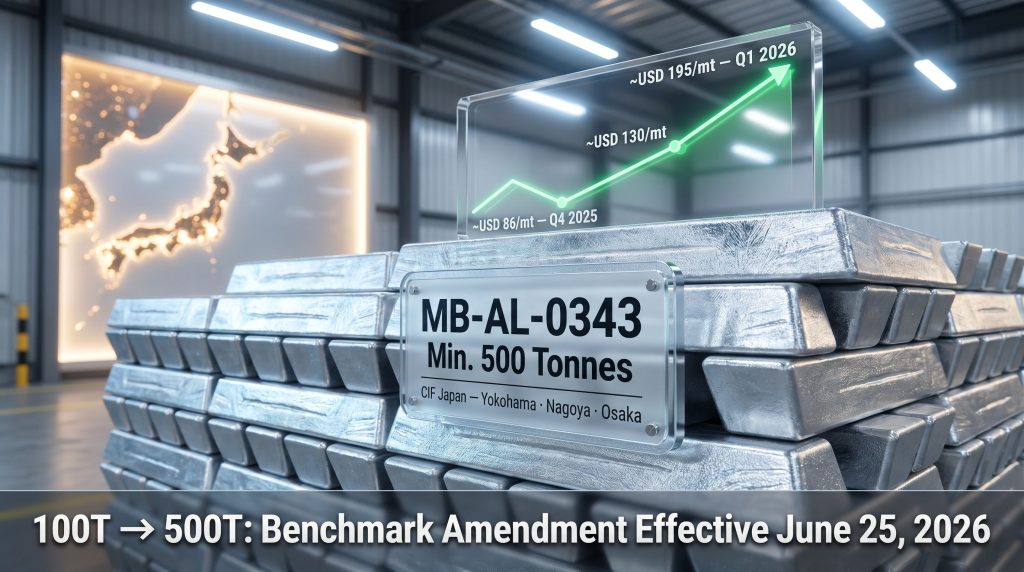
Effective June 25, 2026, the minimum qualifying transaction size for the MB-AL-0343 assessment was raised from 100 tonnes to 500 tonnes. On its surface, this appears to be a minor technical adjustment. In practice, it represents a meaningful recalibration of which market activity feeds into the benchmark calculation.
The amendment followed a structured review process:
- May 18, 2026 — Initial proposal published via pricing notice
- May 18 to June 17, 2026 — Formal market consultation period open to all participants
- June 17, 2026 — Decision to proceed confirmed following review
- June 25, 2026 — Amendment takes effect across all assessments published under MB-AL-0343
Notably, no formal feedback was received during the consultation window. The decision to proceed was based on preliminary market observations gathered before the formal consultation opened — qualitative signals from market participants indicating that sub-100-tonne spot transactions were producing price readings inconsistent with what larger commercial buyers were actually experiencing in the market.
The Full Amended Specification at a Glance
| Specification Attribute | Amended Detail |
|---|---|
| Price Code | MB-AL-0343 |
| Quality | P1020A / 99.7% min Al purity (Si ≤0.10%, Fe ≤0.20%) |
| Accepted Forms | Ingot, T-bar, Sow |
| Minimum Quantity | 500 tonnes (amended from 100 tonnes) |
| Delivery Basis | CIF main Japanese ports (Yokohama, Nagoya, Osaka) |
| Timing Window | Within two calendar months |
| Unit | USD/tonne |
| Payment Terms | Cash against documents (2 days after Bill of Lading date) |
| Publication Schedule | Daily, 6–7pm Singapore time |
Why Transaction Size Thresholds Are Central to Benchmark Credibility
The Distortion Risk Hidden in Small-Volume Trades
Price reporting agencies face an inherent tension in benchmark construction: the more transactions they include, the more statistically robust the assessment appears — but not all transactions are equally representative of the market they are trying to measure.
Small-volume aluminium trades can arise from a range of circumstances that have little to do with the prevailing market rate for commercially significant volumes. Furthermore, shifts in the aluminum and alumina markets more broadly can amplify the distortion effect of atypical small-lot trades. Consider the following scenarios:
- Distressed selling by a counterparty needing urgent liquidity
- One-off logistics arrangements between non-standard trading partners
- Balancing trades designed to top up existing inventory rather than establish new supply positions
- Transactions between affiliated entities at negotiated rather than arm's-length prices
When these transactions fall below the commercial threshold that characterises the behaviour of major trading houses, smelters, and large Japanese end-users, including them in a benchmark calculation introduces noise rather than signal.
Benchmark Integrity Principle: A price assessment's value derives not from the volume of transactions it captures, but from how accurately it reflects the cost of acquiring material at commercially meaningful scale. Filtering out sub-threshold trades is a quality control measure, not a restriction on market access.
Who Is Affected — and How
The practical impact of the 500-tonne minimum varies considerably depending on where a participant sits in the supply chain:
-
Large integrated trading houses and primary smelters: Minimal disruption. The vast majority of standard spot transactions in the Japanese aluminium import market already involve volumes well in excess of 500 tonnes. These participants will see no change in their ability to contribute to or rely on the benchmark.
-
Smaller regional traders and intermediaries: Transactions at the lower end of the volume range may no longer qualify as benchmark-eligible. This reduces their influence on the assessed price but does not prevent them from transacting — it simply means their trades will not feed into the formal assessment calculation.
-
Japanese end-users and manufacturers: Potentially the greatest beneficiaries. A benchmark anchored in larger, more commercially representative transactions provides a more reliable reference for procurement cost planning, hedging programme design, and quarterly contract negotiations with overseas suppliers.
Reading the Premium Through a Cycle of Extreme Volatility
A Benchmark Stress-Tested by Market Turbulence
The timing of this specification amendment is notable given the degree of volatility the MJP spot premium has experienced over the past twelve months. Understanding this volatility adds important context to why a more robust benchmark specification is particularly valuable right now.
| Period | Approximate MJP Spot Premium | Key Driver |
|---|---|---|
| Q4 2025 Low | ~USD 86/mt | Demand weakness, supply overhang |
| Late 2025 Recovery | ~USD 130/mt | Supply tightening, restocking activity |
| Q1 2026 Spot | ~USD 195/mt | Demand recovery, producer discipline |
| Q1 2026 Contract Offers | USD 190–203/mt | Producer repricing cycle |
The decline to approximately USD 86/mt in Q4 2025 represented a multi-year low, driven by a combination of weakened Japanese industrial demand and elevated global primary aluminium supply — particularly from Chinese smelters operating at high utilisation rates. From that trough, the premium recovered by approximately 85% to around USD 130/mt by late 2025, before accelerating further to approximately USD 195/mt in Q1 2026 as spot availability tightened and downstream manufacturing demand improved.
The Contract vs. Spot Divergence: A Critical Signal for Market Watchers
One of the more instructive dynamics of this period was the significant gap that opened between spot premiums and contract offer levels during the Q1 2026 negotiation season. Major aluminium producers submitted quarterly contract offers to Japanese buyers in the range of USD 190 to 203/mt — roughly 50% higher than Q4 2025 contract levels that had been set during the market trough.
This divergence between rapidly moving spot premiums and the lagged quarterly contract cycle is precisely the scenario in which a high-frequency, representative spot benchmark delivers the most value. Procurement teams and traders need daily price discovery to understand whether contract offers from producers are aligned with, below, or above prevailing spot market conditions. A benchmark contaminated by small, non-representative transactions could systematically misrepresent this relationship during periods of rapid market movement.
Less-Known Market Dynamic: The quarterly contract negotiation cycle for Japanese aluminium imports — historically anchored by discussions between major Japanese trading houses and overseas smelters — has traditionally used the MJP spot premium as both a reference point and a negotiating anchor. When spot premiums move sharply within a quarter, the gap between existing contracts and prevailing spot rates creates arbitrage pressure that often accelerates the next round of contract repricing.
PRA Governance: How Methodology Changes Are Managed
Transparency as a Foundation of Market Trust
The process through which the minimum tonnage amendment was developed and implemented reflects standard price reporting agency governance practice. Price reporting agencies are expected to follow structured, transparent consultation processes before altering benchmark specifications — a requirement that exists because benchmarks are embedded in commercial contracts, hedging instruments, and procurement frameworks relied upon by thousands of market participants.
The key stages of a standard PRA methodology review follow a consistent sequence:
- Internal identification of a potential specification issue through routine market engagement
- Publication of a formal proposal notice accessible to all market participants
- A defined consultation window during which market feedback can be submitted
- A decision notice confirming whether the proposal will proceed, with reasoning
- Implementation of the amended specification on a specified effective date
What is less commonly understood is the role of pre-consultation market intelligence in this process. PRAs engage with brokers, traders, producers, and end-users on an ongoing basis through routine market contact. Qualitative signals gathered through this engagement — such as observations that sub-100-tonne transactions were producing anomalous price readings — can inform a proposal even before the formal consultation window opens. The absence of formal written responses during the consultation period does not necessarily indicate market indifference; it may reflect broad acceptance of a change that market participants had already informally endorsed.
What Market Participants Should Do Now
For those transacting in the Japanese aluminium spot market, the practical implications of the amendment are straightforward:
- Review internal transaction reporting processes to confirm that qualifying trades meet the new 500-tonne minimum threshold
- Assess whether any existing pricing arrangements or contracts reference MB-AL-0343 in ways that may be affected by the specification change
- Note that the daily publication window of 6–7pm Singapore time means the assessment reflects same-day market conditions in Asian trading hours
- Recognise that the two-calendar-month timing window for qualifying transactions ensures the benchmark captures near-term physical market dynamics rather than forward delivery arrangements
Full methodology documentation for MB-AL-0343, including the amended specification, is publicly available through the Fastmarkets methodology page, providing complete transparency on how the benchmark is constructed and assessed.
The next major ASX story will hit our subscribers first
Comparing Minimum Tonnage Standards Across Regional Aluminium Benchmarks
How Japan's 500-Tonne Floor Fits the Global Picture
Japan's aluminium import structure is characterised by large-lot procurement contracts between overseas smelters and major Japanese trading houses — entities that historically negotiate quarterly volumes running into tens of thousands of tonnes. This structural reality makes a 500-tonne spot transaction minimum not just defensible but arguably conservative relative to the actual scale of commercially significant activity in this market.
| Regional Benchmark | Typical Minimum Tonnage | Delivery Basis | Publication Frequency |
|---|---|---|---|
| P1020A CIF Japan (MJP) | 500 tonnes (amended) | CIF main ports | Daily |
| European Duty-Unpaid Premium | Varies by assessment | CIF Rotterdam | Daily/Weekly |
| US Midwest Premium | Varies by assessment | Delivered US | Daily |
| Southeast Asia Premium | Varies by assessment | CIF regional ports | Weekly |
Note: Minimum tonnage thresholds for non-Japan benchmarks are indicative and subject to individual PRA methodology documentation.
The 500-tonne threshold also aligns with what physical aluminium market participants typically classify as a standard commercial lot — broadly defined as transactions in the 501 to 1,500 tonne range. Transactions below this range are generally considered sub-standard lots, often transacted at a discount or through non-standard channels, and are not representative of the price at which large-scale procurement actually takes place. In addition, the broader context of aluminium tariffs impact on global trade flows has made benchmark representativeness even more critical for Japanese importers navigating an increasingly complex procurement environment.
Downstream Impact: Japan's Aluminium Supply Chain in Focus
The Cost Transmission Mechanism
Because Japan imports essentially all of its primary aluminium requirements, movements in the CIF Japan spot premium transmit directly and rapidly through the downstream value chain. The premium is not an abstract financial instrument — it is a real cost embedded in the input prices faced by:
- Automotive manufacturers producing aluminium body panels, wheels, and engine components
- Packaging producers using aluminium sheet for beverage cans and food packaging
- Construction materials suppliers fabricating aluminium extrusions for building applications
- Consumer electronics manufacturers using aluminium die castings and sheet in device enclosures
A benchmark that understates the prevailing premium during a period of market tightening causes fabricators to underprice their products and underhedge their input cost exposure. A benchmark that overstates the premium during periods of weak demand leads to the reverse. Either distortion has real commercial consequences for participants throughout the supply chain.
The move to daily publication of the MB-AL-0343 assessment — as opposed to the previous twice-weekly schedule — represents an equally important enhancement to the benchmark's utility. In fast-moving market conditions of the type seen through 2025 and into 2026, daily price discovery gives procurement teams and risk managers the granular data they need to respond to market movements within commercially relevant timeframes.
Furthermore, it is worth noting that the competitive dynamics among global aluminium mining companies play a meaningful role in shaping the supply conditions that ultimately drive premium movements in import-dependent markets like Japan.
Frequently Asked Questions
What does CIF Japan mean in this context?
CIF, which stands for Cost, Insurance, and Freight, means the seller assumes responsibility for all costs associated with delivering the aluminium to the designated Japanese port, including ocean freight and marine insurance. The buyer's total cost is therefore the sum of the LME aluminium price and the CIF Japan premium.
Why was the minimum raised to 500 tonnes specifically?
The 500-tonne threshold reflects the lower boundary of what physical aluminium market convention defines as a standard commercial lot. Transactions below this level are more likely to reflect atypical market circumstances and less likely to represent the pricing behaviour of major buyers and sellers in the Japanese import market.
Does the amendment affect the quality specification?
No. The P1020A quality specification remains unchanged: minimum 99.7% aluminium purity, with silicon at or below 0.10% and iron at or below 0.20%, consistent with LME delivery standards. Acceptable physical forms continue to include ingot, T-bar, and sow.
How does the spot premium relate to quarterly contract negotiations?
The spot premium serves as a continuously updated reference that informs the bilateral quarterly contract negotiations between aluminium producers and Japanese buyers. Large divergences between spot and contract premiums typically signal that the next contract repricing cycle will involve significant adjustments in one direction or the other.
What is the significance of the two-calendar-month timing window?
This parameter restricts qualifying transactions to those involving delivery within two calendar months of the assessment date. It ensures the benchmark captures near-term physical market conditions and excludes deferred delivery arrangements that may reflect different risk and cost structures. Consequently, this window is particularly important during periods of supply disruption or rapid demand shifts, where near-term and deferred pricing can diverge considerably.
The aluminium P1020A spot premium CIF Japan benchmark also sits within a much broader set of commodity pricing dynamics. For instance, cross-commodity insights from the global steel outlook and emerging steel price challenges in key Asian markets offer useful parallels for understanding how benchmark specification integrity affects physical commodity pricing accuracy across industrial metals more broadly.
The aluminium P1020A spot premium CIF Japan benchmark — and the governance processes that maintain its integrity — ultimately serves as a foundation for transparent, efficient price discovery in one of Asia's most strategically important commodity import markets. The London Metal Exchange continues to provide the underlying reference price from which all regional physical premiums, including the MJP, are constructed and measured.
Disclaimer: This article is intended for informational purposes only and does not constitute financial, investment, or procurement advice. Historical premium figures cited are approximate and based on publicly available market reporting. Past price movements are not indicative of future performance. Market participants should consult the official Fastmarkets methodology documentation for authoritative specification details.
Want To Stay Ahead of Significant ASX Mineral Discoveries the Moment They Hit the Market?
Discovery Alert's proprietary Discovery IQ model scans ASX announcements in real time, delivering instant, actionable alerts on major mineral discoveries across more than 30 commodities — just as De Grey Mining and WA1 Resources demonstrated the transformative potential such discoveries can unlock. Explore historic discovery returns on Discovery Alert's dedicated discoveries page and begin a 14-day free trial to position yourself ahead of the broader market.