June 25, 2026
The Aluminium Industry's Hidden Dependency Problem
Few sectors illustrate the fragility of linear commodity supply chains quite like primary aluminium production. Smelters are expensive, energy-intensive facilities that can sit largely idle not because of power shortages or equipment failure, but simply because the upstream raw material pipeline runs dry. Alumina, the refined intermediate product derived from bauxite ore, is the singular input without which no aluminium smelter can function. When that input is unreliable, underpriced, or geographically inaccessible, even a well-capitalised smelter becomes little more than an expensive fixed asset.
This dynamic sits at the heart of an emerging bilateral arrangement between Tajikistan and Azerbaijan, one that frames the Tajikistan Azerbaijan alumina for aluminium trade partnership not as a simple commodity swap, but as a structural solution to a decades-old industrial bottleneck.
When big ASX news breaks, our subscribers know first
Understanding the Core Exchange: What This Trade Structure Actually Proposes
A Closed-Loop Industrial Model Rarely Seen in Post-Soviet Trade
Most bilateral commodity agreements in the post-Soviet space follow a straightforward extractive logic: one country sells a raw material, the other pays in currency. What distinguishes the emerging arrangement between Dushanbe and Baku is its proposed circularity. Azerbaijan would supply alumina upstream to feed Tajikistan's smelting operations, while Tajikistan would channel value-added aluminium outputs, including specialised industrial compounds such as cryolite and aluminium fluoride, back into Azerbaijani markets.
This model is structurally significant. Rather than each country selling independently into global spot markets, the arrangement creates a bilateral dependency loop that insulates both parties from third-country price volatility and supply disruptions. It is, in effect, a vertically integrated partnership distributed across national borders. For context on how shifts in the global bauxite supply chain influence downstream smelting economics, this bilateral framework represents a deliberate response to those vulnerabilities.
The Key Institutions: TALCO and Azeraluminium
The two primary corporate actors in this arrangement have maintained a cooperation agreement for several years, with discussions continuing to expand as global aluminium prices remain elevated. Their ongoing dialogue reflects not just commercial interest but also an institutional familiarity that reduces the friction typically associated with new cross-border industrial agreements.
- TALCO (Tajik Aluminium Company): The centrepiece of Tajikistan's industrial economy, operating one of Central Asia's largest aluminium smelting facilities
- Azeraluminium: Azerbaijan's state-linked aluminium enterprise, positioned as the potential alumina supplier and downstream aluminium buyer in the proposed exchange
TALCO's Structural Challenge: A Smelter Running at a Fraction of Its Potential
Design Capacity Versus Reality
The scale of TALCO's underutilisation is striking when examined against its engineering specifications. The facility was designed during the Soviet era to operate at substantial industrial scale, and the gap between that ambition and current output tells the story of post-independence resource insecurity. Outdated equipment has been widely cited as a contributing factor to the facility's declining output in recent years.
| Metric | Figure |
|---|---|
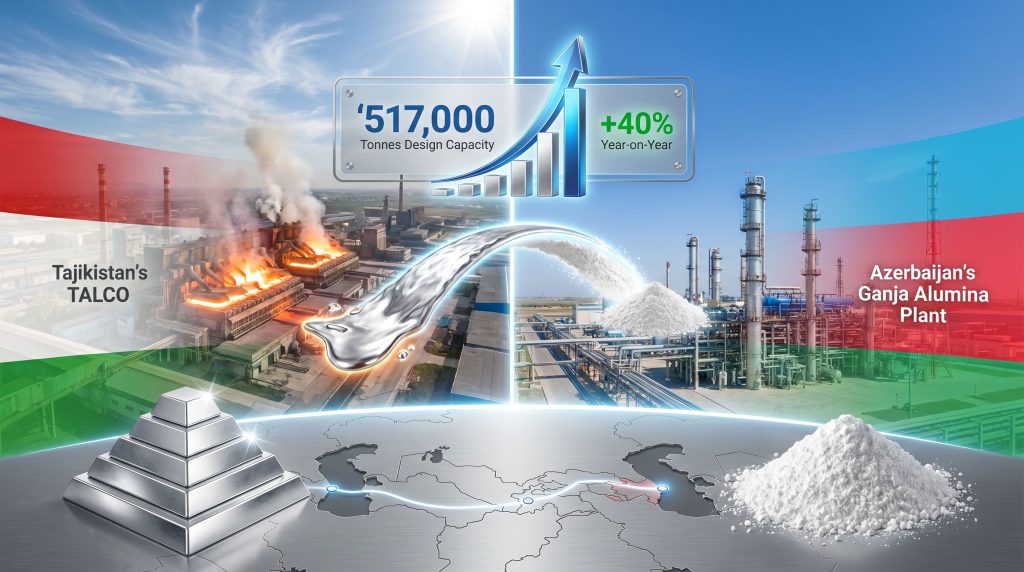
| TALCO Design Capacity | 517,000 tonnes per year |
| Actual 2024 Production | 82,225 tonnes per year |
| Capacity Utilisation Rate | ~15.9% |
| Primary Constraint | Alumina import dependency |
Operating at roughly one-sixth of its designed capacity, TALCO represents one of the most underutilised large-scale smelting assets in the Eurasian region. The implications for Tajikistan's national economy are considerable, given how central the aluminium sector is to the country's industrial output and export revenue.
Why Domestic Bauxite Cannot Solve the Problem
A reasonable question is why Tajikistan does not simply develop its own bauxite-to-alumina processing capability. The answer lies in both geology and capital intensity. While Tajikistan possesses mineral resources, economically viable and technically accessible bauxite deposits suitable for large-scale alumina refining have not been developed to a stage that could support TALCO's input requirements.
Establishing a domestic alumina refinery would require significant upfront capital, years of construction, and consistent feedstock of appropriate grade, none of which are readily available in the near term. This makes external alumina supply not a preference but a structural necessity. The Azerbaijani partnership, if realised, would represent a regionally sourced solution to a problem that has historically forced Tajikistan to source alumina from distant markets at variable costs.
Alumina Quality and Its Impact on Smelter Performance
A detail often overlooked in trade discussions is that alumina is not a uniform commodity. The Bayer process, which is the standard industrial method for refining bauxite into aluminium oxide, produces alumina with varying physical and chemical characteristics depending on feedstock quality and processing parameters. Smelters calibrate their electrolytic reduction cells to specific alumina properties, including particle size distribution, moisture content, and alpha-alumina content.
This means that any alumina supply agreement between Azerbaijan and TALCO would need to specify technical grade requirements, not merely price and volume. If Ganja plant alumina meets TALCO's cell specifications, it simplifies integration significantly. If not, additional blending or processing steps introduce cost and complexity.
The Ganja Alumina Plant: The Infrastructure Pivot Point
Industrial History and the Modernisation Question
Azerbaijan's Ganja Alumina Plant carries considerable Soviet-era industrial heritage. Constructed during a period when integrated aluminium production was a regional priority, the facility processed local alunite ore into aluminium oxide. Alunite-based alumina production is technically more complex and typically less cost-efficient than conventional Bayer process refining, which is one reason the plant's operations became economically difficult to sustain as market conditions shifted after the Soviet collapse.
The plant's potential revival is now central to the bilateral partnership's feasibility. Without consistent, commercially priced alumina output from Ganja, Azerbaijan lacks the upstream production capacity to serve as a meaningful supplier to TALCO. Furthermore, Azerbaijan has signalled capital support for reconstructing TALCO's smelter infrastructure, reinforcing that both sides are treating this as a genuine industrial commitment rather than diplomatic posturing.
"The Ganja plant's modernisation is not simply an Azerbaijani industrial project. It is the foundational prerequisite for the entire bilateral exchange framework. Its operational status determines whether the partnership advances from diplomatic discussion to commercial reality."
Alunite vs. Bauxite: A Key Technical Distinction
This is a technically important distinction for industry observers. Alunite ore typically yields alumina through a more complex extraction process compared to bauxite, often resulting in higher per-tonne production costs. If the Ganja plant is modernised with efficiency improvements that close the cost gap, Azerbaijani alumina could become competitively priced for regional buyers.
If, however, the economics remain unfavourable relative to global spot alumina prices, TALCO may continue sourcing from alternative markets. The commercial viability of the Ganja revival therefore depends heavily on what modernisation capital is committed, what process improvements are implemented, and what price Azerbaijan can offer relative to the international alumina market benchmark.
Bilateral Trade Momentum: A Relationship Building Toward Industrial Integration
Growth Trajectory and Institutional Scaffolding
The commercial relationship between Tajikistan and Azerbaijan, while modest in absolute terms, has been growing at a meaningful pace.
| Period | Trade Data |
|---|---|
| Full Year 2023 | USD 6.1 million total bilateral trade |
| Q1 2024 vs. Q1 2023 | +40% year-on-year growth |
| Active Bilateral Agreements | 80+ regulatory and commercial frameworks |
The 40% growth rate in early 2024 is notable not because of the dollar quantum but because of what it signals directionally. More than 80 bilateral agreements already in force create a dense regulatory and institutional infrastructure upon which an industrial-scale trade partnership can be built. This scaffolding reduces the legal and procedural friction that typically delays large bilateral commodity arrangements.
The 6th Joint Intergovernmental Commission: Formalising the Discussion
The aluminium cooperation concept was formally tabled during the sixth session of the Azerbaijan-Tajikistan Intergovernmental Commission on Trade and Economic Cooperation, held in Baku. This commission format is the standard multilateral mechanism through which post-Soviet states advance commercial cooperation beyond the level of ministerial rhetoric into actionable frameworks.
The fact that aluminium sector cooperation was a featured agenda item reflects how seriously both governments are treating the Tajikistan Azerbaijan alumina for aluminium trade partnership. Beyond metals, the commission also addressed cooperation in energy infrastructure and transport connectivity, reinforcing that the aluminium partnership is embedded within a broader strategic relationship rather than being an isolated transactional discussion.
Logistics and Commercial Viability: The Variables That Will Decide Everything
Three Critical Feasibility Factors
-
Freight Economics Across the Caspian Corridor: The physical distance between Dushanbe and Baku requires multimodal transit, most likely involving Caspian Sea ferry crossings combined with Azerbaijani and Central Asian rail networks. Alumina is a bulk commodity with high weight-to-value characteristics, meaning transport costs as a percentage of total landed cost are significant. If multimodal routing cannot deliver competitive landed alumina prices to TALCO, the arrangement loses its commercial rationale regardless of political goodwill.
-
Ganja Plant Rehabilitation Timeline and Capital Commitment: Without a concrete modernisation schedule and defined capital investment, the alumina supply side of the agreement remains aspirational. The timeline for Ganja's revival directly determines when meaningful alumina volumes could flow to Tajikistan.
-
Global Aluminium Price Environment: Elevated aluminium prices on the London Metal Exchange improve margin viability for smelters like TALCO, supporting their ability to pay market-linked alumina prices. However, price cycles are unpredictable, and any long-term bilateral supply agreement must be stress-tested against price scenarios where aluminium trades at lower levels.
Azerbaijan's Persistent Aluminium Import Dependency
An important nuance in this arrangement is that Azerbaijan, despite having domestic aluminium production capability, continues to import aluminium to meet internal demand. This demand gap is what creates the export market incentive for Tajikistan. TALCO-produced aluminium and derivative products finding a home in the Azerbaijani market would provide TALCO with a geographically accessible, institutionally aligned customer that reduces its exposure to global spot market pricing for output sales.
The next major ASX story will hit our subscribers first
Regional Industrial Policy Implications
A Replicable Model for Post-Soviet Resource Complementarity
If the Tajikistan Azerbaijan alumina for aluminium trade partnership reaches full operational status, it could function as a template for structuring bilateral resource arrangements across the broader Eurasian Economic Corridor. The logic of matching one country's upstream surplus with another country's downstream processing capacity is not unique to aluminium. Similar complementarities exist across other mineral commodity chains in the post-Soviet space, including ferroalloys, copper, and rare earths.
What makes the aluminium case instructive is its specificity. The exchange of alumina for processed aluminium and aluminium compounds like cryolite and aluminium fluoride represents genuine value-added trade rather than simple raw material exchange. Cryolite, in particular, is a critical electrolyte consumed in aluminium smelting itself, creating an interesting recursive dimension to the partnership where Tajikistan potentially exports back compounds that support the very production process Azerbaijan's alumina feeds.
Consequently, leading aluminium producers globally are watching such bilateral frameworks with interest, as they signal a broader shift toward regionally anchored supply arrangements. This is consistent with ongoing aluminium sector restructuring trends observed across multiple jurisdictions, where producers are seeking to reduce exposure to volatile global commodity flows.
"This arrangement reflects a deliberate strategic orientation by both governments toward resource-backed bilateral trade frameworks that reduce third-party market exposure and build durable industrial interdependence across national borders."
Strengthening Industrial Sovereignty Through Bilateral Raw Material Security
For Tajikistan specifically, securing a regionally sourced alumina supply would represent a meaningful step toward industrial sovereignty. Dependence on alumina sourced from distant markets introduces currency exposure, shipping cost volatility, and geopolitical supply risk. A structured, long-term arrangement with a neighbouring partner within a shared institutional framework addresses each of these vulnerabilities simultaneously.
In addition, broader aluminium energy challenges faced by smelters worldwide reinforce why bilateral raw material security is gaining strategic importance. Furthermore, the evolving landscape of aluminium tariff impacts across global markets adds further urgency for smaller producing nations to develop insulated, regionally anchored supply chains of their own.
Frequently Asked Questions
What is alumina and why does Tajikistan need to import it?
Alumina, or aluminium oxide, is the refined intermediate material produced from bauxite ore that serves as the direct feedstock for aluminium smelting. Every tonne of primary aluminium requires approximately two tonnes of alumina. Tajikistan lacks commercially developed domestic bauxite processing capability at the scale TALCO requires, making alumina imports a structural necessity for maintaining smelter operations.
Does Azerbaijan currently produce enough alumina to supply Tajikistan?
Not at present. The Ganja Alumina Plant, which is Azerbaijan's primary alumina production facility, requires modernisation and potential restart before it could supply consistent volumes. Any Azerbaijani alumina export to Tajikistan is therefore contingent on successful plant rehabilitation.
What products will Tajikistan supply to Azerbaijan under this arrangement?
Tajikistan would supply aluminium products to Azerbaijani markets, potentially including cryolite and aluminium fluoride, both of which are value-added aluminium compounds with industrial applications including use in aluminium smelting processes themselves.
How significant is TALCO to Tajikistan's national economy?
TALCO is one of the country's largest industrial enterprises and a major contributor to export revenues. Its capacity utilisation rate directly affects national industrial output, employment, and foreign currency earnings, giving alumina supply security genuine macroeconomic significance for Tajikistan.
When could this trade arrangement become operational?
No firm timeline has been announced. The arrangement remains at the commercial assessment stage, with feasibility dependent on transportation cost modelling, Ganja plant rehabilitation progress, and profitability analysis by both TALCO and Azeraluminium. Final agreement is subject to commercial approvals from the companies involved.
What is the Ganja Alumina Plant and why does it matter?
The Ganja facility is Azerbaijan's primary alumina production asset, historically built to process alunite ore. Its revival is the critical supply-side enabler for the proposed partnership. Without operational alumina output from Ganja, Azerbaijan has no meaningful upstream production base from which to supply Tajikistan.
Key Takeaways
- TALCO operates at approximately 16% of its 517,000-tonne design capacity, making alumina supply security a national industrial priority for Tajikistan
- The proposed exchange creates a closed-loop bilateral supply chain that reduces both countries' exposure to external commodity market volatility
- The Ganja Alumina Plant's modernisation is the critical infrastructure prerequisite that will determine the commercial timeline for any formal agreement
- Bilateral trade between the two countries grew by 40% in Q1 2024, reflecting strong momentum ahead of formal commercial discussions
- Over 80 bilateral agreements provide the institutional foundation for a durable long-term industrial relationship
- Alumina quality specifications, including particle characteristics derived from alunite vs. bauxite processing, represent a technical variable that must be aligned with TALCO's smelter cell requirements
- Final deal execution remains subject to commercial assessments by TALCO and Azeraluminium, including detailed logistics cost modelling and profitability analysis
Readers seeking broader context on global alumina supply dynamics, trade flows, and aluminium sector developments across emerging markets can explore ongoing industry coverage at AL Circle, which provides detailed reporting across the full aluminium value chain.
Want to Identify the Next Major Mineral Discovery Before the Market Catches On?
Discovery Alert's proprietary Discovery IQ model delivers real-time alerts on significant ASX mineral discoveries, transforming complex commodity data across more than 30 minerals into clear, actionable insights for both short-term traders and long-term investors — explore the historic returns major discoveries have generated and begin your 14-day free trial today to position yourself ahead of the market.