August 21, 2026
Queensland's Critical Minerals Budget: Ambition, Coal Dependency, and the Transition Dilemma
Resource-rich states rarely face a clean break from the commodities that built them. The more profitable a legacy resource becomes, the harder it is to redirect capital toward alternatives — even when the long-term case is overwhelming. This tension sits at the heart of Queensland's 2026-27 State Budget, where the Queensland critical minerals budget and coal focus have created a strategic paradox that analysts, investors, and policymakers are still working to decode.
The budget does not represent a pivot away from coal. Nor does it represent a full doubling-down. Instead, it attempts something more complex: using the financial weight of an entrenched fossil fuel economy to fund the infrastructure preconditions for a minerals-driven future. Whether that sequencing works depends on timing, commodity cycles, and political durability that no budget document can guarantee.
When big ASX news breaks, our subscribers know first
The Scale of Queensland's Resource Economy Commitment
The 2026-27 State Budget allocates AU$749.1 million to natural resources, manufacturing, and regional development. This is not a symbolic gesture. It represents a structured attempt to simultaneously defend Queensland's existing industrial base while seeding the next generation of resource sector activity.
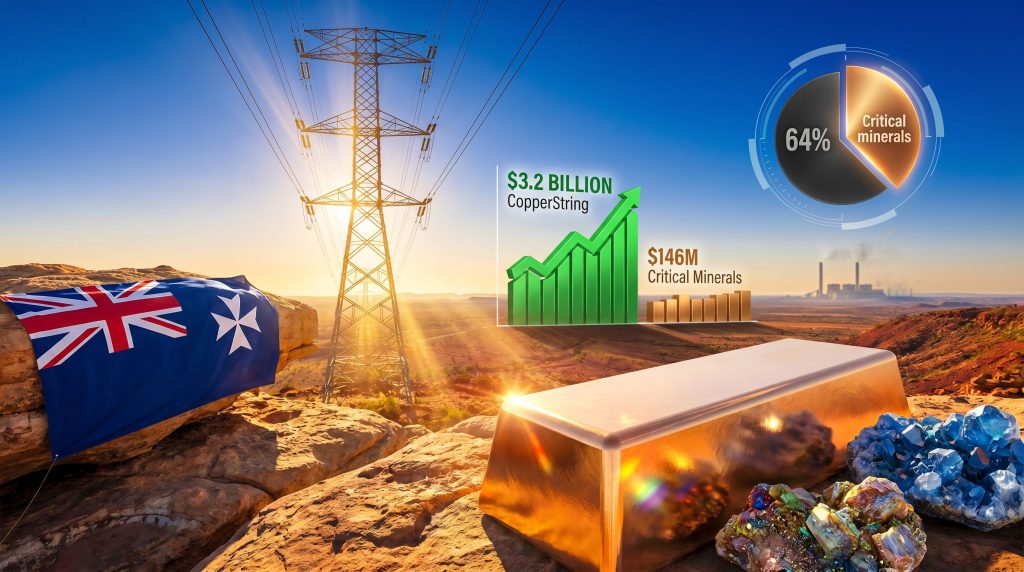
The headline critical minerals package totals AU$146 million, but that figure understates the full strategic architecture. When enabling infrastructure is included, the actual capital commitment oriented toward unlocking Queensland's critical minerals potential runs into the billions. The most significant single item is the $3.2 billion CopperString transmission corridor, which is designed to connect Queensland's North West Minerals Province to the national electricity grid.
Without reliable and affordable grid-connected power, mining operations in the remote north-west face energy costs that make otherwise viable deposits commercially marginal. CopperString is not a critical minerals investment in the conventional sense, but it functions as the foundational precondition for everything else in the strategy. Furthermore, Australia's critical minerals strategy increasingly frames such enabling infrastructure as integral to national competitiveness rather than peripheral to it.
The investment architecture breaks down as follows:
| Investment Stream | Allocated Funding | Strategic Purpose |
|---|---|---|
| Critical minerals extraction, processing and export acceleration | $46.1 million (3 years) | Fast-track project pipeline to global markets |
| Tailings re-commercialisation and abandoned mine re-entry | $33.9 million (2 years) | Unlock legacy resource value |
| North West Energy Fund | $200 million | Bridge energy supply until CopperString delivers |
| Mount Isa Transformation Study | $600 million | Unlock North West Minerals Province potential |
| Mount Isa copper smelter and Townsville refinery support | $300 million (4 years) | Sustain sovereign processing capability |
| CopperString transmission infrastructure | $3.2 billion | Grid connectivity for the North West Minerals Province |
Key Analytical Note: The $46.1 million direct extraction and processing package is the most-cited headline figure, but it represents only a fraction of the enabling infrastructure investment. The real strategic bet is on CopperString and the downstream processing facilities that transform Queensland from a raw materials exporter into a value-add minerals economy.
Inside the Critical Minerals Allocation
The Tailings Re-Commercialisation Opportunity
One of the less-discussed but strategically significant components of the budget is the AU$6.4 million specifically directed at processing historical mine tailings as part of a broader AU$33.9 million two-year program targeting abandoned mine sites.
Tailings re-processing is an emerging discipline within the critical minerals sector that deserves closer attention. Historical mining operations, particularly from the mid-20th century, frequently discarded material that contained economically meaningful concentrations of minerals that were either not commercially viable at the time or simply not prioritised. Those same tailings often contain cobalt, rare earth elements, manganese, and other battery-relevant minerals that carry significant value at current prices.
From an investor and project developer perspective, tailings offer a structurally different risk profile compared to greenfield exploration:
- Existing site infrastructure reduces capital expenditure requirements
- Historical drilling and assay data provides a baseline resource understanding
- Rehabilitation obligations may be partially offset by the re-processing activity
- Permitting pathways can differ from those governing new disturbance approvals
The limitation is metallurgical complexity. Tailings are often fine-grained, oxidised, and mineralogically variable, meaning that processing recoveries can be lower and more inconsistent than primary ore. The economic case depends heavily on the specific mineralogy of each deposit and the processing technology deployed.
Taroom Trough and Domestic Fuel Security
The $19 million fuel security initiative targeting the Taroom Trough is a measure that reflects a growing awareness of Australia's liquid fuel vulnerability. Australia imports a significant proportion of its refined petroleum products, and supply chain disruptions represent a genuine sovereign risk, particularly for remote mining operations that depend on diesel as a primary energy source.
The Taroom Trough is a sedimentary basin in central Queensland with conventional oil and gas prospectivity. The budget allocation aims to accelerate exploration and appraisal activity, expand local refining throughput, and increase strategic storage reserves. For the mining sector specifically, reducing dependence on imported diesel addresses one of the most volatile cost inputs in remote operations.
Coal's Continued Dominance and the Policy Reversal
Understanding the Scale of the Coal Commitment
To properly contextualise the Queensland critical minerals budget and coal focus, the coal-side numbers require direct examination. The state has formally walked back its previous commitment to close coal-fired power stations by 2035. Coal currently accounts for approximately 64% of Queensland's electricity generation, and the revised energy roadmap extends operational commitments well into the 2040s.
The financial scale of this commitment is substantial:
| Coal Energy Investment | Funding Detail |
|---|---|
| Total transmission and coal generator upgrades | $5.1 billion |
| Immediate upgrades (current financial year) | $520 million |
| Stanwell, Tarong and Kogan Creek power station works | Included in $520 million allocation |
| Five-year coal generator maintenance strategy | $1.6 billion |
The arithmetic is striking. The state is committing more than 35 times the headline critical minerals figure to sustaining existing coal power infrastructure. Even when the full critical minerals-enabling architecture is included, coal infrastructure spending dominates the budget's resource allocation by a considerable margin.
Policy Tension: This ratio is not necessarily evidence of misaligned priorities. It may instead reflect the fundamental reality that grid stability during a transition requires substantial maintenance capital. The question analysts are asking is whether that capital is being directed at genuinely transitional assets or at infrastructure whose extended operational life entrenches dependency.
The Revenue Logic Connecting Coal to Critical Minerals
There is an internal fiscal logic to Queensland's dual-track approach that is worth making explicit. Coal royalties generate billions in annual state revenue. That revenue is being used to fund transmission corridors, processing facilities, and exploration programs that would not otherwise attract sufficient private capital at this stage of development.
This model — using the cash flows of a mature commodity to underwrite the development costs of emerging ones — has precedent in Australian resource history. It mirrors, at a state fiscal level, the strategic capital allocation decisions that major diversified miners routinely make across their own project portfolios. The risk, as with any such model, is that the revenue base erodes faster than the replacement assets reach maturity. Indeed, the broader critical minerals demand surge globally makes the case for accelerating this transition even more pressing.
Independent Analysis: What the Budget Gets Wrong
The Grid Reliability Argument and Its Critics
Climate Energy Finance analyst Matt Pollard has argued publicly that applying maintenance capital to ageing coal generators, without simultaneously building out low-cost renewable replacement capacity, creates compounding risks for the Queensland grid. His position is that the economic and environmental sustainability of the grid is placed under increasing stress when the approach focuses on preserving legacy assets rather than enabling their replacement.
This critique has a specific empirical component worth noting. The Queensland government has attributed recent electricity price reductions to its energy policies, but independent regulatory analysis points to a different cause: the increased output from wind and solar generation combined with expanded battery storage capacity across the national grid. The attribution gap matters because it shapes how the government evaluates the effectiveness of its own strategy.
Key concerns raised by independent energy analysts include:
- Ageing coal generators carry escalating unplanned outage risks that maintenance programmes cannot fully eliminate
- The cost curve for renewable generation and storage continues to fall, making coal-based generation progressively less competitive on a levelised cost basis
- ESG-sensitive institutional capital increasingly applies discounts to project pipelines in jurisdictions with high coal policy exposure
- Extended coal lifespans may create regulatory and carbon liability risks as national emissions frameworks evolve
Strategic Frameworks for Evaluating Queensland's Approach
Sovereign Capability and Supply Chain Resilience
The critical minerals investment is framed, in part, around national security and supply chain sovereignty arguments. Copper, rare earths, cobalt, and battery metals are now classified as strategic inputs for defence critical materials, clean energy infrastructure, and advanced manufacturing. Queensland's North West Minerals Province holds documented potential across multiple of these categories, including copper, phosphate, and rare earth mineralisation, though the full extent of the province's resource endowment remains underexplored.
The Mount Isa and Townsville processing investments reflect an explicit attempt to move Queensland up the value chain. Raw ore export generates royalties. Refined copper cathode and rare earth oxides generate processing margins, employment, and the kind of industrial capability that is increasingly difficult to rebuild once it has been lost.
Regional Economic Development as a Parallel Objective
The budget also connects resource sector investment to downstream regional manufacturing in ways that are not immediately obvious. The Queensland Train Manufacturing Program reaching full operational capacity in Maryborough in 2026-27, the confirmation of a new regional manufacturing hub, and the opening of procurement for up to 630 new public transport buses to Queensland-based manufacturers are all connected to the same industrial logic: use resource revenues to build manufacturing capability that reduces import dependency across multiple sectors simultaneously.
The next major ASX story will hit our subscribers first
Queensland Versus Other Australian State Resource Strategies
| State | Primary Resource Focus | Transition Approach | Coal Policy Direction |
|---|---|---|---|
| Queensland | Coal (revenue) + Critical Minerals (investment) | Coal-funded diversification | Extended to 2040s |
| Western Australia | Iron ore, lithium, copper | Renewable energy integration | Collie transition facing difficulty |
| Victoria | Gold, critical minerals | Fiscal pivot from gold royalties | No significant coal exposure |
| South Australia | Copper, rare earths | Renewable energy leadership | Minimal coal dependency |
Western Australia's experience with the Collie coal transition is instructive. The state government has recently been forced to request federal financial support to address shortfalls in the transition programme, suggesting that coal exit strategies require more fiscal planning and longer lead times than initial projections typically capture. Queensland appears to be drawing a different lesson from that experience, choosing to extend coal operations rather than risk a disorderly transition. In addition, the mining electrification trends emerging nationally suggest that states delaying this shift may face compounding competitive disadvantages over time.
Risk and Opportunity Assessment
Key Risks for Investors and Project Developers
- Stranded asset exposure: Extending coal generator lifespans beyond their economic competitive window increases the probability that significant capital becomes unrecoverable before planned retirement
- Transition timing mismatch: Critical minerals projects typically require seven to fifteen years from discovery to sustained production, meaning that new royalty streams from those projects may not materialise before coal revenues begin declining structurally
- Grid competitiveness: Industries locating in Queensland must assess whether long-term electricity costs remain competitive as renewable generation dominates pricing nationally
- Capital allocation signal risk: The 35:1 spending ratio between coal and critical minerals infrastructure may create a perception problem with ESG-aligned institutional investors, even if the underlying critical minerals projects are well-structured
Key Opportunities
- Processing value capture: The Mount Isa and Townsville investments position Queensland to capture refining and smelting margins that currently flow offshore, fundamentally changing the royalty and employment economics of the sector
- CopperString as a multi-decade catalyst: Once operational, the transmission corridor has the potential to unlock project pipelines across the North West Minerals Province that could not previously be commercialised on a standalone power basis
- Tailings monetisation: The re-processing of historical mine waste represents a lower-disturbance, potentially lower-permitting-risk pathway to critical mineral supply that leverages existing site knowledge and infrastructure
- First-mover processing advantage: Australia currently exports a disproportionate share of its critical mineral production as unprocessed or minimally processed material. Queensland's processing investments, if executed effectively, could position the state as a preferred destination for downstream manufacturing requiring secure mineral inputs
Frequently Asked Questions
How much has Queensland committed to critical minerals in the 2026-27 budget?
The direct critical minerals allocation totals AU$146 million, with the primary extraction and export acceleration package amounting to AU$46.1 million over three years. Broader enabling investments, including the $3.2 billion CopperString transmission project and $300 million for processing facilities at Mount Isa and Townsville, substantially expand the total committed capital. Queensland's official critical minerals strategy provides further detail on the policy framework underpinning these allocations.
Why has Queensland extended coal-fired power operations beyond 2035?
The government's stated rationale is grid reliability and baseload energy security during the renewable transition. With coal supplying approximately 64% of Queensland's electricity, the government's position is that premature closure would create supply gaps that the current renewable and storage build-out cannot yet fill. Independent analysts dispute this framing, pointing to rapidly falling renewable costs and expanding battery storage capacity nationally.
What is the strategic significance of the CopperString project?
CopperString is a high-voltage transmission line connecting Queensland's remote North West Minerals Province to the national electricity grid. The fundamental challenge for mining in the region is energy cost: without grid connection, projects must rely on diesel or gas-fired power generation at costs that render many otherwise viable deposits uneconomic. CopperString addresses that constraint directly, functioning as an enabling precondition for the broader critical minerals strategy rather than a minerals investment in itself.
How are coal royalties structurally connected to the critical minerals investment?
Queensland's coal sector generates substantial annual royalty revenue. The government is directing a portion of that revenue toward non-coal infrastructure, including transmission corridors, processing facilities, and exploration incentive programmes. This fiscal cross-subsidy model is the mechanism by which coal's financial maturity underwrites the development-stage economics of the critical minerals sector. Moreover, the role of critical minerals in the energy transition gives this fiscal linkage a significance that extends well beyond Queensland's borders.
What Queensland's Budget Signals for the Broader Industry
The Queensland critical minerals budget and coal focus represents a specific and replicable model of resource state fiscal management: extract maximum value from incumbent commodities while directing a portion of that value toward enabling the infrastructure conditions for their successors. The model's internal logic is coherent. Its execution risk is timing.
The deeper strategic question is whether the critical minerals sector can achieve the royalty productivity needed to replace coal revenues before the coal revenue base is structurally eroded by falling generation costs, national emissions policy evolution, and the accelerating deployment of renewable capacity. CopperString's operational timeline, the pace of processing facility development at Mount Isa and Townsville, and the speed at which exploration in the North West Minerals Province converts into production-stage projects will all be critical variables in answering that question.
For investors, project developers, and analysts tracking the Australian critical minerals sector, Queensland's 2026-27 budget offers a detailed case study in how large, resource-dependent economies manage the intersection of legacy commodity dependency and strategic industrial transition — with all of the contradictions, opportunities, and timing risks that entails.
For ongoing coverage of Queensland's resource sector, policy developments, and investment news across Australian mining, visit Resources Review.
Want to Track the Next Major Critical Minerals Discovery Before the Market Does?
Discovery Alert's proprietary Discovery IQ model scans ASX announcements in real time, instantly identifying significant mineral discoveries across copper, rare earths, and the full critical minerals spectrum — turning complex data into actionable investment insights. Explore historic discoveries and their returns to understand what's at stake, then start your 14-day free trial at Discovery Alert to position yourself ahead of the next major find.