August 5, 2026
America's Critical Minerals Bottleneck Has Never Been About the Ground Beneath Its Feet
For most of the past century, the assumption guiding U.S. industrial strategy was straightforward: mine the raw materials, ship them to manufacturers, and let market forces handle the rest. What that logic failed to anticipate was the wholesale migration of the processing and refining infrastructure sitting between those two endpoints. Today, the United States possesses abundant mineral deposits and one of the world's most sophisticated manufacturing bases, yet the midstream capability connecting ore in the ground to usable advanced materials has largely relocated to foreign competitors, most notably China.
The critical minerals demand surge has further exposed this structural gap — not resource scarcity — as the defining vulnerability in America's critical materials supply chain. And it is precisely this gap that the UMKC Critical Materials Crossroads NSF Engine has been designed to close.
When big ASX news breaks, our subscribers know first
What the UMKC Critical Materials Crossroads NSF Engine Actually Is
The Critical Materials Crossroads initiative is a university-anchored regional coalition led by the University of Missouri-Kansas City. Its central mission is to rebuild U.S. capacity in the midstream stages of the critical minerals supply chain: processing, refining, recycling, and advanced manufacturing. Rather than focusing on extraction or end-product assembly, the programme targets the conversion steps that transform raw concentrates and recovered materials into battery-grade powders, semiconductor-quality metals, rare earth compounds, and aerospace-grade components.
In July 2026, the National Science Foundation selected the initiative as one of 12 new Regional Innovation Engines under its Directorate for Technology, Innovation and Partnerships programme. Each of the 12 selected engines will receive an initial $15 million over two years, with performance-based pathways to significantly larger long-term funding commitments.
The UMKC engine did not emerge overnight. A $1 million NSF Development Award (Award ID: 2305248) granted in May 2023 funded the groundwork for building the coalition and defining the technical and economic scope of the programme. That earlier investment helped assemble what has grown into a partnership of more than 260 universities, manufacturers, government agencies, entrepreneurs, and workforce organisations spanning Missouri and Kansas.
The Funding Architecture: Milestone-Gated and Performance-Driven
One of the most significant features of the NSF Regional Innovation Engines model is its funding discipline. Rather than releasing full allocations upfront, the programme ties subsequent disbursements to demonstrated progress across technical, commercial, and economic development benchmarks. For the UMKC engine, this means the initial two-year phase is effectively a proof-of-concept window.
| Funding Stage | Amount | Timeframe | Conditions |
|---|---|---|---|
| Prior Development Grant | $1 million | Awarded May 2023 | NSF Award ID: 2305248 |
| Initial NSF Engine Award | $15 million | Years 1-2 | Baseline selection criteria |
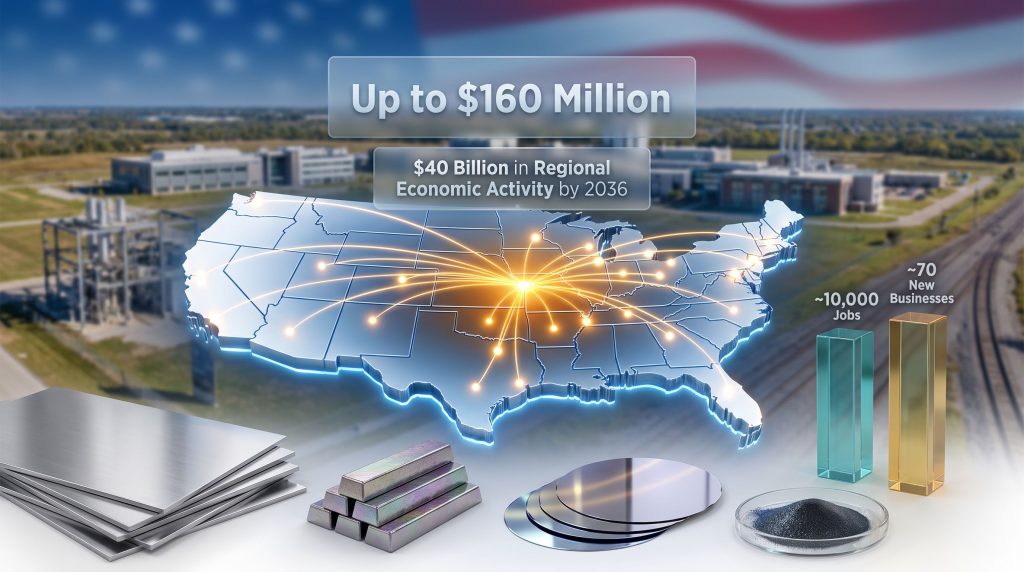
| Full Programme Ceiling | Up to $160 million | 10-year horizon | Technical, commercial and economic milestones |
| Projected Regional Economic Output | $40 billion+ | By 2036 | Estimated regional economic activity |
If the UMKC Critical Materials Crossroads NSF Engine reaches its full funding ceiling of $160 million over a decade, it would likely represent the largest federal grant ever awarded to a higher education institution in Missouri. The milestone-gated structure is not merely administrative; it is a mechanism borrowed from technology commercialisation frameworks, where capital deployment tracks demonstrable progress rather than promises.
The Structural Problem the UMKC Engine Is Solving
Understanding why this initiative matters requires understanding a specific and underappreciated dynamic in mineral supply chains: the difference between resource ownership and processing sovereignty.
The United States holds vast domestic reserves of lithium, rare earth elements, cobalt-adjacent mineralogy, and other critical inputs. Its manufacturing sector consumes these materials at enormous scale across automotive, defence, semiconductor, and energy industries. Yet for decades, the separation between these two realities grew wider as processing and refining capacity steadily migrated offshore, absorbed primarily by China's state-directed industrial expansion.
China now exerts dominant control across multiple stages of the critical minerals supply chain, from mining through chemical separation to the production of refined powders and alloys ready for industrial use. This concentration creates acute exposure for U.S. manufacturers, who face potential disruption through export restrictions, trade policy shifts, or geopolitical escalation. Consequently, rare earth supply chains have become a central focus of national security planning in recent years.
Representative Jason Smith of Missouri has stated publicly that U.S. critical mineral supply chains have shifted overseas to a degree that leaves American energy security dependent on foreign adversaries, and that rebuilding a genuine domestic supply chain for materials powering everything from batteries to jet engines is now an urgent national priority.
The CHIPS and Science Act provided a legislative foundation for exactly this kind of domestic reinvestment, and the NSF Regional Innovation Engines programme is one of its most direct implementation mechanisms. Furthermore, US critical minerals production policy has increasingly prioritised closing the midstream processing gap that leaves domestic reserves stranded from domestic industry.
What the UMKC Engine Will Actually Produce
The initiative's technical focus is deliberately midstream. Feedstocks entering the Kansas City processing ecosystem will include both domestically sourced ore concentrates and recycled spent materials recovered from industrial and consumer sources overseas and within the U.S. These inputs will be refined into commercial-grade outputs across several advanced materials categories.
Key output materials targeted by the initiative include:
- Electrode-grade materials and electrolyte precursors for lithium-ion battery manufacturing
- High-purity refined inputs for semiconductor fabrication and microelectronics production
- Rare earth element powders and alloys for permanent magnet applications in defence, EVs, and wind turbines
- Specialty metals and components for aerospace propulsion systems and medical device manufacturing
This portfolio is notable for its breadth across end-markets. Battery materials, semiconductors, rare earth magnets, and aerospace components represent four distinct demand segments, each with different purity requirements, supply chain dynamics, and commercial pathways. The engine's ability to serve all four simultaneously reflects the diversity of the coalition's industrial partners.
The Feedstock Strategy: Why Recycling Is Central, Not Secondary
A less-discussed but technically significant aspect of the initiative is its explicit incorporation of recycled and secondary feedstocks alongside primary ore concentrates. This matters for several reasons. Recycled materials often arrive in partially processed forms, reducing the energy and chemical inputs required to reach final product specifications.
Urban mining — the extraction of critical materials from end-of-life electronics, batteries, and industrial waste — is increasingly recognised as a near-term domestic supply source that does not require permitting new extraction sites. For rare earth elements in particular, recycling rates globally remain below 5%, meaning vast quantities of already-processed material are currently lost to landfill. An initiative designed to intercept and recover those materials adds genuine new supply to the domestic ecosystem without the long lead times associated with greenfield mining projects.
The Coalition: 260+ Partners and the Industrial Anchor of EaglePicher
The scale of the UMKC engine's partnership network is one of its defining structural features. With more than 260 member organisations, the coalition spans the full range of institutions required to move critical materials research into commercial production.
Academic Partners:
- University of Missouri-Kansas City (Lead Institution)
- University of Missouri
- Missouri University of Science and Technology
- University of Kansas
- Kansas State University
Selected Industry and Institutional Partners:
- EaglePicher Technologies (defence and aerospace battery manufacturing)
- Burns and McDonnell (engineering and construction)
- Wagner Logistics (supply chain and transportation)
- Greater Kansas City Chamber of Commerce
- Kansas City Area Development Council
EaglePicher Technologies deserves particular attention as an industrial anchor. As a Missouri-based manufacturer of specialised batteries for defence and aerospace applications, the company operates at the intersection of two of the highest-specification demand segments for domestically produced advanced materials. Its involvement provides the engine with a direct commercial pathway for battery material outputs that meet stringent defence procurement standards — a market segment largely insulated from cost-based foreign competition. Notably, UMKC is also leading development of a microelectronics hub in Missouri and Kansas, further reinforcing the region's broader advanced materials ambitions.
Why Kansas City's Geography Is a Competitive Advantage
Coastal innovation clusters command most of the attention in technology policy discussions, but the Kansas City region possesses a set of infrastructure advantages that are genuinely difficult to replicate at either coast.
Kansas City sits at the convergence of several major U.S. freight corridors, served by an extensive rail network and connected to inland waterway systems that allow cost-efficient movement of bulk industrial feedstocks. For a processing hub that will handle heavy ore concentrates and finished material shipments, this logistics infrastructure translates directly into lower per-unit operating costs compared to coastal alternatives.
Beyond transportation, the region hosts a manufacturing workforce with existing skills adjacent to the technical requirements of critical materials processing, alongside a growing research university base that provides talent pipeline continuity. Proximity to automotive, aerospace, and battery-adjacent industrial operations across the central U.S. creates natural commercial relationships that reduce the commercialisation distance between laboratory output and industrial purchase order.
The next major ASX story will hit our subscribers first
The Economic Case: Jobs, Business Formation, and the Leverage Ratio
The projected economic impact figures attached to the UMKC Critical Materials Crossroads NSF Engine are substantial, and they become more credible when viewed against the demonstrated performance of the first generation of NSF engines launched in 2024.
| Economic Metric | Projected Figure | Timeframe |
|---|---|---|
| Jobs Supported | ~10,000 | By 2036 |
| Regional Economic Activity | Up to $40 billion | Over 10 years |
| New Small Businesses Formed | ~70 | Programme lifecycle |
| First-Wave Engine Leverage Ratio | ~15:1 (federal to private capital) | First-wave engines (2024) |
The leverage ratio derived from the 2024 first-wave engines is perhaps the most instructive data point. Those 12 engines received a combined initial federal commitment of $135 million and have since attracted more than $2 billion in matching commitments from private companies, philanthropies, and state and local governments. That ratio — approximately 15 dollars of private capital for every federal dollar deployed — suggests the NSF engine model functions as a credibility and de-risking mechanism for private investment rather than a substitute for it.
For the Kansas City region, replicating that dynamic at even a fraction of that ratio would represent a transformative inflow of industrial capital. In addition, the Critical Materials Crossroads NSF Engines finalist designation has already elevated regional and national attention on the initiative's commercial potential.
The National Network Logic: Alaska Extracts, Kansas City Processes
One of the more elegant aspects of the NSF Regional Innovation Engines architecture is its explicit acknowledgement that no single U.S. region can close the critical minerals gap in isolation. The July 2026 selection round included both the UMKC Critical Materials Crossroads and the University of Alaska Fairbanks-led Critical Mineral Accelerator, a programme focused on improving extraction and development of mineral resources in Alaska's resource-rich geology.
The pairing is not coincidental. Alaska holds some of the most significant undeveloped critical mineral deposits in North America. Kansas City has the manufacturing base, logistics infrastructure, and research capacity to process those resources into industrial-grade outputs. Together, they represent complementary nodes in a distributed national supply chain rather than competing regional programmes.
NSF's stated intent is for its engine network to function as an interconnected system that links regional strengths, closes capability gaps, and accelerates the movement of new technologies from research environments into commercial use. The Alaska-Kansas City complementarity illustrates how that architecture works in practice.
Milestone Requirements and Programme Discipline
Unlocking the full $160 million over a decade is not automatic. The NSF engine model requires ongoing demonstration of progress across three distinct milestone categories:
- Technical milestones: Processing yield improvements, material purity benchmarks, and scalability demonstrations that show laboratory results can transfer to pilot and eventually commercial-scale operations.
- Commercial milestones: Deepening industry partnership commitments, revenue-generating activity, and evidence that processed materials are finding buyers in target end markets.
- Economic development milestones: Documented job creation, workforce training completions, and new business formation tracked against the programme's projected targets of 10,000 jobs and 70 new ventures by the end of the programme lifecycle.
This structure means the UMKC engine must demonstrate simultaneous progress across research, commercialisation, and regional economic development — a discipline that distinguishes it fundamentally from traditional academic research grants where technical output alone satisfies programme requirements. A coherent critical minerals strategy of this kind, spanning feedstock sourcing to commercial sales, is increasingly viewed as the blueprint for effective domestic supply chain rebuilding.
What Success Here Would Signal for U.S. Industrial Strategy
UMKC Chancellor Mauli Agrawal has framed the initiative as a once-in-a-generation opportunity to position the Kansas City region as a global leader in critical materials research and innovation — one that reflects what becomes possible when a region aligns around a bold vision with national consequences.
That framing captures something important about the broader significance of the UMKC Critical Materials Crossroads NSF Engine. If a mid-sized Midwest university coalition can successfully rebuild domestic processing capacity for battery materials, semiconductor inputs, rare earth compounds, and aerospace metals within a decade, it validates a model of distributed, university-anchored industrial policy that could be replicated across other capability gaps in the U.S. innovation economy.
The alternative — continued dependence on foreign-controlled processing infrastructure for the materials underpinning American technology and defence sectors — carries risks that have become increasingly difficult to ignore. The UMKC engine is not a complete solution to that problem, but it is a structured, milestone-tested, coalition-built attempt to begin reversing a decades-long strategic drift.
Disclaimer: Projected economic figures, job creation estimates, and funding amounts cited in this article reflect programme targets and NSF programme-level data. Actual outcomes will depend on technical performance, commercial adoption, and ongoing milestone achievement. This article does not constitute financial or investment advice.
Want to Identify the Next Major Mineral Discovery Before the Market Does?
Discovery Alert's proprietary Discovery IQ model delivers real-time alerts on significant ASX mineral discoveries, transforming complex mineral data into clear, actionable investment insights across more than 30 commodities — ideal for investors tracking the critical materials sector. Explore how historic mineral discoveries have generated extraordinary returns and begin your 14-day free trial today to position yourself ahead of the broader market.