July 15, 2026
The Hidden Price Tag Embedded in Every Barrel Heading West
Energy markets have long treated maritime chokepoints as background risk rather than active cost. For decades, the implicit assumption was that the U.S. Seventh Fleet's presence in the Persian Gulf represented a public good, a kind of collective insurance policy for global oil consumers paid for through American defence budgets rather than shipping manifests. That assumption is now being fundamentally renegotiated.
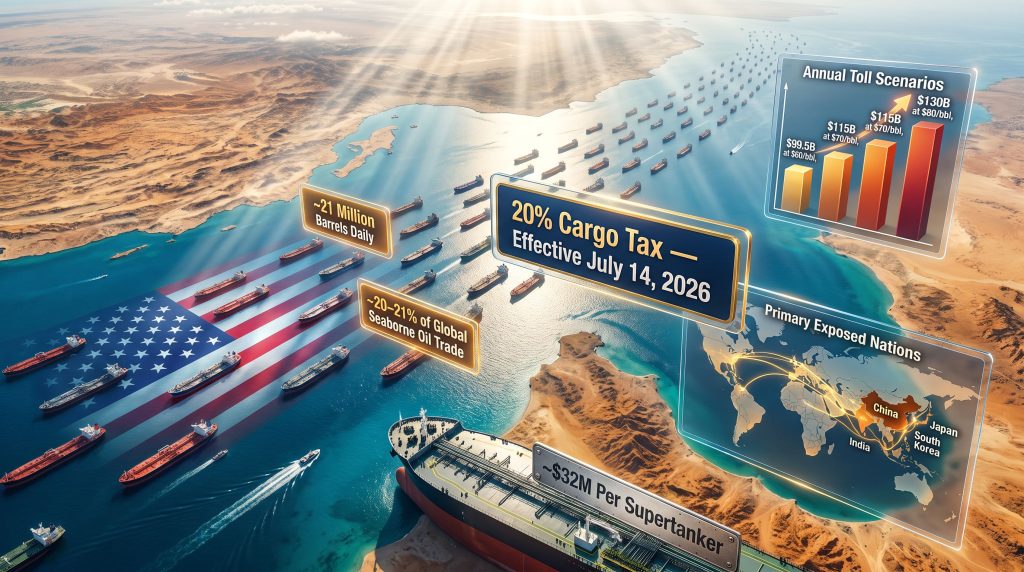
The Trump Strait of Hormuz toll, announced in mid-July 2026, proposes to charge vessels 20% of the commercial value of their cargo for passing through one of the world's most critical energy corridors. Framed publicly as a mechanism to recover safety and security costs, the levy has triggered an international debate spanning maritime law, energy economics, geopolitical precedent, and the unexpected intersection of American energy policy with global decarbonisation. Understanding its full implications requires looking beyond the headline rate to the structural transformation it could impose on how the world prices fossil fuel access. For broader context, the crude oil market overview heading into 2025 already signalled mounting volatility across key maritime corridors.
When big ASX news breaks, our subscribers know first
The Strait of Hormuz in Numbers: The World's Most Consequential 33 Kilometres
Very few geographic features carry the economic leverage concentrated in the Strait of Hormuz. At its narrowest point, the shipping lane is roughly 33 kilometres wide, yet the volumes of energy transiting this corridor each day are staggering in their global significance.
| Metric | Pre-Disruption Baseline |
|---|---|
| Daily oil and petroleum product throughput | ~21 million barrels |
| Daily LNG throughput | ~10 billion cubic feet |
| Share of global seaborne oil trade | ~20-21% |
| Primary LNG exporter dependent on the strait | Qatar |
| Approximate daily cargo value at $70/bbl | ~$1.47 billion |
According to analysis published by Leon Stille on OilPrice.com on 14 July 2026, these volumes mean that applying a 20% ad valorem charge would add approximately $294 million per day, or more than $107 billion annually, to oil shipments alone, before a single LNG cargo, petrochemical tanker, or container vessel is counted.
What makes the Hormuz corridor uniquely vulnerable compared to other chokepoints is the near-total absence of viable bypass alternatives at comparable scale:
- Saudi Arabia operates the East-West Pipeline, capable of carrying approximately 5 million barrels per day to Red Sea terminals, but this represents less than a quarter of normal Hormuz oil volumes
- The UAE's Abu Dhabi Crude Oil Pipeline can deliver roughly 1.5 million barrels per day to Fujairah, bypassing the strait entirely
- Qatar's LNG exports have no pipeline alternative whatsoever, making the country structurally captive to Hormuz maritime access
- The Suez Canal and Bab el-Mandeb are themselves chokepoints, meaning rerouting through the Cape of Good Hope adds weeks of transit time and substantially higher fuel and crew costs
The arithmetic is unforgiving. Even if every available overland pipeline route operated at full capacity simultaneously, the bypass ceiling would remain well below half of normal Hormuz throughput, and even then only for crude oil, not LNG.
How a Ceasefire Became a Toll Booth: The Policy Pivot Timeline
The Trump Strait of Hormuz toll did not arrive without warning, but its trajectory defied easy prediction. U.S. policy on Hormuz passage fees shifted multiple times across a three-month window in 2026, creating the kind of regulatory uncertainty that commodity markets find more unsettling than a clearly defined, stable cost. Furthermore, the broader trade war oil prices dynamic had already been compressing producer margins well before this latest escalation.
| Date | Policy Position | Key Detail |
|---|---|---|
| April 2026 | Threat of U.S.-collected toll | Framed as preferable to Iran collecting fees |
| Mid-April 2026 | 20% toll announced | Applied to eligible cargoes; Iranian vessels banned |
| June 20, 2026 | 60-day toll-free ceasefire declared | Temporary guarantee of free navigation |
| June 24, 2026 | Iran confirmed no-fee assurance | No fees, insurance charges, or tolls for vessels |
| July 13, 2026 | 20% tax reinstated | Effective July 14 at 8 PM GMT; framed as safety and security cost recovery |
A critical and underappreciated detail is the gap between the U.S. proposed levy and Iran's previously reported fee demands. The Trump administration's 20% ad valorem structure translates to approximately $32 million per laden supertanker carrying a typical Very Large Crude Carrier cargo at $70 per barrel. Iran's reported per-vessel fee demand, by contrast, was framed as a roughly $2 million flat charge presented as a navigational service fee. The order-of-magnitude difference matters both legally and economically, a point that has received surprisingly little attention in mainstream coverage.
Breaking Down the Financial Scale of a 20% Hormuz Levy
The ad valorem structure of the proposed toll introduces a self-reinforcing dynamic absent from conventional transit fees. A flat fee per vessel provides predictability; a percentage of cargo value creates a floating cost that rises automatically whenever oil prices increase.
| Oil Price Assumption | Annual Toll on Oil Shipments | Annual Toll on LNG | Combined Estimated Annual Levy |
|---|---|---|---|
| $60 per barrel | ~$92 billion | ~$7.5 billion | ~$99.5 billion |
| $70 per barrel | ~$107 billion | ~$7.5 billion | ~$115 billion |
| $80 per barrel | ~$122 billion | ~$7.5 billion | ~$130 billion |
Figures exclude petrochemicals, fertilisers, containerised goods, and other non-energy cargo. Sources: Stille, OilPrice.com, 14 July 2026; author modelling based on publicly available throughput data.
This creates a potentially destructive feedback loop. A supply disruption raises oil prices, which increases the absolute toll, which raises shipping costs, which inflates insurance and financing premiums, which suppresses demand, which simultaneously reduces revenues for producers while maintaining the toll burden. The mechanism differs fundamentally from any conventional energy tax because its rate is pegged to the very commodity price it helps inflate.
Who Actually Absorbs the Cost?
The 20% nominal rate does not land on a single actor. It cascades through the supply chain in layers:
- Gulf producers (Saudi Arabia, Qatar, UAE) face lower netback prices as buyers demand discounts to offset their toll exposure
- Shipping companies pass costs through elevated freight rates, war-risk surcharges, and crew compensation premiums
- Commodity traders build wider margin buffers into forward contracts and spot transactions
- Refiners and utilities pay higher feedstock prices, compressing margins or passing costs downstream
- Industrial consumers face elevated energy and feedstock bills, increasing manufactured goods costs
- End consumers absorb a material share through higher fuel prices, heating bills, and food costs (fertiliser prices being particularly sensitive to LNG costs)
The most underappreciated transmission channel is fertiliser. Natural gas is the primary feedstock for ammonia production, and ammonia underpins global nitrogen fertiliser supply. A sustained 20% increase in Gulf LNG costs does not stay in the energy sector; it moves directly into food production costs across import-dependent agricultural economies.
Is the Trump Strait of Hormuz Toll Legal?
The legal position is unusually clear, and unusually unfavourable to Washington's proposed policy. Part III of the United Nations Convention on the Law of the Sea (UNCLOS) establishes the right of transit passage through international straits as a customary norm applicable to all vessels. Coastal states bordering international straits retain the right to regulate navigation for safety and environmental purposes, but they cannot charge fees as a condition of transit or obstruct passage for commercial or political reasons.
The International Maritime Organization has stated explicitly that no legal basis exists for toll collection on passage through an international strait, regardless of which state seeks to impose the charge. The IMO's position reflects decades of state practice and legal consensus that transit passage rights are not contingent on payment.
What makes the U.S. position particularly legally exposed is a factor rarely emphasised in public commentary: the United States is not a coastal state bordering the Strait of Hormuz. The strait's shorelines are shared between Iran and Oman. A third-party military power asserting the right to charge vessels for transiting a waterway it does not border represents a legal claim with essentially no precedent in the modern law of the sea.
The Precedent That Could Reshape Maritime Geopolitics
If the principle that naval protection generates a commercial toll right were accepted, the implications would extend well beyond the Gulf. Consider the cascade of potential precedents:
- China could assert fee rights over commercial shipping in the South China Sea, where it maintains contested maritime claims and a growing naval presence
- Russia could claim service charges on Arctic route escorts, where its icebreaker fleet provides indispensable navigation assistance
- Regional naval powers could monetise convoy protection through any contested chokepoint including Bab el-Mandeb, the Malacca Strait, or the Turkish Straits
The conceptual boundary between securing freedom of navigation and monetising control over navigation would dissolve, fundamentally altering the commercial and legal framework governing approximately 80% of global trade by volume.
Three Scenarios for How This Resolves
Scenario 1: Full Implementation and Sustained Enforcement
Under this pathway, the 20% toll becomes a permanent structural feature of Gulf energy pricing. Gulf crude and LNG acquire a persistent geopolitical premium that cannot be hedged through standard financial instruments because it reflects political rather than market risk. Asian importers, who collectively absorb the largest share of Gulf crude, accelerate supply diversification toward U.S., West African, and South American barrels.
Qatar LNG faces the most acute exposure given its complete maritime dependence on Hormuz access. Long-term capital allocation decisions for Gulf upstream projects face viability reassessment, particularly for fields with high breakeven costs that cannot absorb a structural 20% market-access surcharge. The oil price shock already reshaping Canadian energy executives' strategies offers a useful parallel for how producers respond when cost structures shift abruptly.
Scenario 2: Announced But Inconsistently Enforced
This scenario, which many energy market analysts consider the most probable near-term outcome, is paradoxically damaging in ways that are difficult to quantify but easy to feel across shipping and commodity markets. Even without consistent enforcement:
- War-risk insurance premiums remain structurally elevated because underwriters price potential rather than confirmed events
- Tanker operators continue deactivating AIS transponders (so-called going-dark behaviour) to manage perceived seizure risk
- Commodity traders price wider bid-ask spreads into Gulf cargo contracts to compensate for settlement uncertainty
- Cargo financing costs rise as Gulf-origin cargoes become riskier collateral for commodity-backed lending facilities
The market effect of a threatened toll can be indistinguishable from the effect of an implemented one. Uncertainty is a cost with a compounding structure, and energy markets are extraordinarily efficient at converting geopolitical ambiguity into freight rate premiums.
Scenario 3: International Pressure Forces a Reversal Within 60 to 90 Days
Allied economies with the largest exposure, particularly Japan, South Korea, India, and key European LNG importers, possess substantial diplomatic leverage over U.S. trade and security relationships. A coordinated pushback through IMO challenge processes, WTO consultations, and bilateral diplomatic channels could create sufficient political cost to prompt suspension of the toll.
However, even a full reversal would not eliminate the precedent risk. The credible threat of a 20% levy has already demonstrated that Gulf maritime access cannot be treated as politically neutral, permanently adjusting the risk models used by shipping insurers, tanker operators, and commodity traders. The US-China trade war provides a sobering precedent for how quickly retaliatory escalation can overtake diplomatic containment efforts.
The next major ASX story will hit our subscribers first
Trump's Accidental Carbon Tax: The Energy Transition Dimension
Perhaps the most analytically unexpected dimension of the Trump Strait of Hormuz toll is its potential to function as an inadvertent but powerful fossil fuel cost signal with direct energy transition consequences.
Consider what the proposed levy exempts: all energy sources that do not transit the Strait of Hormuz. Domestic electricity generation from wind and solar pays nothing. Nuclear power is entirely unaffected. Hydropower, battery storage, energy efficiency investments, and electrified transport face no Hormuz exposure whatsoever. Indeed, the broader energy transition trends already reshaping investment flows stand to be accelerated significantly by this kind of structural fossil fuel cost premium.
| Policy Mechanism | Annual Cost Imposed on Fossil Fuels | Proceeds Linked to Decarbonisation | Geographic Scope |
|---|---|---|---|
| EU Emissions Trading System | Hundreds of billions of EUR across covered sectors | Yes, partially recycled into climate funds | EU member states |
| Proposed 20% Hormuz Toll | ~$115 billion on oil and LNG alone | No, framed as security cost recovery | Global Gulf energy exporters |
| EU Carbon Border Adjustment Mechanism | Targeted at carbon-intensive imports | Yes, aligned with ETS pricing | EU imports |
The toll's market signal could, in practice, be more powerful than a conventional carbon price in several respects. It arrives suddenly rather than phasing in over years. It applies to an enormous volume of globally traded energy simultaneously. It has no exemptions for energy-intensive industries or transition periods for affected economies.
As Leon Stille observed in his analysis for OilPrice.com, an administration that withdrew from the Paris Agreement and sought to constrain federal clean energy investment may inadvertently deliver a fossil fuel cost shock more consequential for energy transition economics than decades of climate advocacy. The political irony is structural rather than incidental.
How Markets Are Already Responding
The market response to Hormuz toll uncertainty is already visible across multiple asset classes and trade flows, even before the toll's enforcement status is fully clarified:
- Asian oil importers are actively pivoting toward U.S. crude and non-Gulf supply sources, a trade flow reconfiguration with long-term infrastructure implications
- China has begun cutting Saudi crude procurement orders as Hormuz risk premiums and pricing discounts reshape the relative economics of different supply origins
- Tanker operators have resumed AIS transponder deactivation, repeating the going-dark behaviour observed during earlier Hormuz crisis episodes
- European natural gas prices have responded to LNG market tightening, with Qatar's export uncertainty transmitting into continental price benchmarks
- U.S. LNG exporters are reportedly capturing windfall revenues as Asian buyers pay premiums for supply sources outside the Hormuz risk perimeter
Frequently Asked Questions: Trump Strait of Hormuz Toll
What exactly is the Trump Strait of Hormuz toll?
The Trump Strait of Hormuz toll is a proposed 20% ad valorem charge on the commercial value of cargo transiting the Strait of Hormuz, announced by the Trump administration and stated to take effect from July 14, 2026, at 8 PM GMT. The stated justification is recovery of safety and security costs associated with U.S. naval operations in the region.
How much would the toll add to global energy costs?
At a $70-per-barrel oil price assumption, the levy on oil shipments alone would add approximately $107 billion annually. Including LNG, the combined annual cost could approach $115 billion under moderate price assumptions, rising to over $130 billion if oil prices move toward $80 per barrel.
Is the U.S. legally entitled to charge a toll on Strait of Hormuz transit?
Under UNCLOS and established IMO frameworks, the answer is almost certainly no. The right of transit passage through international straits is a well-established principle of international maritime law. The U.S. legal position is further weakened by the fact that it is not a coastal state bordering the strait, making its claim to impose charges even more legally contested than a similar attempt by Iran or Oman would be.
Which countries face the greatest exposure?
The highest-exposure importing nations are those most dependent on Gulf crude and LNG: China, India, Japan, South Korea, and several European LNG importers. Among exporters, Qatar faces unique vulnerability because its LNG export infrastructure has no viable pipeline bypass alternative to Hormuz maritime transit.
Could the toll actually accelerate the energy transition?
The economic logic suggests it could. By imposing a structural cost premium on Gulf fossil fuels without affecting renewable electricity, nuclear power, or energy efficiency, the toll changes the relative competitiveness of energy sources in a manner that directionally favours decarbonisation, even though it was never designed for that purpose and its proceeds are not directed toward climate objectives.
Strategic Takeaways: Contradictions at the Core of U.S. Energy Policy
The Trump Strait of Hormuz toll reveals a fundamental tension within the administration's energy framework. Lower global oil prices have been presented repeatedly as a strategic objective and an anti-inflation tool. A 20% cargo levy on the world's largest oil export corridor works directly against that objective, adding structural cost to roughly one-fifth of global seaborne oil supply.
More broadly, the episode exposes what may be the defining vulnerability of a fossil-fuel-centred energy security framework: military control of supply routes does not guarantee commercial stability if political decisions can reprice access at any moment. A naval presence can deter hostile actors, but it cannot insulate energy markets from the policy choices of the power providing the protection.
Whether the toll is ultimately implemented, suspended, or reversed under diplomatic pressure, the episode has permanently attached a number to the political risk premium embedded in Hormuz-dependent fossil fuel supply chains. That number is 20%. Shipping insurers, tanker operators, commodity traders, long-term infrastructure investors, and energy policy planners will be adjusting their models accordingly for years to come, regardless of what Washington decides next.
The deeper structural lesson may be that energy security built around narrow maritime corridors carries an irreducible political vulnerability that no level of military investment can permanently eliminate. The only energy sources genuinely immune to Hormuz toll risk are those whose fuel never needs to travel through a strait at all.
Disclaimer: This article is intended for informational and educational purposes only. It does not constitute financial, legal, or investment advice. All figures relating to proposed toll costs, annual levy estimates, and energy trade volumes are based on publicly available data and modelling assumptions subject to change. Readers should conduct their own due diligence before making any investment or policy-related decisions. References to scenario modelling represent analytical projections, not confirmed outcomes.
Want to Stay Ahead of the Next Major Commodity Market Shift?
Discovery Alert's proprietary Discovery IQ model scans ASX announcements in real time, instantly identifying significant mineral discoveries that could be materially affected by exactly the kind of structural energy cost shocks explored in this article — start your 14-day free trial today, or explore historic discovery returns to understand the scale of opportunity that early positioning can deliver.