July 15, 2026
The World's Most Dangerous Bottleneck: Understanding the Hormuz Fee Reversal and Its Energy Market Consequences
Global energy security has always been a function of geography as much as geology. The most productive oil fields on Earth mean little if the infrastructure connecting them to consumers becomes contested, disrupted, or weaponised. That fundamental truth sits at the heart of every major crude price shock in living memory, and it explains why Trump drops Hormuz fee became one of the most closely watched energy policy reversals of 2026, as a single body of water measuring just 21 miles at its narrowest point can send shockwaves through commodity markets on multiple continents within hours of a political announcement.
The events of July 14, 2026 offered a textbook illustration of this dynamic. When the Trump administration first announced, then within 24 hours abandoned, a proposed 20% transit fee on cargo moving through the Strait of Hormuz, markets did not simply react to a policy change. They reacted to a sudden, destabilising reminder that the architecture underpinning global oil supply remains fragile, politically exposed, and vulnerable to escalation at remarkably short notice.
When big ASX news breaks, our subscribers know first
Why the Strait of Hormuz Commands Such Outsized Influence Over Global Energy Pricing
To appreciate why the decision to drop the Hormuz fee generated such immediate and sustained market reaction, it helps to understand the physical and commercial reality of the strait itself. The Hormuz passage connects the Persian Gulf to the Gulf of Oman, functioning as the singular maritime exit route for the world's most concentrated cluster of hydrocarbon producers.
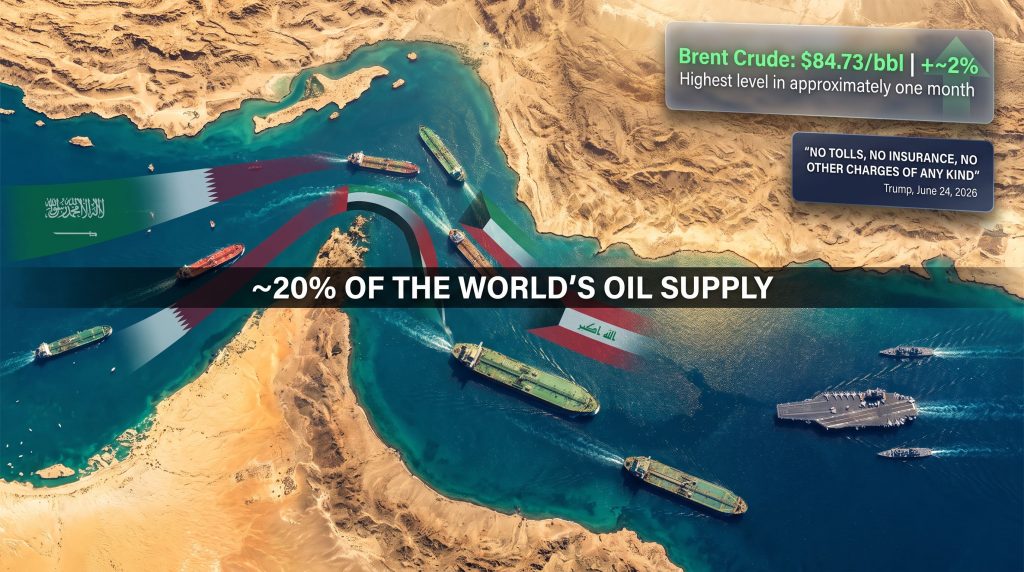
Approximately one-fifth of the world's entire oil supply transits this waterway annually, according to the U.S. Energy Information Administration. The producer nations depending on Hormuz access include Saudi Arabia, Iraq, Kuwait, the United Arab Emirates, Qatar, and Bahrain. Collectively, these countries represent a dominant share of OPEC+ production capacity and hold the majority of the world's proven conventional crude reserves. Furthermore, OPEC's global influence over pricing decisions means that any disruption to member state export routes carries amplified consequences for global benchmarks.
Qatar's position deserves particular attention. As one of the world's three largest exporters of liquefied natural gas, Qatar's entire LNG export infrastructure routes through Hormuz. There is no viable alternative. This creates a structural vulnerability that extends well beyond crude oil markets, reaching directly into global LNG supply, European energy security, and Asian LNG spot markets simultaneously.
The strait's historical role as a geopolitical pressure point is well documented:
- The 1980s Tanker War saw both Iranian and Iraqi forces targeting commercial vessels in the Persian Gulf, drawing the U.S. Navy into convoy escort operations under Operation Earnest Will
- Iran has periodically threatened outright closure of the waterway during periods of maximum sanctions pressure, most recently during the 2018–2019 sanctions cycle
- The 2019 Gulf of Oman tanker attacks, widely attributed to Iranian forces, demonstrated that threats to Hormuz access can be executed through covert means without formal military declaration
- Commercial vessel seizures by Iran's Islamic Revolutionary Guard Corps Navy have occurred multiple times since 2019, establishing a documented pattern of strait-adjacent escalation
Each of these episodes produced immediate crude price volatility, reinforcing the market's conditioned sensitivity to any Hormuz-related news cycle.
The Anatomy of the Proposed 20% Transit Fee
What Did the Fee Actually Propose?
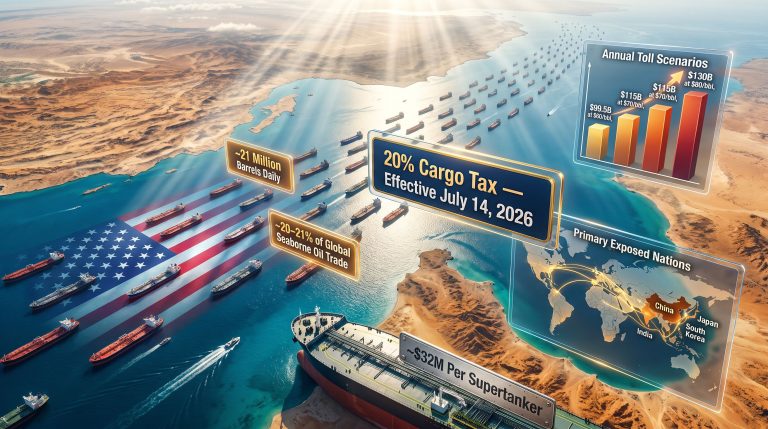
The Trump administration's initial announcement introduced a 20% levy on all non-Iranian cargo transiting the strait. The stated rationale framed this as a reimbursement mechanism for the cost of U.S. naval operations maintaining open access to the waterway. In effect, Washington was proposing to monetise its security umbrella over the Persian Gulf, treating the naval presence as a commercial service for which global energy importers should pay a toll.
The immediate reactions from energy and shipping markets were pointed and swift:
- Shipping industry participants warned the fee would structurally increase transportation costs for crude oil and LNG cargoes on a permanent basis
- Legal scholars and maritime law specialists noted that the International Maritime Organization has consistently held that no legal foundation exists for compulsory toll enforcement in internationally utilised straits under the United Nations Convention on the Law of the Sea. According to CNBC, the IMO reaffirmed this position publicly within hours of the announcement
- Analysts flagged a precedent-setting danger: if the U.S. could impose transit charges over Hormuz, other nations could advance similar arguments over the Strait of Malacca, the Turkish Straits, or the Strait of Gibraltar
- Brent crude responded with upward pressure as traders began pricing a new permanent layer of logistics cost into forward curves
The absence of any enforcement framework, legal mechanism, or collection timeline in the original announcement suggested the proposal was more political signal than operational policy. Nevertheless, markets treated it as a real variable requiring immediate repricing.
One underappreciated dimension of the fee proposal was its potential secondary effect on war risk insurance premiums. Shipping insurance in Persian Gulf waters is already significantly elevated relative to normal trade routes. An official U.S. transit charge would have provided Lloyd's of London and other marine underwriters with a new baseline for quantifying political risk, likely triggering automatic upward revisions to war risk and hull insurance rates for all vessels transiting the region.
How Trump Drops Hormuz Fee: The Gulf State Diplomatic Intervention
The reversal came within 24 hours and was framed not as a retreat but as a strategic upgrade. Bloomberg reported that following direct consultations with representatives from Saudi Arabia, Qatar, Bahrain, Kuwait, and the United Arab Emirates, the Trump administration announced it was replacing the transit fee with a commitment to pursue long-term trade and investment agreements from Gulf states into the U.S. economy.
Trump confirmed publicly that Gulf leaders had encouraged Washington to pursue alternative economic arrangements. The administration recharacterised the shift as preferring sustained bilateral investment flows over a one-time transit charge. U.S. Energy Secretary Chris Wright confirmed the fee was off the table entirely.
No specific investment figures, participating country breakdowns, or deal timelines were disclosed at the time of announcement. This opacity matters for markets because:
- Without quantified investment commitments, the economic rationale for withdrawing the fee cannot be independently verified
- The absence of a formal agreement structure means the arrangement remains politically reversible
- Gulf state sovereign wealth funds have significant existing U.S. investment exposure, making it unclear whether new commitments represent net-additional capital or repackaging of existing planned flows
The diplomatic dynamic also reveals something important about the relative leverage of Gulf producers in this relationship. Washington depends on Gulf state cooperation for military basing rights, OPEC+ production coordination signalling, and regional stability architecture. The speed of the reversal suggests those dependencies created a binding constraint on how far the fee proposal could realistically advance. In addition, the broader context of crude oil trade geopolitics across the region makes such rapid policy recalibrations increasingly common.
Pressuring Iran: Washington's Hard Line on Strait Tolls
Even as the U.S. withdrew its own proposed fee, the administration drew a sharp and public line against any Iranian attempt to impose equivalent charges on commercial shipping. Trump's public statements made clear that any Iranian-imposed transit levy would be treated as an unacceptable violation of the terms of the ceasefire framework and a dealbreaker for ongoing diplomatic negotiations.
On June 24, 2026, the administration announced that Iran had communicated directly that no tolls, insurance requirements, or charges of any kind would be applied to vessels transiting the strait. However, a significant ambiguity persists: as of the most recent reporting, Iran had not issued an independent public confirmation of this assurance.
A joint statement involving Iran and Oman referenced intentions to discuss navigation services consistent with international standards, with language around associated costs that left interpretive room. This gap between U.S. claims and Iranian public positioning is not a minor diplomatic detail. For shipping operators, it represents a real operational risk assessment question: whose assurance governs, and what enforcement mechanism exists if Iranian port authorities or the IRGC Navy act contrary to Washington's characterisation?
Brent Crude Price Action and What the Market Was Actually Pricing
| Metric | Value |
|---|---|
| Brent Crude Settlement Price (July 14, 2026) | $84.73 per barrel |
| Daily Price Change | Approximately +2% |
| Price Context | Highest level in approximately one month |
| Primary Upward Driver | Ongoing military activity and blockade resumption |
| Secondary Factor | Residual policy uncertainty on fee alternatives |
The persistence of elevated pricing despite the fee withdrawal reveals sophisticated market reasoning. Traders correctly distinguished between two separate risk variables:
- The fee itself represented a policy-driven cost layer, analytically containable and potentially reversible
- The active U.S. military campaign and reimposed blockade of Iranian shipping represented an operational reality with direct implications for near-term supply flow
The resumption of the U.S. shipping blockade of Iranian ports and coastal areas, effective the same afternoon as the fee reversal, removed any expectation that geopolitical risk premiums would compress meaningfully. Fresh U.S. military strikes on Iranian targets aimed at degrading Tehran's capacity to threaten commercial vessels added a further escalatory signal that markets were not prepared to ignore. Consequently, the oil market trade risks associated with this episode extended well beyond a single policy reversal.
When the removal of a proposed fee coincides with the resumption of a naval blockade and new military strikes, the net risk signal to energy markets is not neutral. The fee withdrawal was a reduction in policy uncertainty; the military escalation was an increase in supply security uncertainty. On balance, the latter dominated.
The next major ASX story will hit our subscribers first
Regional Exposure: Who Bears the Most Risk from Hormuz Disruption?
| Region | Hormuz Dependency | Primary Exposure |
|---|---|---|
| East Asia (China, Japan, South Korea) | Very High | Crude oil import disruption |
| South Asia (India, Pakistan) | High | Crude and LNG supply cost increases |
| Europe | Moderate | Qatari LNG spot market tightening |
| North America | Low | Indirect price transmission via global benchmarks |
The East Asian exposure deserves particular attention from an energy security planning perspective. China, Japan, and South Korea collectively import the majority of Persian Gulf crude output. Japan and South Korea have virtually no domestic hydrocarbon production of scale, making sustained Hormuz disruption an existential energy security event rather than a manageable supply adjustment. China's strategic petroleum reserve, while substantial, is calibrated for weeks of disruption, not months.
Europe's exposure operates through a different channel. Following the 2022 Russian gas supply disruption, European buyers significantly increased their dependence on Qatari LNG. Any scenario in which Hormuz access becomes impaired removes Qatar from the global LNG swing supply pool at precisely the moment European storage and demand cycles would most require it.
The 60-Day Ceasefire Window and Three Forward Scenarios
The policy environment operates within a ceasefire framework established in April 2026, committing both the U.S. and Iran to maintaining open strait transit without tolls for a minimum of 60 days. The expiry of this window without a successor agreement would structurally remove the constraint on both parties' behaviour. The geopolitical oil price factors at play here suggest the transition period carries substantial repricing risk for global benchmarks.
Scenario 1: Diplomatic Stabilisation
Gulf state investment commitments become formalised, Iran maintains its no-toll assurance publicly, and U.S. military activity de-escalates. Brent crude retreats from elevated levels as risk premiums compress toward underlying supply-demand fundamentals.
Scenario 2: Frozen Conflict
The ceasefire holds technically but military posturing continues on both sides without formal resolution. Oil prices remain range-bound with elevated volatility. Shipping war risk insurance stays structurally elevated. The situation becomes the new baseline rather than resolving.
Scenario 3: Renewed Escalation
Iran challenges the blockade, resumes toll enforcement, or retaliates against naval assets. Acute supply disruption risk materialises. Brent crude tests multi-year highs. Qatari LNG spot availability tightens sharply. Asian buyers accelerate emergency procurement at premium prices.
Disclaimer: These scenarios represent analytical frameworks for understanding potential outcomes and should not be construed as investment advice or price forecasts. Energy markets are subject to rapid and unpredictable change, and actual outcomes may differ materially from any scenario projection.
What the Fee Reversal Signals Beyond the Immediate News Cycle
The 24-hour lifespan of the Hormuz transit fee proposal carries implications that extend well beyond this specific episode. Several structural insights emerge for energy market participants:
- The speed of the reversal demonstrated that Gulf state diplomatic leverage over U.S. Persian Gulf policy remains substantial and operationally effective, even during periods of maximum Washington assertiveness
- The IMO's established legal position on compulsory tolls in international straits creates a meaningful institutional constraint on any future fee proposals, regardless of which government advances them
- Administration officials' language about alternative compensation mechanisms for U.S. naval operations preserves policy optionality, meaning the fee concept has been shelved, not retired
- The episode illustrated that in modern energy markets, the announcement risk of a policy change can be as price-relevant as the policy itself, even when the announcement is reversed within hours
- Shipping operators and energy companies face a structurally uncertain planning environment in which U.S. policy toward the strait can shift materially within a single news cycle
For energy market participants monitoring the situation, the combination of an unresolved military campaign, a temporary ceasefire framework, ambiguous Iranian assurances, and preserved U.S. policy optionality on fee alternatives creates a risk environment that warrants sustained attention well beyond the immediate headlines.
Further coverage of upstream energy developments across the Middle East and global energy corridors is available through World Oil at worldoil.com.
Want to Stay Ahead of the Next Major Energy-Driven Market Opportunity?
When geopolitical flashpoints like the Hormuz fee reversal send shockwaves through commodity markets, Discovery Alert's proprietary Discovery IQ model instantly scans ASX announcements to surface actionable mineral discovery opportunities — ensuring subscribers are positioned ahead of the broader market. Explore historic examples of exceptional discovery returns or start your 14-day free trial at Discovery Alert to gain a real-time edge when market conditions shift.