
June 17, 2026
How Physical Commodity Benchmarks Evolve: The Architecture of Aluminium Premium Pricing
Commodity price benchmarks are rarely static. They evolve in response to structural shifts in how physical markets operate, and the mechanisms that underpin their integrity are often invisible to all but the most engaged market participants. Understanding why a benchmark specification changes, and what it signals about underlying market dynamics, requires looking beneath the headline amendment to the market architecture it reflects.
The recent decision to raise the minimum tonnage threshold in the aluminium P1020A spot premium CIF Japan assessment is precisely this kind of structural signal. It is not a cosmetic adjustment. It is an acknowledgment that the commercial reality of Japan's aluminium import market has outgrown a parameter set under earlier market conditions.
When big ASX news breaks, our subscribers know first
Understanding the P1020A Pricing Layer: More Than a Number
To understand why the aluminium P1020A spot premium CIF Japan minimum tonnage amendment matters, it helps to first understand what the benchmark actually measures and why it exists alongside exchange-listed aluminium prices.
The London Metal Exchange (LME) aluminium price represents the global reference point for the metal's value, but it does not capture the physical cost of delivering a specific grade of aluminium to a specific location under specific contractual terms. That gap is filled by regional premium assessments like the P1020A CIF Japan spot premium, designated by Fastmarkets as MB-AL-0343. For broader context on how aluminium premium pricing operates across different regional markets, the structural logic is consistent worldwide.
The P1020A grade specification itself is a meaningful quality anchor:
- Minimum aluminium purity of 99.7%
- Silicon content maximum of 0.10%
- Iron content maximum of 0.20%
- Accepted physical forms: ingot, T-bar, and sow
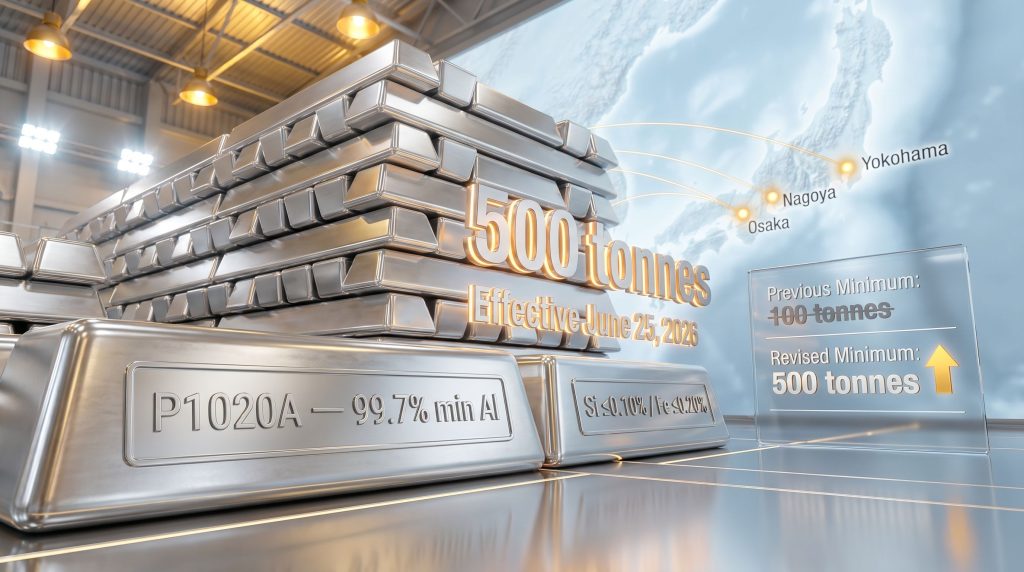
These parameters align directly with LME delivery specifications, making P1020A the standard primary aluminium product traded across major international markets. The CIF Japan premium then layers on top of the LME cash price to reflect actual delivery costs, regional supply-demand dynamics, and logistics to the three primary settlement ports: Yokohama, Nagoya, and Osaka.
The assessment is published daily during a 6-7pm Singapore time window and is quoted in USD per tonne as a premium above the exchange-listed price, not as a standalone figure. This layered structure distinguishes physical premium assessments from exchange prices and is central to how physical aluminium contracts are priced across Asia.
It is also worth understanding how the CIF Japan spot premium differs from the quarterly Metals Japan Premium (MJP). The MJP is negotiated periodically between major aluminium producers and large Japanese buyers, typically covering three-month forward delivery periods. The spot premium, by contrast, reflects near-term physical transactions assessed on a daily basis. The two instruments serve different commercial functions, even though they reference the same physical material and the same delivery locations.
Why Minimum Tonnage Thresholds Are Not a Technicality
The Representativeness Problem in Thinly Traded Physical Markets
Physical commodity benchmarks derive their authority from the quality and representativeness of the transactions they reflect. When a price assessment captures transactions that are too small, too infrequent, or too far from typical commercial terms, the resulting price signal becomes unreliable. This is not a theoretical concern. It is a structural vulnerability that regulators, price reporting agencies, and commercial users take seriously.
In thinly traded physical markets, a handful of small-lot transactions during an assessment window can produce price signals that diverge materially from broader market conditions. Small parcels often change hands in distressed circumstances, between parties with asymmetric information, or at prices that reflect logistical convenience rather than true market equilibrium. Furthermore, when these transactions feed into a daily benchmark, they introduce noise that downstream contract holders, hedgers, and risk managers cannot easily distinguish from genuine price signals. Concerns around base metals price reporting reliability are increasingly relevant across the broader commodities landscape.
Benchmark integrity depends on the degree to which assessed prices reflect what a willing buyer and willing seller would agree to under commercially normal conditions. Minimum tonnage thresholds are one of the primary tools used to enforce this standard.
How Tonnage Thresholds Compare Across Aluminium Benchmarks
The following table illustrates how the revised CIF Japan specification positions itself relative to other major aluminium premium benchmarks:
| Benchmark | Region | Minimum Tonnage | Pricing Basis |
|---|---|---|---|
| P1020A Spot Premium (pre-amendment) | CIF Japan | 100 tonnes | LME cash + premium |
| P1020A Spot Premium (post-amendment) | CIF Japan | 500 tonnes | LME cash + premium |
| Midwest Transaction Premium | United States | Varies by reporter | LME + Midwest |
| Duty-Unpaid Spot Premium | Rotterdam | Varies | LME cash + premium |
The fivefold increase from 100 to 500 tonnes is the most consequential element of this amendment. It fundamentally redraws the boundary of which transactions qualify for inclusion in the assessment, concentrating the benchmark's data inputs on commercially significant, large-parcel trades that better represent Japan's mainstream import flows.
Timeline and Process: How the Amendment Came to Be
From Proposal to Implementation
The amendment followed a structured governance process consistent with international price reporting standards. Fastmarkets published its proposal to amend the minimum tonnage specification for the aluminium P1020A MJP spot premium CIF Japan as part of its ongoing methodology review:
- April 2, 2026 – Initial methodology amendment proposal published by Fastmarkets
- May 18, 2026 – Formal 30-day market consultation period opened
- June 17, 2026 – Consultation period closed; amendment decision confirmed
- June 25, 2026 – Revised specification takes effect
No formal written feedback was received during the consultation window. However, preliminary market intelligence gathered before the consultation concluded indicated that smaller-sized spot transactions were producing skewed price signals that participants viewed as unrepresentative of actual market conditions.
This pre-consultation dialogue informed the decision even in the absence of formal written responses. This distinction is worth noting for market participants who assume that a lack of formal written feedback means no market input was considered. Price reporting agencies operating under IOSCO Principles for Financial Benchmarks typically engage in ongoing dialogue with market participants beyond formal consultation channels, and this intelligence appropriately feeds into methodology decisions.
Full Revised Specification: MB-AL-0343 Post-Amendment
The following table presents the complete before-and-after specification for the aluminium P1020A spot premium CIF Japan assessment:
| Specification Field | Previous Parameter | Revised Parameter |
|---|---|---|
| Quality | P1020A / 99.7% min Al (Si ≤0.10%, Fe ≤0.20%) | Unchanged |
| Accepted Forms | Ingot, T-bar, sow | Unchanged |
| Minimum Quantity | 100 tonnes | 500 tonnes |
| Delivery Location | CIF Yokohama, Nagoya, Osaka | Unchanged |
| Timing Window | Within two calendar months | Unchanged |
| Price Unit | USD/tonne | Unchanged |
| Payment Terms | Cash against documents (2 days after B/L date) | Unchanged |
| Publication Schedule | Daily, 6-7pm Singapore time | Unchanged |
| Package Membership | Fastmarkets base metals package | Unchanged |
Critically, the quality specification remains entirely intact. P1020A-grade material requirements are unchanged. The amendment is exclusively a tonnage floor adjustment, meaning the benchmark continues to track the same grade of metal, to the same ports, under the same delivery and payment conditions.
What the Two-Month Timing Window Signals
One often-overlooked aspect of this benchmark's specification is the two-calendar-month forward delivery window. This parameter positions the spot premium as a near-term physical market signal rather than a forward curve reference. For Japanese aluminium consumers managing short-cycle procurement, this window directly informs purchasing decisions in a way that quarterly MJP negotiations do not.
It also creates an interesting interaction with LME futures pricing. When the LME forward curve is in contango, the two-month spot premium window reflects both physical supply-demand conditions and the carrying cost embedded in nearby physical delivery. Traders and procurement teams that understand this interaction can extract more nuanced information from spot premium movements than a surface-level reading would suggest.
Market Impact: Who Is Affected and How
Japanese Aluminium Consumers
Japan's downstream aluminium processing sector is among the world's most sophisticated, spanning automotive manufacturing, aerospace components, packaging, and consumer electronics. These industries rely on P1020A as primary feedstock, and many short-term procurement contracts are priced with reference to MB-AL-0343.
For these buyers, a more representative benchmark means:
- Reduced risk that contract settlement prices are distorted by marginal, small-lot trades
- Greater alignment between benchmark prices and the actual cost of securing material in commercially meaningful quantities
- Improved confidence in price discovery when negotiating short-term supply agreements
Smelters and Exporters Supplying CIF Japan
Australia, the Middle East, and Southeast Asia collectively represent major sources of P1020A supply into the Japanese market. Smelters and trading companies supplying cargoes to Yokohama, Nagoya, and Osaka will find that the revised 500-tonne floor aligns more naturally with standard commercial parcel sizes for primary aluminium shipments.
For smaller trading operations that occasionally transact in sub-500-tonne lots, the practical implication is that those transactions will no longer qualify for benchmark contribution. This does not prevent such trades from occurring, but it does mean they sit outside the price discovery mechanism.
Contract Holders Referencing MB-AL-0343
Any commercial agreement indexed to MB-AL-0343 should be reviewed ahead of June 25, 2026. While the quality and delivery parameters are unchanged, the shift in minimum tonnage alters the population of transactions informing the daily assessment. Legal and procurement teams should confirm that the revised methodology remains consistent with the commercial intent of indexed contracts.
Parties to contracts referencing the Fastmarkets aluminium P1020A CIF Japan spot premium should treat the June 25 effective date as a firm deadline for internal review, not a future consideration.
The next major ASX story will hit our subscribers first
The Broader Significance: What Methodology Amendments Reveal About Market Maturity
IOSCO Principles and the Governance of Physical Benchmarks
Price reporting agencies like Fastmarkets operate within a governance framework informed by the IOSCO Principles for Financial Benchmarks, which were established in 2013 following concerns about manipulation risks in major financial benchmarks. These principles emphasise transparency, representativeness, and accountability in benchmark methodologies. In fact, LME benchmark governance has itself come under scrutiny in recent years, reinforcing why rigorous oversight of physical price assessments is so important.
The structured consultation process behind this amendment, including a formal 30-day public window and documented decision rationale, reflects adherence to this framework. Even when no formal written responses are received, the published record of the consultation process itself provides market participants with the transparency needed to understand how and why benchmark specifications evolve.
What a 5x Tonnage Increase Says About Japanese Market Liquidity
There is a speculative but analytically grounded interpretation of this amendment that deserves attention. When a benchmark's minimum tonnage floor is raised fivefold, it implies that the distribution of actual market transactions has shifted upward. If sub-100-tonne parcels were still commercially common in the Japanese spot market, excluding them would hollow out the benchmark's data inputs and undermine its function.
The fact that market participants themselves flagged small-lot transactions as unrepresentative suggests that the centre of gravity in Japanese aluminium spot trading has moved toward larger parcel sizes. This shift has implications not just for Japan but for global steel market trends and broader metals procurement dynamics across Asia.
This could reflect several structural developments:
- Consolidation among Japanese aluminium importers and processors, with larger buyers now dominating spot procurement
- Growing preference among exporters for fewer, larger shipments to reduce per-tonne logistics costs
- A reduction in opportunistic small-lot trading as market conditions have stabilised and forward planning has improved
Japan consistently imports more than 2 million tonnes of primary aluminium annually, and the ports of Yokohama, Nagoya, and Osaka handle a substantial proportion of those flows. At that scale of throughput, a 500-tonne minimum represents a relatively modest commercial parcel, reinforcing the view that the old 100-tonne floor had become genuinely anachronistic. Consequently, metals market policy shifts across major trading blocs are creating additional pressure for benchmark methodologies to reflect contemporary commercial realities.
Frequently Asked Questions
What is MB-AL-0343?
MB-AL-0343 is the Fastmarkets designation for the aluminium P1020A spot premium CIF Japan minimum tonnage amendment benchmark. It measures the premium above the LME aluminium cash price for P1020A-grade aluminium delivered to major Japanese ports, published daily at 6-7pm Singapore time in USD per tonne.
When does the revised specification take effect?
The new 500-tonne minimum tonnage requirement becomes operative on Thursday, June 25, 2026.
Does the amendment change the quality specification?
No. The P1020A quality parameters, including the 99.7% minimum aluminium purity, silicon maximum of 0.10%, and iron maximum of 0.20%, remain entirely unchanged. The amendment applies exclusively to the minimum transaction size for benchmark eligibility.
How does this benchmark differ from the quarterly MJP?
The spot premium is assessed daily and reflects near-term physical transactions within a two-calendar-month delivery window. Fastmarkets has also separately proposed amending the frequency of the aluminium P1020A MJP spot premium CIF Japan assessment, signalling broader ongoing review of these instruments. The quarterly MJP, however, is negotiated periodically between producers and major buyers for three-month delivery periods. Both reference P1020A-grade material delivered to Japanese ports, but they serve distinct commercial functions within the aluminium pricing ecosystem.
What should contract holders do before June 25?
Any agreement that references MB-AL-0343 as a pricing mechanism should be reviewed by legal and procurement teams to confirm alignment with the revised methodology. Questions can be directed to Fastmarkets through their official pricing contacts, as referenced in the published methodology notice.
Key Takeaways
- The minimum tonnage for the aluminium P1020A spot premium CIF Japan minimum tonnage amendment rises from 100 tonnes to 500 tonnes, effective June 25, 2026
- The fivefold increase reflects market participant feedback that smaller transactions were producing price signals unrepresentative of broader commercial conditions
- Quality specifications, delivery locations, timing windows, payment terms, and publication schedules remain unchanged
- The amendment follows a structured 30-day consultation process aligned with IOSCO benchmark governance standards
- Japanese aluminium consumers, exporters, and contract holders should review their commercial positions ahead of the effective date
- At a structural level, the amendment signals that Japan's physical aluminium spot market has matured toward larger, more commercially standardised parcel sizes
This article is intended for informational purposes only and does not constitute financial, legal, or trading advice. Parties with commercial contracts referencing MB-AL-0343 should seek independent professional guidance regarding the implications of the revised specification for their specific agreements.
Want to Stay Ahead of Significant Mineral Discoveries on the ASX?
While benchmark methodology shifts reveal how physical commodity markets mature, the real opportunity for investors lies in identifying transformative mineral discoveries the moment they are announced — Discovery Alert's proprietary Discovery IQ model scans ASX announcements in real time, delivering actionable alerts across more than 30 commodities, so subscribers can act before the broader market catches on. Explore historic discovery returns to understand what major finds can deliver, and begin a 14-day free trial at Discovery Alert to position yourself at the forefront of the next significant ASX discovery.