July 7, 2026
Why Regional Premium Benchmarks Matter More Than Most Traders Realise
Commodity pricing is rarely as simple as a single global number. While the London Metal Exchange provides the foundational reference price for aluminium traded worldwide, the LME cash price alone tells only part of the story. The physical reality of buying and selling metal involves ports, logistics corridors, smelting cost structures, currency dynamics, and regional supply-demand imbalances that a single exchange-derived figure cannot capture. This gap between global benchmark and local market reality is precisely why regional premium assessments exist, and why the aluminium P1020A FOB Indonesia premium assessment holiday pricing schedule update carries meaningful commercial weight for anyone operating in Asian metals markets.
When big ASX news breaks, our subscribers know first
Understanding What P1020A Grade Aluminium Actually Represents
Not all primary aluminium is created equal. Within the quality hierarchy of unwrought aluminium, P1020A sits at a level that satisfies the most stringent downstream and exchange-delivery requirements. The designation itself signals a specific compositional profile that distinguishes this material from lower-purity alloys used in casting and alloying applications where trace element tolerances are wider.
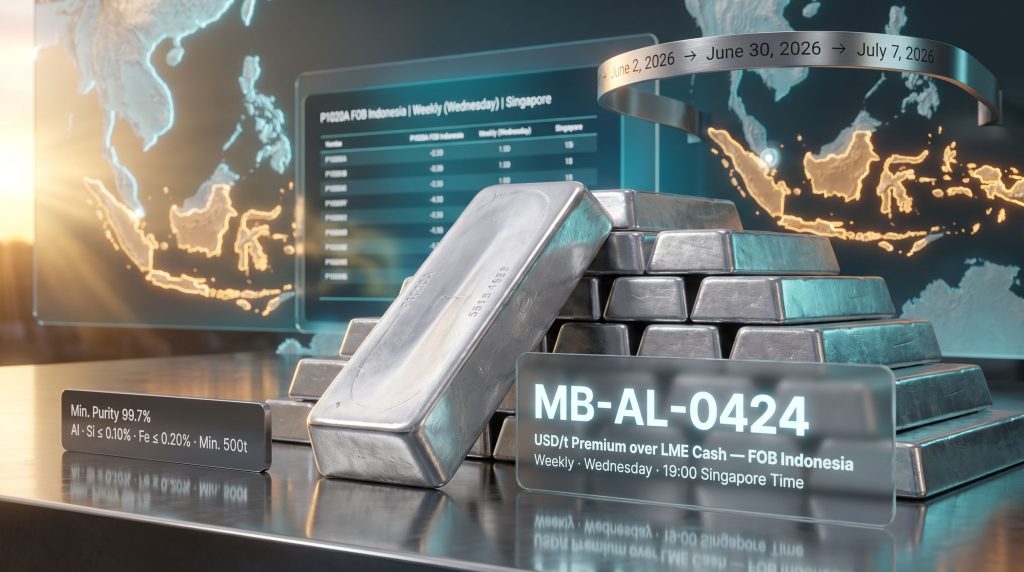
The full specification profile that defines P1020A-grade material is as follows:
| Specification Parameter | Requirement |
|---|---|
| Minimum Aluminium Purity | 99.7% |
| Maximum Silicon (Si) Content | 0.10% |
| Maximum Iron (Fe) Content | 0.20% |
| Acceptable Physical Forms | Ingot, T-bar, Sow |
| Minimum Transaction Quantity | 500 tonnes |
The 99.7% minimum purity threshold is not arbitrary. It directly mirrors the LME's own delivery specifications, which means P1020A material is fungible with exchange-warranted metal. This fungibility matters enormously for traders who need to move between physical and paper positions without facing quality discounts or delivery disputes.
What is less commonly understood is how silicon and iron content limits function as proxies for smelter quality control. Elevated silicon levels typically indicate contamination from furnace linings or inadequately controlled alloying additions during casting, while excess iron content often reflects the quality of alumina feedstock or scrap inputs used in the production process. Both impurities reduce the electrical conductivity and tensile strength characteristics that high-end industrial buyers require, which is why the thresholds embedded in P1020A specifications are enforced, not merely suggested.
The MB-AL-0424 Assessment: Full Specification Breakdown
The Fastmarkets assessment carrying the code MB-AL-0424 is the specific instrument used to benchmark the aluminium P1020A FOB Indonesia premium. Understanding each component of its specification helps market participants use it correctly.
- Assessment code: MB-AL-0424
- Unit of measurement: USD per tonne, expressed as a premium over LME Cash aluminium
- Delivery basis: Free on Board (FOB) Indonesia
- Timing window: Within one calendar month from the date of assessment
- Accepted payment mechanisms: Telegraphic Transfer (TT) or Letters of Credit (LC) at sight
- Publication schedule: Weekly, every Wednesday at 7:00 PM Singapore time
- Package: Part of the Fastmarkets base metals data package
The FOB delivery basis carries a specific and consequential risk allocation. Under FOB terms, the Indonesian seller bears all costs and responsibilities until the moment the metal is loaded onto the vessel at an Indonesian port. From that point forward, the buyer assumes freight risk, insurance obligations, and all destination-side costs. This makes FOB assessments structurally different from CIF assessments, which bundle freight into the quoted price.
This distinction becomes commercially critical when buyers attempt to compare Indonesian-origin material with, for example, metal quoted on a CIF basis for Japanese or Korean delivery. Direct price comparison without freight adjustment produces misleading cost models and can result in procurement decisions that appear competitive on paper but prove more expensive once the full landed cost is calculated.
What Drives the FOB Indonesia Premium Above LME Cash?
The premium component of the MB-AL-0424 assessment reflects a layered set of market forces specific to Indonesian-origin aluminium. Furthermore, understanding these forces is essential for accurate cost modelling. These include:
- Domestic production cost structures including energy inputs, labour costs, and smelting efficiency metrics at Indonesian facilities
- Port handling and export documentation costs unique to the Indonesian regulatory and logistics environment
- Regional supply-demand balance between the volume of aluminium Indonesian smelters produce for export and the appetite from Northeast and Southeast Asian buyers
- Currency dynamics involving the Indonesian rupiah and its interaction with USD-denominated commodity contracts
- Tariff and export duty frameworks that influence the net realised price for Indonesian producers after government levies
The assessment methodology normalises for non-standard payment terms and transaction structures to ensure each weekly observation reflects a commercially representative market price rather than an outlier transaction. In addition, shifts in regional industrial demand across Asia can amplify or compress the premium from week to week, making it a useful barometer of broader market sentiment.
The Holiday Calendar Amendment: What Changed and Why It Matters
Effective Tuesday, July 7, 2026, the aluminium P1020A FOB Indonesia premium assessment holiday pricing schedule was updated. The change is straightforward in its mechanics but meaningful in its rationale: the assessment now observes the Singapore public holiday calendar rather than the UK public holiday calendar that had previously governed non-publication days.
Publication timing remains fixed at weekly, every Wednesday at 7:00 PM Singapore time. No changes were made to any price specifications, quality thresholds, minimum quantities, or payment terms.
The Consultation and Amendment Timeline
| Milestone | Date |
|---|---|
| Change first proposed via pricing notice | June 2, 2026 |
| Consultation period opens | June 2, 2026 |
| Consultation period closes | June 30, 2026 |
| Amendment decision confirmed | June 30, 2026 |
| Changes take effect | July 7, 2026 |
The logic behind the shift is grounded in market geography rather than administrative convenience. Singapore functions as the primary commercial, financial, and trading hub for Southeast Asian metals markets. The overwhelming majority of physical aluminium transactions involving Indonesian-origin material are negotiated, confirmed, and settled by counterparties operating within Singapore business hours and observing the Singapore commercial calendar.
When a weekly price assessment falls on a day recognised as a public holiday in Singapore but not in the UK, the practical result is that the most relevant market participants are unavailable to provide the market intelligence, counterparty confirmations, and transaction data that underpin a credible price observation. Publishing an assessment under those conditions weakens the quality of price discovery without adding meaningful information.
When a pricing benchmark is published on a day when the relevant trading community is not active, the resulting assessment reflects thinner market participation. Over time, this erodes confidence in the assessment's representativeness. Aligning the holiday calendar with Singapore is therefore not merely administrative housekeeping; it is a substantive improvement to the benchmark's integrity.
Consequently, this amendment reflects a broader industry trend towards aligning aluminum and alumina markets benchmarks with the operational realities of the regions they serve, rather than defaulting to legacy European calendar conventions.
How PRA Governance Works: The Amendment Process Explained
Price Reporting Agencies operate under governance frameworks that require transparency and structured stakeholder engagement before any specification changes take effect. The process followed for the MB-AL-0424 holiday calendar amendment illustrates how this works in practice.
Stage 1: Proposal Notice
A formal pricing notice is published, detailing the proposed change, its rationale, and the timeline for consultation. This notice was issued on June 2, 2026. Fastmarkets' pricing notice for this amendment provides full details of the rationale and process followed.
Stage 2: Consultation Period
Market participants, including producers, traders, end-users, and financial institutions, are given a defined window to submit feedback. The consultation ran from June 2 to June 30, 2026.
Stage 3: Decision Notice
Following review of all submissions, the PRA publishes a decision notice confirming whether the change will proceed. The decision was confirmed on June 30, 2026.
Stage 4: Implementation
The amendment takes effect on the confirmed date. Implementation occurred on July 7, 2026.
Participants who submitted comments during the consultation period can have their non-confidential responses made available to other market participants upon request. This maintains an auditable record of market input and ensures the decision-making process is documented and defensible.
It is worth noting that the PRA governance structure exists partly because commodity benchmarks like MB-AL-0424 are used as contractual pricing anchors. When a physical supply agreement references a weekly assessment as its pricing mechanism, any change to that assessment's methodology carries direct financial implications for both parties. The formal consultation process provides a structured safeguard against arbitrary changes that could disadvantage contract holders.
The FOB Indonesia Assessment in the Context of Asian Aluminium Premium Markets
To appreciate why a dedicated FOB Indonesia assessment exists, it helps to understand the broader architecture of Asian aluminium premium benchmarks.
| Assessment Type | Delivery Basis | Publication Frequency | Holiday Calendar |
|---|---|---|---|
| P1020A FOB Indonesia (MB-AL-0424) | FOB Indonesia | Weekly (Wednesday) | Singapore |
| P1020A MJP CIF Japan | CIF Japan | Weekly | Japan |
| Asian aluminium spot premiums (general) | Various CIF/FOB | Weekly/Daily | Varies by market |
Each assessment in this landscape serves a distinct commercial function. CIF Japan assessments reflect the all-in cost of metal delivered to Japanese ports, incorporating freight and insurance. The FOB Indonesia assessment strips those elements out, isolating the value at point of origin. For buyers capable of arranging their own freight, the FOB basis can offer cost advantages over CIF-priced alternatives, particularly when spot freight rates decline.
Indonesia's Growing Significance as an Aluminium Export Origin
Indonesia's emergence as a meaningful source of primary aluminium exports reflects a structural shift in the regional supply landscape. The country possesses substantial bauxite reserves, and government-driven policies over the past decade have encouraged investment in domestic alumina refining and primary aluminium smelting rather than raw ore export. This upstream integration is closely tied to global bauxite supply dynamics, which have themselves shifted considerably as Indonesia tightened its raw ore export policies.
For Japanese, Korean, and broader Northeast Asian buyers, Indonesian-origin aluminium represents an alternative sourcing channel that reduces dependence on traditional supply corridors. The expansion of Indonesian production capacity means that the FOB Indonesia premium is increasingly watched not just as a niche regional indicator but as a meaningful signal of Southeast Asian supply competitiveness relative to other origin points including Australia, the Middle East, and Russia.
However, it is worth noting that aluminium tariff impacts in major consuming economies can redirect trade flows, influencing which origin points offer the most attractive net pricing for buyers navigating evolving customs frameworks.
The next major ASX story will hit our subscribers first
Practical Applications for Buyers, Traders, and Procurement Teams
Understanding the structure of the aluminium P1020A FOB Indonesia premium assessment is one thing. Applying it effectively across commercial and analytical functions is another.
Contract indexation: Physical supply agreements that reference MB-AL-0424 as a pricing anchor benefit from the assessment's weekly cadence and standardised methodology. Procurement teams can use the published premium to determine the aluminium component of invoiced prices with transparency and auditability.
Risk management: The separation of the LME Cash base price from the regional premium allows traders to manage each component independently. LME aluminium premium contract specifications provide a useful reference point for understanding how exchange-traded instruments interact with physical market benchmarks. Over-the-counter instruments referencing the FOB Indonesia premium can hedge the regional premium component.
Market intelligence: Week-on-week movements in the FOB Indonesia premium carry informational value beyond the immediate transaction. A widening premium may signal that Indonesian smelters are running at high utilisation with strong order books, while a compressing premium can indicate excess inventory or weakening Asian demand.
For procurement teams building cost models, the FOB premium published in MB-AL-0424 is only the starting point. Arriving at a true landed cost requires adding current spot freight rates for the relevant shipping route, applicable port surcharges at the destination, insurance costs, and any import duties or value-added taxes levied by the destination country's customs framework.
Data access: The MB-AL-0424 assessment is accessible through multiple channels within the Fastmarkets platform, including the dashboard interface, Excel add-in, mobile application, and API integration for automated data pipeline consumption. Subscribers can configure alerts to capture each Wednesday publication as it is released.
Frequently Asked Questions: Aluminium P1020A FOB Indonesia Premium Assessment
What is the aluminium P1020A FOB Indonesia premium assessment?
A weekly benchmark price published every Wednesday at 7:00 PM Singapore time, measuring the USD-per-tonne premium above the LME Cash aluminium price for P1020A-grade primary aluminium exported on a free-on-board basis from Indonesian ports. Its assessment code is MB-AL-0424.
Why does the FOB Indonesia assessment now follow the Singapore holiday calendar?
The change aligns the assessment's non-publication days with the commercial calendar of the market most relevant to Indonesian aluminium transactions. Singapore is the primary financial and trading hub for Southeast Asian base metals, making its holiday calendar a more operationally accurate reference than the UK calendar previously applied.
What quality standards must aluminium meet under MB-AL-0424?
Material must satisfy P1020A grade requirements: a minimum aluminium purity of 99.7%, silicon content not exceeding 0.10%, and iron content not exceeding 0.20%, consistent with LME delivery specifications. Acceptable physical forms are ingot, T-bar, and sow.
What is the minimum transaction size reflected in the assessment?
The assessment captures transactions of a minimum 500 tonnes, ensuring the benchmark reflects commercially representative trade volumes rather than atypical small-lot deals that could distort the published level.
How does the PRA consultation process protect market participants?
Price Reporting Agencies issue a formal proposal notice, open a defined consultation window for stakeholder feedback, then publish a decision notice. This documented process ensures any specification change is subject to market scrutiny before implementation, protecting the interests of participants who rely on the assessment as a contractual pricing reference.
Among the aluminium industry leaders that engage most actively with PRA consultations are large integrated producers, whose contract books are directly affected by any amendment to widely referenced benchmarks.
Readers seeking additional detail on Fastmarkets pricing methodologies and assessment specifications can access publicly available documentation at Fastmarkets Methodology.
Want to Know When the Next Major ASX Mineral Discovery Hits the Market?
Discovery Alert's proprietary Discovery IQ model scans ASX announcements in real time, delivering instant alerts on significant mineral discoveries across more than 30 commodities — turning complex market data into clear, actionable insights for traders and investors at every level. Explore Discovery Alert's discoveries page to see the historic returns major discoveries have generated, and begin your 14-day free trial today to position yourself ahead of the broader market.