
July 7, 2026
The Molecule That Could Reshape Global Energy Trade
For decades, the architecture of global energy trade has been defined by a simple but powerful logic: nations with abundant fossil fuel reserves built the infrastructure to extract, process, and export those resources, while importing nations built the terminals, pipelines, and refineries to receive them. That infrastructure locked in trade relationships for generations. Today, a parallel process is beginning to take shape around a fundamentally different commodity: green hydrogen. And the nations moving fastest to establish institutional control over its export flows may define the next era of energy geopolitics just as decisively as OPEC shaped the last one.
The ACWA Saudi green hydrogen export mandate, announced in July 2026, represents one of the most structurally significant moments in this emerging trade architecture. Saudi Arabia has designated a single national utility operator as the exclusive channel through which the Kingdom's green hydrogen, green ammonia, green methanol, green fuels, and renewable electricity will reach international markets. Understanding what this means requires looking well beyond the headline figure.
When big ASX news breaks, our subscribers know first
Why Exclusivity Is the Central Feature, Not a Footnote
Most commentary on green hydrogen developments focuses on production volumes, cost targets, or bilateral trade agreements. But the most analytically significant aspect of this development is the word exclusive.
In commodity trade, exclusivity at the sovereign level is rare. It signals that a government has made a deliberate choice to consolidate export authority rather than allow a fragmented marketplace of competing national producers, each signing separate offtake deals with foreign buyers. This matters for several reasons that are rarely discussed in mainstream energy coverage.
First, fragmentation in early-stage commodity markets creates a credibility problem. If multiple domestic producers are simultaneously pitching long-term supply contracts to European utilities, those buyers face uncertainty about which counterparty actually controls sufficient production capacity to honour their commitments. Exclusivity eliminates that ambiguity entirely.
Second, sovereign export mandates function as an implicit guarantee mechanism. When an international buyer signs a long-term offtake agreement with an entity holding a government-granted exclusive mandate, the risk profile of that agreement changes materially. Contract enforcement, supply continuity, and policy stability all carry a different weight than they would under a purely commercial arrangement.
Third, the institutional model being constructed here is not without historical precedent. It closely mirrors the early architecture of national oil companies in Gulf states, which were not simply commercial entities but sovereign instruments for managing the export of a strategic resource. ACWA Power is being positioned to perform an analogous function for clean energy molecules.
What the Mandate Actually Covers
The scope of the ACWA Saudi green hydrogen export mandate is broader than many initial reports have captured. The mandate covers five distinct export categories:
| Export Category | Primary Application |
|---|---|
| Green Hydrogen | Industrial feedstock, fuel cell power generation |
| Green Ammonia | Fertiliser production, maritime fuel, hydrogen carrier |
| Green Methanol | Shipping fuel, chemical sector feedstock |
| Green Fuels | Sustainable aviation fuel, industrial applications |
| Renewable Electricity | European and Arab regional grid supply |
The inclusion of renewable electricity transmission alongside hydrogen derivatives is particularly notable. It suggests Saudi Arabia is not simply targeting the hydrogen economy but positioning itself as a broad-spectrum clean energy exporter capable of serving both molecule-based and electron-based demand. Furthermore, this mirrors the broader push across the region, where Saudi exploration licenses are reshaping global resource strategies.
The Production Engine: NEOM Green Hydrogen Company
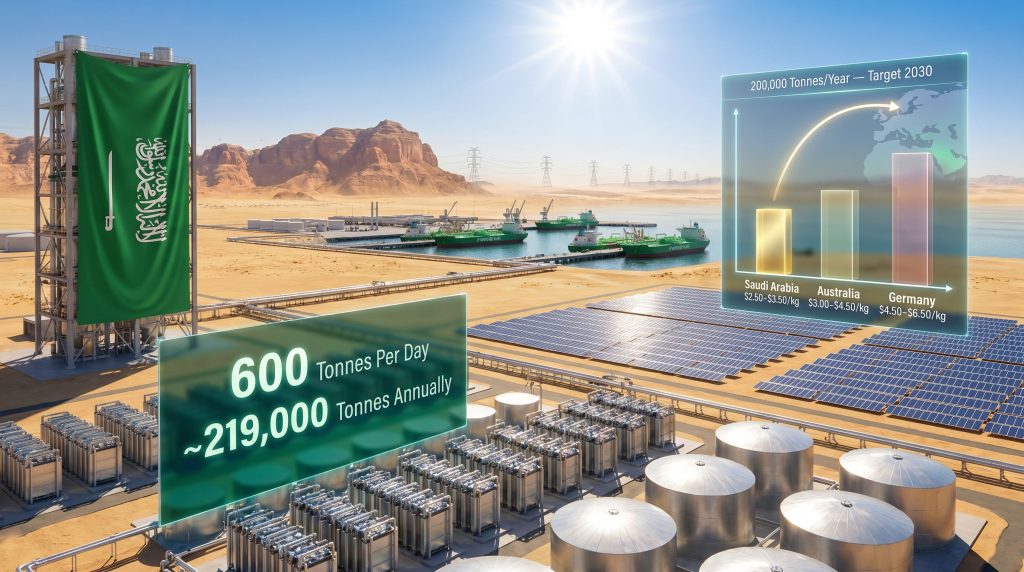
The production foundation underpinning the mandate centres on the NEOM Green Hydrogen Company, a joint venture between ACWA Power, NEOM, and Air Products. The facility, located in the NEOM giga-project zone in northwestern Saudi Arabia, is designed to produce up to 600 tonnes of carbon-free hydrogen per day, which translates to approximately 219,000 tonnes annually at full operational capacity.
As of mid-2026, construction is approximately 80% complete, with full commissioning targeted for 2027. At that scale, the facility would rank among the largest dedicated green hydrogen production installations globally at the point of its launch.
Why the 600 Tonnes Per Day Figure Deserves Scrutiny
Green hydrogen production costs are heavily influenced by scale. Electrolyser systems, which split water molecules using renewable electricity to produce hydrogen, benefit from substantial economies of scale in both capital expenditure and operational efficiency. At 600 tonnes per day, the NEOM facility is operating in a volume range where:
- Electrolyser procurement can leverage bulk supply agreements with manufacturers
- Renewable energy input contracts can be structured at grid-scale pricing rather than spot pricing
- Logistics infrastructure costs can be distributed across a sufficiently large output to reduce per-kilogram transport overhead
- Multiple simultaneous offtake agreements can be honoured without any single buyer representing a concentration risk
A detail that is not widely appreciated: green ammonia, the primary export form of the NEOM facility's output, requires approximately 0.18 tonnes of hydrogen per tonne of ammonia produced. At 600 tonnes of hydrogen per day, the facility's theoretical ammonia output capacity approaches 3,300 tonnes per day. This volumetric transformation is what makes ammonia the preferred carrier for maritime hydrogen transport, as it is liquid at moderate pressures and can be handled using infrastructure that partially overlaps with existing petrochemical logistics systems.
ACWA Power's Qualification: Execution Track Record Over Political Appointment
The selection of ACWA Power as the exclusive export vehicle reflects a history of demonstrated execution at scale rather than a purely administrative designation. The company has developed, financed, constructed, and operated major renewable energy and desalination infrastructure across the MENA region and internationally, providing it with capabilities across the full project lifecycle that are directly relevant to the mandate's requirements.
Key capability dimensions include:
- Project finance structuring for capital-intensive, long-duration infrastructure
- Renewable energy operations across utility-scale solar photovoltaic and wind assets
- Desalination integration, relevant given that green hydrogen production requires large volumes of ultra-pure water
- International partnership networks spanning European energy majors, sovereign wealth funds, and development finance institutions
- Offtake agreement negotiation for long-term energy supply contracts across multiple jurisdictions
The desalination dimension is worth highlighting specifically. Green hydrogen production requires deionised water as the electrolysis feedstock, and water scarcity in Saudi Arabia means that scaling hydrogen production is inseparable from scaling water treatment capacity. ACWA Power's existing expertise in large-scale desalination gives it a capability that pure-play renewable energy developers operating in water-abundant regions simply do not possess. In addition, the broader significance of mining and exploration licences across Saudi Arabia underscores how comprehensively the Kingdom is restructuring its resource export infrastructure.
Export Market Architecture: Europe First, Region Second
The commercial agreements underpinning the mandate reveal a clear geographic prioritisation. European industrial markets, driven by decarbonisation mandates under the EU Hydrogen Strategy and REPowerEU framework, represent the primary demand destination. Arab regional markets form a secondary but strategically important layer.
Key Agreements Already in Place
| Agreement | Partner | Volume or Target | Timeline |
|---|---|---|---|
| India-Middle East-Europe Economic Corridor MoU | Multiple European counterparties | Export pathway established | Signed July 2025 |
| Green Ammonia Corridor MoU | EnBW Energie Baden-Württemberg AG | Export pathway to Germany | Signed February 2026 |
| Green Hydrogen Delivery Agreement | SEFE (Germany) | 200,000 tonnes/year | Target delivery by 2030 |
The agreement with SEFE is particularly significant from a market structure perspective. SEFE, formerly a subsidiary of Gazprom Germania, was restructured under German state oversight following Russia's invasion of Ukraine and has since become a central vehicle for Germany's energy security diversification strategy. A commitment of 200,000 tonnes of green hydrogen per year by 2030 from Saudi Arabia represents a meaningful component of Germany's import-dependent hydrogen supply strategy.
The IMEC Corridor as Infrastructure Logic
The India-Middle East-Europe Economic Corridor provides the physical trade infrastructure context for these agreements. While the corridor's primary media attention has focused on its implications for container shipping and digital connectivity, its energy dimension is equally consequential. Saudi Arabia's geographic position at the corridor's midpoint creates a structural logistics advantage over competing exporters such as Australia, Chile, and Namibia, all of whom face significantly longer shipping routes to European terminals.
Saudi Arabia's renewable resource endowment combined with its geographic proximity to European demand centres via the IMEC corridor gives it a structural cost advantage that few other potential green hydrogen exporters can replicate.
How Saudi Arabia's Cost Position Stacks Up Globally
Green hydrogen production economics are primarily determined by the cost of renewable electricity, which accounts for roughly 70-80% of total production cost in electrolytic systems. Saudi Arabia's solar irradiance levels, among the highest recorded globally, enable renewable electricity generation at levelised costs that consistently benchmark below most competing regions. This resonates with the wider conversation around critical minerals and the energy transition, where resource endowment is increasingly reshaping geopolitical influence.
Indicative green hydrogen production cost projections (2026):
| Production Region | Estimated Cost Range (USD/kg) |
|---|---|
| Saudi Arabia | $2.50 – $3.50 |
| Morocco | $2.60 – $3.80 |
| Chile | $2.80 – $4.00 |
| Australia | $3.00 – $4.50 |
| Germany (domestic) | $4.50 – $6.50 |
Disclaimer: These figures are indicative estimates based on publicly available industry modelling and technology cost assumptions. Actual production costs will vary based on electrolyser procurement, financing terms, water treatment costs, and renewable energy contract pricing. These figures should not be relied upon as investment advice.
A dimension often absent from green hydrogen cost comparisons is the water treatment premium applicable in arid production environments. Unlike Chilean or Australian producers who can access fresh water at relatively low cost, Saudi producers must factor in desalination costs as a direct input to hydrogen production economics. This partially offsets the solar irradiance advantage, though at current desalination technology costs the net competitive position remains favourable.
The next major ASX story will hit our subscribers first
Risks That the Mandate Does Not Eliminate
The strategic logic of the ACWA Saudi green hydrogen export mandate is coherent, but coherent strategy and successful execution are not the same thing. Several material risks remain that neither the mandate's scope nor ACWA Power's track record can fully mitigate.
Supply Chain and Technology Risks
- Electrolyser manufacturing bottlenecks: Global demand for large-scale electrolysers has consistently outpaced production capacity. Lead times for utility-scale systems can extend to two to three years, creating schedule risk for facilities targeting 2027 commissioning
- Water-energy nexus constraints: Scaling hydrogen production in a water-scarce environment requires parallel scaling of desalination capacity, introducing a secondary infrastructure dependency
- Ammonia cracking infrastructure: European buyers receiving green ammonia must convert it back to hydrogen at the destination port. Ammonia cracking at commercial scale remains an emerging technology, and the absence of sufficient cracking infrastructure in European ports represents a genuine bottleneck to full supply chain activation
Commercial and Regulatory Risks
- The EU's renewable hydrogen import certification framework, including rules on additionality and temporal matching of renewable electricity, is still being refined. These rules will determine whether Saudi-produced hydrogen qualifies for the premium pricing that European industrial buyers and fuel cell operators are prepared to pay
- Carbon border adjustment mechanisms under development in the EU could affect the economics of green ammonia imports depending on how shipping emissions are accounted for
- Competition from Morocco, Namibia, and Australia is intensifying, and each of these nations is pursuing sovereign-level hydrogen export strategies that could compete with Saudi Arabia for the same European offtake agreements. For instance, green hydrogen in South Africa is gaining EU backing as an alternative supply source, further diversifying the competitive landscape
The Yanbu Node: A Multi-Site Export Architecture
Beyond the NEOM facility, the Green Ammonia Corridor agreement with EnBW references the Yanbu green hydrogen hub as a complementary production site. This detail suggests that Saudi Arabia's green hydrogen export strategy is being designed around a multi-node production architecture rather than a single flagship facility.
Yanbu's location on the Red Sea coast provides direct maritime access to the Suez Canal route, which is the primary shipping corridor for energy commodities moving between the Gulf region and European ports. A Yanbu-based production hub would therefore reduce reliance on overland transport from NEOM to port facilities and could offer logistics cost advantages for certain European destination markets. Consequently, this aligns with the evolving debate around critical raw materials and the green transition, where infrastructure positioning is becoming as important as resource availability.
What This Means for the Broader Clean Energy Trade Order
The institutional structure being constructed around the ACWA Saudi green hydrogen export mandate is not simply a commercial arrangement. It is an attempt to replicate, in the clean energy domain, the institutional architecture that gave Gulf states durable market power in the fossil fuel era.
The parallels are instructive:
- Exclusive national export mandates mirror the role that national oil companies played in controlling hydrocarbon supply flows
- Long-term offtake agreements replicate the supply security logic of LNG contracts, which locked in trade relationships for 20 to 25 years
- Investment in multi-site production infrastructure and export corridor development echoes the pipeline and terminal investments that created irreversible dependencies in fossil fuel importing nations
The nation that succeeds in becoming the default counterparty for green hydrogen imports in European and Asian industrial supply chains may hold a position of structural energy influence that persists well beyond the transition decade.
However, whether Saudi Arabia can successfully occupy that position depends on execution quality, technology cost evolution, and the regulatory frameworks that European importers ultimately adopt. The exclusive green hydrogen export rights granted to ACWA Power suggest the ambition is not merely to participate in the clean energy market. It is to help define its rules.
Disclaimer: This article contains forward-looking statements, indicative cost projections, and analysis of policy frameworks that are subject to change. Nothing in this article constitutes financial or investment advice. Readers should conduct independent research and consult qualified advisers before making any investment decisions related to companies or sectors discussed herein.
Want to Track the ASX Discoveries Driving the Energy Transition?
Discovery Alert's proprietary Discovery IQ model delivers real-time alerts on significant ASX mineral discoveries — including the critical minerals and clean energy resources reshaping global trade — ensuring subscribers can identify actionable opportunities ahead of the broader market. Explore historic discovery returns on Discovery Alert's discoveries page and begin your 14-day free trial today to position yourself at the forefront of the next major find.