July 13, 2026
The Hidden Geography of Aluminium: Why One Shipping Lane Holds a Global Industry Hostage
Most commodity markets distribute their production risk across multiple geographies, building natural resilience into their supply architecture. Aluminium, however, has developed a structural concentration in the Middle East over the past two decades that leaves the global packaging industry surprisingly exposed to a single geopolitical fault line. Understanding the Middle East conflict impact on aluminium packaging supply chains requires looking beyond spot prices and into the underlying logistics of how primary metal actually moves around the world.
This is no longer a theoretical risk scenario. It has become an active stress test of assumptions that the industry built its sourcing strategies around during a period of relative regional stability. Furthermore, the breadth of downstream consequences — from beverage cans to foil laminates and flexible packaging — underscores just how deeply embedded Gulf region metal has become in modern consumer economies.
When big ASX news breaks, our subscribers know first
How the Gulf Became a Global Aluminium Powerhouse
The transformation of the Middle East into a dominant aluminium producing region was driven by a clear industrial logic: abundant, low-cost energy in the form of natural gas, combined with strategic sovereign investment in smelting infrastructure, created internationally competitive production costs. Countries like the UAE, Bahrain, and Saudi Arabia leveraged hydrocarbon revenues to build world-scale smelting operations that could undercut producers reliant on more expensive energy grids.
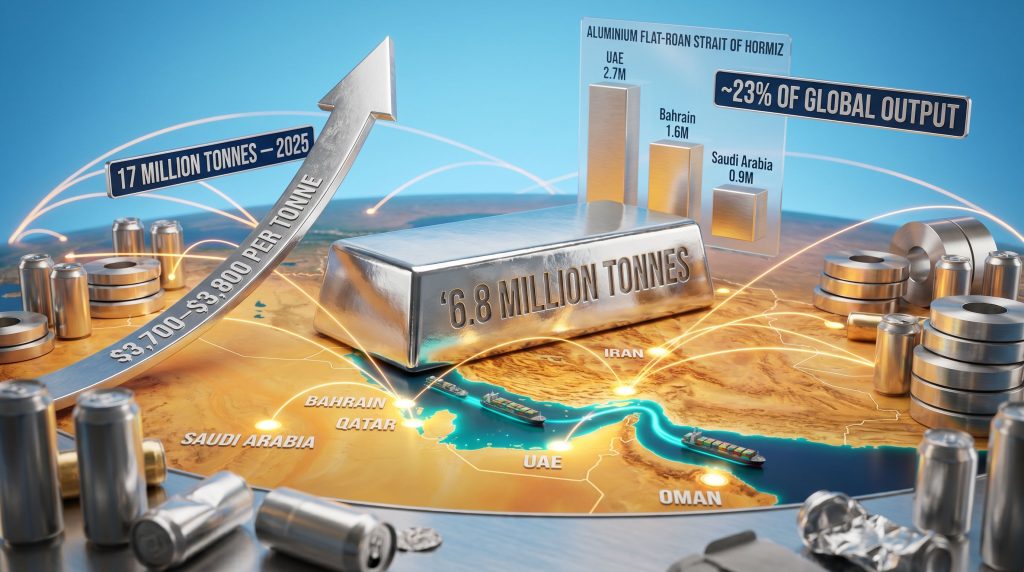
The result is a regional production footprint that now accounts for approximately 6.8 million tonnes of annual aluminium output, representing 23% of total global production. This is not marginal capacity. It is a structural pillar of the global primary aluminium market, and its concentration creates a single-point-of-failure risk that the industry has historically underweighted. Consequently, even partial disruptions to this output carry outsized consequences for every downstream sector.
The regional breakdown of this production reveals just how concentrated the output actually is:
| Country | Annual Output (Million Tonnes) | Share of Regional Output | Share of Global Output |
|---|---|---|---|
| UAE | 2.7 | 39% | ~9% |
| Bahrain | 1.6 | 24% | ~5.5% |
| Saudi Arabia | 0.9 | 13% | ~3% |
| Qatar | 0.7 | 10% | ~2.4% |
| Iran | 0.6 | 9% | ~2% |
| Oman | 0.4 | 6% | ~1.4% |
| Total | 6.8 | 100% | ~23% |
Critically, the region does not consume the bulk of what it produces. Approximately 80 to 85% of regional output is exported, equating to roughly 5.3 million tonnes per year flowing outward to manufacturing hubs across Asia, Europe, and the Americas. This export dependency means that any disruption to outbound shipping has an immediate and amplified effect on downstream consumers in markets thousands of kilometres away.
The Strait of Hormuz: A Chokepoint the Industry Cannot Afford to Ignore
The Strait of Hormuz is a maritime corridor approximately 33 kilometres wide at its narrowest navigable point. Virtually all seaborne exports from Gulf aluminium producers must transit this waterway before reaching international shipping lanes. The strait's strategic importance to energy markets is well documented, but its role as a critical aluminium logistics corridor is far less appreciated by most market participants.
What makes the Hormuz risk particularly insidious for the packaging sector is that it creates disruption without requiring any direct damage to smelting infrastructure. When conflict escalates, shipping insurers respond by dramatically increasing war risk premiums on vessels transiting the region. Carriers begin rerouting or declining certain cargoes altogether, and port congestion develops as operational uncertainty causes scheduling delays. Indeed, instability in the Middle East has already demonstrated its capacity to rattle global commodity logistics in ways that extend well beyond energy markets.
The effect of shipping disruption in a conflict zone functions identically to a smelter curtailment in terms of downstream impact. Finished primary metal and alumina inputs that feed the smelters themselves become stranded simultaneously, compounding the supply shock at both ends of the production chain.
Freight cost escalation during conflict periods is not merely an inconvenience. For aluminium, where the metal itself trades at a base price supplemented by regional delivery premiums, surging logistics costs translate directly into landed cost inflation for every packaging converter in the importing country. The hidden cost multiplier embedded in insurance premium surges and freight rate spikes can add hundreds of dollars per tonne to the effective input cost before a single kilogram of finished packaging is produced.
Quantifying the Supply Risk: A 3 to 3.5 Million Tonne Gap Against Sector Demand
How Large Is the Potential Shortfall?
The aluminium packaging sector consumed approximately 16.70 million tonnes in 2025, with projections pointing toward 17.16 million tonnes in 2026. Flat rolled products, including aluminium sheet used in beverage cans and foil used in flexible packaging and pharmaceutical applications, represent the primary end-use category driving this demand trajectory.
Global aluminium flat rolled product consumption by the packaging sector is projected at approximately 17 million tonnes in 2025, rising to 17.5 million tonnes in 2026. Against this backdrop, the potential supply disruption from sustained Middle East conflict is estimated at 3 to 3.5 million tonnes, representing a gap equivalent to more than 20% of the sector's total annual demand.
This is not a rounding error or a manageable shortfall that can be absorbed through inventory drawdowns and minor logistics adjustments. A disruption of this magnitude would require structural responses across the entire value chain, from sourcing strategy redesign through to potential product format changes at the consumer goods level. Furthermore, the aluminium tariff impact already weighing on global markets means that manufacturers enter this crisis period with reduced financial headroom.
Value-added flat rolled products face disproportionate exposure compared to commodity-grade primary metal because their production requires consistent, specification-grade feedstock. Packaging foil, in particular, demands very tight alloy chemistry tolerances that cannot simply be substituted with whatever metal happens to be available from alternative origins at short notice.
Regional Vulnerability: Which Packaging Hubs Face the Greatest Pressure?
The Middle East conflict impact on aluminium packaging supply chains does not distribute evenly across geographies. Each major producing region carries its own combination of import dependency, alternative sourcing options, and structural resilience.
United States
The United States carries approximately a 21% import dependency on foreign primary aluminium to supplement domestic production. Gulf region metal forms a meaningful component of this import mix. When Gulf supply tightens, the immediate domestic signal appears in the Midwest Premium, which represents the above-LME delivery cost for physical aluminium in the US market. The introduction of US aluminum tariffs has further complicated the sourcing landscape, adding an additional layer of cost pressure to an already strained supply picture.
- Midwest Premium dynamics transmit Gulf disruptions directly into domestic cost structures
- Can manufacturers operating on per-unit margins measured in fractions of a cent face disproportionate exposure to input cost volatility
- The domestic scrap recycling infrastructure provides a partial buffer, but secondary metal supply cannot be scaled rapidly enough to fully offset a multi-million tonne primary supply shock
Europe
European aluminium converters face approximately 20% import exposure to non-domestic primary metal sources, with Middle Eastern producers forming part of that supply mix. What makes Europe's position particularly complex is the compounding effect of energy cost pressures on domestic smelting capacity. European primary aluminium production has been structurally weakened by high electricity costs, meaning alternative supply corridors from non-Gulf sources must absorb demand that domestic smelters can no longer economically service.
Asia
Asian flat rolled product manufacturers occupy a complex position within this disruption scenario. Many of the largest FRP producers in Asia source primary aluminium through a combination of domestic Chinese production, regional suppliers, and Gulf imports. India presents an interesting dual dynamic, functioning simultaneously as a growing consumer of primary aluminium and as an emerging alternative supplier to global markets. East Asian producers exploring supply rerouting options face meaningful cost penalties as longer shipping distances from alternative origins add freight time and expense.
Brazil
Brazil's exposure operates primarily through pricing transmission rather than direct supply dependency. Domestic and regional South American sourcing provides a degree of insulation from physical Gulf shortages. However, LME aluminium price escalation driven by global supply tightness transmits cost pressure to every market participant regardless of their direct sourcing geography. Additionally, any reorientation toward Asian alternative suppliers introduces extended freight timelines that create operational planning challenges for Brazilian packaging manufacturers.
Price Trajectory and Value Chain Stress
Under sustained conflict conditions, industry analysis points toward aluminium prices potentially reaching $3,700 to $3,800 per tonne, a level that would represent a material escalation from recent trading ranges and create significant margin compression across the packaging value chain.
Price escalation at the LME level is only the first layer of cost impact. Regional delivery premiums, war risk insurance surcharges, and extended freight costs layer additional inflation onto the landed cost of metal for packaging converters in every importing country.
The distribution of this cost burden across the value chain is not uniform. In addition, different participants have very different capacities to absorb or pass through price increases:
| Value Chain Participant | Cost Exposure | Likely Response |
|---|---|---|
| Primary Smelters (Gulf Region) | Operational disruption, logistics constraints | Production curtailment, force majeure |
| Flat Rolled Product Manufacturers | Rising feedstock costs, supply shortages | Surcharge implementation, allocation |
| Can Makers and Packaging Converters | Input cost inflation, reduced availability | Contract renegotiation, material substitution |
| Bottlers and Beverage Brands | Packaging cost increases | Repricing, format switching |
| End Consumers | Potential retail price increases | Demand elasticity response |
Thin-margin packaging converters, sitting between metal suppliers and major consumer goods brands, are the most financially exposed segment. They typically operate under fixed or semi-fixed pricing agreements with brand customers while facing spot or near-spot exposure on their input costs. A rapid escalation in aluminium prices creates a timing mismatch that can be existentially damaging for smaller operators without hedging programmes or pricing escalation clauses.
The next major ASX story will hit our subscribers first
Material Substitution: Relief Valve or False Comfort?
When primary aluminium supply tightens, the immediate question for packaging manufacturers is whether alternative materials can fill the gap. The answer is more complicated than a simple yes or no. End-user sectors worldwide are already grappling with the present aluminium chaos, and each substitution pathway carries its own limitations.
PET plastic is the most commonly cited substitution pathway in beverage packaging. Certain product categories can transition relatively smoothly between aluminium cans and PET bottles, and some bottlers have maintained dual-format capability specifically to manage supply volatility. However, large-scale format switching requires production line requalification, retailer acceptance of different SKU presentations, and consumer communication — none of which can be accomplished quickly.
Scrap aluminium and secondary metal represent a more immediately accessible bridge supply option. Secondary aluminium production does not rely on Gulf region primary metal, and recycling infrastructure in the US and Europe holds meaningful spare capacity. The limitation is compositional: packaging-grade alloys require precise chemistry that is harder to consistently achieve from scrap-based production at scale, particularly for thin-gauge foil applications.
Steel also enters substitution discussions in certain packaging formats, though the steel substitution outlook suggests that steel's own market dynamics and cost pressures limit its viability as a straightforward drop-in replacement.
While substitution pathways exist, each carries its own cost, regulatory, and sustainability trade-offs. Many large packaging manufacturers have made binding public commitments to aluminium's circularity credentials as part of their ESG frameworks. Switching to PET, even temporarily, creates tension with those commitments and may trigger scrutiny from sustainability-focused investors and customers.
How Manufacturers Are Responding and What Comes Next
Major packaging manufacturers are responding to the supply shock risk through a combination of inventory building, contract restructuring, and accelerated geographic diversification of their primary metal sourcing. Force majeure clauses in long-term supply agreements are receiving renewed legal scrutiny as both buyers and sellers seek clarity on their obligations under sustained disruption scenarios.
The longer-term structural implications extend beyond the immediate crisis. A sustained period of Gulf supply disruption would almost certainly accelerate investment in smelting capacity outside the region, particularly in locations combining low-cost renewable energy with proximity to major consuming markets. This dynamic could reshape the global aluminium supply architecture in ways that persist well beyond any eventual resolution of the current conflict.
Furthermore, among the top aluminium producers, strategic responses are already diverging, with some accelerating capacity expansions outside the Gulf corridor while others deepen hedging programmes and long-term offtake agreements to secure supply certainty. Similarly, the Alcoa aluminum market downgrade has reinforced the sense that the broader industry is navigating a period of fundamental uncertainty that extends well beyond any single geopolitical trigger.
Strategic aluminium reserves, analogous to strategic petroleum reserves maintained by energy-importing nations, are also likely to enter policy discussions in packaging-intensive economies. The concept of holding physical buffer stocks of primary metal or flat rolled product to absorb short-term supply shocks has historically been considered unnecessary. That assumption is now being actively reassessed.
Frequently Asked Questions: Aluminium Packaging and Middle East Supply Disruption
How does the Middle East conflict directly affect aluminium packaging availability?
Gulf region producers supply approximately 23% of global primary aluminium. When conflict disrupts shipping through the Strait of Hormuz, the physical metal cannot reach packaging converters in Asia, Europe, and the Americas, creating shortages that translate into reduced production capacity and higher prices throughout the packaging value chain.
Which countries face the greatest risk of packaging shortages from Gulf disruptions?
The United States, with approximately 21% import dependency, and Europe, with around 20% exposure, face the most acute near-term vulnerability. Asian processing hubs that rely on Gulf feedstock for FRP production are also significantly exposed.
Will aluminium beverage cans become more expensive?
Under sustained disruption conditions, with prices potentially reaching $3,700 to $3,800 per tonne, cost increases at the converter level are likely to flow through to consumer goods pricing, though the timing and extent of pass-through will vary by market and product category.
What alternative materials can packaging manufacturers use?
PET plastic, secondary aluminium from scrap, and in some applications steel, represent the primary substitution pathways. Each carries cost, quality, and sustainability trade-offs that limit their usefulness as complete solutions.
How long could disruptions last, and what triggers recovery?
Duration depends entirely on the geopolitical trajectory of the conflict. Market recovery would be triggered by a return to stable shipping conditions through the Strait of Hormuz, though freight and insurance cost normalisation typically lags the resolution of physical conflict by weeks to months.
Is the packaging sector more vulnerable than other aluminium end-use segments?
Yes, for two reasons. First, packaging flat rolled products require specification-grade feedstock that cannot easily be substituted with off-grade metal. Second, the packaging sector's volume scale — consuming over 16 million tonnes annually — means even modest percentage disruptions create enormous absolute shortfalls.
Key Takeaways for the Aluminium Packaging Industry
- A potential supply gap of 3 to 3.5 million tonnes against sector consumption of 16.70 to 17.16 million tonnes annually represents a structural threat capable of disrupting production across multiple continents
- Price escalation toward $3,700 to $3,800 per tonne under sustained conflict conditions will compress converter margins unless contractual mechanisms allow cost pass-through to brand customers
- The Strait of Hormuz functions as a single-point-of-failure in the global aluminium logistics network that the industry has systematically underpriced in its supply chain resilience planning
- Regional vulnerability is uneven, with the US and Europe carrying the most acute direct import exposure, while Brazil and parts of Asia face more indirect but still meaningful price transmission risk
- Material substitution offers partial relief at best, with each alternative pathway constrained by technical, regulatory, and sustainability considerations that prevent rapid scale-up
- Long-term structural responses, including supply chain diversification away from Gulf dependence, exploration of strategic buffer stocks, and redesigned long-term supply contracts with explicit disruption provisions, are likely to reshape how the global packaging industry sources primary aluminium for years to come
This article contains forward-looking assessments and price projections based on industry analysis available at the time of writing. Commodity markets are inherently unpredictable, and actual outcomes may differ materially from scenarios described. Readers should not rely on this content as financial or investment advice.
For further industry data and reporting on aluminium supply chain dynamics and global flat rolled product markets, AL Circle provides ongoing coverage across the full aluminium value chain at alcircle.com.
Want to Track ASX Mineral Discoveries Before the Broader Market Reacts?
Supply chain shocks like the Middle East's grip on global aluminium illustrate precisely why identifying resource opportunities early carries such significant value — Discovery Alert's proprietary Discovery IQ model delivers real-time alerts on significant ASX mineral discoveries, turning complex commodity data into actionable insights for both short-term traders and long-term investors. Explore historic examples of major mineral discoveries and their market returns, then begin your 14-day free trial to position yourself ahead of the next major market-moving announcement.