
June 5, 2026
How Commodity Benchmarks Get It Right: The Mechanics Behind Aluminium Premium Price Corrections
In physical commodity markets, the reliability of a price signal is only as strong as the accuracy of the information supporting it. Traders, procurement managers, and contract negotiators do not simply use a published number in isolation; they read the accompanying rationale to understand what that number means. When the rationale contains an error, even one that leaves the numerical price untouched, the consequences ripple through cost models, procurement decisions, and market sentiment in ways that are rarely visible from the outside.
This is precisely why the correction issued by Fastmarkets to the rationale of its MB-AL-0346 aluminium P1020 premium in-whs dup Rotterdam benchmark deserves more analytical attention than a routine administrative notice might suggest. Furthermore, understanding what drove the correction helps market participants engage more confidently with benchmark assessments going forward.
When big ASX news breaks, our subscribers know first
What the Rotterdam Aluminium P1020 In-Whs Dup Benchmark Actually Measures
Before dissecting what changed and why it matters, it is worth establishing a clear understanding of what this benchmark represents in the first place.
The aluminium P1020 premium, in-whs dup Rotterdam tracks the additional cost, expressed in USD per tonne, that buyers must pay above the London Metal Exchange cash price to acquire primary aluminium stored in Rotterdam warehouses on a duty-unpaid basis. The "P1020" or "P1020A" designation refers to the internationally recognised purity grade for primary aluminium, requiring a minimum aluminium content of 99.7%. This grade forms the foundational input across a vast range of manufacturing sectors, from automotive body panels to aerospace structures and beverage packaging.
The "in-whs dup" structure is commercially specific. It means:
- The metal is physically held inside a Rotterdam warehouse facility
- Import duties have not yet been settled by the selling party
- The buyer assumes responsibility for customs clearance costs upon taking ownership
This contrasts with a duty-paid (DP) premium, where customs costs are already embedded in the quoted price, making DP premiums more directly applicable for European end-users who have already cleared the metal through customs. The duty-unpaid structure, by contrast, is heavily utilised by traders managing bonded inventory, cross-border arbitrage positions, and flexible delivery strategies across multiple European destinations.
Rotterdam functions as the primary European hub for physical aluminium delivery and premium discovery because of its unmatched port infrastructure, deep liquidity in LME-approved warehouse capacity, and its role as the natural entry point for aluminium imported from the Middle East, North Africa, North America, and historically Russia.
Anatomy of the Correction: What Changed and What Did Not
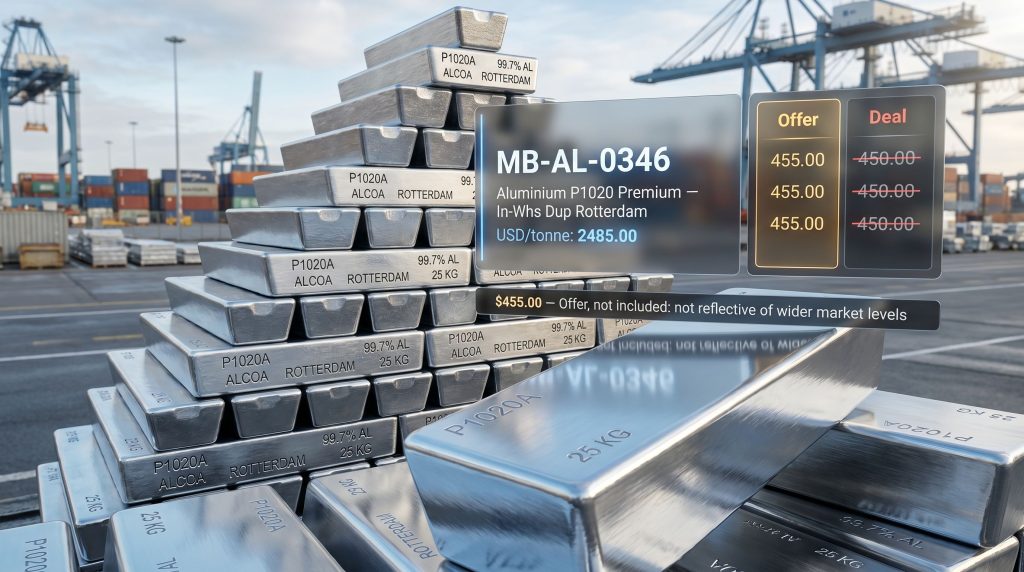
The correction issued by Fastmarkets on June 4, 2026, addressed a reporter error in the published rationale and trade log for MB-AL-0346. The published numerical price itself remained entirely unaffected. What changed was the description of a specific data point that had been referenced in the written assessment rationale.
The original rationale had described the excluded data point as a deal at $455.00 for large tonnage, positioned below the assessed benchmark range. The corrected version reclassified this as an offer at $455.00 for large tonnage, excluded on the basis that it was not considered reflective of broader prevailing market conditions.
| Element | Erroneous Version | Corrected Version |
|---|---|---|
| Rationale language | One deal below the assessed range was not included | One offer below the assessed range was not included |
| Trade log entry | Deal at $455.00 for large tonnage | Offer at $455.00 for large tonnage |
| Published benchmark price | Unaffected | Unaffected |
At first glance, swapping the word "deal" for "offer" may appear trivial. In physical commodity markets, however, these two terms carry fundamentally different commercial and analytical weight. Indeed, this distinction is precisely why the aluminium P1020 premium in-whs dup Rotterdam correction warrants careful scrutiny from any participant relying on published rationales.
Why the Deal vs. Offer Distinction Carries Real Market Weight
Price reporting agencies do not treat all incoming data equally. The methodology governing benchmark assessments operates on a hierarchy of evidential reliability:
- Completed transactions (deals) represent actual buyer-seller agreements at specific prices and carry the highest evidential weight in benchmark construction
- Firm bids and offers indicate willingness to transact at stated levels but lack confirmation of a counterpart agreement
- Indicative levels represent directional market colour without formal commitment
When the original rationale described a deal at $455.00 below the assessed range, sophisticated market participants reading that notice would naturally interpret this as evidence that a completed transaction had occurred at a price beneath the benchmark window. That signal implies genuine downward pressure exists in the market, even if it was excluded as an outlier. The market inference is meaningful: someone actually traded below the assessed range.
An offer at $455.00, by contrast, simply means a seller expressed a willingness to transact at that level. No buyer accepted. No transaction cleared. The information content is categorically different. An offer below the range could reflect a seller under liquidity pressure, a volume-specific discount strategy, or simply a testing price that found no counterpart. It does not carry the same evidential weight as a consummated trade.
A misclassification between a deal and an offer in a price rationale is not merely a semantic error. It is the difference between a market signal that has been confirmed by both parties to a transaction and one that represents a single party's unaccepted aspiration.
Understanding Outlier Exclusion in PRA Benchmark Methodology
The fact that the $455.00 offer was excluded from the assessed range is itself instructive. Fastmarkets, like other major price reporting agencies, applies structured outlier exclusion methodology to prevent single anomalous data points from distorting the broader benchmark assessment.
Several conditions can lead to a data point being excluded:
- The price level sits outside the range supported by the majority of observed market activity
- The transaction involved non-standard lot sizes, with "large tonnage" deals frequently negotiated at volume discounts that deviate from standard market pricing
- The counterparties or conditions are not representative of typical arms-length market transactions
- The offer or bid is assessed as reflecting distress pricing rather than market consensus
The "large tonnage" qualifier attached to the $455.00 level is particularly relevant here. Volume-specific pricing in physical aluminium markets routinely diverges from standard lot pricing because large buyers carry meaningful negotiating leverage. A large-tonnage offer at a discount does not represent the price available to a typical buyer in the spot market. Including it in the assessed range would produce a benchmark that underrepresents the actual cost faced by the majority of market participants.
The Structural Drivers Behind the Rotterdam Aluminium Premium
Understanding why corrections to the aluminium P1020 premium in-whs dup Rotterdam matter requires appreciating the forces that drive this benchmark in the first place. These dynamics are also reflected in how aluminium premiums in Mexico and other regional markets respond to shifts in global supply and demand.
| Driver | Market Mechanism |
|---|---|
| LME warehouse inventory levels | Lower stocks tighten physical availability, lifting premiums |
| European industrial demand | Automotive and packaging output shapes physical buying appetite |
| Freight and logistics costs | Port congestion or shipping disruptions affect delivery economics |
| Import arbitrage flows | Reflects cost of bringing metal from non-EU origins into Rotterdam |
| EUR/USD currency dynamics | USD-denominated premiums interact with currency moves for European buyers |
| EU trade and CBAM policy | Carbon Border Adjustment Mechanism reshaping import cost structures |
One emerging structural consideration that market participants are increasingly watching is the phased implementation of the EU Carbon Border Adjustment Mechanism. Fastmarkets notably launched dedicated CBAM certificate price assessments on the same date as this correction notice, June 4, 2026, reflecting growing demand for carbon cost transparency in metals markets.
As CBAM matures, the embedded carbon cost of imported primary aluminium, which varies significantly depending on the energy mix of the producing country, could reshape the relationship between duty-unpaid and duty-paid premiums. Aluminium smelted using coal-intensive power grids, for instance, may attract materially higher CBAM costs than aluminium produced with hydroelectric power. This creates a new layer of complexity in how duty-unpaid premiums are interpreted and priced into contracts.
Furthermore, the broader context of US aluminium tariffs has added additional uncertainty to global premium structures, redirecting trade flows and placing further pressure on European benchmark discovery. The wider aluminum and steel tariff impact has similarly influenced how producers and traders position inventory across key hubs, including Rotterdam.
The next major ASX story will hit our subscribers first
How the Rotterdam Premium Compares to Other Global Benchmarks
| Benchmark | Location | Duty Structure | Primary Use Case |
|---|---|---|---|
| MB-AL-0346 (Rotterdam dup) | Rotterdam | Duty-Unpaid | European import trading, arbitrage |
| Rotterdam Duty-Paid Premium | Rotterdam | Duty-Paid | European end-user procurement |
| Midwest Premium (MWP) | United States | Duty-Paid | North American physical delivery |
| Japan CIF Premium | Japan | CIF basis | Asian import benchmarking |
The Rotterdam duty-unpaid premium occupies a unique position in this landscape because it reflects raw arbitrage economics before fiscal obligations are layered in. Traders comparing import economics across origins use the duty-unpaid premium as a cleaner signal of physical market tightness or oversupply. For further context, the LME aluminium premium duty-paid European contract specifications provide a useful counterpoint for understanding how duty-paid structures are formally defined alongside duty-unpaid assessments.
How to Read an Aluminium Premium Price Rationale Correctly
For procurement professionals, traders, and analysts who rely on these benchmarks, understanding how to interpret a Fastmarkets price rationale is a practical skill with direct commercial implications.
- Identify the assessed range to establish the published benchmark window for that session
- Review which transactions were included and whether they represent deals, firm bids, or offers
- Examine excluded data points and understand the stated methodology basis for exclusion
- Assess directional language carefully as terms like "unchanged," "firmed," and "softened" each carry distinct analytical meaning
- Note any volume qualifiers since large-tonnage pricing can diverge meaningfully from standard lot market levels
- Check for correction notices as subsequent amendments may have altered elements of the original rationale
Several language conventions in price rationales are frequently misread by less experienced market participants:
- The phrase not reflective of wider market levels does not invalidate a transaction; it means the data point was assessed as an outlier relative to the broader market consensus
- Large tonnage pricing represents a specific market segment, not the general spot market condition
- Unchanged is a factual price statement, while stable carries an implied trend assessment and should be read differently
How PRA Correction Frameworks Reinforce Benchmark Credibility
Are Corrections a Sign of Weakness?
A counterintuitive truth in benchmark governance is that a well-functioning correction framework is a sign of institutional strength, not weakness. Price reporting agencies operating under the IOSCO Principles for Financial Benchmarks are required to maintain transparent, auditable correction procedures that serve the interests of all market participants.
Fastmarkets publishes correction notices publicly, specifying precisely what changed, what remained unaffected, and how market participants can engage with the process. This public audit trail serves multiple functions:
- Regulatory transparency: Correction notices form part of the auditable record regulators can examine to verify methodology compliance
- Subscriber trust: Customers can independently verify whether corrections affected their contract pricing periods
- Market integrity: Transparent corrections prevent erroneous information from persisting in the market data record
Fastmarkets serves more than 14,000 global customers across metals, agriculture, and forest products markets. Its methodology documentation is publicly accessible, and its correction framework includes open channels for market participants to submit feedback, whether confidentially or on the record, through dedicated contact points.
Opaque pricing environments where errors go uncorrected are far more damaging to market confidence than transparent systems where corrections are issued promptly and explained clearly.
In addition, leading aluminium producers such as those tracked among the leading aluminium producers globally rely on benchmark integrity when negotiating long-term supply agreements tied to published premium assessments. Consequently, corrections like this one carry direct commercial implications across the supply chain. The Alcoa market outlook further illustrates how benchmark reliability influences equity valuations and investor confidence in the sector. For independent real-time pricing data, the Fastmarkets MB-AL-0346 price page provides a direct reference for current assessment levels.
Frequently Asked Questions on the MB-AL-0346 Correction
What exactly is the aluminium P1020 premium, in-whs dup Rotterdam?
It is Fastmarkets' benchmark for the physical premium paid to acquire P1020A grade primary aluminium stored in Rotterdam warehouses on a duty-unpaid basis, quoted in USD per tonne above the LME cash price.
Did the correction change the published aluminium premium price?
No. The numerical price assessment remained unchanged. Only the written rationale and trade log description were corrected, specifically reclassifying a data point from a deal to an offer.
Why does it matter whether $455.00 was a deal or an offer?
A deal confirms a completed transaction at that price. An offer reflects a seller's stated willingness only, with no confirmed buyer. The two convey entirely different market conditions to analysts and procurement teams benchmarking against the assessment.
Why was the $455.00 offer excluded from the assessed range?
It was assessed as not representative of broader prevailing market conditions. Its large-tonnage nature may also have indicated volume-specific pricing that diverges from standard lot market levels.
How can market participants engage with this correction?
Participants can contact Fastmarkets at pricing@fastmarkets.com or basemetals@fastmarkets.com using the subject line referencing the aluminium P1020 premium, in-whs Rotterdam. Feedback may be submitted confidentially or on the record.
Key Takeaways for Market Participants
- The aluminium P1020 premium in-whs dup Rotterdam correction addressed a rationale and trade log error, with the published benchmark price remaining fully unaffected
- The reclassification of a $455.00 data point from deal to offer carries material analytical significance even though no price changed
- Rotterdam's duty-unpaid premium is a critical reference benchmark for European aluminium import economics, arbitrage strategies, and contract pricing resets
- Emerging CBAM certificate pricing is beginning to interact with physical aluminium premium structures, potentially reshaping the gap between duty-unpaid and duty-paid benchmarks over time
- Transparent correction frameworks are a governance standard, not an admission of systematic unreliability, and are foundational to PRA credibility under internationally recognised benchmark principles
Readers seeking further context on commodity price assessment methodology and benchmark governance can consult the publicly available resources at Fastmarkets Methodology, which outlines the assessment standards applied across Fastmarkets' base metals price packages.
Want To Stay Ahead of Significant ASX Mineral Discoveries Before the Broader Market Moves?
Discovery Alert's proprietary Discovery IQ model delivers real-time alerts on high-potential ASX announcements across more than 30 commodities, turning complex data into clear, actionable insights for both traders and long-term investors — start your 14-day free trial today, or explore why historic mineral discoveries have the potential to generate extraordinary returns.