June 4, 2026
The Architecture of Scarcity: How Asia's Energy Vulnerabilities Are Reshaping Global Development Finance
Mineral supply chains have never been purely economic constructs. Throughout modern industrial history, the nations that controlled access to critical raw materials wielded disproportionate influence over the pace and direction of technological change. Today, that dynamic is intensifying at a speed that is forcing governments, multilateral institutions, and private investors to rethink the foundational assumptions of development finance. The World Bank and Japan energy security and critical minerals strategy announced in June 2026 is not simply a bilateral aid expansion. It represents a structural response to a set of converging pressures that have been building for decades and are now reaching an inflection point.
When big ASX news breaks, our subscribers know first
Three Compounding Risks Redefining Asia's Energy Landscape
Understanding why the RISE+ and DRIVE frameworks matter requires first understanding the layered vulnerabilities they are designed to address. Asia's energy challenge is not a single problem. It is the product of at least three reinforcing risk vectors operating simultaneously:
-
Supply concentration risk: A handful of nations control the majority of mining and processing capacity for the minerals that underpin clean energy technology. Rare earth supply chains, for example, remain heavily concentrated in China, which handles the overwhelming majority of global refining capacity across multiple critical mineral categories.
-
Transit chokepoint exposure: Approximately 80% of the crude oil passing through the Strait of Hormuz is destined for Asian markets, including China, India, and Japan. For Southeast Asian nations, roughly 55% of total crude oil imports originate from the Middle East, creating a structural dependency on a geopolitically volatile corridor that extends well beyond petroleum to liquefied natural gas, fertilisers, and industrial feedstocks.
-
The transition-investment paradox: Geopolitical instability strengthens the long-term case for renewable energy adoption while simultaneously introducing the short-term uncertainty that delays capital commitment to large-scale infrastructure. This self-reinforcing dynamic is precisely where multilateral development institutions are positioned to intervene.
Key Insight: Asia accounts for more than half of global electricity demand, with consumption growing at approximately 5% annually as of 2025, according to data from Ember. This means the region must build new clean capacity and replace fossil fuel infrastructure at the same time, amplifying demand for stable critical minerals and energy security exponentially.
What RISE+ Actually Does and Why the Design Matters
Most critical minerals programmes announced over the past decade have focused on one side of the value chain: either securing upstream extraction rights or funding downstream processing capacity in wealthy importing nations. The RISE+ facility takes a different approach by targeting the middle of the chain in developing economies, where the greatest structural inefficiencies and the most significant opportunities for economic transformation exist.
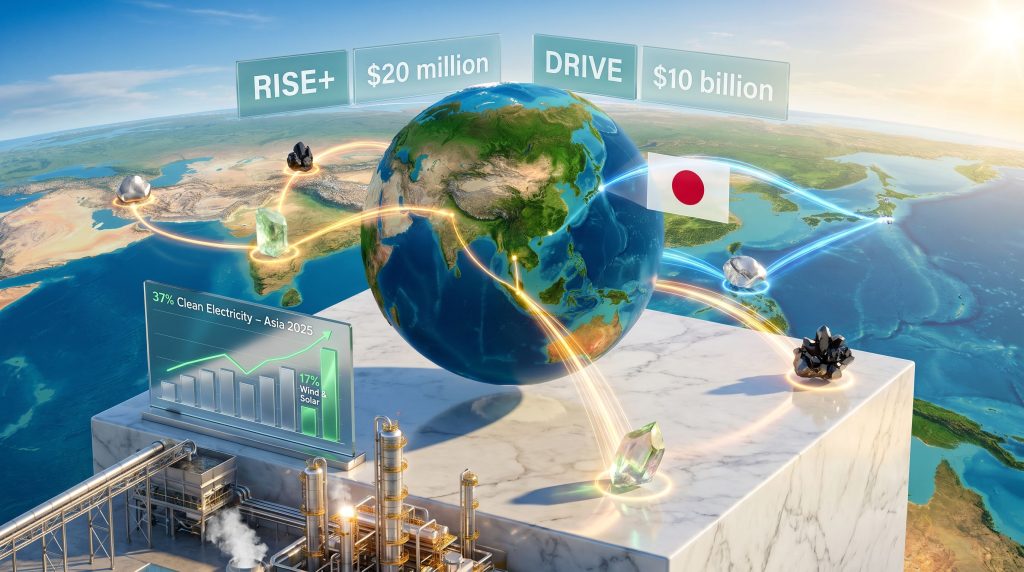
Established as a $20 million trust fund facility, RISE+ expands on the original RISE Partnership that Japan introduced during its G7 presidency in 2023. The programme's core architecture rests on four operational pillars:
-
Infrastructure co-investment to support downstream mineral processing capacity in resource-holding nations.
-
Coordination mechanisms to mobilise private-sector capital into markets where commercial investment alone would not flow at sufficient scale or pace.
-
Industrial decarbonisation support, reducing the embedded carbon in mineral supply chains to meet increasingly stringent Scope 3 procurement requirements in importing markets.
-
Energy access expansion in remote, resource-adjacent communities, creating economic inclusion alongside industrial development.
The Mineral Focus: Aligning Supply Investments With Clean Energy Demand
The specific minerals targeted by the RISE+ framework reflect the technology requirements of the energy transition rather than historical extraction patterns. Furthermore, critical minerals demand is set to accelerate significantly as the clean energy build-out intensifies across the region:
| Mineral | Primary Clean Energy Application | Concentration Risk Level |
|---|---|---|
| Lithium | EV batteries, grid-scale storage | High |
| Nickel | Battery cathodes, stainless steel | Moderate to High |
| Rare Earth Elements | Wind turbines, EV motors, electronics | Very High (China-dominant processing) |
| Cobalt | Battery chemistry | High (DRC-concentrated mining) |
A critical insight often overlooked in mainstream coverage is that supply concentration risk differs between the mining and processing stages of the value chain. A nation may hold significant rare earth ore deposits yet remain dependent on foreign processing capacity to convert that ore into commercially usable materials. RISE+ is specifically designed to close this gap by funding the industrial infrastructure that transforms raw mineral wealth into refined, market-ready output.
Decarbonisation as a Market Access Tool, Not Just a Climate Goal
One underappreciated dimension of RISE+ is its decarbonisation mandate. As importing nations in Japan, South Korea, and the European Union face growing regulatory pressure to account for supply-chain emissions through mechanisms like carbon border adjustment frameworks, the embedded carbon intensity of mineral exports is becoming a direct determinant of market access and pricing premiums.
A developing nation that processes minerals using fossil-fuel-powered infrastructure may find itself progressively priced out of premium markets even if its ore quality is competitive. RISE+ co-investments in cleaner processing infrastructure therefore serve a dual function: reducing emissions and improving the long-term commercial positioning of beneficiary nations in regulated import markets. This approach aligns closely with the broader critical raw materials strategy being advanced in other major importing blocs.
The DRIVE Framework: Engineering Resilience Across Interconnected Economies
While RISE+ addresses the supply side of the critical minerals challenge, the DRIVE framework (Dynamic Response for Invigorating Value Chains and Energy Security) targets a different but related vulnerability: the systemic fragility of energy supply chains serving smaller, import-dependent developing economies.
Traditional energy security instruments, primarily bilateral supply agreements and national fuel reserves, are designed to handle manageable, single-source disruptions. They perform poorly when disruptions are simultaneous, multi-source, and sustained, which is precisely the scenario that escalating Middle East instability presents. DRIVE is structured to address this higher-complexity threat environment through four distinct mechanisms:
-
Sovereign financing instruments structured to support government-level energy procurement during crisis conditions.
-
Private investment mobilisation channels designed to direct commercial capital into energy infrastructure in high-risk markets where developers would otherwise not operate.
-
Technical and policy advisory services that build institutional capacity within governments to manage supply-chain complexity at a professional standard.
-
Collective purchasing mechanisms that allow smaller economies to aggregate demand, improving their negotiating leverage and reducing per-unit procurement costs.
The Institutional Architecture Behind DRIVE
DRIVE operates as a complement to Japan's POWERR Asia initiative, a $10 billion programme addressing fuel shortages and supply disruptions across the Asia-Pacific region. The World Bank Group coordinates DRIVE implementation alongside two major Japanese development finance institutions:
-
Japan Bank for International Cooperation (JBIC): Provides sovereign and quasi-sovereign financing instruments capable of operating in markets too risky for commercial lenders.
-
Japan International Cooperation Agency (JICA): Delivers technical assistance, institutional capacity building, and policy advisory support to recipient governments.
This tripartite structure creates what development finance professionals describe as a blended finance architecture, combining concessional public capital, sovereign guarantees, and commercial investment within a single programmatic framework to de-risk participation for private sector actors.
Strategic Framing: DRIVE is not simply a humanitarian energy aid programme. It functions as a geopolitical hedging instrument, systematically reducing the leverage that dominant energy exporters can exercise over import-dependent developing economies during periods of supply stress.
Japan's Institutional Memory: Decades of Resource Strategy Made Multilateral
Japan's engagement with RISE+ and DRIVE is not improvised diplomacy. It reflects an institutional approach to resource security that has been refined over more than four decades of policy evolution.
Following the oil shocks of the 1970s, Japan developed one of the world's most sophisticated national resource risk management systems. The country has operated a rare-metals stockpiling programme since 1983, administered through government-private coordination mechanisms and later formalised under the Japan Organisation for Metals and Energy Security (JOGMEC). This programme maintains strategic reserves of critical minerals as insurance against supply disruptions, a capability that most other importing nations did not begin developing until the 2020s.
Japan's International Resource Strategy, updated in 2020, introduced explicit supply-chain diversification mandates and elevated critical minerals to the same national security priority level as energy supply. The 2023 G7 presidency then gave Japan the multilateral platform to convert these bilateral risk-management instincts into the globally coordinated architecture now embodied in RISE+.
| Japan Resource Policy Pillar | Operational Objective |
|---|---|
| Decarbonisation alignment | Secure minerals required for clean energy technology manufacturing |
| Energy security | Reduce structural import dependence on geopolitically concentrated suppliers |
| Economic competitiveness | Maintain industrial output through stable critical input costs |
| Geopolitical diversification | Build alternative supply corridors reducing China-linked processing dependency |
Japan's approach is distinctive because it integrates commercial, diplomatic, and development finance instruments into a single coherent national strategy. The Australia-Japan joint statement on critical minerals cooperation further illustrates how this bilateral model is being extended to trusted partner nations. The World Bank partnership, consequently, scales this proven model to a multilateral institutional level, potentially extending its logic to dozens of additional beneficiary and partner nations.
Asia's Clean Energy Progress and the Growth Paradox
Asia's energy transition has made measurable progress. According to Ember's 2025 regional data, clean electricity sources accounted for 37% of Asia's total power generation, rising from 34% the prior year. Wind and solar combined delivered 17% of regional electricity, marginally above the global average, and renewable sources now represent approximately one-third of Asia's total power mix.
However, these headline figures mask a structural complication that makes the World Bank and Japan energy security and critical minerals strategy more urgent, not less:
The Growth Paradox: Regional electricity demand expanded by approximately 5% in 2025, meaning that absolute fossil fuel consumption has not declined despite the growing renewable share. Asia must simultaneously build new clean capacity and replace existing fossil infrastructure, a dual investment requirement that translates directly into accelerating demand for energy transition mining capacity and critical mineral output.
Regional Transition Trajectories at a Glance
| Sub-Region | Transition Status | Primary Constraint |
|---|---|---|
| China | Advanced, solar and battery storage scaled rapidly | Export dependency on processed minerals |
| Southeast Asia (ASEAN) | Emerging, balancing development with rising demand | ~55% crude imports from Middle East |
| South Asia | Early-stage, energy access remains primary challenge | Infrastructure financing gaps |
| Japan and South Korea | Mature importers | Structural fossil fuel dependency, mineral import reliance |
The next major ASX story will hit our subscribers first
Benchmarking RISE+ and DRIVE Against Competing Frameworks
The World Bank and Japan partnership does not operate in isolation. Multiple overlapping frameworks are pursuing similar supply-chain resilience objectives, each with distinct institutional logic and financing mechanisms:
| Framework | Lead Institution | Primary Focus | Financing Scale |
|---|---|---|---|
| RISE+ | World Bank and Japan | Critical minerals supply chain development in developing economies | $20 million (trust fund) |
| POWERR Asia | Japan (bilateral) | Asia-Pacific energy resilience | $10 billion |
| Minerals Security Partnership (MSP) | US-led, G7 aligned | Supply chain diversification, China exposure reduction | Multi-billion (aggregate) |
| EU Critical Raw Materials Act | European Commission | Strategic stockpiling, domestic processing mandates | Regulatory plus financing |
| IEA Critical Minerals Initiative | International Energy Agency | Data coordination, market transparency | Advisory and analytical |
The RISE+/DRIVE model's distinguishing feature is its explicit focus on developing economy beneficiaries rather than on securing supply for wealthy importing nations. This creates a different political economy around the programmes and potentially greater long-term durability, as resource-holding nations have stronger incentives to participate actively when the framework delivers economic development benefits rather than simply extracting value to industrial importers.
What This Means for Resource-Rich Developing Nations
For governments holding significant critical mineral deposits, the current convergence of geopolitical demand for supply diversification and multilateral financing availability creates an unusual window for renegotiating the terms of resource development. Historically, resource-rich developing nations have exported the majority of economic value to processing and manufacturing hubs elsewhere. RISE+ is specifically designed to shift this equation.
Key strategic considerations for governments evaluating participation include:
-
Value-capture architecture: Ensuring domestic processing and manufacturing capacity is constructed alongside extraction, retaining a greater share of per-tonne export value domestically.
-
Infrastructure leverage: Using programme co-investment commitments to develop transport, energy, and logistics networks with broader economic utility beyond the mineral sector itself.
-
Carbon positioning: Investing in cleaner processing infrastructure to qualify for premium pricing in markets with active carbon border adjustment mechanisms, potentially achieving an estimated 2 to 3 times increase in per-tonne export value compared to unprocessed ore exports.
-
Workforce conditionality: Embedding skills-transfer and employment quality requirements into investment agreements to ensure industrial development creates durable local economic participation rather than enclave extraction.
Disclaimer: Projections regarding value uplift from downstream processing represent indicative analytical estimates based on general commodity economics and should not be treated as guaranteed financial outcomes. Actual results will vary significantly depending on mineral type, processing technology, market conditions, and policy environment.
The Forward Outlook: Critical Minerals as the Infrastructure of the Energy Transition
The RISE+/DRIVE partnership signals a structural evolution in how development finance institutions conceptualise their role in the global economy. Rather than funding discrete projects, they are increasingly designing systemic supply-chain architecture intended to function over decades rather than project cycles.
Three macro-level implications stand out for policy, investment, and industry stakeholders:
-
Geopolitical risk is now an explicit development finance design variable. Programmes like DRIVE are openly structured to reduce the leverage of concentrated energy suppliers over import-dependent economies, an objective that would have been diplomatically unusual for multilateral institutions to state openly even a decade ago.
-
Critical minerals are being treated as infrastructure. The investment logic applied to roads, ports, and power grids is being extended to mineral supply chains, with multilateral institutions providing the de-risking function that makes long-horizon private investment viable.
-
Blended finance is no longer experimental. The combination of sovereign, development, and private capital within a single programmatic framework has become the standard delivery mechanism for mobilising investment at the scale the clean energy transition requires.
As Asia's electricity demand continues expanding at approximately 5% annually and the region's clean energy share pushes toward 50%, the volume of critical minerals required will grow exponentially. The supply-chain architecture being constructed through programmes like RISE+ and DRIVE is therefore not supplementary to the energy transition. It is foundational infrastructure for the next two decades of regional and global economic development, and the World Bank and Japan energy security and critical minerals strategy is central to making that architecture a reality.
Want to Capitalise on the Critical Minerals Driving Asia's Energy Transition?
Discovery Alert's proprietary Discovery IQ model delivers real-time alerts on significant ASX mineral discoveries — including lithium, nickel, rare earths, and cobalt — instantly empowering subscribers to identify actionable opportunities ahead of the broader market. Explore historic discoveries and their market-moving returns, then begin your 14-day free trial to position yourself at the forefront of the next major find.