July 22, 2026
India's Energy Security Gamble: Why Venezuela Now Sits at the Centre of Asia's Crude Supply Rethink
Few structural vulnerabilities in modern energy economics are as stark as a major industrial economy sourcing nearly all of its crude oil from outside its borders. When the transit corridor serving that supply is physically disrupted, the consequences ripple through refinery schedules, fuel pricing, foreign exchange reserves, and political calculus simultaneously. That is precisely the scenario India confronted when the Strait of Hormuz, a narrow maritime passage historically carrying close to 40% of the country's oil supply flows, became inaccessible during the Iran conflict. The strategic response that followed has fundamentally altered how India thinks about crude procurement, and Venezuela oil exports to India have emerged as one of the most consequential elements of that recalibration.
When big ASX news breaks, our subscribers know first
Why India's Crude Import Strategy Is Undergoing a Structural Reset
The Hormuz Dependency Problem
India imports approximately 90% of the crude oil it consumes, a dependency ratio that places it in a structurally precarious position whenever Middle Eastern supply chains face disruption. For decades, the dominant logic of Indian crude procurement centred on price optimisation, with state-owned refiners and private sector players systematically sourcing the most competitively priced barrels available within established relationships. The Strait of Hormuz sat at the centre of this architecture, facilitating the transit of roughly four-in-ten barrels arriving at Indian ports.
When the Iran conflict triggered a closure of this chokepoint, the resulting supply shock forced a rapid reassessment of procurement priorities. The primary criterion shifted from price advantage to supply security, compelling India's energy planners to simultaneously pursue multiple alternative supply corridors that had previously been treated as secondary options. Furthermore, India's resource security strategy has extended well beyond crude oil, encompassing critical minerals and long-term supply partnerships across multiple continents.
India's Position in the Global Oil Demand Hierarchy
As the world's third-largest oil consumer, India's procurement decisions carry significant weight in global crude markets. The country's refinery infrastructure presents a particularly important technical dimension to this story. A substantial portion of India's refining capacity, particularly within the complex configuration at Reliance Industries' Jamnagar facility, is engineered to efficiently process heavy, high-sulphur crude grades.
This technical characteristic creates a natural alignment with non-Middle Eastern producers whose output tends toward heavier, more viscous crude streams that simpler refinery configurations struggle to process economically. The execution of India's diversification mandate has involved both state-owned enterprises and private sector participants, including Indian Oil Corporation, Bharat Petroleum, and Hindustan Petroleum.
What Venezuela's Oil Export Capacity Actually Looks Like in 2026
Venezuela's Production Recovery: From Collapse to Resurgence
Venezuela's crude export volumes have reached their highest level since 2018, representing a notable milestone in a production recovery trajectory that has been neither linear nor guaranteed. At its lowest point during the crisis years, Venezuela's national oil company PDVSA was producing well below 500,000 barrels per day, a collapse from a peak exceeding 3 million barrels per day in the late 1990s.
However, infrastructure constraints continue to act as a ceiling on Venezuela's recovery potential. Ageing pipeline networks, insufficient drilling rigs, chronic electricity supply shortfalls, and decades of underinvestment in upstream maintenance all combine to limit how rapidly production can scale. The gap between Venezuela's theoretical resource endowment and its actual deliverable production capacity remains vast.
The Sanctions Variable: How U.S. Policy Shifts Unlocked Indian Demand
The resumption of Venezuela oil exports to India in April 2026, following a roughly twelve-month hiatus, was directly enabled by Washington's easing of sanctions on the South American producer. Consequently, this policy adjustment created the legal and commercial conditions necessary for Indian refiners to engage with PDVSA without triggering secondary sanctions exposure. Understanding the U.S. policy on PDVSA is therefore essential context for interpreting the pace and scale of the trade recovery.
The conditional and reversible nature of this sanctions relief is the single most significant risk factor embedded in the India-Venezuela energy relationship. Any shift in U.S. executive policy could disrupt established supply flows with minimal notice, forcing Indian buyers to rapidly reallocate purchase volumes.
This uncertainty does not eliminate the commercial logic of engaging Venezuelan crude, but it does mean that Indian buyers are likely structuring purchase arrangements with built-in flexibility rather than committing to long-term take-or-pay contracts that would expose them to sanctions-related force majeure scenarios. In addition, oil trade geopolitics continue to evolve rapidly, adding further complexity to procurement planning across the broader Asian refinery complex.
Venezuela's Crude Quality Profile and Its Fit for Indian Refineries
The technical characteristics of Venezuelan crude are central to understanding why only a limited subset of global refinery configurations can efficiently process it. Venezuelan heavy grades typically exhibit API gravities in the 16° to 22° range, combined with high sulphur content and elevated viscosity, making them fundamentally different from the lighter, sweeter crude grades that dominate global trade benchmarks like Brent or WTI.
The table below compares Venezuelan crude against grades that Indian refiners regularly process:
| Crude Type | API Gravity | Sulphur Content | Primary Indian Buyers |
|---|---|---|---|
| Venezuelan Heavy | ~16–22° | High | Reliance, select PSU refiners |
| Arab Heavy (Saudi) | ~27° | High | IOC, BPCL, HPCL |
| Iranian Heavy | ~30° | Medium-High | Historically IOC, MRPL |
| Russian Urals | ~31° | Medium | IOC, Nayara Energy |
Indian refiners that have invested in coking units, hydrocrackers, and advanced desulfurisation equipment can process Venezuelan heavy crude at competitive economics despite its challenging physical properties. The discount applied to this grade relative to medium sour benchmarks partially compensates for the higher processing complexity, creating margin capture opportunities for technically equipped refiners that simpler facilities cannot access.
How Fast Are Venezuela Oil Exports to India Actually Growing?
Monthly Volume Progression: A Data-Driven Trajectory
The quantitative picture of Venezuela oil exports to India's growth trajectory reveals a trend that has accelerated sharply in 2026. Drawing on data compiled by Kpler and corroborated by independent tanker-tracking sources, the progression looks as follows:
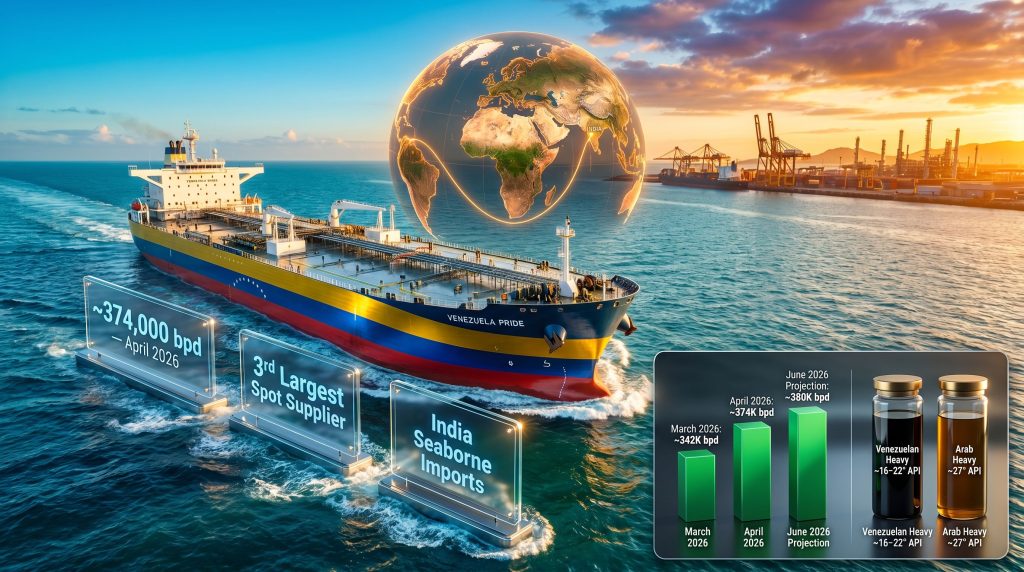
- March 2026: Approximately 342,000 barrels per day received by Indian buyers, establishing the pre-surge baseline
- April 2026: Volumes reaching approximately 374,000 barrels per day on some estimates, with Kpler's tanker-tracking methodology placing arrivals at approximately 283,000 bpd, reflecting differences in data methodology between providers
- June 2026: Kpler forward projections pointing toward approximately 380,000 bpd, a potential new post-2020 high
The convergence of multiple independent shipping data sources around the 280,000 to 380,000 bpd range for the April to June 2026 window suggests a genuine and sustained volume surge rather than an isolated spot purchase event. This distinction matters significantly for assessing whether the trend is structural or opportunistic.
The methodology differences between data providers are worth understanding. Tanker-tracking analytics firms use vessel AIS positioning data to estimate cargo arrivals, but variations in how partial cargoes, transhipment legs, and blending operations are categorised can produce materially different headline figures for the same underlying physical flows. The consistent directional signal across providers, however, points unambiguously toward a significant increase in Venezuelan crude reaching Indian ports. According to Reuters, Venezuela's overall export volumes have jumped to their highest level since 2018, driven largely by growing sales to the United States and India.
Venezuela's Ascent in India's Supplier Rankings
Perhaps the most striking data point in this analysis is Venezuela's emergence as the third-largest spot crude supplier to India in June 2026, according to statements by India's Ministry of External Affairs. This ranking would have been considered implausible eighteen months prior, when Venezuela was effectively absent from India's supplier mix due to sanctions restrictions.
The traditional hierarchy of India's crude supply had been dominated by Saudi Arabia, Iraq, the United Arab Emirates, and Russia. Venezuela's rapid ascent into the top three reflects not only the opportunistic capture of discounted barrels during a supply crisis, but also a deliberate strategic decision by Indian procurement teams to cultivate this supply corridor. Furthermore, global crude shipments have been restructuring broadly in 2025 and 2026 as buyers across Asia adjust their supplier relationships in response to evolving geopolitical conditions.
2024 Bilateral Trade as a Baseline Reference Point
India's 2024 crude petroleum imports from Venezuela were valued at approximately $1.76 billion, with crude constituting the dominant category in the bilateral trade relationship. Trading Economics data confirms that crude oil and petroleum bituminous minerals represent the overwhelming share of Venezuelan exports to India. Given the volume escalation observed through the first half of 2026, this figure is likely to expand materially as the year progresses. If June 2026 run rates are sustained, the annualised bilateral crude trade value could approach or exceed $2.5 billion, representing a meaningful expansion of the commercial relationship.
What Is Driving the India-Venezuela Energy Relationship Beyond Spot Purchases?
Diplomatic Architecture: The Modi-Rodriguez Summit
Acting Venezuelan President Delcy Rodriguez's June 2026 state visit to New Delhi, spanning June 3 through 7, represented a formal diplomatic inflection point in the bilateral relationship. The timing of the visit, occurring simultaneously with India's active supply crisis response, was significant. It demonstrated that both governments viewed the energy relationship as strategic rather than merely transactional.
India's Ministry of External Affairs characterised Venezuela explicitly as part of the country's energy security planning framework, with Rudrendra Tandon, secretary east in the Ministry, describing the relationship as offering structural complementarity that extends beyond opportunistic crude purchasing.
Beyond Crude: The Multi-Sector Investment Conversation
The agenda of the Modi-Rodriguez discussions extended well beyond crude supply arrangements. Preliminary conversations covered several distinct investment tracks:
- Pharmaceutical manufacturing: Potential Indian participation in Venezuela's pharmaceutical production sector, leveraging India's considerable generic drug industry expertise
- Critical minerals and mining: Investment interest in Venezuela's mineral resource endowment, which includes lithium deposits, gold, and coltan, a mineral used in electronics manufacturing
- Upstream energy participation: Broader discussions around Indian company involvement in Venezuela's oil and gas sector beyond simple crude purchasing arrangements
Significantly, no formal agreements were signed during the June visit. This distinction is important: diplomatic intent and commercial execution are two distinct processes in the India-Venezuela context, with the latter subject to the same sanctions uncertainty that governs crude purchasing decisions. For comparison, Chile's resource strategy offers a useful parallel in how South American nations are structuring their relationships with Asian industrial economies around critical resource endowments.
The Structural Complementarity Framework
The concept of structural complementarity between the two economies is worth examining in technical detail. India possesses significant surplus refinery capacity specifically configured for heavy crude processing, a capital-intensive specialisation that took decades to develop. Venezuela, however, possesses the world's largest proven reserves of precisely the heavy crude grades that this refinery infrastructure is optimised to process.
This alignment of technical capabilities and resource endowments creates an economic logic that transcends short-term price arbitrage. It suggests the foundation for a durable supply relationship, provided that sanctions risk can be managed and PDVSA's operational reliability remains sufficient to deliver contracted volumes consistently.
How Does the Venezuela Option Compare to India's Other Diversification Levers?
India's Post-Hormuz Supply Diversification Matrix
Understanding the relative positioning of Venezuela within India's broader diversification strategy requires examining multiple supplier options across several dimensions simultaneously:
| Supplier Region | Supply Reliability Risk | Price Competitiveness | Geopolitical Complexity | Volume Scalability |
|---|---|---|---|---|
| Venezuela | Medium (sanctions risk) | High (discounted crude) | Medium | Medium-High |
| Russia | Medium (secondary sanctions) | High (discounted crude) | High | High |
| West Africa (Nigeria, Angola) | Low-Medium | Medium | Low | Medium |
| North America (U.S., Canada) | Low | Medium | Low | High |
| Central Asia (Kazakhstan) | Low-Medium | Medium | Low-Medium | Medium |
This comparison reveals that Venezuela occupies a distinctive position in India's diversification portfolio: high price competitiveness combined with medium geopolitical complexity and constrained but growing volume scalability.
Why Venezuelan Crude Offers a Price Advantage That Matters
The economics of processing discounted heavy crude have been well understood by sophisticated refinery operators for decades. Venezuelan heavy grades trade at substantial discounts to medium sour benchmarks, reflecting their challenging physical characteristics and the commercial risk premium associated with sanctions exposure. For Indian refiners with the technical capability to process these grades, the discount represents a genuine margin capture opportunity.
The discount-to-complexity trade-off works as follows: lower feedstock acquisition costs partially offset the higher capital and operating costs associated with running cokers, hydrocrackers, and advanced desulfurisation units at elevated throughput rates. When the discount is sufficiently large, as is typically the case with sanctioned crude, the economics favour heavy crude processing even after accounting for the full complexity cost burden.
The Russian Crude Parallel: Lessons India Has Already Learned
India's rapid scaling of Russian crude imports following 2022 provides the most directly relevant precedent for understanding the Venezuela trajectory. In both cases, the initial barrier was sanctions exposure. In both cases, Indian refiners navigated the regulatory landscape to access heavily discounted barrels. Key differences between the two scenarios are worth noting:
- Logistics: The Venezuela-to-India route is approximately 40% longer than the Russia-to-India route, increasing tanker costs and turnaround times
- Tanker availability: Venezuelan crude requires specialised VLCCs capable of handling ultra-heavy grades, limiting the available vessel pool
- Payment mechanisms: Settlement arrangements for Venezuelan crude are more complex, potentially requiring greater use of non-dollar intermediaries
- Sanctions architecture: The U.S. sanctions framework governing Venezuela differs structurally from that applied to Russia, requiring different compliance approaches
The next major ASX story will hit our subscribers first
What Are the Key Risks Embedded in India's Venezuela Oil Import Strategy?
Sanctions Reinstatement Risk: The Washington Variable
The most consequential risk in the India-Venezuela crude relationship is the reversibility of U.S. sanctions relief. The current permissions enabling Indian refiners to engage with PDVSA are conditional and can be modified or withdrawn through executive action. Mitigation strategies being employed by Indian buyers include:
- Maintaining diversified supplier portfolios that can absorb volume reallocation if Venezuelan flows are disrupted
- Structuring Venezuelan crude purchases as spot transactions rather than long-term contracts where possible
- Accelerating strategic petroleum reserve filling with Venezuelan crude during periods of availability
- Developing flexible refinery feedstock switching capabilities that allow rapid substitution between Venezuelan and alternative heavy sour grades
Logistics and Tanker Availability Constraints
The physical distance between Venezuelan loading terminals and Indian west coast ports creates logistical challenges that do not exist for Persian Gulf suppliers. Round-trip voyage times of approximately 45 to 55 days require careful scheduling to maintain consistent supply flows. Port infrastructure on both ends of the trade route also requires attention, with Venezuelan export terminals experiencing periodic operational disruptions due to maintenance deferrals.
PDVSA Operational Reliability
Venezuela's state oil company has a documented history of production volatility, infrastructure underinvestment, and operational disruptions that make delivery reliability a genuine concern for Indian buyers. Indian buyers are likely managing this risk through a combination of contractual flexibility, maintaining buffer inventory positions, and retaining relationships with alternative suppliers capable of delivering similar heavy sour crude grades on short notice.
Frequently Asked Questions: Venezuela Oil Exports to India
How much Venezuelan crude is India currently importing?
Based on data compiled by Kpler, India received approximately 283,000 barrels per day of Venezuelan crude in April 2026, the highest monthly volume since March 2020. Other tracking methodologies have placed April arrivals slightly higher at approximately 374,000 bpd. Forward estimates from Kpler point toward approximately 380,000 bpd arriving in June 2026, which would represent a new post-2020 high.
Why did India stop importing Venezuelan oil and when did it resume?
India's Venezuelan crude imports were effectively halted for approximately twelve months prior to April 2026 due to U.S. sanctions restrictions on Venezuela's oil sector, which created prohibitive compliance risks for Indian refiners engaging directly with PDVSA. The resumption occurred in April 2026 following Washington's easing of sanctions, which re-established the legal and commercial pathway for Indian refiners to purchase Venezuelan crude without triggering secondary sanctions exposure.
Which Indian companies are buying Venezuelan crude?
Reliance Industries has been confirmed as a direct cargo buyer of Venezuelan crude, purchasing both directly from PDVSA and through trading intermediaries. Reliance's Jamnagar refinery complex is particularly well suited to Venezuelan heavy grades. PSU refiners including Indian Oil Corporation have also been involved in India's broader crude diversification programme, though the extent of direct Venezuelan crude purchasing among state-owned entities requires verification against individual company procurement disclosures.
Is Venezuela a reliable long-term oil supplier for India?
The structural complementarity between Venezuela's heavy crude production profile and India's refinery infrastructure creates a genuine foundation for a durable supply relationship. However, two factors substantially qualify this potential: the conditional and reversible nature of U.S. sanctions relief means supply access can be disrupted by external policy decisions, and PDVSA's operational history introduces delivery reliability risks that require careful management.
What other sectors are India and Venezuela discussing for investment?
During Acting President Rodriguez's June 2026 visit to New Delhi, preliminary discussions covered potential Indian participation in Venezuela's pharmaceutical manufacturing sector, its critical minerals and mining industries (including lithium, gold, and coltan), and broader upstream energy sector involvement. No formal agreements were concluded during the visit, with any investments expected to proceed through commercial negotiations between companies on separate timelines.
The Strategic Outlook: Can Venezuela Become a Pillar of India's Energy Security Architecture?
Scenario 1: Sustained Sanctions Relief and Deepening Bilateral Ties
In this scenario, Venezuela consolidates its position as a top-five crude supplier to India within twelve to eighteen months, with volume growth sustained or accelerated from current levels. Formal investment frameworks covering upstream participation, refinery integration, and potentially critical minerals development emerge through commercial negotiations. Bilateral crude trade value expands materially beyond the 2024 baseline of $1.76 billion, approaching or exceeding $3 billion annually as supply relationships mature.
Scenario 2: Sanctions Reimposition Disrupts the Relationship
A U.S. policy reversal forces Indian buyers to rapidly reallocate purchase volumes away from Venezuelan crude, creating short-term supply management challenges. India's investments in refinery feedstock flexibility and diversified supplier relationships provide partial insulation against this disruption. The diplomatic relationship between India and Venezuela survives the commercial interruption, but the energy trade track enters a holding pattern pending further sanctions policy evolution.
Scenario 3: Selective Engagement Without Full Institutionalisation
India maintains Venezuela as a significant but non-dominant spot market supplier, purchasing opportunistically during periods of sanctions availability without committing to the institutional infrastructure of a long-term supply partnership. Investment discussions in critical minerals and pharmaceuticals advance independently of crude flow developments. The relationship stabilises at a commercially pragmatic level, delivering meaningful but not transformative diversification value within India's overall supply architecture.
India's engagement with Venezuela is most accurately understood as one component of a comprehensive post-Hormuz supply architecture recalibration, one that simultaneously pursues diversification across Latin America, West Africa, North America, and Central Asia. Venezuela's role in this architecture is significant and growing, but its ultimate scale will be determined by factors in Washington as much as by decisions in New Delhi or Caracas.
Key Statistics Summary: Venezuela Oil Exports to India at a Glance
| Metric | Value | Context |
|---|---|---|
| India's crude import dependency | ~90% of consumption | Structural vulnerability driver |
| Hormuz Strait share of prior Indian oil supply | ~40% | Crisis trigger for diversification mandate |
| Venezuelan crude arrivals – April 2026 (Kpler) | ~283,000 bpd | Highest since March 2020 |
| Venezuelan crude arrivals – April 2026 (alternative estimate) | ~374,000 bpd | Reflects methodology differences across providers |
| June 2026 projected arrivals | ~380,000 bpd | Kpler tanker-tracking forward estimate |
| 2024 bilateral crude trade value | ~$1.76 billion | Annual baseline reference point |
| Venezuela's spot supplier ranking in India (June 2026) | 3rd largest | Reflects rapid market share gain from zero in prior year |
| Venezuela crude export volumes | Highest since 2018 | Production recovery milestone for PDVSA |
This article contains forward-looking statements, projections, and scenario analyses based on available data and market reporting as of June 2026. Tanker-tracking volume estimates are subject to methodology differences between data providers and should not be interpreted as definitive trade figures. The scenarios presented are analytical frameworks, not financial advice. Readers should conduct independent research and consult professional advisors before making investment or commercial decisions based on the information presented.
For further context on India's evolving crude import strategy and Venezuela's oil sector developments, World Oil provides ongoing coverage of South American upstream developments and South Asian energy policy at worldoil.com.
Want to Capitalise on the Next Major Commodity Discovery Before the Broader Market Reacts?
As India's energy security recalibration reshapes global crude flows and commodity supply chains, Discovery Alert's proprietary Discovery IQ model delivers real-time notifications on significant ASX mineral discoveries — instantly transforming complex resource data into actionable investment insights for both traders and long-term investors. Explore how historic mineral discoveries have generated substantial returns and begin your 14-day free trial today to position yourself ahead of the market.