
July 22, 2026
Why US Defense Critical Minerals Waivers Matter More Than Ever
Modern weapons depend on materials that rarely make headlines until they become scarce. Radar modules, infrared optics, precision-guided munitions, jet engines, submarine systems, and permanent magnets all rely on a narrow list of specialty minerals and processed metals that are often sourced outside the United States.
That is the core issue behind the tightening of US defense critical minerals waivers. This is not simply a trade story. It is a procurement risk story. If a defense contractor cannot secure compliant gallium, rare earth magnet inputs, antimony, or germanium, the problem can move quickly from sourcing difficulty to production delay, contract exposure, and operational shortfall.
The vulnerability is structural. According to the USGS 2025 Mineral Commodity Summaries, the US remains heavily import reliant for a range of defense-relevant materials, with several categories effectively at total dependence. In practice, that means some military supply chains have little room for disruption when geopolitics, export restrictions, or processing bottlenecks hit the market.
"The real constraint is often not the ore body itself, but the midstream step: separation, refining, alloying, magnet making, powder metallurgy, and certification to defense-grade standards."
When big ASX news breaks, our subscribers know first
Import Dependence Is Concentrated in Strategically Sensitive Materials
The most important fact for contractors is that defense supply chains are exposed at multiple points, not just mining. For many minerals, the United States may have geological potential, but limited domestic refining or component manufacturing capacity still creates reliance on foreign supply.
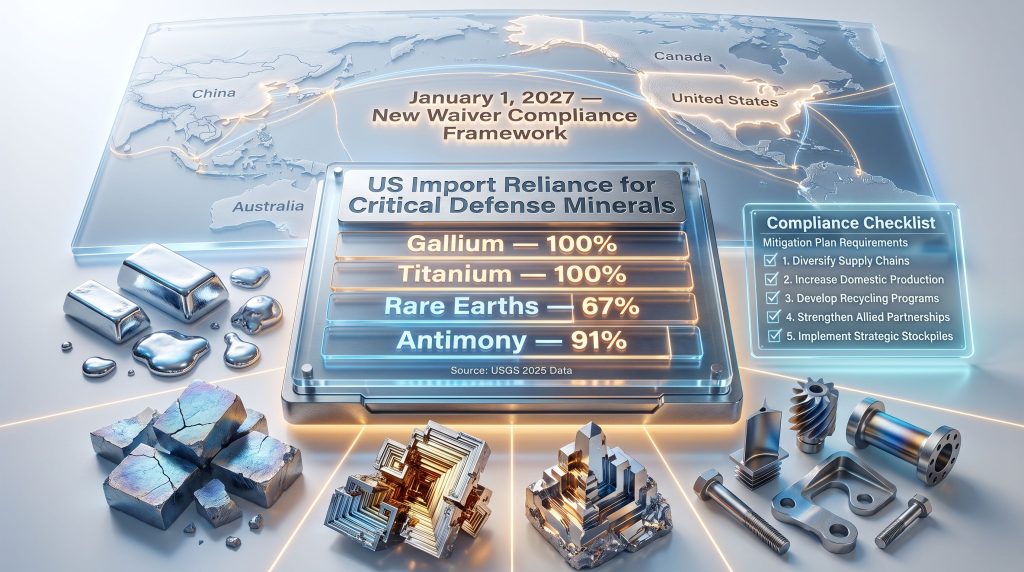
US Import Reliance for Key Defense Minerals
| Critical material | US import reliance | Typical defense use |
|---|---|---|
| Gallium | 100% | AESA radar, RF semiconductors, electronic warfare |
| Titanium | 100% | Aircraft, submarines, armor |
| Niobium | 100% | Missile and jet engine alloys |
| Tantalum | 100% | Military electronics, capacitors |
| Graphite | 100% | Batteries, energy storage |
| Uranium | 99% | Naval nuclear fuel cycle inputs |
| Antimony | 91% | Ammunition, explosives, flame retardants |
| Rare earths | 67% | Permanent magnets in missiles, drones, F-35 systems |
| Tungsten | more than 50% | Armor-penetrating ammunition, hard metals |
| Germanium | more than 50% | Night vision, thermal imaging, infrared optics |
Source: USGS 2025 Mineral Commodity Summaries
This matters because defense demand is small in tonnage compared with sectors such as automotive, semiconductors, and clean energy, but military demand is unusually hard to replace. A missile guidance system cannot simply swap in generic commercial-grade material if purity, heat tolerance, magnetic performance, or traceability requirements are not met.
Why Defense Buyers Feel Shortages Faster
- Defense systems often require high-purity or tightly qualified inputs.
- Material substitution can trigger retesting, redesign, and recertification.
- Procurement timelines are long, but spot market shocks can be immediate.
- Contractors compete with much larger buying pools in electronics, EVs, and industrial manufacturing.
- For some materials, Chinese refining or processing dominance remains the critical choke point rather than mine supply alone.
Furthermore, the demand for critical minerals for semiconductors continues to intensify competition between civilian and defence procurement channels, making compliant sourcing even more difficult for contractors.
What Changed in the July 2026 Executive Order
The July 20, 2026 executive order tightened the framework for US defense critical minerals waivers by making exception-based sourcing harder to justify. Before this change, contractors could still seek waivers to buy sensitive materials from restricted foreign sources when compliant alternatives were unavailable. Under the new approach, the burden of proof rises materially.
Beginning January 1, 2027, contractors seeking a waiver must demonstrate extensive efforts to source from compliant suppliers or show that no compliant material is actually available. The order also states that failure to satisfy requirements can affect future contract opportunities.
Countries Formally Treated as Prohibited Sources
- China
- Russia
- Iran
- North Korea
What Contractors Now Need to Show
The order turns waiver applications into evidence-heavy compliance submissions. Contractors must be prepared to document:
- The supplier involved and its country of origin.
- The efforts made to identify domestic or allied alternatives.
- A practical phase-out strategy for noncompliant material.
- A timeline to reach full compliance.
- A mitigation plan that can be accepted by the Pentagon procurement system.
This is a meaningful shift because sourcing compliance becomes part of contract performance, not merely a paperwork exercise.
Supply Chain Mapping Is Now the Centre of Compliance
One of the most consequential features of the new regime is the requirement to map supply chains back toward raw material origin. That extends beyond prime contractors and reaches into subcontractor networks, where problematic sourcing has historically been harder to detect.
For many companies, this is the hidden challenge. A prime contractor may know its Tier 1 supplier, but not always the smelter, refiner, alloy producer, powder processor, or magnet manufacturer further down the chain.
What a Workable Traceability System Must Include
- Bill of materials discipline at product level
- Country-of-origin verification for sensitive inputs
- Supplier declarations backed by audit rights
- Risk ranking for high-exposure materials
- Alternative supplier pipelines before shortages emerge
- Documentation that can survive contract review and legal scrutiny
Contractors that already invested in digital supply chain intelligence, supplier qualification, and mineral traceability are likely to have an advantage when bids are evaluated.
Why This Policy Arrived Now
The executive order did not emerge in isolation. It sits within a broader escalation in critical minerals policy and export control friction.
Key Policy and Market Milestones
| Date | Development | Why it matters |
|---|---|---|
| December 2023 | China imposed controls on certain natural and synthetic graphite products | Tightened battery and industrial carbon supply risk |
| July 2024 | China added gallium and germanium export controls | Pressured semiconductor and optics inputs |
| September 2024 | China added antimony metal to export controls | Increased munitions and explosives supply concern |
| September 2024 | US finalised Section 301 tariff changes | Chinese indium, tantalum, and chromium faced 25% duties |
| April 2026 | China imposed controls on dysprosium, terbium, certain finished magnets, and products involving several heavy rare earth-related elements | Hit the highest-value magnet performance inputs |
| June 2026 | US committed about $2.9 billion in direct federal funding over five weeks for rare earth metals and magnet supply chain buildout outside China | Attempted to accelerate non-Chinese midstream capacity |
| July 14, 2026 | Department of Defense launched a financing initiative for investment vehicles targeting domestic critical mineral supply chain gaps | Expanded capital formation tools |
| July 20, 2026 | Executive order tightened waiver requirements | Raised compliance burden |
| January 1, 2027 | New framework takes effect | Creates near-term deadline pressure |
There is also a market psychology dimension here. Governments often move quickest when a strategic dependency becomes visible to non-specialists. Export controls on relatively obscure materials such as gallium, germanium, dysprosium, and terbium helped expose how dependent advanced manufacturing is on a handful of refined inputs, not just bulk commodities.
Which Minerals Face the Highest Compliance Risk?
Not all materials are equally exposed. Some have friendlier allied sourcing options, while others face severe midstream bottlenecks.
Gallium and Germanium
Gallium is at 100% US import reliance, while germanium stands at more than 50% according to USGS 2025 data. Both are essential in defense electronics and sensing systems. Gallium compounds are central to high-frequency semiconductors used in radar and electronic warfare, while germanium is a key infrared optical material for thermal imaging and night vision.
The challenge is not only mine supply. Refining and purification are technically demanding, and defence applications require consistency in crystal quality, impurity control, and fabrication standards.
Rare Earths and Permanent Magnets
Rare earth supply risk is often misunderstood. The biggest vulnerability is not necessarily raw rare earth mining but magnet production, especially NdFeB magnets that use additives such as dysprosium and terbium to maintain performance at high temperatures. Those characteristics matter in missiles, drones, actuators, and aerospace systems exposed to heat and vibration.
Even if upstream rare earth concentrate becomes available outside China, converting that material into defence-suitable separated oxides, metals, alloys, and finished magnets is a different industrial challenge. Consequently, rare earth supply chains remain one of the most difficult areas for rapid compliance, and America's rare earth supply chain faces particular pressure given the scale of domestic demand.
Antimony, Tungsten, and Munitions Metals
Antimony at 91% import reliance has direct relevance to ammunition, explosives, and flame-retardant systems. The antimony shortage risks facing the defence sector are compounded by China's export controls, which have already tightened global availability. Furthermore, understanding antimony in defense applications clarifies why substitution is rarely straightforward.
Tungsten, with more than 50% import reliance, is indispensable in hard metals and armor-piercing applications because of its density and hardness. In munitions, performance compromises can be unacceptable, so compliance usually means rebuilding the supply chain rather than redesigning the application.
Titanium and Niobium
Titanium and niobium illustrate another issue: long qualification cycles. Aerospace and naval systems often require exact metallurgical performance, fatigue resistance, corrosion characteristics, and certified processing routes. Even if a new supplier exists, qualifying the material can take significant time.
Brazil is a major global supplier of niobium, but qualification, alloy integration, and defence-specific approvals are still measured in years rather than months. That timing mismatch is a central risk under the 2027 deadline.
The next major ASX story will hit our subscribers first
Operational Consequences for Defense Contractors
Contractors should think about US defense critical minerals waivers in three layers: compliance, cost, and competitiveness.
Immediate Operational Implications
- More internal legal and procurement oversight
- Greater audit pressure across subcontractor chains
- Potential repricing of bids to reflect sourcing risk
- More working capital tied up in inventory and buffer stock
- Higher value placed on allied processing relationships
- Increased use of recycling and secondary recovery where technically feasible
A Practical Scenario
Consider a defence electronics supplier that still depends on Chinese-origin gallium-bearing input. Under the new regime, it would likely need to identify alternative sources, document outreach attempts, show whether volume and specification requirements can be met, and submit a transition plan if immediate replacement is not possible.
If no accepted mitigation path exists, the company may face contract remedies such as lost option periods, suspended task orders, or termination risk in severe cases. The underlying problem is that compliant supply may not yet exist at commercial scale even when the policy deadline arrives.
"The central tension is simple: procurement rules can change faster than mines, refineries, alloy plants, or magnet lines can be built and qualified."
How the US Approach Compares With Allies
The United States appears to be taking a more contract-enforced route than many partner economies. For instance, the US–Australia framework for securing critical mineral supply illustrates how allied nations are attempting to develop compliant sourcing pipelines through investment and partnership rather than procurement penalties alone.
| Policy dimension | United States | European Union | Australia |
|---|---|---|---|
| Main tool | Executive order plus procurement compliance | Critical Raw Materials Act | Investment support and partnership model |
| Formal prohibited suppliers | Yes | Generally no blanket equivalent | Generally no blanket equivalent |
| Primary pressure mechanism | Contract consequences | Strategic targets and diversification | Supply development and export partnerships |
| Timeline intensity | High, with 2027 compliance pressure | Longer-dated targets | Ongoing but less deadline-driven |
The US model is more operationally aggressive because it pushes responsibility onto the contractor base immediately, rather than waiting for long-dated policy targets to mature.
What Comes Next for Supply Chains and Investors
Over time, tighter US defense critical minerals waivers could redirect capital toward compliant mining, refining, alloying, and magnet manufacturing in the US and allied jurisdictions. However, timing matters. New supply projects often take 5 to 10 years from development through commissioning and qualification, especially in complex specialty materials.
That leaves several likely near-term themes:
- Stockpiling and inventory management become more important.
- Recycling and secondary recovery gain strategic value where purity can be maintained.
- Allied processing capacity may matter more than new mine announcements.
- Midstream assets could attract more investor attention than upstream projects alone.
- Qualification risk may prove just as important as geology.
For investors, the nuance is critical. A promising ore deposit does not automatically solve a defence supply bottleneck. Project value depends on processing route, impurity profile, jurisdiction, financing, environmental approvals, customer qualification, and whether the material can actually meet defence-grade specifications.
Investor Caution and Forward-Looking Disclaimer
Any projection about winners from this policy shift involves uncertainty. Supply chain realignment can create opportunity, but it can also expose delays, cost overruns, permitting setbacks, metallurgical complexity, and demand volatility. This article is for informational purposes only and should not be treated as investment, legal, or procurement advice. Policy implementation may evolve, and contractors should verify obligations against official procurement guidance and contract-specific requirements.
In short, the new waiver regime is likely to reshape sourcing strategies across the defence industrial base. The most resilient contractors will be those that treat minerals not as anonymous inputs, but as strategic components whose origin, processing pathway, and qualification status now directly affect their ability to win and keep defence business.
Could The Next Critical Minerals Discovery Reshape Supply Chains?
Discovery Alert’s proprietary Discovery IQ model delivers real-time alerts on significant ASX mineral discoveries, helping investors identify emerging opportunities across strategically important commodities such as rare earths, antimony, tungsten and gallium before the broader market reacts. Explore how major discoveries have driven exceptional market returns on Discovery Alert’s discoveries page and begin a 14-day free trial to stay ahead of the market.