July 22, 2026
The Anatomy of a Chokepoint: When Geography Becomes Energy Policy
Few concepts in global energy security are as deceptively simple as the Strait of Hormuz. On a map, it appears as a narrow sliver of water between Iran and Oman, barely 33 kilometres across at its most constrained navigable point. In practice, it functions as the circulatory valve of the entire global oil system, with an estimated 17 to 20 million barrels of crude oil and refined petroleum products passing through it every single day under normal operating conditions.
That is roughly one-fifth of all oil traded internationally, flowing through a corridor that no commercial operator controls and no insurance policy can adequately price during periods of active conflict. When that corridor becomes dangerous, the consequences extend far beyond the vessels directly at risk. They cascade through freight markets, insurance pricing, refinery procurement decisions, and ultimately into the fuel costs paid by hundreds of millions of consumers across Asia.
That cascading process is exactly what unfolded in July 2026, when two of India's largest state-owned refiners made the operationally significant decision to halt Iraqi crude loadings in response to sharply deteriorating security conditions along the Hormuz transit route. This development — India refiners halt Iraq oil loadings on Hormuz risk — has since reverberated through current crude oil markets and energy security planning circles globally.
When big ASX news breaks, our subscribers know first
Why Iraq's Oil Is Structurally Trapped by Hormuz Geography
To understand why India refiners halt Iraq oil loadings on Hormuz risk is such a consequential development, it is necessary to first understand the geographic trap that southern Iraqi crude exports have always operated within.
Iraq's primary export terminals, including Basra Oil Terminal and the broader cluster of offshore loading infrastructure in the northern Persian Gulf, are connected to global markets by a single viable route: through the Strait of Hormuz and into the Gulf of Oman. Unlike Saudi Arabia, which possesses the East-West Pipeline providing a limited bypass to Red Sea export terminals, Iraq has no functioning large-scale pipeline alternative to the Persian Gulf.
This means that when Hormuz security deteriorates, Iraq's export capacity does not simply become more expensive to access. It becomes physically inaccessible unless shipowners are willing to accept the risks that insurers are increasingly unwilling to cover at commercially viable premium levels.
The primary Iraqi grades affected are Basra Heavy and Basra Medium, both of which are sour crudes with relatively high sulphur content. These grades are priced and contracted specifically for refineries configured to process them, which is a critical point when assessing how quickly alternative supply can be sourced.
The July 2026 Security Deterioration: What Changed the Risk Calculus
Attacks on Transponder-Dark Vessels: A New Threshold
The events that precipitated India's loading suspensions were not simply another iteration of familiar Gulf tensions. What distinguished the July 2026 escalation was a specific and alarming development: commercial vessels operating with their Automatic Identification System (AIS) transponders switched off — a long-established risk-mitigation technique known in the industry as running dark — were also being targeted.
Transponder suppression had historically served as a rudimentary form of concealment for tankers operating in contested waters. The implicit assumption was that a vessel broadcasting no position signal presented a harder target and reduced the political stakes of an attack. The targeting of dark-running vessels in July 2026 invalidated that assumption entirely, raising the effective minimum risk threshold for every commercial operator regardless of the precautions they adopted.
Iraq's Oil Ministry spokesman Salim Al-Rikabi publicly acknowledged that the deteriorating security environment and rising insurance costs had caused some companies to cancel scheduled loading operations. The confirmation from Baghdad was notable precisely because it came from the exporting nation, underscoring that this was not merely a shipping industry perception problem but a commercially verified disruption with real revenue consequences for the Iraqi state.
The Specific Operational Decisions Made by Indian State Refiners
Both Indian Oil Corporation and Mangalore Refinery and Petrochemicals moved to suspend loadings, according to reporting first carried by Bloomberg via ET EnergyWorld on 22 July 2026. The specifics of each refiner's decision illuminate just how seriously the risk assessment had shifted.
| Refiner | Action Taken | Vessel Involved | Cargo Capacity |
|---|---|---|---|
| Indian Oil Corporation (IOC) | Abandoned planned supertanker loading | Lila Jamnagar | Up to 2 million barrels |
| Mangalore Refinery & Petrochemicals (MRPL) | Suspended Iraqi crude lifting | Undisclosed | Not specified |
The decision to abandon a fully loaded supertanker programme is not made lightly. Supertankers of the Lila Jamnagar class represent not only a cargo value potentially exceeding $150 million USD at prevailing crude prices, but also significant vessel and crew exposure. The risk-reward calculation had clearly shifted to the point where delay was commercially preferable to transit.
A structurally important detail in both cases is the contract mechanics. Indian state refiners typically purchase Iraqi crude under long-term agreements with Iraq's State Oil Marketing Organisation that require the buyer, not the seller, to arrange and insure shipping. This means Indian refiners carry direct vessel risk in a way that differs from destination-delivered contracts. When war risk insurance surcharges escalate sharply, the cost lands squarely on the Indian buyer.
India's Shipping Ministry Directive and Its Global Implications
Alongside the commercial decisions by IOC and MRPL, India's Shipping Ministry issued a formal directive instructing shipowners, vessel managers, and seafarer recruitment agencies to refrain from deploying Indian maritime workers on vessels scheduled to transit the Strait of Hormuz until further notice.
This directive carries significance well beyond India's domestic fleet. Indian nationals constitute one of the largest national cohorts in the global merchant navy, accounting for approximately 12 to 15 percent of the world's seafarers according to International Maritime Organisation workforce data. A blanket deployment restriction covering this population creates genuine crew sourcing constraints for international vessel operators, regardless of the flag the vessel flies or the nationality of its beneficial owner.
India's Iraq Dependency: Why Substitution Is Harder Than It Looks
The Scale of the Exposure
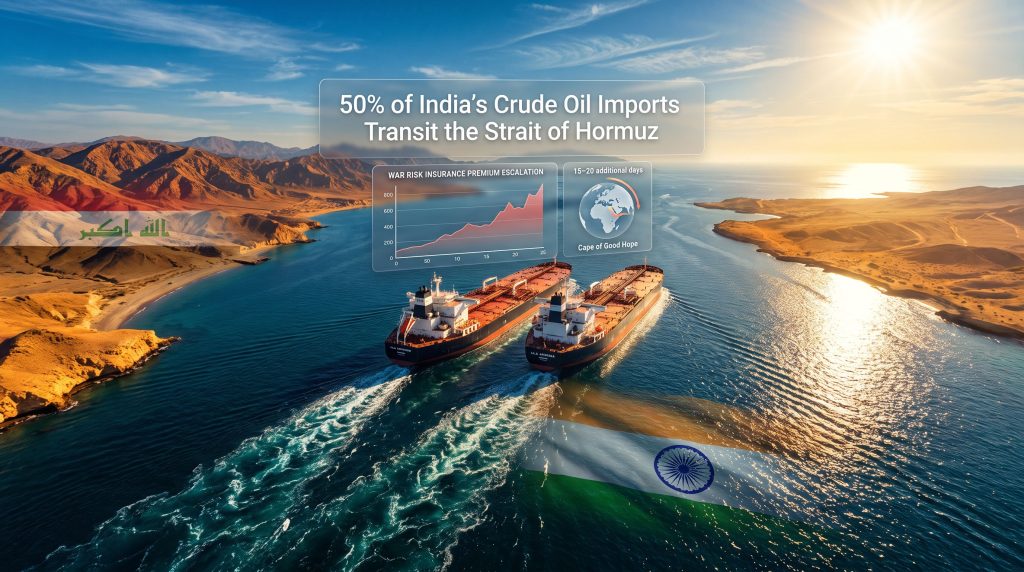
Iraq has occupied either the first or second position in India's crude import supplier rankings for most of the past decade, competing closely with Saudi Arabia and, more recently, Russia. Approximately 50 percent of India's total crude oil imports ordinarily transit the Strait of Hormuz, spanning supplies from Iraq, Saudi Arabia, Kuwait, and the UAE.
This concentration is not the product of poor planning. It reflects the commercial reality that Gulf crude is geographically proximate, contractually well-established, and precisely matched to the sulphur processing configurations of Indian refineries that were built or upgraded with these grades in mind. Furthermore, the broader crude oil price trends influencing procurement decisions have long favoured Gulf supply over Atlantic Basin alternatives.
Why Refinery Configuration Constrains Flexibility
A point that receives insufficient attention in mainstream energy coverage is the role of refinery hardware in determining how quickly crude substitution can occur. Indian refineries processing Basra Heavy are equipped with specific desulphurisation units, vacuum distillation columns, and coking infrastructure calibrated for high-sulphur sour crude.
Switching to sweeter grades from West Africa or lighter grades from the Americas is not simply a procurement decision. It involves:
- Adjusting crude distillation unit operating parameters to account for different density and viscosity profiles
- Recalibrating desulphurisation unit throughput where sulphur content differs materially from the design feedstock
- Managing yield changes across the refinery product slate, which affects the economics of fuel output
- Potentially accepting lower refinery utilisation rates during the transition period
The grades most commonly evaluated as alternatives to Iraqi supply include Brazilian pre-salt grades such as Tupi and Buzios, Angolan grades including Girassol and Dalia, and Colombian crude such as Castilla Blend. While these are available on spot markets and have been increasingly purchased by Indian refiners in recent years as part of incremental diversification strategies, they involve voyage distances that add 7 to 15 days of additional transit time compared to Persian Gulf loadings.
The substitution of Iraqi crude is not a volume-for-volume swap. Refinery configuration, sulphur tolerances, freight economics, and contract structures all determine the practical pace of any supply pivot, and that pace is measured in weeks and months, not days.
Russia's Role as a Partial Buffer and Its Limitations
Since 2022, Russian crude routed via non-Hormuz pathways — primarily through the Baltic and Black Sea — has functioned as an important supplement to India's supply mix, particularly given the discounts at which sanctioned Russian grades have been offered. However, this buffer carries its own constraints, including evolving sanctions frameworks, payment mechanism complexity, and the reality that Russian crude grades do not fully replicate the processing characteristics of Basra Heavy in all refinery configurations.
The Insurance Market as the True Gatekeeper
One of the least widely understood dynamics in maritime energy logistics is the degree to which war risk insurance markets function as de facto regulators of which voyages actually proceed. Lloyd's of London and the specialist marine insurance syndicates that price war risk coverage do not simply respond to events. They shape commercial behaviour in real time through premium movements.
When war risk premiums escalate sharply, as they did following the July 2026 attacks, the effect is not merely to increase voyage costs. At a certain premium threshold, the economics of a voyage become negative regardless of the cargo value, because the insurance cost plus the freight cost exceeds the commercial benefit of the delivery. This is the mechanism through which insurance markets effectively close a shipping lane without any formal governmental or regulatory action.
The targeting of transponder-dark vessels was particularly damaging to this market because it eliminated a risk stratification that insurers had begun to price in. If concealment provides no protective benefit, underwriters must price for the full attack probability on every Hormuz transit, significantly raising the floor premium for the corridor. These oil market disruptions consequently affect WTI and Brent futures pricing in ways that extend well beyond the immediate physical supply shortfall.
Scenario Pathways: How This Disruption Resolves
Short-Term Resolution (2 to 4 Weeks)
A rapid de-escalation through diplomatic channels or a unilateral suspension of maritime pressure would allow war risk premiums to normalise relatively quickly. Insurance markets respond to demonstrated safety improvements, and a period without attacks could see premiums retrace within weeks. Indian refiners would likely resume Iraqi loadings once vessel operators confirm insurance coverage at commercially viable rates.
Under this scenario, the physical supply gap would be bridged through:
- Strategic petroleum reserve drawdowns at Indian refinery tank farms
- Accelerated spot market purchases of compatible grades from non-Hormuz origins
- Temporary processing rate reductions at affected refineries
Prolonged Disruption (2 to 6 Months)
A sustained period of Hormuz insecurity would trigger structural changes in procurement strategy at the refinery planning level. Long-term contract diversification toward Atlantic Basin suppliers would accelerate, and the cost of alternative supply would become embedded in refinery operating economics for an extended period.
Iraq's fiscal position would come under significant pressure. The country's budget relies on oil revenues for approximately 90 percent of government income according to International Monetary Fund assessments, making any sustained export volume reduction a serious macroeconomic problem for Baghdad.
Structural Realignment (6 Months and Beyond)
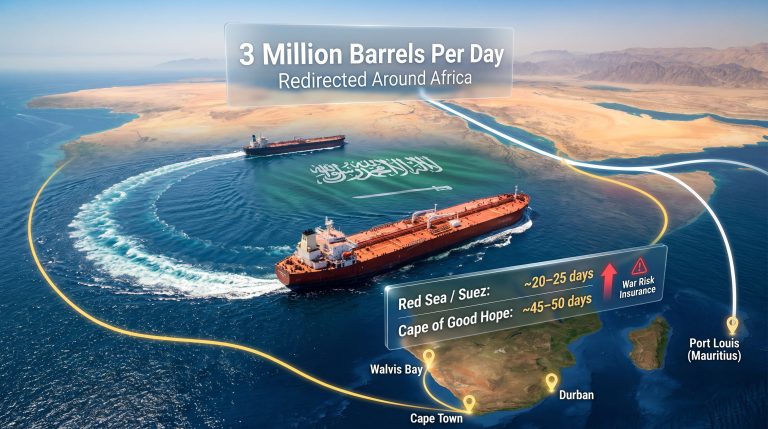
If Hormuz instability transitions from a crisis to a persistent geopolitical feature, the consequences become generational rather than cyclical. Global tanker routing patterns would shift permanently, with Cape of Good Hope voyages becoming standard practice for Gulf-to-Asia crude movements. This adds approximately 15 to 20 days of voyage time, permanently increasing freight costs, working capital requirements, and carbon emissions per barrel delivered.
India's strategic petroleum reserve expansion plans, already under consideration by the government, would likely be accelerated as a structural hedge against future Hormuz-dependent supply interruptions. In addition, the broader geopolitical trade tensions reshaping energy supply chains globally would further accelerate this structural pivot away from single-corridor dependency.
The next major ASX story will hit our subscribers first
Market Implications: Price, Freight, and Geopolitical Premium
Crude Price Dynamics During Hormuz Stress
Physical supply withdrawals of the scale represented by Indian refiner loading suspensions exert upward pressure on crude benchmarks through two distinct mechanisms. The first is straightforward: reduced demand for Iraqi crude lowers the premium buyers are willing to pay for that specific grade, while simultaneously increasing competition for alternative Hormuz-independent grades, pushing their prices higher.
The second mechanism is psychological. Futures markets price Hormuz disruption risk as an option on supply continuity, and when real-world events validate that risk scenario, the risk premium embedded in forward curves expands. This can move prices considerably beyond what the physical volume impact alone would justify.
Tanker Rate Implications
Shipowners who continue transiting Hormuz under elevated war risk conditions command significant rate premiums. Those who divert to the Cape of Good Hope route face longer voyage durations, which effectively removes vessel capacity from the global fleet by tying up ships on longer voyages. Both effects are bullish for tanker day rates, particularly in the Very Large Crude Carrier segment that dominates Gulf-to-Asia trade.
Key Takeaways for Energy Market Participants
The suspension of Iraqi crude loadings by IOC and MRPL represents more than an operational inconvenience. It is a signal of systemic stress in the Hormuz transit corridor that carries implications across freight markets, crude pricing, insurance underwriting, and long-term energy security planning. The decision by India refiners to halt Iraq oil loadings on Hormuz risk has exposed structural vulnerabilities that will take years, not months, to fully address. Several conclusions stand out:
- The targeting of transponder-dark vessels has fundamentally altered the risk floor for Hormuz transit, making risk mitigation through concealment no longer viable
- India's buyer-arranged shipping contract structure with Iraq places direct vessel risk on Indian state refiners, making them uniquely sensitive to war risk insurance cost escalation
- Refinery configuration constraints mean crude substitution is a slow-moving process measured in weeks, not days, regardless of spot market availability
- Iraq's near-total export dependence on Hormuz transit creates a structural vulnerability that diplomatic engagement cannot rapidly resolve
- The insurance market, rather than any governmental body, is functioning as the primary gatekeeper determining which Hormuz voyages proceed and at what economic cost
Furthermore, these oil market disruptions will continue to test the resilience of global energy supply chains in ways that demand sustained attention from policymakers, refiners, and market participants alike. Comprehensive reporting from Bloomberg has confirmed the scale and significance of these operational changes as they continue to unfold.
Disclaimer: This article contains forward-looking scenario analysis and references to market dynamics that involve inherent uncertainty. Projections regarding supply disruption duration, crude price movements, and freight rate trajectories are speculative in nature and should not be construed as investment advice. Energy market conditions can change rapidly in response to geopolitical developments.
Want to Stay Ahead of the Resource Discoveries Shaping Tomorrow's Markets?
While Hormuz disruptions reshape global energy supply chains, significant mineral discoveries on the ASX continue to create compelling opportunities for informed investors — and Discovery Alert's proprietary Discovery IQ model delivers real-time alerts the moment they're announced, turning complex data into actionable insights. Explore historic examples of exceptional discovery returns and begin your 14-day free trial today to position yourself ahead of the broader market.