July 22, 2026
Water Scarcity Is Quietly Becoming the Biggest Threat to the Energy Transition
The global energy transition is typically framed around commodity prices, geopolitical supply chains, and the pace of battery technology development. Far less attention is directed toward a resource that underpins virtually every stage of mineral extraction, processing, and refining: freshwater. As critical minerals demand accelerates, the hydrological systems that mining operations depend upon are coming under mounting pressure from competing users, climate-driven variability, and structural scarcity. Competition for water in mining and metals was once treated as a background operational input but is rapidly becoming a defining constraint on whether the energy transition can be delivered at the scale and speed required.
When big ASX news breaks, our subscribers know first
The Hidden Bottleneck: Water as a Structural Risk to Critical Mineral Supply Chains
Why Water Is No Longer a Background Operational Variable
Water has historically been categorised alongside power and logistics as a basic operational necessity for mining. That framing is no longer adequate. At the site level, water is consumed across a remarkably wide range of functions: ore processing and concentration, dust suppression on haul roads and waste dumps, slurry transport through pipelines, hydrometallurgical leaching circuits, and cooling systems for smelters and refineries. Each of these functions draws on local water resources in ways that interact directly with surrounding communities, ecosystems, and competing industrial users.
A critical but underappreciated dynamic involves ore grade decline. As higher-grade mineral deposits are progressively depleted, the industry increasingly relies on lower-grade ore bodies that require substantially greater volumes of rock to be processed per unit of metal produced. This grade-to-water relationship is nonlinear: halving the ore grade can more than double the water intensity per tonne of refined output, depending on the processing method used. The implication is that water demand in mining is structurally increasing even without any expansion in production volumes, creating an intensifying footprint on watersheds that are already stressed.
How Physical Water Risk Is Reshaping Mine Feasibility Economics
Water risk is now entering mine feasibility models and project finance assessments in ways it simply was not a decade ago. Lenders, institutional investors, and insurers are beginning to require water risk disclosure as part of environmental, social, and governance due diligence. Projects located in catchments with high baseline water stress face longer permitting timelines, stricter operational conditions, and in some jurisdictions, hard limits on freshwater withdrawal volumes. These constraints are beginning to affect project economics before a single tonne of ore is extracted.
Furthermore, the integration of natural capital in mining assessments is increasingly shaping how water risk is quantified and reported to stakeholders, reinforcing that freshwater is not a free input but a finite and contested resource.
How Exposed Is the Global Mining Sector to Physical Water Risk?
Mapping the Scale Across 12,000 Facilities
The International Council on Mining and Metals (ICMM) has released a landmark dataset, built on its Global Mining Dataset covering approximately 12,000 facilities worldwide, including mines, smelters, refineries, and processing plants. Produced in partnership with the WWF's Water Risk Team and the World Resources Institute (WRI), this represents the first comprehensive, cross-commodity global assessment of physical water risk exposure across the full breadth of the mining and metals sector.
The findings are striking in their scale:
| Physical Water Risk Indicator | % of Global Facilities Exposed |
|---|---|
| At least one high physical water risk indicator | 65.7% |
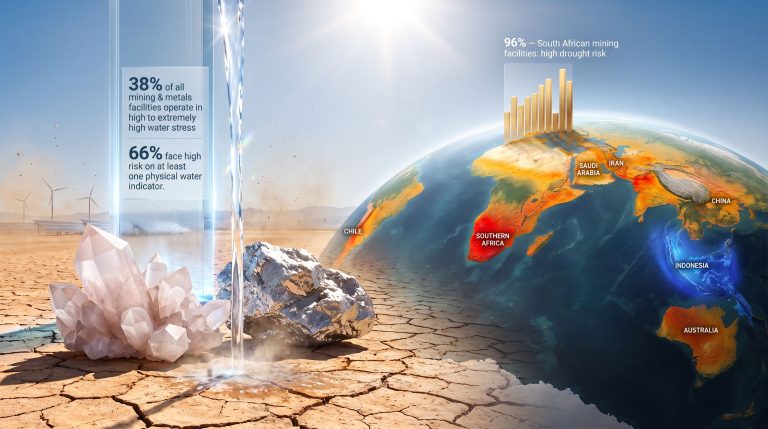
| High or extremely high baseline water stress or arid zones | 38.2% |
| High or extremely high baseline water depletion | 27.4% |
| High drought risk | 27.0% |
| High or extremely high interannual supply variability | 16.2% |
| High or extremely high flood risk | 14.0% |
| High risk across three or more simultaneous indicators | 4.9% |
Nearly two-thirds of all mining and metals facilities globally operate in areas facing at least one significant physical water risk. That figure is not a marginal finding. It signals a systemic condition embedded in the geographic reality of where mineral deposits exist.
Compound Exposure: When Multiple Risks Stack at the Same Site
Perhaps more concerning than single-indicator exposure is the phenomenon of compound risk, where multiple hydrological stressors converge at the same facility simultaneously. Nearly 5% of facilities face high or extremely high risk across three or more water risk indicators at the same time. These sites are effectively operating at the intersection of drought exposure, baseline water stress, and supply variability, creating conditions where any single adverse event can trigger cascading operational consequences.
This stacking effect is geographically concentrated rather than randomly distributed. It tends to cluster in precisely those regions that host the world's most critical mineral endowments, a coincidence that carries profound implications for supply chain resilience.
Which Commodity Types Face the Highest Flood Exposure?
While drought and baseline stress dominate the aggregate risk picture, flood exposure is disproportionately concentrated in specific commodity sectors. Facilities involved in the following operations face above-average flood risk relative to the global mining average:
- Alumina refining
- Aluminium smelting
- Molybdenum production
- Steel production
This pattern reflects the processing-heavy nature of these commodities, which tend to require large, flat infrastructure footprints often situated near water bodies or in low-lying coastal and riverine zones.
What Does Competition for Water Actually Mean in a Mining Context?
Defining the Four Dimensions of Water Competition
The term competition for water in mining and metals encompasses a set of distinct but interrelated tensions. Understanding these dimensions is essential for accurately assessing the risk landscape:
- Mining versus local communities – Groundwater drawdown and surface water diversion can reduce availability for drinking water, sanitation, and subsistence livelihoods in surrounding populations.
- Mining versus agriculture – Shared river basins and aquifer systems create direct allocation conflicts between irrigated farming and mineral processing operations, particularly in semi-arid regions.
- Mining versus industrial and energy users – Multiple industries drawing from the same catchment during drought conditions can create acute shortfalls, particularly where thermoelectric power generation also depends on cooling water.
- Mining versus ecosystems – Environmental flow reductions, thermal loading, and contamination risks affect riparian biodiversity, wetland function, and downstream water quality.
Why Competition for Water Ranks as the Sector's Greatest Physical Water Risk
The ICMM analysis identifies competition for water as the single greatest physical water risk facing the global mining and metals sector. This finding carries a specific meaning: it is not merely about absolute water scarcity, but about the social and political dynamics of allocation under scarcity. A mine may have legal water rights and sufficient technical capacity to extract groundwater, but if doing so demonstrably diminishes supply for neighbouring communities or agricultural users, the consequences extend well beyond hydrology.
The Social Licence Dimension: How Water Disputes Escalate Into Operational Shutdowns
Water disputes have a well-documented history of escalating from regulatory friction into full operational shutdowns. Community-led opposition to mining projects, when water access is perceived to be threatened, has resulted in permit cancellations, blockades, and in some regions, sustained legal challenges that have delayed or permanently shelved projects. Social licence to operate is not a static condition granted at project approval. It is continuously renegotiated through the lived experience of surrounding communities, and water is frequently the most visible and viscerally understood point of contention.
Which Regions Face the Most Acute Water Competition Pressures?
Geographic Hotspots: A Regional Breakdown
Water risk is global in scope but highly uneven in distribution. The following regional breakdown illustrates where the most acute pressures are concentrated:
| Region | Primary Water Risk Profile | Key Statistic |
|---|---|---|
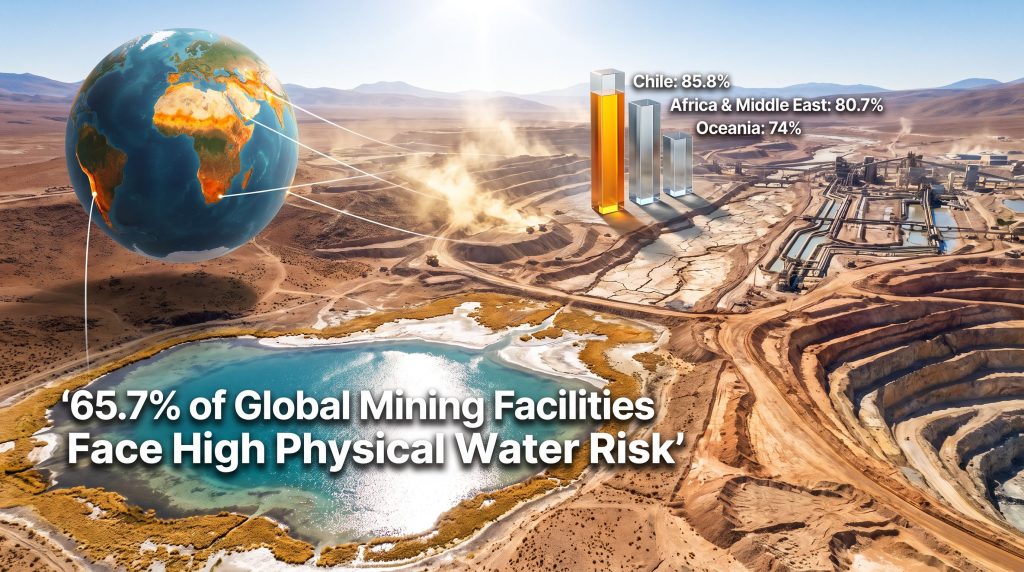
| Chile (Copper and Lithium) | Baseline water stress and interannual variability | 85.8% of facilities face both risks simultaneously |
| Africa and Middle East | Chronic drought dominance | 80.7% exposed to high or very high drought risk |
| Oceania | Interannual supply unpredictability | 74% face high or extremely high variability |
| Global Average | Multi-indicator exposure | 65.7% face at least one high-risk indicator |
Chile as a Case Study: The World's Copper and Lithium Heartland Under Hydrological Pressure
Chile occupies a unique and precarious position in the global critical minerals landscape. It is the world's largest copper producer and, as Chile lithium resources demonstrate, holds a substantial share of identified global lithium reserves, concentrated predominantly in the hyper-arid Atacama Desert and its surrounding salares. In this context, 85.8% of Chilean mining facilities simultaneously face high or extremely high baseline water stress and interannual variability, a combination that compounds operational risk in ways that static stress metrics alone cannot capture.
The Atacama's lithium brine operations are particularly sensitive. Extraction from subsurface brine aquifers raises contested questions about hydrological connectivity between the brine and freshwater systems used by Indigenous communities and flamingo habitats. This scientific uncertainty has become a major axis of regulatory and social conflict, illustrating how incomplete hydrological knowledge can itself become a source of project risk.
Africa and the Middle East: Drought Risk as a Chronic Structural Constraint
Across Africa and the Middle East, 80.7% of mining facilities face high or very high drought risk. Unlike flood or variability risks, which can be acute and episodic, drought risk in these regions is frequently chronic and structural. Extended dry periods deplete groundwater reserves that have taken centuries to accumulate, and recovery timelines following severe droughts can extend across multiple operational mine lifetimes.
Oceania's Volatility Problem: When Annual Supply Becomes Unpredictable
74% of Oceanian mining facilities face high or extremely high interannual variability in water supply. Variability risk is distinct from absolute scarcity: it describes conditions where sufficient water may exist on average but where the timing and volume of availability fluctuates significantly from year to year. For mining operations that require consistent water supply for continuous processing circuits, high variability creates operational planning challenges that cannot be resolved through efficiency measures alone, requiring storage infrastructure, alternative sourcing arrangements, or flexible processing configurations.
Is the Energy Transition Making Water Competition Worse?
The Demand Paradox: Clean Energy Materials Require Water-Intensive Production
There is a structural irony embedded in the energy transition that receives insufficient attention. The materials required to manufacture solar panels, wind turbines, EV battery systems, and electricity grid infrastructure are predominantly sourced from mineral deposits located in regions already experiencing significant hydrological stress. Scaling up output to meet clean energy targets therefore risks deepening water insecurity in the very communities and ecosystems that are also among the most vulnerable to climate change. In this sense, the critical minerals and energy transition nexus carries a water dimension that policymakers cannot afford to overlook.
WRI data indicates that at least 16% of critical mineral mines globally are already operating in high water stress zones. As production volumes increase in response to energy transition demand, that proportion and the intensity of extraction within those zones is likely to grow.
Why Water Risk Is Now a Material Issue for Energy Transition Timelines
Mine development timelines in water-stressed regions are increasingly subject to extended environmental impact assessments, water allocation negotiations with regulators and communities, and in some jurisdictions, mandatory independent hydrological studies before approvals can proceed. Each of these processes adds time and cost to project development, compressing the window within which new supply can reach market. For commodities like copper and lithium, where demand growth projections are steep and lead times for new mines already stretch across a decade or more, water-related delays represent a tangible risk to energy transition timelines.
The next major ASX story will hit our subscribers first
How Does Water Intensity Vary Across Mining Operations?
The Role of Ore Grade, Processing Method, and Operational Function
Water intensity in mining is not uniform across commodities or operations. Several factors drive significant variation:
- Ore grade: Lower-grade deposits require processing larger volumes of material per unit of product, increasing water consumption proportionally or in some cases superlinearly, depending on the processing circuit.
- Processing method: Hydrometallurgical processes such as heap leaching and solvent extraction electrowinning (SX-EW) used in copper production have different water profiles compared to conventional flotation circuits. Leaching operations can recycle significant water volumes but require careful management of process solution chemistry.
- Dust suppression: In arid open-cut operations, road and stockpile dust management can account for a material proportion of total site water consumption, particularly where haul road networks are extensive.
- Slurry transport: Pumping ore concentrates or tailings as aqueous slurries through pipelines is water-intensive, though closed-loop systems can partially recover this water downstream.
Fit-for-Purpose Water Sourcing: Matching Quality to Operational Need
An underappreciated efficiency lever in mining water management involves matching water quality to operational requirements rather than defaulting to fresh groundwater or surface water for all functions. High-quality freshwater is genuinely required for some applications, particularly in certain metallurgical processes sensitive to dissolved solids concentrations. However, dust suppression, road compaction, and some slurry transport functions can utilise lower-quality water sources, including treated mine-affected water, brackish groundwater, or reclaimed process water. Deploying fit-for-purpose sourcing strategies can meaningfully reduce freshwater withdrawals without compromising operational performance.
What Are the Regulatory and Reputational Risks of Poor Water Management?
The Shift from Site-Level to Catchment-Level Accountability
Regulatory frameworks governing mining water use are evolving from a site-centric model, focused on discharge quality and licensed withdrawal volumes, toward a catchment-level accountability framework that considers cumulative impacts across multiple users within a shared hydrological system. This shift has significant implications for how operators assess and disclose water risk. A facility that meets all of its individual licence conditions may still face regulatory exposure if its cumulative contribution to catchment-level stress is considered disproportionate.
Investor Expectations and the Financing Prerequisite
Institutional investors and development finance institutions are progressively requiring detailed water risk disclosure as a condition of financing for new mining projects. Frameworks such as the CDP Water Security questionnaire, the Task Force on Nature-related Financial Disclosures (TNFD), and sector-specific guidance from bodies like ICMM are establishing the vocabulary and metrics through which water risk is assessed and compared across portfolios. Projects that cannot demonstrate credible water stewardship strategies face increasing difficulty accessing capital on competitive terms.
How Are Leading Mining Companies Responding to Water Competition?
Operational Responses: Five Practical Levers for Reducing Water Competition Risk
Mining companies are deploying a range of strategies to reduce their exposure to water competition and improve their stewardship credentials:
- Improving process water efficiency across mineral extraction and refining circuits through circuit redesign, reagent optimisation, and reduced water-to-ore ratios.
- Adopting secondary and recycled water sources including mine-affected water treatment, stormwater capture, and desalination where coastal proximity makes it viable.
- Implementing basin-scale water management in collaboration with governments, regulators, and affected communities to allocate shared resources equitably.
- Enhancing real-time water monitoring and disclosure through installation of continuous measurement systems and integration with public reporting frameworks.
- Engaging in integrated land and water use planning at regional scales to align mine water requirements with broader catchment management objectives.
The Case for Cross-Sector Collaboration
No single mining operator, regardless of scale, can resolve systemic water competition challenges acting alone. The hydrological systems within which mines operate are shared resources subject to pressures from multiple industries, climate dynamics, and population growth simultaneously. Effective water stewardship therefore requires coordinated action across governments, industry associations, investors, downstream users of mined materials, and the communities most directly affected.
ICMM's framing of responsible water management emphasises that it must be socially equitable, environmentally sustainable, and economically beneficial, recognising that these dimensions are inseparable in practice. An operation that secures water at the expense of community access may achieve short-term operational continuity but faces compounding social and regulatory risk that ultimately undermines its long-term viability. Consequently, mining decarbonisation strategies increasingly incorporate water stewardship as an integrated component rather than a separate concern.
What Does a Comprehensive Water Risk Dataset Change for the Industry?
From Fragmented Site Data to Cross-Commodity Global Assessment
Prior to the ICMM dataset, water risk assessments in mining were predominantly conducted at the individual project level, using bespoke methodologies that made cross-site and cross-commodity comparisons extremely difficult. Policymakers lacked a consolidated evidence base from which to design water governance frameworks scaled to the challenge. Investors lacked standardised metrics for comparing water risk exposure across mining portfolios. And communities lacked accessible information about how their local water resources compared to broader patterns of stress.
The release of a standardised, publicly accessible dataset covering 12,000 facilities across the full commodity spectrum fundamentally changes this information landscape. It establishes a common baseline from which more sophisticated analysis, including scenario modelling under different climate trajectories and demand projections, can be built.
How Policymakers and Investors Can Use Water Risk Data
WRI has noted that responsible mineral development begins with shared access to credible, publicly available data on where water risks are greatest. Without a consolidated information base, effective planning across the full critical mineral value chain remains impractical. The ICMM dataset represents a meaningful contribution to building that foundation, though it is explicitly positioned as a starting point rather than a definitive solution.
Limitations of the current dataset include its focus on physical water quantity risks, with water quality risks such as contamination and acid mine drainage treated separately. Further refinement through collaboration with governments, research institutions, and civil society will be necessary to build a genuinely comprehensive risk picture. The World Resources Institute's Aqueduct tool provides complementary catchment-level data that operators and policymakers can use alongside the ICMM dataset to strengthen their assessments.
Frequently Asked Questions: Competition for Water in Mining and Metals
What is the biggest water risk facing the global mining sector?
Competition for water in mining and metals between operations and other users, including communities, agriculture, and other industries, is identified as the greatest physical water risk. This encompasses both acute scarcity conditions and the social and political dynamics of allocation under scarcity.
Why are critical mineral mines disproportionately located in water-stressed regions?
Mineral deposits form through geological processes that are often associated with arid or semi-arid tectonic environments. Porphyry copper and lithium brine deposits, for instance, are geologically concentrated in the hyper-arid Andes. The geographic overlap between mineral endowment and hydrological stress is a structural feature of the resource base, not a planning failure.
How does water competition affect a mine's social licence to operate?
When communities perceive that mining operations are reducing their access to clean water or diminishing agricultural water availability, organised opposition can escalate through legal challenges, protest actions, and political pressure. These dynamics have caused project delays and cancellations globally, making community water relations a material business risk.
What is baseline water stress and how is it measured in a mining context?
Baseline water stress measures the ratio of total annual water withdrawals to total available annual renewable supply in a given catchment, expressed as a percentage. High stress indicates that a large proportion of available renewable supply is already being withdrawn, leaving little buffer for additional demand or for periods of below-average precipitation.
Can mining operations realistically reduce their freshwater dependency?
Yes, though the degree of reduction achievable varies significantly by commodity and processing method. Closed-loop water recycling systems, dry stacking of tailings instead of conventional wet tailings storage, and adoption of seawater or brackish water for appropriate process steps can substantially reduce freshwater withdrawal volumes. However, some metallurgical processes impose genuine quality constraints on input water that limit substitution options.
What role do investors play in driving better water risk management in mining?
Investors are increasingly leveraging capital allocation decisions to incentivise improved water stewardship. By requiring water risk disclosure, engaging company boards on stewardship strategies, and in some cases applying financing conditions tied to water performance benchmarks, the investment community is creating meaningful commercial pressure for operational improvement.
The Path Forward: Coordinated Water Governance as a Prerequisite for Energy Transition Success
Why Water Risk Management Is No Longer Optional
The data is unambiguous. With nearly two-thirds of global mining and metals facilities exposed to at least one significant physical water risk, and with demand for critical minerals projected to scale dramatically over the coming decades, water stewardship can no longer be treated as a voluntary enhancement to standard operational practice. It is a prerequisite for maintaining operational continuity, securing financing, retaining social licence, and ultimately for delivering the materials that the energy transition requires.
The Three Pillars of Effective Water Stewardship at Scale
| Pillar | Description | Who Is Responsible |
|---|---|---|
| Data Transparency | Publicly accessible, cross-commodity water risk datasets enabling informed planning | Industry bodies, research institutions, governments |
| Integrated Planning | Regional land and water use coordination that aligns mining requirements with broader catchment governance | Governments, regulators, mining operators |
| Stakeholder Engagement | Inclusive governance frameworks that incorporate community, Indigenous, and agricultural perspectives in water allocation decisions | Operators, civil society, investors |
Building a Water-Resilient Critical Minerals Supply Chain
The immediate priorities for the sector cluster around three practical imperatives. First, expanding and refining the shared data infrastructure that now exists through the ICMM dataset to encompass water quality risks, climate scenario overlays, and more granular community-level impact assessments. Second, translating catchment-level risk intelligence into operational and regulatory frameworks that manage cumulative impacts rather than individual facility footprints in isolation. Third, embedding water equity considerations, meaning the rights and needs of communities and ecosystems as primary water users, into the front-end design of new mining projects rather than treating them as constraints to be managed reactively.
The energy transition cannot succeed if it reproduces, at accelerated scale, the water conflicts that have historically constrained mining development in water-stressed regions. Coordinated governance, grounded in transparent shared data and genuine stakeholder inclusion, is the only viable pathway to a critical minerals supply chain that is both sufficient in volume and sustainable in its relationship with the hydrological systems it depends upon.
This article is intended for informational purposes only and does not constitute financial or investment advice. Forward-looking statements regarding industry trends, regulatory developments, and supply chain dynamics involve inherent uncertainty and should not be relied upon as predictions of future outcomes. Readers should conduct independent research and consult appropriate professional advisers before making investment or business decisions.
Want to Stay Ahead of Critical Mineral Discoveries Before Water and Resource Constraints Reshape Supply Chains?
Discovery Alert's proprietary Discovery IQ model delivers real-time alerts the moment significant ASX mineral discoveries are announced, transforming complex geological data into actionable investment insights for both short-term traders and long-term investors — explore historic discoveries and their market returns, then begin your 14-day free trial to position yourself ahead of the market.