
July 22, 2026
When Both Exits Close: The Logic of a Dual-Chokepoint Energy Crisis
Global energy markets are built on the assumption that if one shipping corridor fails, another will absorb the flow. For decades, this redundancy principle has functioned as an invisible stabiliser, reassuring buyers from Tokyo to Rotterdam that Middle Eastern crude would find its way to market regardless of localised disruptions. The events of July 2026 have placed that assumption under its most serious stress test yet, with Saudi oil tankers making Red Sea U-turns after a Houthi warning that simultaneously pressured both of Saudi Arabia's primary crude export pathways.
Understanding why this matters requires looking past the vessel tracking data and into the structural geography of Middle Eastern oil logistics, a system that has operated under carefully designed redundancy for half a century, and is now experiencing something it was never engineered to handle. The crude oil market dynamics at play here extend well beyond simple shipping delays.
When big ASX news breaks, our subscribers know first
Saudi Arabia's Export Architecture: Designed for Redundancy, Not Dual Failure
Saudi Arabia's crude export infrastructure reflects decades of strategic engineering. The country's oil fields sit primarily in the Eastern Province, adjacent to the Arabian Gulf. From there, the default export route runs through the Strait of Hormuz, the narrow waterway separating the Gulf from the open ocean.
To reduce dependence on that single corridor, Saudi Aramco operates the East-West Pipeline, a major overland artery that carries crude westward across the Arabian Peninsula, terminating at the Red Sea port of Yanbu. This pipeline was constructed precisely so that Gulf disruptions, whether from Iranian military posturing or naval incidents, would not paralyse Saudi export capacity.
For decades, that redundancy functioned as intended. The problem in 2026, however, is that both corridors are now compromised simultaneously:
- The Strait of Hormuz faces ongoing closure pressure stemming from broader Iran-related tensions
- The Red Sea corridor via Bab el-Mandeb is now subject to Houthi naval blockade warnings targeting Saudi-linked vessels specifically
- Saudi Arabia's backup route has, for the first time, become its own threat vector
This is not a conventional shipping disruption. It is a structural failure of the redundancy architecture that has underpinned Saudi export security for generations.
The Bab el-Mandeb Factor: A Strait Most Markets Underestimate
The Bab el-Mandeb Strait, positioned between Yemen and the Horn of Africa, is the southern gateway connecting the Red Sea to the Gulf of Aden and onward to global shipping lanes. Approximately 6 to 7 million barrels per day of crude oil and petroleum products transit this corridor under normal conditions, making it one of the most consequential waterways in global energy trade despite receiving far less media attention than the Strait of Hormuz.
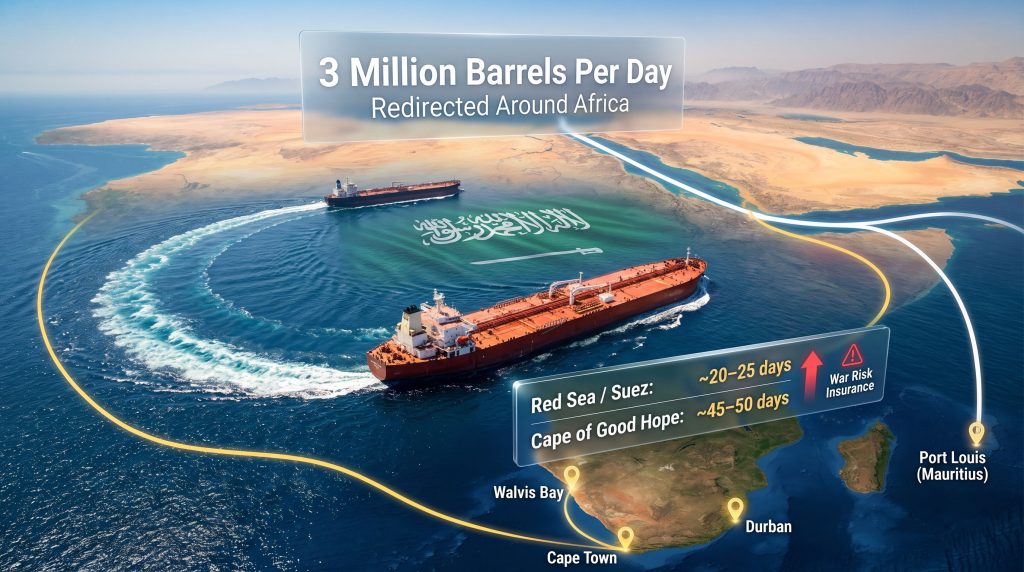
When vessels cannot transit Bab el-Mandeb southbound, the navigation logic reverses entirely. Rather than continuing toward Asia, vessels must turn northward, transit the Suez Canal, cross the Mediterranean, and then navigate the full length of Africa's Atlantic coast before rounding the Cape of Good Hope. The journey effectively doubles in both distance and duration.
Furthermore, the oil price volatility trends associated with such disruptions tend to compound rapidly once market participants price in sustained rerouting at scale.
The simultaneous pressure on both the Strait of Hormuz and the Red Sea corridor represents a genuinely unprecedented dual-chokepoint scenario for Middle Eastern oil exports, one for which global shipping markets have no direct historical precedent in terms of combined geographic scope.
What Triggered the Saudi Tanker U-Turns on July 21, 2026
The sequence of events that led to Saudi oil tankers making Red Sea U-turns after the Houthi warning unfolded across approximately eight days in July 2026.
On July 13, Houthi forces accused Saudi Arabia of conducting an airstrike on the runway at Sanaa International Airport. Yemen's internationally recognised government, which Saudi Arabia supports, acknowledged that its forces targeted the runway to prevent the landing of an Iranian aircraft, though Riyadh did not formally claim direct responsibility. In response, the Houthi movement fired missiles toward southern Saudi Arabia, ending what had been a period of relative military calm. Saudi air defence systems intercepted those projectiles.
The Houthi movement then issued formal warnings to global shipping companies, declaring that any vessel involved in loading or discharging cargo at Saudi Arabian ports risked being targeted regardless of its location. The movement framed this as a naval blockade of Saudi Arabia, a direct response to the military confrontation. According to reporting from the Times of Israel, the US confirmed Houthi forces had already targeted a Saudi-owned tanker in the latest Red Sea attack.
The Saudi-led coalition subsequently announced measures to protect shipping through Bab el-Mandeb, but the warnings were sufficient to trigger an immediate fleet-level response.
The Vessels That Changed Course
On July 21, at least three confirmed tankers reversed course in the Red Sea, with reports suggesting up to five Saudi-linked vessels were ultimately affected:
| Vessel Name | Approximate Cargo | Destination | Action Taken |
|---|---|---|---|
| Xin Long Yang (VLCC) | ~2 million barrels | China | Reversed toward Suez Canal |
| Rodos | ~700,000 barrels | India | Reversed toward Suez Canal |
| New Prime | Undisclosed | Yanbu (planned) | Turned back near Oman |
| Additional vessels | Undisclosed | Various | Up to 5 tankers total affected |
The scale of the response indicates this was not a series of isolated vessel decisions but a coordinated, industry-wide risk assessment playing out in real time across multiple shipping operators. Bloomberg's coverage of the Chinese tanker U-turn further confirmed the breadth of operators affected by the Houthi threat warnings.
The Economics of Diversion: What the Reroute Actually Costs
Redirecting a Very Large Crude Carrier (VLCC) around Africa's southern tip introduces costs across multiple dimensions that compound significantly over time.
Time: The Cape of Good Hope route adds up to four weeks to delivery timelines for vessels bound for Asian markets. For a VLCC carrying 2 million barrels destined for a Chinese refinery, that delay directly affects inventory planning and procurement scheduling at the destination.
Fuel: The additional voyage distance, exceeding 20,000 kilometres compared to the Red Sea route, requires substantially greater fuel consumption. For a VLCC burning roughly 80 to 100 tonnes of marine fuel per day, four additional weeks translate into fuel expenditures measured in the hundreds of thousands of dollars per voyage.
Insurance: War risk insurance surcharges for Red Sea-adjacent routes have risen sharply across the industry. Vessels avoiding those zones and taking the Cape route operate under standard commercial insurance rates, but the rerouting itself reflects the repricing of risk in the underlying market.
Charter rates: Longer voyage durations reduce effective fleet availability. When the same number of vessels is completing longer journeys, the supply of available tonnage for new cargo commitments tightens, placing upward pressure on VLCC spot rates globally.
Route Comparison at a Glance
| Factor | Red Sea / Suez Route | Cape of Good Hope Route |
|---|---|---|
| Voyage time (Saudi to China) | 20 to 25 days | 45 to 50 days |
| Current security risk | High (active Houthi threat zone) | Low |
| War risk insurance | Elevated surcharges active | Standard commercial rates |
| Fuel cost differential | Baseline | Significantly higher |
| Impact on fleet availability | Neutral | Tightening (longer tie-up of vessels) |
If approximately 3 million barrels per day of Saudi crude is redirected around Africa on a sustained basis, the cumulative freight cost increase across the global tanker market becomes a meaningful factor in delivered crude pricing for Asian refiners.
A Pattern With History: The 2023–2024 Red Sea Crisis as Precedent
The July 2026 disruption does not emerge in isolation. The current Saudi oil tankers' Red Sea U-turns follow a pattern established when Houthi attacks on commercial shipping first triggered mass rerouting in late 2023.
During the first five months of 2024, crude oil and petroleum products transported via the Cape of Good Hope surged from approximately 5.9 million barrels per day in 2023 to around 8.7 million barrels per day, a 47% increase in African route traffic within a single year. That earlier crisis demonstrated both the adaptability of global shipping markets and the structural weaknesses of African port infrastructure when placed under sudden, concentrated demand.
The 2026 scenario differs from 2023–2024 in one critical respect: where the earlier crisis involved generalised attacks on commercial shipping, the current Houthi warning specifically targets Saudi Arabian export operations. This narrows the risk profile to a single nation's trade flows rather than distributing it across the broader commercial fleet. Consequently, this creates more concentrated pressure on Saudi Aramco's ability to fulfil export commitments to Asian customers.
The next major ASX story will hit our subscribers first
African Ports: Geographic Beneficiaries With Infrastructure Gaps
The rerouting of global oil tankers around southern Africa creates tangible commercial opportunities for a range of African port ecosystems. However, the 2024 experience demonstrated clearly that geographic positioning alone does not guarantee commercial capture.
Key ports positioned along or near the Cape route include:
- Walvis Bay and Lüderitz (Namibia): Gaining market share from South Africa due to faster vessel turnaround times and expanded fuel supply capabilities
- Port Louis (Mauritius): Emerging as a preferred refuelling and maritime services hub, particularly for operators that encountered operational difficulties in South Africa during the 2024 disruption
- Cape Town and Durban (South Africa): Directly on the route but constrained by port congestion, regulatory complexity, and limited large-vessel refuelling capacity
- Tema (Ghana): Benefiting from increased Atlantic-side vessel traffic
- Tanger Med (Morocco): Strategically positioned near the Mediterranean entry point for vessels completing the Cape route northbound
Infrastructure Warning: South Africa's failure to fully capture the 2024 shipping surge, with Maersk and other major operators diverting to Namibia and Mauritius after encountering refuelling and operational challenges, demonstrates that the window between disruption events has not been used to close the infrastructure gaps that were identified at the time.
The priority investment areas that would allow African ports to convert recurring disruption cycles into durable commercial positioning include:
- Expanded fuel storage and bunkering capacity scaled for VLCC requirements
- Improved customs and port clearance systems to reduce vessel turnaround times from days to hours
- Development of dry-dock and ship-repair facilities capable of handling the largest crude carriers
- Regulatory harmonisation across southern African jurisdictions to reduce operational friction for international operators
Egypt's Dual Position: Canal Revenue and Pipeline Revival
While African ports compete for refuelling and service revenue, Egypt occupies a structurally distinct position in this disruption cycle. As tankers reverse northward toward the Suez Canal, Egypt benefits through two separate mechanisms simultaneously.
The Suez Canal generated $9.4 billion in revenue during the 2022/23 financial year, before earlier Houthi attacks on commercial shipping significantly reduced traffic and associated toll income. The current diversions, which route vessels northward through Egyptian waters before they continue around Africa, represent a partial restoration of that revenue stream.
Simultaneously, the SUMED Pipeline (Suez-Mediterranean Pipeline) is regaining operational relevance. This infrastructure allows crude to move between the Red Sea and the Mediterranean without requiring full canal passage, providing an additional transit option for oil that needs to bypass the Red Sea corridor while reaching European markets.
Egypt's dual beneficiary position makes it one of the more strategically interesting players in the current disruption dynamic, gaining from both tanker transit fees and pipeline throughput as the regional shipping architecture reorganises around the conflict. In addition, OPEC's market influence over broader production decisions will play a significant role in how quickly any supply gaps are addressed.
Supply Chain Indicators Worth Watching
For market participants monitoring the downstream effects of Saudi oil tankers' Red Sea U-turns, several key indicators will signal whether this disruption is transient or structural:
- VLCC spot rate movements: Rising rates will confirm that longer voyage durations are tightening effective fleet supply
- Asian refinery inventory levels: Particularly Chinese and Indian crude stocks, which will draw down if Saudi delivery delays extend beyond four to six weeks
- War risk insurance premium trajectories: Sustained elevation signals that underwriters view the Houthi threat as durable rather than episodic
- Saudi Aramco export volume data: Any divergence between stated production and confirmed loadings would indicate that export commitments are being compromised at the source
Furthermore, the trade war economic impact on Asian demand forecasts remains a parallel variable that could either amplify or partially offset the supply-side pressure created by the rerouting.
Geopolitical Scenarios and Their Market Implications
| Scenario | Assessed Probability | Expected Market Impact |
|---|---|---|
| Short disruption (under 4 weeks), routes normalise | Moderate | Temporary freight rate spike, limited crude price effect |
| Extended blockade lasting 1 to 3 months | Moderate to High | Sustained tanker rate elevation, potential crude price premium for Asian buyers |
| Dual-chokepoint escalation (Hormuz and Red Sea simultaneously) | Lower but elevated | Significant supply shock, potential for strategic reserve releases by IEA members |
| Diplomatic resolution and Houthi ceasefire | Lower near-term probability | Rapid route normalisation, freight rate correction |
Understanding the oil prices and trade war relationship is also relevant here, as Chinese demand responses to sustained freight cost increases could influence how quickly alternative supply arrangements are negotiated.
Disclaimer: Scenario assessments above represent analytical frameworks based on publicly available information and historical precedent. They do not constitute financial advice or investment recommendations. Energy market outcomes are subject to geopolitical variables that cannot be reliably forecast.
Frequently Asked Questions
Why did Saudi oil tankers make Red Sea U-turns after the Houthi warning?
Yemen's Houthi movement issued formal warnings to shipping companies in July 2026, stating that any vessel involved in loading or discharging cargo at Saudi ports risked being targeted regardless of its position. Rather than risk transiting the Bab el-Mandeb Strait southward under those conditions, multiple tankers reversed course northward toward the Suez Canal to take the longer Cape of Good Hope route.
How much Saudi crude could be rerouted around Africa?
If the disruption continues at its current intensity, approximately 3 million barrels per day of Saudi crude exports could be redirected around Africa's southern tip instead of transiting through the Red Sea and Suez Canal.
How much additional time does the Cape of Good Hope route add?
The diversion around Africa adds up to four weeks to voyage times compared to the Red Sea and Suez Canal route, with corresponding increases in fuel consumption, insurance costs, and chartering expenses.
Which African ports benefit most from the rerouting?
Walvis Bay and Lüderitz in Namibia and Port Louis in Mauritius are currently the strongest commercial beneficiaries, having captured business that South African ports lost due to congestion and operational constraints. Morocco's Tanger Med and Ghana's Tema also benefit from increased vessel traffic on the Atlantic leg of the route.
How does the 2026 situation differ from the 2023–2024 Red Sea crisis?
The 2023–2024 disruption involved generalised Houthi attacks on commercial shipping. The 2026 scenario adds a new dimension by specifically targeting Saudi Arabia's export infrastructure while the Strait of Hormuz simultaneously faces separate closure pressure, creating a dual-chokepoint dynamic without modern precedent.
Want to Stay Ahead of the Next Major Commodity Disruption?
When geopolitical shocks reshape energy and resource markets this rapidly, timing is everything — and Discovery Alert's proprietary Discovery IQ model delivers real-time alerts on significant ASX mineral discoveries the moment they are announced, turning complex market signals into actionable investment opportunities. Explore how historic discoveries have generated substantial returns and begin your 14-day free trial today to position yourself ahead of the broader market.