
July 22, 2026
When Refineries Export More Than They Supply: The Economics Behind Africa's Most Watched Energy Asset
There is a fundamental tension embedded in the way large-scale refining infrastructure interacts with sovereign resource policy. When a government builds its energy strategy around domestic processing capacity, it assumes that the flow of raw feedstock will match the ambitions of the facility it helped attract. When that assumption breaks down, the consequences ripple through fuel prices, foreign exchange markets, and geopolitical trade relationships simultaneously. The situation unfolding around Nigeria's flagship refining complex offers one of the most instructive case studies in this dynamic that the global energy industry has seen in years.
Understanding why Dangote refinery fuel exports are climbing at the same time domestic consumers face record pump prices requires looking past surface-level contradictions and into the structural economics of refinery feedstock, currency mismatches, and the realities of operating a world-scale processing facility inside a developing market with chronic supply chain constraints.
When big ASX news breaks, our subscribers know first
The Feedstock Gap That Is Reshaping Nigeria's Energy Landscape
At its rated capacity, the 650,000 barrels per day Dangote refinery in Lekki, Lagos represents the largest single refining installation on the African continent. On paper, it should be capable of transforming Nigeria from a net importer of refined petroleum products into a substantial exporter, while simultaneously eliminating the domestic fuel scarcity that has plagued the country for decades.
In practice, the facility is fighting a different kind of problem entirely: not the mechanical or technical challenges of commissioning a complex of this scale, but the far more difficult challenge of securing sufficient raw crude to feed it. Furthermore, Nigeria's infrastructure constraints compound these difficulties, making consistent feedstock delivery an ongoing operational challenge.
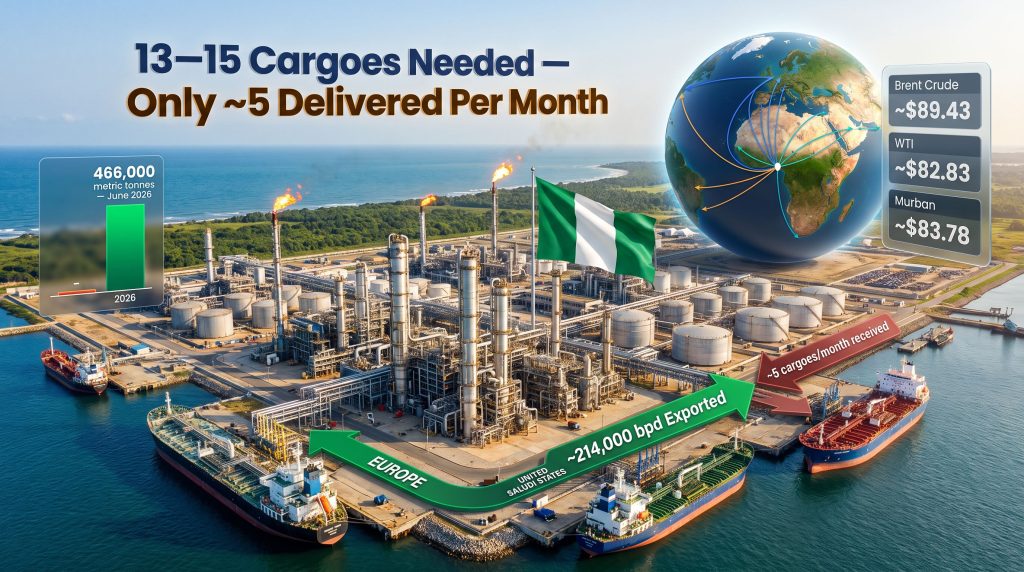
Industry reporting indicates that the refinery requires between 13 and 15 crude cargoes per month to sustain optimal throughput across its processing units. Current domestic supply under the existing naira-for-crude arrangement is reportedly tracking closer to five cargoes per month. That is a shortfall of roughly 60 to 65% of stated feedstock requirements, and it is the single most important number in understanding every commercial decision the refinery has made since production began ramping up.
To compensate, the facility has been sourcing crude from international markets. This introduces an immediate cost premium, because internationally traded crude is priced in US dollars against benchmarks that have remained elevated throughout 2025 and into 2026. Consequently, the broader crude oil price trends observed globally have made international sourcing increasingly expensive:
| Crude Benchmark | Price Level |
|---|---|
| Brent Crude | ~$89.43 per barrel |
| West Texas Intermediate (WTI) | ~$82.83 per barrel |
| Murban Crude | ~$83.78 per barrel |
| OPEC Basket | ~$84.17 per barrel |
| Gasoline Futures | ~$3.391 per gallon |
With raw material costs at these levels, and with geopolitical trade tensions in key producing regions continuing to support elevated price floors, the economics of processing internationally sourced crude for domestic naira-denominated sales become deeply problematic.
The Naira-for-Crude Policy: A Well-Intentioned Framework Under Severe Strain
The naira-for-crude arrangement was designed to address a structural inefficiency that has historically defined Nigeria's energy paradox: a major oil-producing nation importing refined products at great foreign exchange cost. The policy framework was intended to allow the Dangote refinery to receive domestically produced crude oil in exchange for selling finished petroleum products locally in naira, thereby reducing Nigeria's dependence on expensive fuel imports and preserving foreign exchange reserves.
The design logic was sound in theory. The execution has encountered a problem that the policy architects may not have fully anticipated.
Devakumar Edwin, Group Vice President of Oil and Gas at Dangote Industries Limited, addressed this operational reality in an interview with Vanguard, explaining that the refinery has been operating at full capacity while exporting a portion of its production precisely because crude deliveries under the naira arrangement have fallen dramatically short of requirements. He further described the financial challenge in specific terms: the refinery management took on considerable financial risk by continuing to sell petroleum products domestically in naira, yet converting those naira proceeds into US dollars, the currency required to pay international crude suppliers, has proven operationally impossible.
This is not a minor accounting inconvenience. It represents a fundamental currency mismatch at the core of the refinery's operating model:
- Input costs are priced in US dollars (international crude benchmarks)
- Revenue from domestic sales is denominated in Nigerian naira
- Naira convertibility into USD has been severely constrained by Nigeria's foreign exchange market conditions
- International crude suppliers require payment in US dollars, not naira
- The gap between naira inflows and dollar outflows cannot be bridged without either export revenue in hard currency or a functioning FX conversion mechanism
The result is a system where export sales are not a strategic preference but a financial survival mechanism. Selling refined products to European, American, and regional buyers in US dollars generates the hard currency the refinery needs to pay for its next shipment of internationally sourced crude. The export-first dynamic is, in this context, an entirely rational response to a broken domestic currency conversion system.
Mapping the Export Surge: Where Dangote's Fuel Is Going
The scale of the export reorientation is significant enough to have materially altered global refined product trade flows in specific categories. Nigeria's total refined product exports reached approximately 214,000 barrels per day in March 2026, with Dangote's output as the primary driver. By April 2026, jet fuel shipments to Europe alone were tracking at approximately 70,000 barrels per day, with the total European jet fuel allocation reaching an estimated 466,000 metric tonnes by June 2026.
| Export Destination | Product Type | Estimated Volume | Period |
|---|---|---|---|
| African Regional Markets | Mixed refined products | ~90,000 bpd | March 2026 |
| Europe | Jet fuel | ~70,000 bpd | April 2026 |
| Europe (total jet fuel) | Jet fuel | ~466,000 metric tonnes | June 2026 |
| United States | Gasoline | First cargo | August 2025 |
| Saudi Arabia | Refined products | Confirmed shipments | June 2026 |
The June 2026 figure is particularly striking: Nigeria overtook the United States as Europe's largest single source of jet fuel, a development that would have been considered implausible as recently as 2023 when the refinery was still in its commissioning phase.
The first gasoline cargo shipped to the United States in August 2025 was an early signal that Dangote's commercial ambitions extended well beyond the African continent. That delivery demonstrated that Nigerian refined products could meet the specification standards required for the world's most demanding fuel market, a technical validation that opened doors to further transatlantic trade relationships.
The inclusion of Saudi Arabia as a destination for Nigerian refined product exports deserves particular attention. Saudi Arabia is itself a major refining nation, home to the Ras Tanura complex and a range of sophisticated downstream assets. The fact that Dangote is shipping products into that market reflects price competitiveness and product quality that goes beyond what most analysts projected at the project's outset.
The Four Operational Pressures Forcing an Export-Driven Model
The export strategy is not being driven by a single factor. Four distinct pressures are operating simultaneously, and their combined effect makes an export-oriented operating posture virtually unavoidable at this stage:
1. The domestic crude shortfall. Receiving approximately five cargoes per month against a stated requirement of 13 to 15 means the refinery cannot fill its domestic obligations through local feedstock alone. International crude is the only alternative, and that crude must be paid for in hard currency.
2. The naira-to-dollar conversion barrier. Even where domestic revenues are strong in naira terms, the inability to convert those earnings into US dollars creates a liquidity mismatch that prevents the refinery from settling international crude invoices. This problem persists regardless of how much naira-denominated fuel the facility sells domestically.
3. Elevated global crude benchmarks. With Brent trading around $89.43 per barrel and the OPEC basket at $84.17, the cost of sourcing internationally is structurally high. The OPEC market influence on benchmark pricing means the margin available on naira-denominated domestic sales at regulated or near-regulated prices is insufficient to cover these input costs. Export sales at dollar-denominated international market prices offer materially better margin profiles.
4. Geopolitical supply disruptions creating opportunistic export windows. Ongoing instability in key Middle Eastern producing and refining regions has created periodic supply gaps, particularly in European aviation fuel markets. Dangote's geographic position and processing capability have allowed it to step into these gaps with competitively priced product at precisely the moments when European buyers are most motivated to diversify their supplier base.
Regional and Global Market Disruption: What the Export Surge Means for Competitors
The transformation in Nigeria's position within refined product trade flows is best understood through comparison:
| Market Position | Pre-Export Scale | Post-Surge Situation (2026) |
|---|---|---|
| Nigeria's role in European jet fuel | Negligible | Largest single supplier (June 2026) |
| US gasoline imports from Nigeria | None | First cargo delivered (Aug 2025) |
| West African intra-regional supply | Import-dependent | Partially supplied by Dangote |
| Saudi Arabia as product destination | Self-sufficient | Receiving Nigerian refined exports |
For West African neighbours, Dangote's approximately 90,000 barrels per day of regional exports in March 2026 represents a partial solution to the chronic import dependency that has defined the region's fuel supply for decades. Countries that previously relied on European or Middle Eastern product arriving via long-haul tanker routes are now accessing Nigerian-refined fuel at shorter transit distances and, potentially, more competitive prices.
For European refiners, particularly those producing jet fuel for aviation hubs, the emergence of a new large-scale competitor with low-cost feedstock access during periods of domestic crude availability represents a structural shift in the competitive landscape. The scale of the June 2026 jet fuel volumes from Nigeria is large enough to influence price dynamics, not just fill incremental spot demand.
The next major ASX story will hit our subscribers first
The Domestic Consequence: Nigerian Consumers Carry the Cost
The export-driven operational strategy has a direct and measurable impact on Nigerian fuel consumers. When a refinery of this scale is directing a significant portion of its output abroad, the domestic market receives less supply than its nameplate capacity would suggest is available. Combined with the crude shortfall constraining total throughput, the result is a domestic market that remains tighter than it should be given the presence of a 650,000 barrel per day facility operating within its borders.
However, an earlier oil price rally driven by global macroeconomic factors has further complicated the domestic pricing environment, making cost pass-through to consumers even more pronounced.
The central policy tension here is rarely articulated clearly: redirecting more domestically produced crude to the Dangote refinery for local processing would reduce Nigeria's crude export volumes and the foreign exchange those exports generate. Nigeria faces a direct trade-off between maximising short-term hard currency earnings from crude exports and capturing long-term value through domestic refined product sales. Resolving this tension requires a political decision, not merely a commercial one.
Scenario modelling around crude allocation changes illustrates the stakes clearly. If domestic crude deliveries were to double from approximately five cargoes to ten per month, the refinery could meaningfully increase domestic supply, reducing the structural pressure to export for hard currency. However, this would require diverting crude currently sold on international markets, with corresponding reductions in upstream export revenue for the Nigerian National Petroleum Company and the federal government.
Three Trajectories for the Refinery's Next Phase
The operational position as it stands in mid-2026 represents an unstable equilibrium. Three distinct scenarios exist for how this situation evolves over the following 24 months:
Scenario A: Crude Supply Resolved. Domestic crude allocations increase to the 13 to 15 cargo per month level required for full throughput. The refinery serves the Nigerian domestic market comprehensively while maintaining selective export programmes where margin and logistics support it. Domestic fuel prices moderate as supply increases.
Scenario B: Status Quo Persists. Feedstock deliveries remain at current depressed levels, the naira conversion problem continues without structural resolution, and export revenue remains the primary mechanism for generating the hard currency needed to fund international crude purchases. Domestic prices remain elevated and Nigerian consumers continue absorbing the cost of the supply gap.
Scenario C: Structural Pivot to Export Refiner. Dangote Industries formally repositions the facility as a regional and global export-oriented refinery, sourcing international crude systematically and structuring the majority of its offtake agreements in US dollar-denominated export contracts. The domestic market is served as a secondary priority, and the refinery operates more analogously to the large export refining hubs at Rotterdam or Jamnagar than to a domestically focused processing asset.
Benchmarking Against the World's Export Refining Giants
The comparison to Jamnagar is instructive. Reliance Industries' complex in Gujarat, India, which processes in excess of 1.2 million barrels per day, was explicitly designed from its earliest phases as an export-oriented facility. Its economics were built around international crude sourcing and dollar-denominated product exports from the outset, not retrofitted to that model after domestic supply arrangements failed. The lesson for Nigeria is that export refining at scale requires a financial architecture, currency management framework, and supply chain design that is fundamentally different from a domestically oriented plant.
Rotterdam's position as Europe's refining hub offers a different model: a geographically strategic processing location that draws on multiple crude sources and serves a diverse range of end markets through an integrated logistics network. According to the Port of Rotterdam Authority, the hub handles hundreds of millions of tonnes of cargo annually, underscoring the scale at which competitive export refining must operate. Dangote's location on the Atlantic coast of West Africa provides analogous geographic advantages, sitting at the crossroads of transatlantic shipping lanes with access to both African regional demand and trans-oceanic export markets.
Whether by deliberate strategic design or operational necessity, Dangote refinery fuel exports amid crude shortages have effectively demonstrated that the facility can compete in global refined product markets at a scale that reshapes established trade flows. The question of whether this export capability becomes the refinery's primary identity, or remains a consequence of a domestic supply problem waiting to be resolved, will be answered by decisions made in Abuja as much as in Lagos.
This article contains forward-looking analysis and scenario projections based on publicly available information and reported operational data. Readers should note that refinery throughput figures, export volumes, and crude benchmark prices are subject to change. Nothing in this article constitutes financial advice or an investment recommendation.
Want to Capitalise on the Resource and Energy Discoveries Reshaping Global Markets?
Discovery Alert's proprietary Discovery IQ model delivers real-time alerts on significant ASX mineral discoveries, instantly translating complex data across 30+ commodities into actionable investment insights — explore the historic returns major discoveries have generated and begin your 14-day free trial at Discovery Alert to position yourself ahead of the market.