June 4, 2026
Indonesia's RKAB Quota System: The Regulatory Mechanism Reshaping Nickel Markets
When sovereign governments decide to manage commodity output through discretionary annual quota systems rather than market signals, the consequences ripple far beyond national borders. In Indonesia's nickel sector, this dynamic has been building for years, and the events of mid-2026 have brought it into sharp focus. The Weda Bay Nickel ore production halt due to mining quota exhaustion is not an isolated operational failure. It is a window into the structural tension between resource nationalism, industrial policy, and the global supply chains that depend on Indonesian nickel flowing reliably to market.
When big ASX news breaks, our subscribers know first
Understanding the RKAB Framework: Annual Mining Quotas as a Policy Instrument
Indonesia's Rencana Kerja dan Anggaran Biaya, commonly abbreviated as RKAB, is the government-administered mechanism through which the Ministry of Energy and Mineral Resources sets annual extraction limits for individual mining concessions. Each year, operators submit work plans and budget proposals to the ministry, which then issues approved production volumes. These quotas are not simply administrative paperwork. They function as hard production ceilings that determine exactly how many wet metric tonnes of ore a concession holder is legally permitted to extract in a given calendar year.
The policy rationale behind tightening RKAB allocations in 2026 reflects several converging objectives. Furthermore, understanding these objectives is essential for anyone monitoring the Indonesian nickel industry challenges that continue to shape market dynamics:
- Supply-side price management: Indonesia is acutely aware that flooding global markets with low-cost nickel ore erodes the value of its own resource base. Quota reductions are a deliberate tool to prevent oversupply from depressing nickel prices.
- Downstream industrial development: Jakarta's long-term strategy prioritises processing ore into higher-value products such as nickel pig iron, nickel matte, and battery-grade nickel sulphate on Indonesian soil, rather than exporting raw ore.
- Resource nationalism: Controlling extraction volumes keeps leverage in Indonesian hands, ensuring that foreign joint venture partners cannot unilaterally maximise output at the expense of national policy objectives.
"The RKAB system transforms what might appear to be a technical permitting process into a live instrument of macroeconomic management. When quota allocations diverge sharply from operational baselines, the consequences are immediate and material."
The Production Mathematics Behind the Weda Bay Suspension
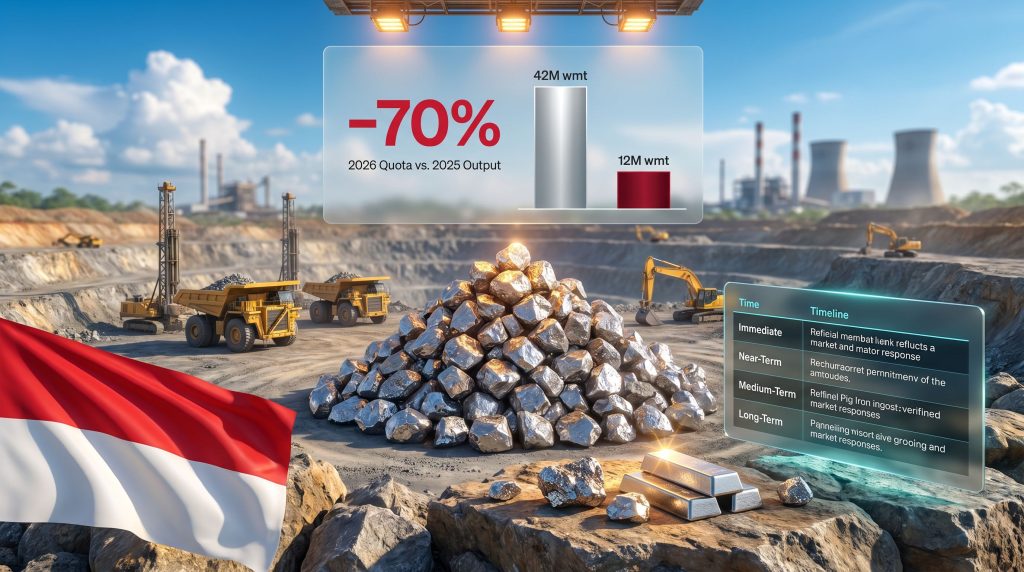
The arithmetic of the Weda Bay Nickel ore production halt due to mining quota constraints is stark. In 2025, the operation extracted approximately 42 million wet metric tonnes of nickel ore, making it one of the most prolific single-source nickel ore suppliers in the world. For 2026, the initial RKAB allocation was set at just 12 million wet metric tonnes, a reduction of roughly 70% compared to the prior year's actual output.
| Metric | 2025 Actual | 2026 Initial Quota | Variance |
|---|---|---|---|
| Annual Ore Volume (wet metric tonnes) | 42 million | 12 million | -70% |
| Share of IWIP Total Ore Processed | ~35% | Significantly reduced | Material deficit |
| Potential Ore Deficit at IWIP (if no extension) | N/A | ~30 million wmt | Critical shortfall |
At an operational rate calibrated for 42 million tonnes annually, a 12 million tonne ceiling is consumed rapidly. By late May 2026, that initial quota had been fully exhausted, triggering an immediate suspension of ore mining activities. The operation transitioned into what the industry terms a care-and-maintenance phase, with workforce reductions implemented as extraction ceased.
What Care-and-Maintenance Actually Means for a Mining Operation
The care-and-maintenance classification is widely misunderstood outside the mining industry. It does not mean a site is abandoned or that equipment is left to deteriorate. Rather, it refers to a structured operational posture in which:
- All commercial ore extraction is suspended indefinitely.
- Essential infrastructure, including haul roads, processing facilities, water management systems, and tailings containment, is actively maintained to preserve the asset.
- A reduced workforce manages safety, environmental compliance, and equipment preservation.
- The operation remains capable of resuming commercial production relatively quickly once the regulatory constraint is resolved.
The cost structure during care-and-maintenance differs significantly from active production. Fixed costs, including site security, environmental monitoring, and equipment servicing, continue to accrue without revenue generation. This creates a financial drain that intensifies pressure on the operating joint venture to secure a quota extension promptly.
Indonesia Weda Bay Industrial Park: Why Concentration Risk Matters
The Indonesia Weda Bay Industrial Park, widely referred to as IWIP, is one of Southeast Asia's most significant nickel processing hubs, handling approximately 120 million wet metric tonnes of nickel ore annually across its integrated smelting and refining operations. Weda Bay Nickel's 42 million tonnes of annual ore supply in 2025 represented roughly one-third of that total feedstock requirement.
This concentration of supply dependency in a single concession holder is the critical vulnerability exposed by the current quota crisis. When a single upstream supplier accounting for 35% of a major industrial park's feedstock encounters a 70% production cut, the downstream consequences are not hypothetical. They are structural. Consequently, the broader Indonesian nickel price trends are increasingly sensitive to how this situation resolves.
NPI Production Buffers and the Stockpile Runway
Nickel pig iron smelters at IWIP do not immediately go dark when upstream ore supply contracts. Existing ore stockpiles accumulated during prior periods of higher production provide a buffer that sustains downstream processing for a limited time. However, this buffer is finite, and the industry distinction between ore mining suspension and NPI production continuity matters enormously to investors and supply chain managers.
The stockpile runway is a short-term mechanism, not a structural solution. Once accumulated inventories are drawn down to minimum operational thresholds, the upstream quota problem directly translates into a downstream output reduction. The timeline for this transition depends on current stockpile volumes at IWIP, which are not publicly disclosed in granular detail, but industry norms suggest a buffer measured in weeks to a few months rather than quarters.
Global Supply Chain Implications: The Philippine Import Substitution Problem
If Weda Bay Nickel's quota is not extended before IWIP stockpiles are depleted, the industrial park's operators face a binary choice: source replacement ore from the Philippines or accept reduced NPI output. Neither option is cost-neutral, and this is where the Weda Bay situation transforms from a local regulatory matter into a global nickel market event.
Philippine nickel ore is technically viable as a feedstock for Indonesian NPI smelters, but it comes with meaningful cost penalties:
- Logistics costs are materially higher given shipping distances and port infrastructure constraints.
- Ore grade variability between Indonesian laterite deposits and Philippine sources can affect smelter efficiency and processing yields.
- Volume scalability is limited. The Philippines cannot rapidly ramp ore export volumes to fill a potential 30 million wet metric tonne deficit without straining its own production capacity and export logistics.
"When a 30 million wet metric tonne ore deficit cannot be substituted at equivalent cost, the shortfall does not disappear. It converts into elevated NPI production costs, which in turn apply upward pressure on global nickel benchmark prices."
Short-Term to Long-Term Market Response Framework
| Timeframe | Likely Market Response |
|---|---|
| Immediate (0-4 weeks) | Ore supply gap at IWIP; NPI output sustained by existing stockpiles |
| Near-term (1-3 months) | Stockpile depletion begins; Philippine import volumes increase; cost pressure on NPI producers rises |
| Medium-term (3-6 months) | NPI price floor elevation; potential nickel price support on LME as high-cost production becomes marginal |
| Long-term (6-12 months) | Structural reassessment of Indonesian quota policy; foreign investor confidence recalibration across the sector |
Indonesia's Policy Calculus: Price Support Versus Investment Deterrence
The Indonesian government's decision to implement a 70% quota reduction at one of its most productive nickel operations is not the result of bureaucratic miscalculation. It reflects a deliberate supply-side management strategy in a nickel market that has been characterised by chronic oversupply since 2022–2023, when Indonesian NPI production growth significantly outpaced global demand growth, particularly from the battery supply chain.
By constraining upstream ore output, Indonesia effectively signals to global markets that it will not allow domestic oversupply to permanently depress nickel prices to levels that undermine the long-term viability of its own resource industry. This is a sophisticated application of resource nationalism that goes beyond simple export controls.
However, the strategy carries a significant countervailing risk. Chinese industrial groups, which represent critical joint venture partners across Indonesia's nickel processing sector, have publicly signalled that combinations of quota restrictions and escalating tax burdens create genuine deterrents to continued capital investment. When the world's largest consumer and processor of nickel raises concerns about the investability of Indonesian nickel assets, the policy calculus becomes considerably more complex.
The Joint Venture Architecture and Sovereign Risk
Weda Bay Nickel's ownership structure exemplifies the multi-party complexity that characterises major Indonesian nickel assets. The operation involves a French mining major (Eramet), a Chinese industrial group (Tsingshan Group), and Indonesian state mining enterprise Antam in a tri-party arrangement. Eramet has publicly responded to the initial production volumes granted by Indonesian authorities, highlighting the real-world impact on the joint venture's commercial viability.
When the sovereign partner's government imposes quota restrictions that render the operation commercially unviable for months at a time, it creates a structural tension within the joint venture itself. Each partner carries different risk tolerances, capital cost structures, and strategic objectives. A European mining company with global portfolio diversification manages an Indonesian care-and-maintenance phase differently to a Chinese industrial group with integrated downstream NPI consumption requirements. This divergence of interests under regulatory pressure is an underappreciated dimension of sovereign risk in Indonesian nickel assets.
"Institutional investors modelling Indonesian nickel exposure need to embed a structural risk premium that accounts not just for commodity price volatility, but for the discretionary nature of annual quota allocations. When production volumes can be reduced by 70% through an administrative decision, conventional reserve and production forecasts carry a materially wider confidence interval."
The next major ASX story will hit our subscribers first
The RKAB Revision Process: Three Scenarios and Their Market Consequences
RKAB revisions are typically processed by Indonesia's Ministry of Energy and Mineral Resources before the end of July each year. This creates a defined decision window for the Weda Bay Nickel ore production halt situation, with the outcome expected to fall into one of three materially different scenarios:
- Full quota restoration to approximately 42 million wet metric tonnes: This outcome represents operational normalisation. IWIP's ore supply deficit would be resolved, Philippine import substitution pressure would ease, and the market disruption would be contained to the Q2 2026 period. Long-term investor confidence, however, would still need to account for the precedent set.
- Partial quota extension in the range of 25–30 million wet metric tonnes: A compromise outcome that allows partial production recovery but leaves a residual ore deficit at IWIP. Philippine imports would still need to increase, and NPI production costs would remain elevated relative to pre-restriction levels.
- No extension granted within the July 2026 window: The most disruptive scenario. A sustained ore deficit at IWIP would force a structural shift toward higher-cost Philippine ore across the facility's entire feedstock procurement strategy. NPI production costs would rise materially, providing a floor under global nickel prices through H2 2026 and potentially into 2027.
Broader Strategic Implications for Battery Supply Chains
The Weda Bay Nickel ore production halt due to mining quota exhaustion carries implications that extend beyond the nickel pig iron market into the emerging battery materials supply chain. Indonesia has positioned itself as a cornerstone of global battery-grade nickel sulphate supply, with significant investment flowing into high-pressure acid leach (HPAL) processing facilities designed to convert laterite ore into EV battery precursor materials. In addition, the Indonesian nickel in energy transition continues to attract considerable strategic attention from battery manufacturers worldwide.
A regulatory environment that can impose a 70% production cut on the country's largest nickel ore operations creates planning uncertainty not just for NPI smelters, but for the entire downstream value chain dependent on Indonesian nickel. Battery manufacturers, cathode active material producers, and EV original equipment manufacturers that have built supply chain strategies around Indonesian nickel availability must now incorporate RKAB quota risk into their supply security frameworks.
This broader signal — that Indonesian resource governance is willing to accept short-term production disruptions in pursuit of long-term price and industrial policy objectives — is likely to accelerate supply chain diversification efforts among major battery technology buyers. Furthermore, investors assessing the wider battery metals investment landscape will need to account for this regulatory dimension when modelling Indonesian nickel exposure. Even so, Indonesia continues to offer compelling cost and resource scale advantages, particularly given the battery storage demand growth reshaping global energy markets.
Frequently Asked Questions: Weda Bay Nickel Production Halt
What caused the Weda Bay Nickel ore production halt in 2026?
The suspension resulted from the exhaustion of the operation's RKAB annual mining quota, which was set at 12 million wet metric tonnes for 2026. This represented a reduction of approximately 70% compared to the 42 million wet metric tonnes extracted in 2025.
Will nickel pig iron production be immediately affected?
Not immediately. Existing ore stockpiles at IWIP are expected to sustain near-term NPI production. However, if the quota is not extended before stockpile levels fall to minimum operational thresholds, downstream output will face material disruption.
When could a quota extension be approved?
RKAB revisions are typically processed before the end of July each year. The outcome of ongoing discussions between the joint venture operator and Indonesia's Ministry of Energy and Mineral Resources is expected within this window.
What is the scale of the potential ore shortfall at IWIP?
If no extension is granted, an estimated deficit of approximately 30 million wet metric tonnes could emerge at the Indonesia Weda Bay Industrial Park, representing roughly one-third of the facility's total annual ore processing capacity.
How does this situation affect global nickel prices?
A sustained ore shortfall at one of Indonesia's largest nickel processing hubs would likely elevate NPI production costs, reduce output volumes, and provide a degree of price support for benchmark nickel on the London Metal Exchange, particularly if Philippine ore imports cannot substitute at comparable cost or volume.
Want To Stay Ahead Of The Next Major Commodity Market Shift?
Discovery Alert's proprietary Discovery IQ model scans ASX announcements in real time, instantly identifying significant mineral discoveries and actionable investment opportunities across nickel, battery metals, and more than 30 other commodities — turning complex market signals into clear, timely insights. Explore historic major mineral discoveries and their market returns, then begin your 14-day free trial at Discovery Alert to position yourself ahead of the next significant market move.