July 22, 2026
The Anatomy of an Oil Laundering Machine: How Iran Turned Iraq Into Its Financial Lifeline
For decades, the world's most sophisticated sanctions evasion operation ran not through clandestine back-channels or rogue micro-states, but through one of the most oil-rich countries on earth. Iraq, sharing borders, shared geological formations, and deeply interwoven political relationships with Iran, became the primary conduit through which Tehran moved sanctioned crude, funds, and influence into global markets. The architecture of this system was not accidental. It was deliberate, layered, and refined over years of institutional complicity. Understanding how it worked, and why Washington has now shifted from passive observation to active dismantlement, is essential context for anyone tracking US sanctions on Iraq oil smuggling to Iran and the broader transformation of Middle East energy geopolitics.
When big ASX news breaks, our subscribers know first
Why the Iraq-Iran Oil Corridor Existed for So Long
The fundamental enabler of Iran's Iraqi oil corridor was geography. Several of the most productive oil-bearing geological formations in the world straddle the Iran-Iraq border, including reservoirs in the southern Mesopotamian Basin. Because crude oil does not respect political boundaries underground, oil extracted near the border cannot be definitively attributed to one national territory over another through physical analysis alone.
This geological ambiguity created a structural loophole that became the foundation of a multi-billion dollar laundering operation. Iranian crude, once commingled with Iraqi output at shared or proximate extraction points, became effectively indistinguishable in terms of origin. What followed was a documentation exercise rather than a technical one: paperwork was altered to reflect Iraqi provenance, and the blended cargo moved into international markets carrying the reputational and legal shield of non-sanctioned Iraqi oil.
Iran's former Petroleum Minister Bijan Zanganeh acknowledged this practice publicly in 2020, stating that exported Iranian oil does not leave under Iran's name and that the associated documentation is changed repeatedly along with cargo specifications. This admission, made openly at the time, received surprisingly limited attention in Western policy circles, reflecting the broader tolerance that multiple successive U.S. administrations extended to this system for years.
How the Blending and Re-Documentation Pipeline Operated
The physical mechanics of US sanctions on Iraq oil smuggling to Iran evasion followed a repeatable playbook with distinct operational stages:
| Stage | Method | Key Location |
|---|---|---|
| Extraction | Crude sourced from border-straddling or proximate fields | Qayara Oil Field, southern Iraq |
| Land Movement | Official Iraqi trucking authorisations used for transport | Southern Iraq road corridors |
| Terminal Blending | Iranian crude mixed into Iraqi oil streams at port facilities | VS Oil Terminal FZE, Khor al-Zubair |
| Documentation Alteration | Country-of-origin paperwork rewritten to show Iraqi source | Port of loading |
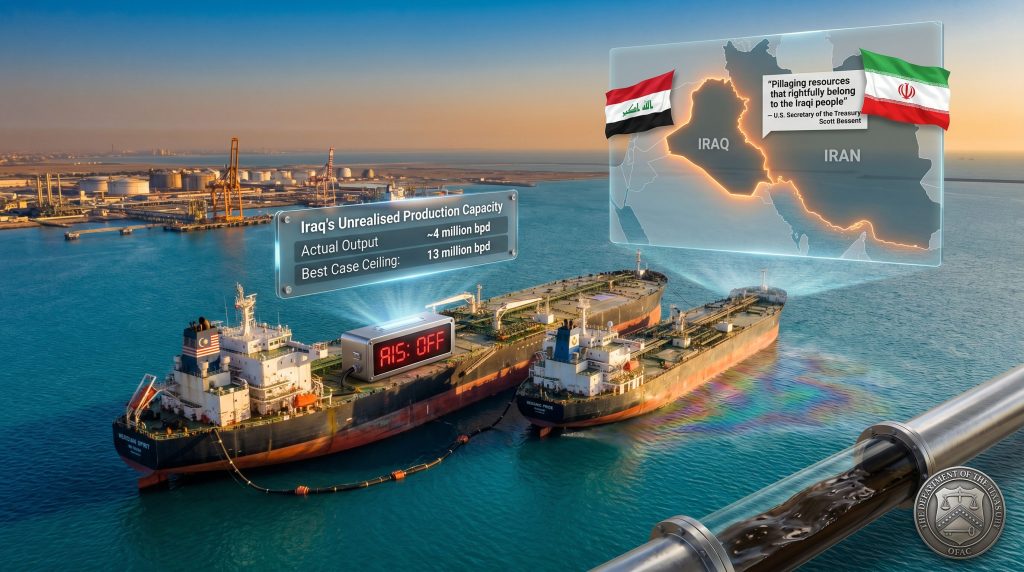
| Maritime Disappearance | Vessel AIS tracking systems deactivated | Open international waters |
| Ship-to-Ship Transfer | Cargo moved between vessels outside jurisdiction boundaries | Near Southeast Asian maritime corridors |
| Flag Substitution | Oil transferred to tankers flying Malaysian or Indonesian flags | At-sea or near-port handover points |
| End Delivery | Rebranded crude sold to buyers, primarily Chinese independent refiners | China, Malaysia, Indonesia |
The Automatic Identification System, or AIS, is a mandatory maritime tracking tool that broadcasts a vessel's identity, position, heading, and speed to other ships and shore-based monitoring stations. It was designed for collision avoidance and search-and-rescue coordination, but it functions equally as a sanctions enforcement tool by allowing regulators and analysts to track vessel movements. Deliberately deactivating AIS renders a tanker effectively invisible to routine monitoring, a practice sometimes referred to in maritime compliance circles as going dark.
The subsequent use of ship-to-ship transfers in international waters compounds this evasion layer. Cargo moved between vessels at sea is difficult to document, rarely witnessed by enforcement authorities, and can be attributed to the receiving vessel's flag state, not the originating one. Malaysia and Indonesia have historically featured prominently in these transfer operations because vessels flying those flags carry the implicit legitimacy of non-sanctioned trading nations, lending surface-level credibility to cargo manifests that list Southeast Asian ports as points of origin.
Furthermore, similar evasion playbooks have been documented in other sanctioned contexts. The sanctions on Russian oil have demonstrated that the ghost fleet model and AIS manipulation are not unique to Iranian networks but represent a broadly adopted methodology across multiple state actors seeking to monetise sanctioned energy exports.
Iran's then-Foreign Minister Mohammad Javad Zarif told an audience at the 2018 Doha Forum that if Iran had perfected any art, it was the art of evading sanctions, and that this expertise could theoretically be taught to others. This statement, made openly at an international policy forum, illustrated how institutionalised and even celebrated the evasion architecture had become within Iran's governing apparatus.
The OFAC Enforcement Architecture: Three Executive Orders and What They Authorise
The legal foundation for current enforcement actions rests on three executive orders that together cover the full spectrum of Iran-related sanctionable conduct:
- Executive Order 13846 targets Iran's energy and financial sectors, forming the primary instrument for oil-related designations
- Executive Order 13902 extends sanctions to Iran's construction, manufacturing, and mining industries, capturing upstream supply chain participants
- Executive Order 13224 addresses terrorism financing, creating the legal bridge between oil smuggling revenues and Iran's proxy militia activities
When OFAC designates an individual or entity under these authorities, the consequences are automatic and cascading:
- All U.S.-jurisdiction assets are immediately frozen with no notice period required
- U.S. persons and financial institutions are broadly prohibited from any transaction with designated parties
- Foreign banks and energy purchasers face secondary sanctions exposure if they knowingly facilitate significant transactions with blocked entities
- Vessels, terminal operators, and intermediary companies connected to designated networks become subject to separate identification and restriction actions
The secondary sanctions mechanism is particularly significant because it extends Washington's enforcement reach beyond American borders. A Chinese bank processing a payment for a cargo of blended crude that originated in a sanctioned Iranian field is potentially exposed to secondary sanctions even if no U.S. person or institution was directly involved in the transaction. For a broader overview of the international sanctions against Iran, the historical development of these frameworks reveals how progressively the enforcement architecture has expanded over several decades.
Who Was Targeted: The Designation Cascade
The July 2025 OFAC actions represented a notable escalation in both the seniority of targets and the explicit linkage drawn between commercial oil networks and Iranian militia financing.
The Salim Ahmed Said Network formed the first wave of designations, targeting the operational logistics layer of the blended crude export chain, including entities involved in transport coordination, terminal access, and financial clearing for sanctioned petroleum.
The Waleed al-Samarra'i Network followed, expanding designations to include an Iraqi-Kittitian businessman whose network was alleged to have systematically disguised Iranian crude as Iraqi oil for onward sale to international buyers.
Iraq's Deputy Oil Minister, Ali Maarij Al-Bahadly, represented the most diplomatically significant designation. OFAC alleged that Al-Bahadly used both his prior role heading the Iraqi parliament's oil and gas committee and his subsequent ministerial position to:
- Authorise the trucking of oil products worth several million dollars per day from the Qayara Oil Field
- Direct those shipments to VS Oil Terminal FZE at Khor al-Zubair for export processing
- Enable the commingling of Iranian crude within officially documented Iraqi oil export flows
- Facilitate the operational activities of Iran-backed militia Asa'ib Ahl Al-Haq
The State Department simultaneously designated six entities and formally identified four vessels for their participation in the purchase, transport, and marketing of Iranian petroleum in violation of U.S. sanctions law.
U.S. Treasury Secretary Scott Bessent described the Iranian regime's conduct as pillaging resources that belong to the Iraqi people in order to fund terrorism against the United States and its partners, framing the enforcement action as protective of Iraqi sovereign interests rather than purely punitive toward Baghdad.
Designating a sitting deputy minister crosses a threshold that prior administrations consistently avoided. It signals that Washington is now prepared to impose personal costs on governance-level actors rather than limiting enforcement to commercial intermediaries, a significant recalibration of enforcement philosophy. This approach aligns broadly with how the U.S. policy on PDVSA evolved, where successive rounds of designation gradually moved from purely commercial targets toward state-institutional actors.
The Geopolitical Dimension: Chinese and Russian Energy Interests in Iraq
How Have Chinese and Russian Interests Shaped the Landscape?
The enforcement campaign cannot be fully understood without examining its secondary objective: limiting the entrenchment of Chinese and Russian energy interests in Iraqi upstream development.
Following the U.S. withdrawal from the Joint Comprehensive Plan of Action in May 2018, Beijing significantly expanded its energy footprint across the Middle East. In Iraq specifically, current industry estimates indicate that Chinese companies manage more than one-third of all proven oil and gas reserves and are involved in operations covering over two-thirds of Iraq's current production capacity. This concentration of Chinese operational control over a country with Iraq's reserve base represents a strategic concern that goes well beyond bilateral U.S.-China trade tensions.
A high-ranking Russian official, in a disclosure reported previously by energy analysts tracking Kremlin strategic communications, characterised the joint China-Russia approach to Middle Eastern energy as a deliberate effort to exclude Western firms from deals in Iraq and Iran, with the stated objective of making the end of Western energy hegemony in the region the decisive chapter in a broader geopolitical contest. Whether or not one accepts this framing at face value, the strategic logic is clear: energy dependency creates leverage, and leverage over Iraq's oil flows translates to leverage over global supply.
OFAC's secondary sanctions warning explicitly directed at foreign financial institutions connected to China's independent refinery sector, issued amid ongoing U.S.-China trade negotiations, adds a further dimension to this enforcement action. These so-called teapot refiners have historically been among the most active purchasers of discounted sanctioned crude from Iran and Russia. Exposing them to secondary sanctions designation risks disrupting a purchasing channel that Iran relies on to monetise its oil production. Consequently, these geopolitical trade shifts are reshaping how nations structure their energy partnerships and compliance obligations on a global scale.
The next major ASX story will hit our subscribers first
Iraq's Unrealised Production Potential and the Western Operator Premium
What Is Iraq's True Production Ceiling?
A less frequently discussed dimension of this enforcement campaign involves Iraq's theoretical production ceiling and the identity of the operators best positioned to reach it.
Iraq's 2013 Integrated National Energy Strategy modelled three distinct forward production trajectories:
| Scenario | Target Capacity | Original Timeline |
|---|---|---|
| Best Case | 13 million bpd (declining to ~10 million bpd long-term) | Peak by 2017, sustained through 2023 |
| Mid-Range | 9 million bpd | 2020 |
| Worst Case | 6 million bpd | 2020 |
| Actual Output (Pre-Conflict Baseline) | 4.0 to 4.2 million bpd | 2025 |
The gap between actual output and even the worst-case INES scenario represents one of the largest single-country production shortfalls in global oil markets. Closing this gap requires substantial investment in reservoir pressure management infrastructure, with the Common Seawater Supply Project being the most critical near-term requirement. This project involves extracting and treating seawater from the Persian Gulf for injection into declining oil reservoirs to maintain the subsurface pressure necessary for continued extraction.
French supermajor TotalEnergies is currently engaged in this project alongside three other Iraqi energy initiatives, representing the type of Western technical and capital involvement that U.S. policy is designed to create the conditions for. Industry assessments consistently indicate that Western energy companies retain meaningful technological and operational advantages over Chinese and Russian counterparts in complex reservoir management and enhanced oil recovery applications. OPEC's market influence over Iraqi output decisions further complicates the timeline for closing this production gap.
Secondary Sanctions Exposure: Who Faces Risk?
The enforcement escalation creates measurable compliance risk across a broad spectrum of actors:
| Actor Category | Exposure Level | Primary Risk Trigger |
|---|---|---|
| Chinese independent (teapot) refineries | High | Purchasing Iranian crude falsely documented as Iraqi |
| Foreign financial institutions processing oil payments | High | Facilitating transactions with designated entities |
| Maritime insurers covering flagged tankers | Moderate | Providing coverage to vessels on OFAC identification lists |
| Southeast Asian commodity traders | Moderate to High | Brokering blended crude cargoes linked to sanctioned networks |
| Iraqi state-adjacent oil entities | Escalating | Continued institutional facilitation of sanctioned flows |
If Baghdad fails to demonstrate meaningful enforcement cooperation, the next escalation tier could plausibly include restrictions on Iraq's access to U.S. dollar-denominated correspondent banking networks, through which the overwhelming majority of Iraq's oil export revenues are processed. Such a step would have immediate and severe consequences for the Iraqi state budget, which is almost entirely dependent on oil revenues.
Iraq's Political Transition and the U.S. Two-Track Approach
Following parliamentary elections held on 11 November, a prolonged political negotiation process produced Prime Minister-designate Ali al-Zaidi, a businessman whose partial cabinet subsequently received parliamentary approval. Key portfolios including Interior and Defence remained unresolved at the time of the most recent OFAC actions.
President Trump publicly congratulated al-Zaidi following his nomination and extended a personal invitation for the Prime Minister-designate to visit Washington after completing government formation. This diplomatic warmth stood in direct contrast to Trump's earlier January statement threatening to withdraw U.S. support for Iraq if former Prime Minister Nouri al-Maliki had been designated to lead a new cabinet.
The simultaneous application of targeted sanctions against Iran-aligned actors within Iraq's oil ministry and public diplomatic support for a new government perceived as more aligned with Western interests reflects a coherent dual-track strategy. Enforcement actions punish incumbents who enabled the old system while diplomatic signals create incentives for the incoming administration to break with it.
What This Signals for Global Oil Markets
The trajectory of US sanctions on Iraq oil smuggling to Iran enforcement carries implications that extend well beyond bilateral diplomacy:
- Designating a senior government official rather than purely commercial actors marks a structural shift in enforcement philosophy that other oil-producing governments should interpret as a warning regarding governance-level complicity
- Secondary sanctions warnings aimed at Chinese refinery purchasers represent a direct linkage between the Iraq-Iran enforcement campaign and U.S.-China strategic competition
- Iraq's production gap of approximately 5 to 9 million bpd relative to its modelled potential means that reshaping its upstream operator base has material consequences for long-term global supply capacity
- The combination of enforcement pressure and political diplomacy suggests Washington is pursuing durable structural change in Iraq's energy governance rather than a temporary enforcement spike
- Continued escalation, particularly any move toward restricting Iraqi correspondent banking access, could have significant near-term consequences for global oil supply availability
This article is intended for informational and analytical purposes only and does not constitute investment advice. Forecasts, scenario analyses, and geopolitical assessments involve inherent uncertainty and should not be relied upon as predictions of future market conditions or policy outcomes.
Want To Stay Ahead of Major Commodity Shifts Reshaping Global Markets?
Discovery Alert's proprietary Discovery IQ model delivers real-time alerts on significant ASX mineral discoveries, instantly translating complex geological and commodity data into actionable investment insights — explore historic discoveries and their remarkable returns to understand the opportunity, then begin your 14-day free trial at Discovery Alert to position yourself ahead of the market.