July 22, 2026
The Quiet Signals Hidden Inside a Modest Production Beat
Global iron ore markets rarely move on single data points in isolation. What matters far more is the layered context surrounding any given number: where it sits relative to expectations, which operational systems drove it, and what it implies about the trajectory of one of the world's most consequential commodity supply chains. When the second-largest seaborne iron ore producer reports its quarterly figures, traders, steel mills, and long-term investors all run the same diagnostic exercise simultaneously.
The headline percentage rarely tells the whole story. Vale iron ore output up 0.8% in the second quarter of 2026 is the kind of figure that risks being dismissed as unremarkable. However, peeling back the layers reveals a more textured picture: a meaningful beat against analyst consensus, a record quarter at the company's flagship mine, and a divergence between production and sales growth that carries its own market signal.
When big ASX news breaks, our subscribers know first
Why the Consensus Beat Matters More Than the Year-Over-Year Change
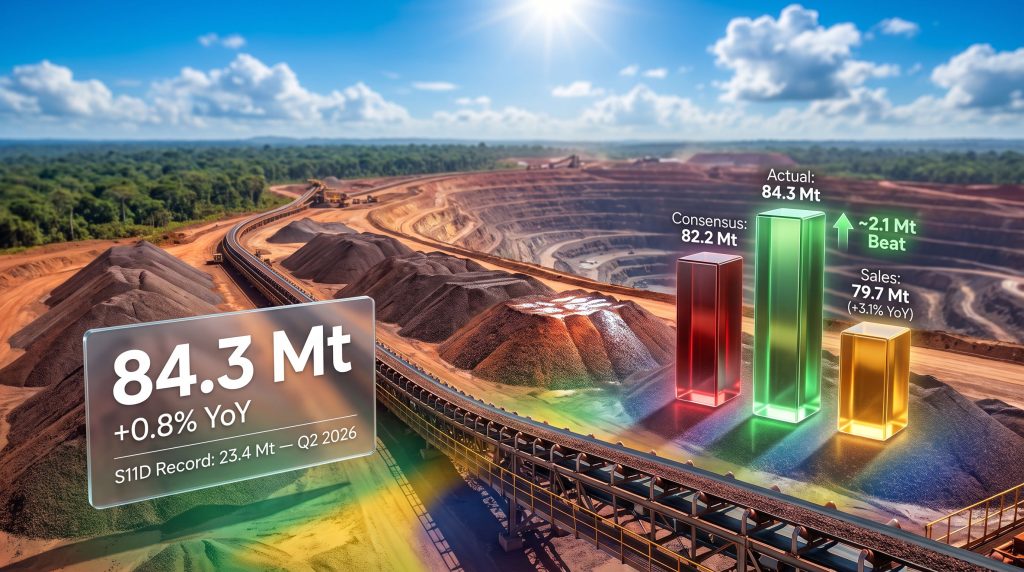
For the April to June 2026 quarter, Vale reported total iron ore production of 84.3 million metric tonnes (Mt), a 0.8% increase compared to the same period in 2025. Viewed in isolation, that number looks modest. But the more analytically significant figure is the gap between what actually happened and what the market expected.
The Visible Alpha analyst consensus had pencilled in 82.2 Mt ahead of the release. Vale's actual output exceeded that estimate by approximately 2.1 Mt, representing a roughly 2.6% beat against consensus. Furthermore, understanding the iron ore demand outlook helps contextualise why even modest production beats carry significant weight in current market conditions.
"In commodity markets, the delta between actual and anticipated supply is often a stronger near-term price signal than year-over-year growth rates. A 2.6% production beat at Vale's scale adds real tonnes to the seaborne market that traders had not priced in."
This distinction matters for how iron ore markets absorb the data. When a major producer surprises to the upside on volume, it can place short-term downward pressure on spot prices, particularly when China steel and iron ore demand is simultaneously navigating uncertainty. Understanding this dynamic is essential for reading Vale's quarterly reports beyond surface-level metrics.
How Vale's Three Operating Systems Performed
Vale's iron ore operations span three core geographic systems across Brazil, each with distinct geological characteristics, infrastructure constraints, and production profiles.
The Norte System and the S11D Record
The standout result of the quarter came from the S11D mine in the Carajás mineral province of Pará state, which recorded a record quarterly output of 23.4 Mt. This is not a trivial milestone. S11D is widely regarded as one of the highest-quality large-scale iron ore deposits on the planet, with ore grades routinely exceeding 66% iron content compared to the global seaborne benchmark grade of around 62% Fe.
Higher-grade ore reduces the energy required in the steelmaking blast furnace process, making it structurally more valuable to steel producers operating under emissions intensity constraints. Additional volume contributions came from the Capanema brownfield expansion and the VGR1 (Vargem Grande 1) processing operation, which added incremental throughput capacity to the Norte system during the quarter.
What makes S11D particularly distinctive from an operational standpoint is its truckless mining architecture. Unlike conventional open-pit operations that rely on fleets of diesel haul trucks, S11D uses an in-pit crushing and conveying system that moves crushed ore via a network of conveyor belts stretching approximately 9.5 kilometres through tunnels in the Serra Norte mountain range. This design eliminates a significant diesel consumption burden and dramatically reduces the per-tonne operating cost profile compared to legacy Minas Gerais assets.
The Sudeste System: Steady Recovery
The Sudeste (Southeastern) system, anchored by Vale's legacy Minas Gerais operations, delivered positive year-over-year performance in Q2 2026. This system has undergone significant structural reconfiguration following the Brumadinho dam collapse in 2019, which forced the suspension of multiple upstream tailings facilities and triggered a multi-year production adjustment programme.
The Sudeste system's gradual recovery reflects both regulatory compliance progress and Vale's ongoing investment in dry-stacking tailings technology, which eliminates the water-based tailings dam structures associated with the legacy incidents. In addition, Vale has been expanding its autonomous truck fleet at Brucutu and other Minas Gerais operations through a partnership with Caterpillar, integrating the same automation philosophy applied at S11D across a broader asset base.
The Sul System: A Drag on the Aggregate
Not all systems performed equally. Both the Norte system (excluding S11D's record contribution) and the Sul (Southern) system recorded year-over-year declines, partially offsetting the headline gains. The Sul system's underperformance reflects the structural challenges facing Vale's older, geologically more complex southern assets, where ore bodies are thinner, grades are lower, and processing costs per tonne are meaningfully higher than at S11D.
| Operating System | Q2 2026 YoY Trend | Key Driver |
|---|---|---|
| Norte (incl. S11D) | Positive: Record at S11D (23.4 Mt) | S11D record + Capanema and VGR1 volumes |
| Sudeste | Positive YoY | Operational recovery, steady throughput |
| Sul | Negative YoY | Structural weakness in legacy assets |
| Total Output | +0.8% YoY = 84.3 Mt | Net result across all systems |
Iron Ore Sales Grew Faster Than Production: What That Signals
A detail that deserves more attention than it typically receives is the divergence between Vale's production growth and its sales volume growth. Vale's production and sales results show iron ore sales reached 79.7 Mt in Q2 2026, a 3.1% year-over-year increase that materially outpaced the 0.8% production growth rate. Consequently, this gap between production and sales growth warrants careful interpretation.
When sales expand faster than production, there are generally three explanations:
- Inventory drawdown: Vale monetised stockpiles accumulated in prior quarters, converting previously produced material into recognised revenue.
- Logistics throughput improvement: Gains in rail and port capacity allowed a higher proportion of produced ore to reach customers within the same quarter.
- Demand pull from steel mills: Stronger near-term purchasing by Chinese or other Asian steel producers may have accelerated order fulfilment.
The 4.6 Mt gap between production and sales (84.3 Mt produced versus 79.7 Mt sold) reflects normal operational inventory buffering. However, the fact that this gap tightened relative to the production growth rate suggests Vale's supply chain executed efficiently during the quarter.
"A faster rate of sales growth relative to production growth is generally interpreted as a constructive near-term revenue signal, since it indicates that previously capitalised inventory is being converted into cash flow."
Vale's Infrastructure: The Hidden Constraint on Output
One dimension of Vale's production story that rarely receives adequate coverage is the degree to which output is constrained not by mining capacity but by logistics infrastructure. Vale operates two major rail corridors in Brazil: the Estrada de Ferro Carajás (EFC), which connects the Pará mines to the Port of Ponta da Madeira in São Luís, and the Vitória a Minas (EFVM) railway serving the Minas Gerais operations and the Port of Tubarão in Espírito Santo.
Ponta da Madeira is one of the largest iron ore export terminals in the world, capable of loading very large ore carriers (VLOCs) of up to 400,000 deadweight tonnes. Any disruption to these rail or port systems can rapidly constrain Vale's ability to convert production into sales, regardless of how well the mines themselves are performing. For further context on how expanding iron ore logistics capacity shapes broader supply chain dynamics, this infrastructure dependency remains a key source of operational risk that quarterly production figures alone do not capture.
Where Vale Sits in the Global Iron Ore Market
Vale's production scale places it in a small group of operators whose quarterly output figures are genuinely market-moving. The three dominant seaborne iron ore suppliers globally are Vale, Rio Tinto (ASX: RIO), and BHP (ASX: BHP), with their combined volumes representing the overwhelming majority of internationally traded iron ore supply.
| Producer | Primary Region | Approximate Annual Production Guidance |
|---|---|---|
| Vale | Brazil (Pará, Minas Gerais) | ~310 to 340 Mt range |
| Rio Tinto (RIO) | Pilbara, Western Australia | ~330 to 345 Mt range |
| BHP (BHP) | Pilbara, Western Australia | ~250 to 260 Mt range |
Note: Figures represent approximate annual guidance ranges and are subject to quarterly revision.
A 2.1 Mt production beat at Vale's scale is not absorbed silently by the market. At the seaborne level, unexpected supply additions interact with Chinese steel mill inventory cycles to influence spot price dynamics on the Singapore Exchange iron ore derivatives market, where most price discovery for 62% Fe fines occurs. Furthermore, understanding iron ore surplus risks becomes increasingly relevant when multiple major producers simultaneously beat consensus forecasts.
It is worth noting that Chinese blast furnace steel production remains the single largest demand variable in iron ore pricing. Any shift in Chinese property sector activity, infrastructure investment cycles, or blast furnace utilisation rates can amplify or offset the supply signal embedded in Vale's quarterly production beat.
The next major ASX story will hit our subscribers first
The S11D Ramp Trajectory and Its Long-Term Implications
The record 23.4 Mt quarterly output from S11D is strategically important beyond the immediate volume contribution. The mine's nameplate capacity was originally designed for approximately 90 Mt per year, implying a quarterly run rate ceiling of roughly 22.5 Mt under full utilisation.
A 23.4 Mt quarter either reflects S11D operating above its original design parameters, which some operational optimisation programmes have achieved at similar large-scale mines, or signals that Vale's ongoing expansion investments at the Carajás complex are beginning to yield measurable throughput upside. As S11D's contribution to total output grows, it progressively reduces Vale's dependence on the more operationally complex Minas Gerais asset base. This geographic rebalancing toward northern Brazil carries meaningful cost structure implications, given that S11D's cost per tonne is among the lowest in the global iron ore industry.
Key Risks and Forward-Looking Considerations
Several factors warrant monitoring as Vale progresses through the second half of 2026. For broader context, iron ore miner demand insights suggest that macro conditions will play an equally important role alongside individual company performance metrics.
- Full-year guidance adherence: Whether a strong Q2 result leads to guidance upgrades or simply confirms the company is tracking within its existing range.
- S11D throughput ceiling: Whether the record Q2 output can be sustained or represents a single-quarter operational peak.
- Chinese demand trajectory: The H2 2026 outlook for Chinese steel production will be heavily influenced by property sector policy, infrastructure spending, and seasonal construction patterns.
- Sul system recovery: A return to year-over-year growth across all three operating systems would represent a broadening of Vale's operational health beyond the S11D-anchored narrative.
- Logistics disruptions: Weather events, equipment failures, or labour actions affecting EFC or EFVM rail corridors remain low-probability but high-impact risks.
- Tailings compliance progress: Continued regulatory scrutiny of tailings management in Minas Gerais remains an ongoing operational constraint on the Sudeste and Sul systems.
"The durability of Vale's quarterly performance will ultimately depend on whether S11D can sustain record-level throughput while legacy Minas Gerais assets stabilise, rather than continuing to decline. That balance defines the company's output trajectory through the remainder of 2026."
Summary: Reading Vale's Q2 2026 Result in Full Context
Distilling the quarter into its most analytically meaningful components:
- 84.3 Mt produced in Q2 2026, a 0.8% year-over-year increase and a ~2.1 Mt beat versus the Visible Alpha consensus forecast of 82.2 Mt
- S11D delivered a record 23.4 Mt, underpinned by its truckless conveyor system and high-grade ore body exceeding 66% Fe content
- Capanema and VGR1 provided supplementary volume support to the Norte system
- Iron ore sales of 79.7 Mt grew at 3.1% year-over-year, outpacing production growth and signalling inventory drawdown and logistics execution
- The Sul system continued to underperform year-over-year, introducing structural divergence across Vale's three-system portfolio
- The production beat adds real supply to seaborne markets, with potential short-term pricing implications dependent on Chinese demand conditions
For investors and commodity market participants, the deeper read from Vale iron ore output up 0.8% in the second quarter is not the modest headline growth rate. It is the combination of a meaningful consensus beat, a record quarter at a world-class low-cost asset, and the accelerating geographic shift in Vale's production centre of gravity toward northern Brazil's Carajás complex.
Disclaimer: This article is for informational purposes only and does not constitute financial advice. Production figures, guidance ranges, and market estimates are subject to revision. Investors should conduct independent research before making investment decisions. Commodity price forecasts involve inherent uncertainty.
Want To Catch The Next Major Mineral Discovery Before The Market Moves?
Discovery Alert's proprietary Discovery IQ model scans ASX announcements in real time, instantly translating complex mineral data into actionable insights for both short-term traders and long-term investors — explore historic discoveries and their returns to understand the scale of opportunity, then begin your 14-day free trial at Discovery Alert to position yourself ahead of the broader market.