August 5, 2026
When Annual Forecasts Become Rear-View Mirrors: Aluminium's 2026 Price Story
Commodity price forecasting has always carried an inherent tension between methodological rigour and real-world velocity. Multilateral institutions like the World Bank build their projections from supply-demand models, trade flow data, and macroeconomic assumptions that, by their nature, reflect conditions as they existed weeks or months before publication. In fast-moving industrial metals markets, this lag can transform a carefully constructed World Bank aluminium price forecast into something resembling a historical data point the moment it reaches public circulation.
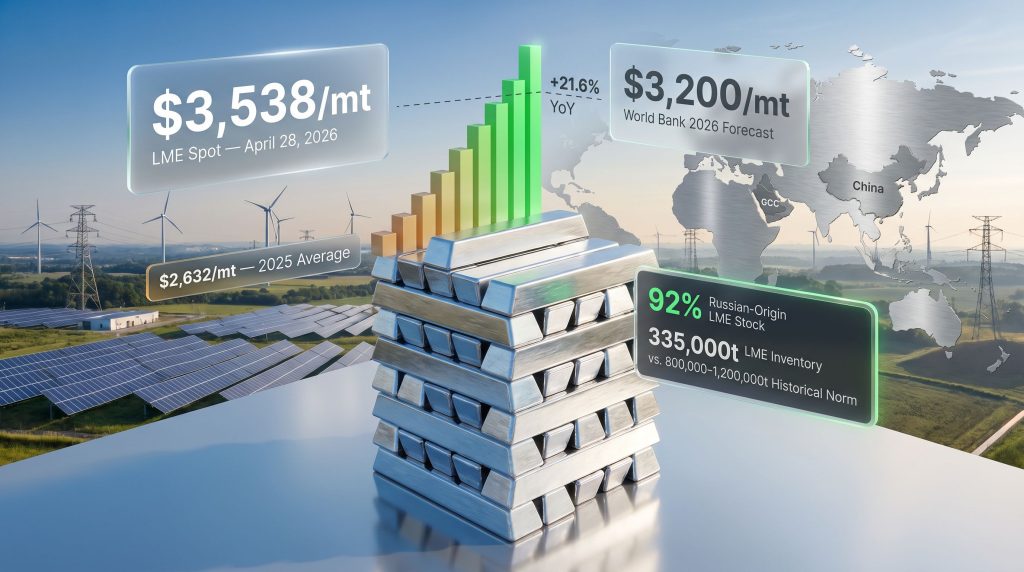
That dynamic is playing out with unusual clarity in the aluminium market during the first half of 2026. The World Bank's April 2026 Commodity Markets Outlook projects aluminium prices to average USD $3,200 per metric tonne across the full year, a figure representing a 21.6% year-on-year increase from the 2025 baseline of USD $2,632/mt. Prices are then expected to moderate to USD $3,000/mt by 2027.
The forecast is analytically sound, grounded in real supply constraints and legitimate demand tailwinds. The problem, for those treating it as a ceiling, is that LME spot prices had already exceeded that annual average target before the report was even published.
When big ASX news breaks, our subscribers know first
The World Bank Aluminium Price Forecast and Where Markets Actually Are
The aluminum and alumina markets sit within the World Bank's broader Commodity Markets Outlook, which covers energy, agriculture, and base metals. The April 2026 edition acknowledged a fundamentally tighter aluminium market than had been anticipated in prior forecasts, with the upward revision driven by several converging forces: persistently depleted visible inventories, supply chain disruption linked to geopolitical instability, and structural demand acceleration from electrification and green energy infrastructure.
The headline numbers tell a stark story about the gap between institutional forecasting timelines and physical market conditions:
| Metric | Value |
|---|---|
| World Bank 2026 Forecast (Annual Average) | USD $3,200/mt |
| 2025 Average Price (Base Year) | USD $2,632/mt |
| Year-on-Year Increase | +21.6% |
| World Bank 2027 Projection | USD $3,000/mt |
| LME Spot Price (April 28, 2026) | USD $3,538/mt |
| LME $3,000/mt Threshold Crossed | March 2, 2026 |
By April 28, 2026, spot prices had reached USD $3,538/mt, sitting approximately 10.6% above the World Bank's full-year average projection. The $3,000/mt threshold, which the Bank appears to treat as a 2027 retreat level, had actually been breached on March 2, 2026, nearly two months before the report's publication. In market terms, the forecast had been rendered conservative almost immediately.
Analysts with exposure to the physical aluminium market have characterised the USD $3,200/mt projection as leaning toward the conservative end, given that spot prices have already surpassed that level while underlying supply-demand dynamics have shown no meaningful signs of easing.
The implication is significant: the World Bank figure may be functioning less as a price target and more as a structural floor, below which a genuine demand collapse or supply normalisation event would be required to push values.
How the World Bank Aluminium Forecast Compares Across Institutions
Placing the World Bank's projection within the broader institutional landscape reveals a notable divergence in methodology and assumptions across major forecasters. Furthermore, while the World Bank sits at the more optimistic end of the consensus range, its position has effectively been validated by physical market performance. According to commodity market price forecasts, these divergences are not unusual during periods of heightened market volatility.
| Institution | 2026 Aluminium Price View | Key Rationale |
|---|---|---|
| World Bank | USD $3,200/mt (annual average) | Tight supply, low inventories, green demand growth |
| Deutsche Bank | ~USD $2,925/mt avg; Q2 peak ~$3,100/mt | Demand recovery ex-China, slowing Chinese output growth |
| J.P. Morgan | ~USD $2,200/mt (Q2 2025 reference point) | Subdued global demand growth (~1% YoY), projected ~200,000t surplus |
| Analyst Consensus (MENA Research) | USD $3,300–$3,600/mt range | Supply tightness, market fragmentation, geopolitical risk premium |
The divergence between J.P. Morgan's lower reference point and the World Bank's projection illustrates how dramatically different outcomes emerge depending on assumptions about Chinese export behaviour, geopolitical disruption severity, and AI-driven infrastructure demand. J.P. Morgan's more cautious positioning reflected a view that demand growth would remain subdued at around 1% year-on-year, with a projected surplus of approximately 200,000 tonnes adding downward pressure. Events in early 2026 have so far not supported that scenario.
The more bullish analyst consensus, projecting a range of USD $3,300 to $3,600/mt, appears closest to where physical markets have traded in recent weeks, suggesting that supply fragmentation and geopolitical risk premiums are being priced more aggressively than institutional models anticipated.
The Inventory Crisis Behind the Price Story
Understanding why the World Bank aluminium price forecast has already been exceeded requires a close examination of what is happening at the physical storage level. The numbers are stark by any historical standard.
LME-registered primary aluminium inventories declined to approximately 270,000 tonnes by the end of March 2026, before recovering to around 335,000 tonnes by April 27, 2026. That partial recovery, while directionally positive, does little to change the underlying picture:
- At the current global production rate of approximately 203,290 tonnes per day, the April inventory level equates to roughly 1.5 days of global primary aluminium production
- Historical LME aluminium inventory norms have ranged between 800,000 and 1,200,000 tonnes, meaning current levels represent less than half the historical floor
- Analysts suggest the current market is operating within a structurally lower range of 300,000 to 600,000 tonnes, reflecting a permanent shift in how physical aluminium flows through exchange and off-exchange channels
- A sharp drawdown of approximately 420,000 tonnes occurred during February 2026 alone, driven primarily by high physical premiums and arbitrage flows redirecting metal into stronger regional markets
The Russian Metal Concentration Problem
Headline inventory figures, already low by historical standards, are further complicated by a composition problem that makes actual accessible supply even tighter than raw numbers suggest.
By the end of March 2026, Russian-origin aluminium accounted for approximately 92% of total LME-registered primary aluminium stocks. Indian aluminium, previously the second-largest origin category within LME warehouses, had been entirely depleted. Indian metal was rapidly absorbed into global supply chains, reflecting its strong commercial acceptance across Western and neutral-market buyers.
The sanctions framework adds a layer of technical complexity that is poorly understood outside specialist circles:
- Aluminium produced after April 13, 2024 is ineligible for LME warrant placement under current sanctions restrictions
- Material produced prior to that cutoff date remains eligible for warrant and exchange trading
- Approximately 60% of Russian-origin LME stock is classified as Type-1 warrant, confirming it was produced before the pre-sanctions production cutoff
- Post-cutoff Russian production moves predominantly through Asian warehouse channels, often at discounted prices, outside the LME warrant system
This bifurcation creates a misleading headline inventory signal. The concentration of Russian metal inflates exchange-registered stock figures while the actual pool of freely tradeable, non-Russian aluminium available to Western and neutral-market buyers is considerably smaller than the aggregate number implies. LME inventories no longer fully capture the global supply landscape, as the proportion of off-warrant and privately held stocks has grown significantly.
This dynamic represents one of the least understood structural shifts in the aluminium market: the divergence between what exchange warehouses report and what is actually accessible to the majority of global buyers. Ongoing uncertainty regarding the Strait of Hormuz may be prompting some Western and European buyers to reassess their self-sanctioning posture on Russian aluminium, adding a further layer of complexity to market positioning.
Seasonal Patterns vs. Structural Shifts
Q1 inventory drawdowns in aluminium markets have historically been seasonal, with replenishment typically occurring through April and May as production cycles normalise and logistics flows resume. The April 2026 partial recovery to 335,000 tonnes is consistent with this seasonal pattern on the surface. However, analysts tracking GCC export flows have flagged that disruption to Gulf Cooperation Council producer logistics is complicating this traditional rhythm, potentially limiting the magnitude and durability of any inventory rebuild.
China's Production Cap: The Supply Ceiling That Changes Everything
For over a decade, the default assumption in aluminium supply analysis was that China could always expand production to meet global demand growth. That assumption has been fundamentally altered. In addition, the broader context of China metals demand across steel and iron ore markets reveals similar structural constraints emerging across multiple commodities simultaneously.
China operates under a regulatory production ceiling of 45 million tonnes per annum for primary aluminium, a policy designed to manage domestic energy consumption, environmental targets, and industrial overcapacity. In 2025, Chinese aluminium output reached approximately 44 million tonnes, leaving the industry operating within just 2.3% of its statutory limit. The practical headroom for further meaningful supply growth from the world's largest producer is now negligible.
This is a structural inflection point in global aluminium supply dynamics. The historical pattern of Chinese capacity additions absorbing demand growth and capping price rallies is no longer available as a market mechanism. The implications cascade through the entire supply outlook:
| Supply Source | Trajectory | Primary Driver |
|---|---|---|
| China (primary) | Near capacity ceiling | 45mt regulatory cap; ~44mt achieved in 2025 |
| Ex-China Asia (new smelters) | Modest growth | Competitive energy costs enabling incremental capacity |
| Recycled/Secondary Aluminium | Rising contribution | Circular economy policy, improving scrap collection rates |
| Europe (primary) | Below 2021 levels | Sustained energy cost pressure, smelter curtailments unreversed |
| GCC Exporters | Near-term disruption | Logistical uncertainty from geopolitical tensions |
European primary aluminium production has not recovered to pre-2022 levels. The initial shock from energy price surges following Russia's invasion of Ukraine triggered a wave of smelter curtailments across the continent. Unlike past energy shocks, the cost pressures have not fully receded, and ongoing energy market volatility linked to Middle Eastern tensions has compounded the structural challenge for European smelters.
The modest supply relief coming from new ex-China Asian smelter capacity and increasing recycled aluminium contributions is real, but insufficient in scale to replace the growth that a Chinese expansion would historically have provided.
Demand Architecture: Why Electrification Is Replacing Construction as the Core Narrative
The demand side of the aluminium equation is undergoing a compositional transformation that has important implications for price sustainability. Traditional demand models weighted construction and automotive applications heavily. Those segments remain significant, but the growth vector has shifted decisively toward energy transition infrastructure.
The aluminium intensity of the global energy transition is substantial across multiple application categories:
- Solar photovoltaic systems: frames, racking structures, mounting hardware, and panel components
- Wind energy infrastructure: nacelle housings, structural components, and transmission hardware
- Power grid transmission: aluminium conductor steel-reinforced (ACSR) cable deployment at scale as grid expansion accelerates
- Energy storage systems: battery enclosures, thermal management components, and structural housings
- Electric vehicles: lightweighting applications across body panels, chassis structures, and battery housings
- AI data centre infrastructure: cooling systems, structural components, and power distribution hardware
The World Bank has specifically flagged that faster-than-anticipated adoption of artificial intelligence could drive incremental base metal demand through expanded data centre construction and the associated power infrastructure buildout required to support it. This is a demand vector that was largely absent from aluminium market models as recently as 2023 and represents genuine upside optionality that most forecasts have not fully priced.
Counterbalancing these tailwinds is persistent weakness in the construction sector. China's property market downturn continues to weigh on construction-related aluminium consumption, while elevated interest rates across multiple advanced economies suppress new residential construction activity. However, at the global aggregate level, electrification demand growth is more than compensating for construction sector drag.
The next major ASX story will hit our subscribers first
Scenario Analysis: Can Aluminium Reach $3,600/mt in 2026?
With spot prices already trading above the World Bank's full-year average forecast in late April, the more relevant analytical question is not whether the $3,200/mt figure will be achieved, but how much higher prices might go and under what conditions. The aluminium tariffs impact introduced in 2025 continues to shape these dynamics, adding further complexity to an already fragile supply picture.
| Scenario | Price Range | Key Trigger Conditions |
|---|---|---|
| Base Case (World Bank) | ~$3,200/mt full-year average | Gradual supply normalisation, moderate demand, no new disruptions |
| Upside Case | $3,300–$3,600/mt | Prolonged GCC disruption, AI demand acceleration, sustained inventory tightness |
| Downside Case | $2,800–$3,000/mt | Macro deterioration, demand contraction, unexpected Chinese export surge |
| Tail Risk (Supply Shock) | Above $3,600/mt | Major smelter curtailments, sanctions escalation, critical logistics disruption |
Factors That Could Push Prices Above $3,600/mt
- Prolonged disruption to the Strait of Hormuz affecting GCC aluminium export logistics beyond current market expectations
- Acceleration in Western buyer self-sanctioning reducing the already-thin pool of accessible non-Russian supply
- Faster-than-anticipated AI data centre buildout creating additional base metal demand across power and construction supply chains
- Structural underinvestment in new primary smelting capacity outside China and the GCC creating medium-term supply deficits
Factors That Could Pull Prices Below $3,000/mt
- Significant macroeconomic deterioration reducing industrial demand across key consumption regions
- Unexpected geopolitical resolution releasing pent-up GCC supply back into global trade flows
- Faster-than-expected ramp-up of ex-China Asian smelting capacity providing incremental supply relief
- Demand destruction from sustained high aluminium prices causing downstream substitution toward alternative materials
The current risk balance, given tight visible inventories, Russian metal concentration dynamics, China's proximity to its production ceiling, and durable electrification demand growth, leans toward the upside scenario over the near to medium term. The analyst consensus range of $3,300 to $3,600/mt for the full-year average appears more consistent with actual market conditions than the World Bank's more conservative baseline. Furthermore, the top aluminium producers are navigating these pricing pressures alongside significant operational constraints.
Frequently Asked Questions: World Bank Aluminium Price Forecast 2026
What is the World Bank's official aluminium price forecast for 2026?
The World Bank's April 2026 Commodity Markets Outlook projects aluminium to average USD $3,200 per metric tonne in 2026, representing a 21.6% increase from the 2025 average of USD $2,632/mt. Prices are forecast to ease to USD $3,000/mt in 2027.
Why do some analysts consider the World Bank's forecast conservative?
LME spot prices surpassed the $3,200/mt annual average target before the report was published, reaching $3,538/mt on April 28, 2026. The combination of persistently low inventories, Russian metal concentration dynamics, and geopolitical supply disruption suggests the full-year average may exceed the World Bank's projection.
What is the current level of LME aluminium inventory?
As of late April 2026, LME-registered aluminium inventories stood at approximately 335,000 tonnes, well below the historical norm of 800,000 to 1,200,000 tonnes and equivalent to roughly 1.5 days of global primary production at current output rates.
Why does Russian metal dominate LME warehouse stocks?
Russian-origin aluminium accounts for approximately 92% of LME-registered primary stocks as of end-March 2026. Western buyers have broadly adopted self-sanctioning practices, leaving Russian metal concentrated in exchange warehouses while Indian and other origin categories have been absorbed into the market. Aluminium produced after April 13, 2024 is ineligible for LME warrant placement under current sanctions frameworks.
How does China's production cap affect global aluminium supply?
China's regulatory ceiling of 45 million tonnes per annum effectively prevents further meaningful output growth, as 2025 production of approximately 44 million tonnes leaves minimal remaining headroom. This removes the historical mechanism by which Chinese supply expansion absorbed global demand growth and capped price rallies.
When will the World Bank next update its aluminium price forecast?
The next scheduled update to the World Bank Commodity Markets Outlook is anticipated in October 2026, at which point revised projections are expected to better reflect the structural supply tightness that physical markets have already priced in.
What the World Bank Aluminium Forecast Really Signals for Market Participants
The broader significance of the World Bank aluminium price forecast for 2026 extends beyond the specific dollar figure. The 21.6% upward revision is itself a signal that even conservative institutional models have been forced to acknowledge structural tightening that more nimble market participants had already priced. The gap between the $3,200/mt forecast and the $3,538/mt spot price observed on April 28 reflects not a failure of analysis, but a fundamental mismatch in the tempo at which physical markets move versus the cadence of institutional reporting cycles.
Consequently, the interplay between tariffs and supply chains has compounded these pressures, reshaping regional trade flows in ways that institutional models struggle to capture in real time. Key structural takeaways for understanding the aluminium market through the remainder of 2026 include:
- China's proximity to its 45 million tonne production cap eliminates the single largest historical source of supply-side pressure relief
- Inventory normalisation is constrained by geopolitical fragmentation, the Russian metal concentration problem, and GCC export disruption, preventing the seasonal replenishment patterns that have historically provided price relief
- The headline LME inventory figure overstates actual accessible supply for the majority of global buyers, given the dominance of warrant-ineligible Russian metal and the growing proportion of off-exchange, privately held stock
- Electrification and AI infrastructure demand represent durable structural tailwinds that most pre-2024 forecasting models did not adequately capture
- The $3,300 to $3,600/mt analyst consensus range represents the most coherent forward scenario if current supply-demand dynamics persist through the second half of 2026
As S&P Global has noted, the scale of upward pressure on aluminium prices is increasingly eclipsing even the World Bank's revised projections, underscoring how rapidly this market has moved beyond baseline assumptions.
Disclaimer: This article is intended for informational purposes only and does not constitute financial advice or a recommendation to buy or sell any security or commodity. Price forecasts involve inherent uncertainty and are subject to revision based on changing market conditions, geopolitical developments, and macroeconomic factors. Readers should conduct independent research and consult qualified financial advisers before making investment decisions.
Want to Capitalise on the Next Major ASX Commodity Discovery Before the Market Does?
Discovery Alert's proprietary Discovery IQ model delivers real-time alerts on significant ASX mineral discoveries — including those tied to high-demand commodities like aluminium — instantly transforming complex market data into actionable investment insights for both short-term traders and long-term investors. Explore how historic mineral discoveries have generated substantial returns on Discovery Alert's dedicated discoveries page, and begin your 14-day free trial today to position yourself ahead of the broader market.