June 5, 2026
When Geopolitics Meets Industrial Policy: A Perfect Storm for Aluminium Markets
Commodity markets rarely move on a single catalyst. The most significant price dislocations in history have almost always been the result of multiple forces converging simultaneously, overwhelming the market's capacity to self-correct. The aluminium price rally from Middle East crisis and China capacity cap is a textbook example of this dynamic in 2026. A geopolitical crisis in the Gulf region and a structural production ceiling in China have collided at the worst possible moment for global supply, producing the kind of price rally that catches even well-positioned market participants off guard.
Understanding why this rally is happening, how far it can go, and who stands to benefit requires looking beneath the headline numbers to the structural vulnerabilities that were already present before the first supply shock materialised.
When big ASX news breaks, our subscribers know first
The Aluminium Market Was Already Walking a Tightrope
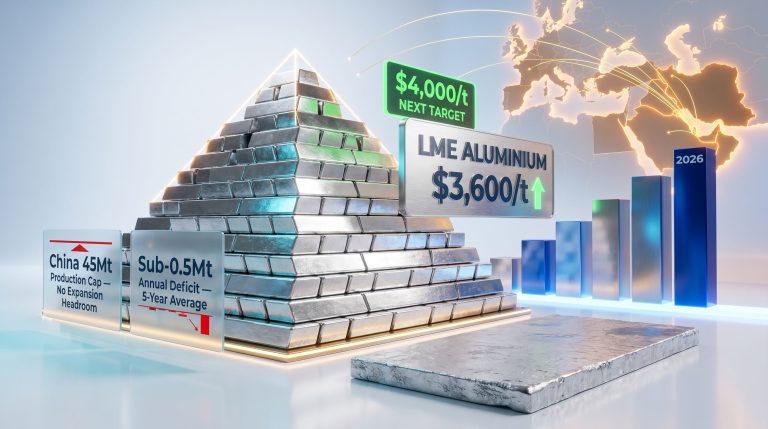
The global aluminium market entered 2026 in a precarious position. Over the preceding five years, the market had averaged a supply deficit of fewer than 0.5 million tonnes annually, a figure that sounds modest but represents an extraordinarily thin cushion when set against global annual consumption of roughly 70 million tonnes.
What makes this deficit particularly dangerous is its persistence. Unlike cyclical shortfalls that correct quickly as producers respond to price signals, this structural deficit has been sustained by a combination of rising demand from the energy transition, constrained capacity growth in non-Chinese smelting, and China's increasing proximity to its self-imposed output ceiling.
Several warning signs were already visible before the Middle East crisis escalated:
- London Metal Exchange registered warehouse stocks had been trending lower for over 18 months, reducing the visible buffer available to absorb disruptions
- Regional physical delivery premiums in Europe and North America had climbed materially above their five-year averages, signalling that buyers were already competing for immediately available metal
- Capacity utilisation at Gulf Cooperation Council smelters was running near maximum, leaving little slack to absorb demand surges
- Non-Chinese smelting capacity additions had lagged behind demand growth due to permitting timelines, energy costs, and capital constraints
The aluminium production process itself creates additional rigidity. Primary smelting requires approximately 14,000 to 15,000 kilowatt-hours of electricity per tonne of metal produced, making energy costs the dominant cost variable at 30 to 40 percent of total operating expenses. Any disruption to regional energy markets therefore feeds directly into production economics, adding a cost dimension to the supply dimension of any shock.
How the Middle East Crisis Created a Supply Emergency
The Gulf's Strategic Role in Global Aluminium Trade
The Gulf Cooperation Council region has developed into one of the world's most competitive aluminium export corridors over the past two decades. Access to low-cost energy, sovereign investment in large-scale smelting infrastructure, and proximity to growing Asian and European markets positioned GCC producers as pivotal swing suppliers in the global trade network.
This concentration of capacity in a single geographic region has created a structural vulnerability that the market systematically underpriced during the long period of regional stability. Furthermore, when geopolitical risk in West Asia escalated sharply in 2026, the war pushing fragile aluminium markets exposed just how vulnerable the market truly was.
The Strait of Hormuz: A Chokepoint the Market Cannot Bypass
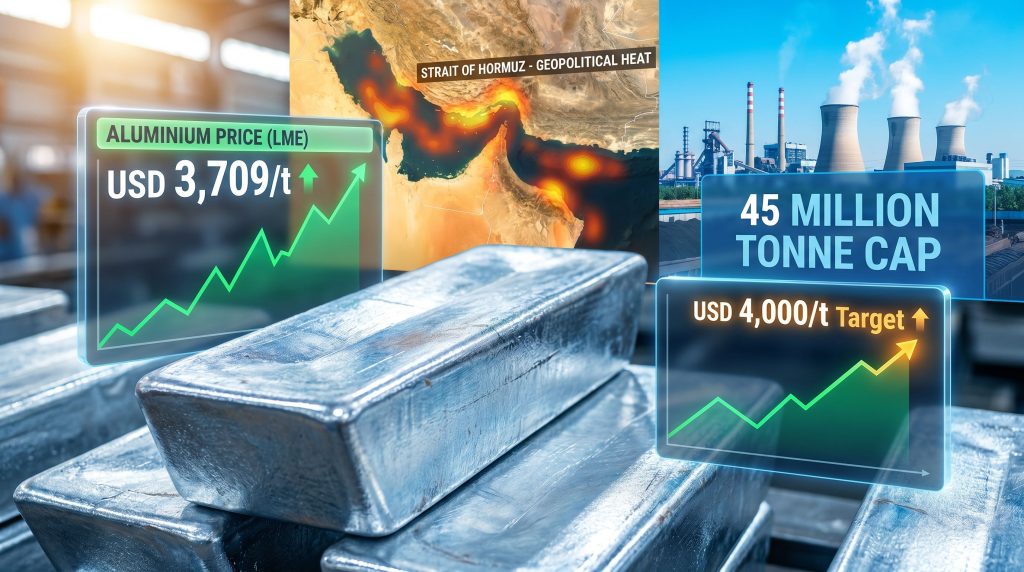
Iran's announced intention to completely block the Strait of Hormuz, confirmed through geopolitical monitoring sources in early June 2026, has introduced a critical new dimension to aluminium market risk. The Strait is the primary maritime corridor through which a significant portion of GCC aluminium exports transit, and its effective closure would constitute a force majeure event of the first order for global metal supply chains.
The cascading effects of this threat extend well beyond the direct shipping disruption:
- Cargo insurance costs have risen sharply for vessels operating in the region, adding logistical costs that widen the delivered price differential
- Route diversions via the Cape of Good Hope add approximately 10 to 14 days to transit times, compressing the effective availability of metal in consuming regions
- Force majeure clauses in long-term supply contracts have been activated by some GCC producers, removing committed volumes from the market at short notice
- Energy supply uncertainty within the Gulf is creating secondary cost pressures on smelters that remain operational, as regional power prices tighten alongside the broader energy market shock
The broader energy market impact is significant. An oil price rally of nearly 8 percent occurred in response to the escalating tensions, with West Texas Intermediate reaching USD 94.20 per barrel and Brent Crude approaching USD 97.23 per barrel. For aluminium producers reliant on hydrocarbon-based power generation, this energy price shock translates directly into elevated production costs, even for smelters not directly affected by conflict.
Supply Concentration Risk: Quantifying the Exposure
| Risk Factor | Impact Level | Primary Market Response |
|---|---|---|
| GCC smelter outage risk | High | LME spot price spike, force majeure activation |
| Strait of Hormuz shipping disruption | High | Regional premium surge in Europe and Asia |
| Regional energy price escalation | Medium-High | Production cost increases at GCC smelters |
| Freight and insurance cost increases | Medium | Widening delivered price differentials |
| Cargo delay and port disruption | Medium | Near-term physical availability compression |
Why China's Production Cap Has Removed the Market's Safety Valve
The 45 Million Tonne Ceiling and Its Policy Origins
China accounts for more than 55 percent of global primary aluminium production, a concentration that has historically given it an unmatched ability to stabilise international markets through export adjustments. When supply tightened elsewhere, Chinese exports typically expanded, acting as a pressure valve that prevented LME prices from entering sustained upward spirals.
That mechanism is now structurally impaired. China's government has maintained a self-imposed ceiling of 45 million tonnes per year on primary aluminium output, introduced as part of broader national industrial planning frameworks targeting energy consumption reduction and carbon intensity goals. China industrial demand patterns have placed Chinese production near this threshold throughout 2025 and into 2026, effectively exhausting the marginal capacity available to respond to global shortfalls.
This is not a temporary constraint. Non-Chinese smelting capacity takes years to develop, requiring:
- Identification and permitting of suitable sites with access to competitive power
- Securing long-term power purchase agreements at economically viable rates
- Engineering, procurement, and construction timelines of three to five years for greenfield smelters
- Capital investment commitments that require sustained high prices to justify
The result is that the global market cannot substitute Chinese volume quickly, regardless of price signals.
What Happens to Trade Flows When China Cannot Expand Output?
When Chinese production growth stalls near the cap, several interconnected effects ripple through global trade flows:
- Net aluminium exports from China soften as domestic demand continues to grow, absorbing available production
- The volume of Chinese metal available to arbitrage international price differentials contracts materially
- Regional markets that previously relied on Chinese export surges to balance supply must find alternative sources or accept higher prices
- LME prices decouple from SHFE prices as international markets tighten faster than domestic Chinese markets
"The combination of a geopolitically disrupted GCC export corridor and a capacity-capped Chinese production system has, for the first time in modern aluminium market history, simultaneously removed both of the primary supply response mechanisms that markets have relied upon during previous periods of stress."
LME Prices at Multi-Year Highs: The Path Toward USD 4,000 per Tonne
Where the Market Stands in Mid-2026
The aluminium price rally from Middle East crisis and China capacity cap dynamics has driven LME prices through multiple resistance levels that had previously capped upward moves during the 2022 to 2024 period. Prices have now reached levels above USD 3,600 per tonne, with intraday trading activity recording levels approaching USD 3,709 per tonne as supply anxiety intensifies.
Analysts monitoring the market have identified USD 4,000 per tonne as the next critical psychological and technical threshold. Breaking through this level would represent the highest sustained aluminium price since the post-pandemic supply shock of 2022, and would likely trigger a fresh round of strategic stockpiling by downstream consumers.
Historical Price Context: The Scale of the Current Move
| Price Level (USD/t) | Market Context |
|---|---|
| 2,200 to 2,400 | Average LME range during the low-volatility 2022 to 2024 period |
| 3,000 | Pre-crisis resistance level breached in early 2026 |
| 3,600 to 3,709 | Current trading range as of mid-2026 |
| 4,000 | Analyst near-term target if disruptions escalate or persist |
| 4,200+ | Potential extreme scenario if GCC outages are prolonged |
Physical Premiums Are Rising Faster Than the Headline Price
A critical but often overlooked dimension of the current rally is that physical delivery premiums are climbing faster than the LME benchmark price itself. This is a technical signal of exceptional importance. When the premium component of the delivered price rises disproportionately to the exchange price, it indicates that the shortage is concentrated in physically available metal rather than paper contracts.
For industrial consumers, this means the effective cost of purchasing aluminium is rising even faster than the LME numbers suggest. European duty-paid premiums and North American Midwest premiums have both expanded materially in 2026, compounding the headline price move and creating significant procurement challenges for manufacturers locked into fixed-price contracts.
Who Benefits and Who Pays: The Asymmetric Impact on Producers and Consumers
How Rising Prices Flow Through to Producer Margins
For aluminium producers operating outside the conflict-affected Gulf region, the current price environment represents a significant earnings tailwind. The fundamental dynamics are straightforward: when realised prices rise while operating costs remain relatively stable, the margin between production cost and market price widens, directly improving profitability.
Producers with integrated bauxite-to-aluminium operations are particularly well-positioned. Their upstream cost base is largely insulated from the spot energy price volatility affecting GCC smelters, while they capture the full benefit of elevated LME prices and widening regional premiums. The top aluminium companies — including Alcoa, Chalco, Century Aluminum, Kaiser Aluminum, NALCO, Hindalco, Hydro, and Vedanta — all reported improved Q1 2026 earnings driven primarily by the price environment rather than volume growth.
The Consumer Side: Margin Compression and Strategic Stockpiling
The same price environment that benefits producers creates significant challenges for downstream manufacturers. Industries with the highest aluminium intensity and the lowest ability to pass through input cost increases are experiencing the most severe margin compression. In addition, the aluminium and alumina markets are being further strained by the convergence of these upstream pressures with downstream demand dynamics.
Industries most affected include:
- Automotive manufacturers facing rising input costs at a time when competitive pressure and consumer price sensitivity limit price increases
- Construction sector buyers seeing project economics deteriorate as aluminium-intensive products become more expensive
- Packaging producers grappling with can sheet and foil price increases that flow through to consumer goods companies
- Aerospace manufacturers with long-duration fixed-price contracts absorbing costs that cannot be recovered until contract renewal
A secondary effect of the price rally is that some larger consumers are accelerating strategic stockpiling, pulling forward purchases to build inventory buffers. However, this behaviour collectively tightens near-term availability further, creating a self-reinforcing cycle that amplifies price pressure in the short term.
The next major ASX story will hit our subscribers first
The Inventory Problem: Why Every Supply Signal Is Amplified
LME Warehouse Stocks and the Structural Buffer Deficit
One of the least-discussed but most important factors in the current price rally is the critically low level of aluminium inventories held in LME-registered warehouses. When exchange stocks are ample, supply disruptions can be absorbed without immediate price responses, as buyers draw down visible inventory while the market waits for supply to normalise.
In the current environment, that buffer is effectively absent. Unlike oil markets, where government-held strategic petroleum reserves can be released to dampen supply shocks, aluminium has no equivalent national strategic stockpile mechanism in most major consuming countries. The LME warehouse system is therefore the market's primary visible inventory mechanism, and its depletion leaves the price to do the sole work of rationing available supply.
SHFE Dynamics and the China Domestic Disconnect
Shanghai Futures Exchange aluminium inventories reflect the domestic Chinese supply-demand balance, which operates with some independence from the LME international market. Divergent downstream consumption patterns within China, combined with periodic destocking cycles, have created short-term price oscillations on the SHFE that can temporarily diverge from LME trends.
However, the structural production cap fundamentally limits China's ability to rebuild domestic inventories quickly following any drawdown. Consequently, even the SHFE inventory system cannot provide meaningful relief to international markets in the current environment.
Bull Case, Bear Case, and Everything Between
Scenarios That Could Drive Aluminium Toward and Beyond USD 4,000 per Tonne
- Sustained or escalating conflict in the Gulf resulting in prolonged GCC smelter outages that remove significant tonnage from the market
- Formal force majeure declarations by major GCC producers covering delivery obligations to European and Asian buyers
- A decision by Chinese authorities to maintain the 45 million tonne cap without adjustment despite international market tightness
- Continued drawdown of LME warehouse stocks toward levels that trigger physical delivery stress
- Accelerating demand from electric vehicle production and grid infrastructure buildout, where aluminium intensity continues to grow
Conditions That Could Moderate or Reverse the Rally
- Diplomatic de-escalation in West Asia that restores shipping normalcy through the Strait of Hormuz
- A policy decision by Chinese authorities to adjust or temporarily suspend the production cap
- Demand destruction from downstream industries unable to absorb sustained high input costs, particularly in construction and automotive
- A broader global economic slowdown that reduces industrial aluminium consumption below current projections
- Inventory restocking by producers and traders that temporarily satisfies physical demand in key consuming regions
Furthermore, the imposition of US aluminium tariffs could introduce additional trade flow distortions that complicate any straightforward market rebalancing, regardless of how geopolitical conditions evolve.
Scenario Comparison: Price Trajectory Under Different Outcomes
| Scenario | Price Trajectory (USD/t) | Key Trigger |
|---|---|---|
| Escalation continues | 3,800 to 4,200 | Prolonged GCC outages, cap maintained |
| Status quo persists | 3,400 to 3,700 | No resolution, no cap adjustment |
| Partial de-escalation | 2,900 to 3,200 | Shipping partially restored, output recovers |
| Full resolution | 2,400 to 2,700 | Conflict ends, China cap adjusted |
Key Metrics That Will Determine the Next Price Move
What to Watch Going Forward
Market participants monitoring the aluminium price rally from Middle East crisis and China capacity cap dynamics should focus on a specific set of leading indicators rather than reacting to daily price movements:
- Monthly Chinese primary aluminium production data relative to the 45 million tonne annualised cap, which will signal whether Chinese authorities are allowing any flexibility in the policy ceiling
- LME and SHFE warehouse inventory levels, with particular attention to whether stocks cross below thresholds that historically triggered physical delivery stress
- GCC smelter operational status reports and any formal force majeure declarations that would remove confirmed volumes from the market
- Regional delivery premiums in Europe and North America, which function as leading indicators of physical supply stress before movements appear in the LME benchmark price
- Downstream demand signals from automotive production schedules and construction sector order books, indicating whether demand destruction is beginning to offset supply tightness
- Shipping insurance rates and freight costs for vessels operating in the Gulf region, which provide real-time signals of geopolitical risk intensity
"The aluminium market in 2026 is navigating the intersection of geopolitical shock and structural industrial policy constraint. Until the Middle East situation stabilises or China's production framework is adjusted, the market lacks a credible supply response mechanism. For producers with stable cost structures operating outside the conflict zone, the current environment represents a compelling earnings period. For consumers and policymakers, it raises deeper questions about how dependent critical industrial supply chains have become on concentrated geographic nodes that were never designed to bear this level of systemic risk."
For a broader perspective on how end-user sectors worldwide are grappling with the present aluminium chaos, the downstream impacts are proving as consequential as the supply-side disruptions themselves.
Frequently Asked Questions: Aluminium Price Rally 2026
What is causing the aluminium price rally in 2026?
Two simultaneous and structurally independent forces are driving the rally. Geopolitical disruptions in the Middle East, including threats to block the Strait of Hormuz and direct risks to Gulf smelting operations, are constraining supply from one of the world's most important aluminium export regions. Simultaneously, China's proximity to its self-imposed 45 million tonne annual production cap has removed the country's historical ability to offset international supply shortfalls through export surges.
How high could aluminium prices go?
LME aluminium prices have already surpassed USD 3,600 per tonne, with intraday levels approaching USD 3,709 per tonne recorded in recent sessions. Market analysts have identified USD 4,000 per tonne as a credible near-term target if Gulf disruptions deepen or persist and China maintains its production ceiling without adjustment. An escalation scenario could push prices beyond this threshold.
Why cannot China simply produce more aluminium to stabilise the market?
China operates under a government-mandated ceiling of 45 million tonnes per year on primary aluminium production, introduced to manage national energy consumption targets and carbon intensity goals. With output running near this threshold, there is no meaningful production headroom available to offset international supply shortfalls, removing China's traditional role as a global swing producer.
Which industries are most affected by rising aluminium costs?
Automotive manufacturing, construction, aerospace, and packaging sectors face the most significant exposure. These industries combine high aluminium intensity with limited ability to rapidly pass through input cost increases to end customers, creating margin compression that is directly visible in corporate earnings results.
Are aluminium producers benefiting from the price environment?
Yes, producers with stable cost structures operating outside the conflict-affected Gulf region are capturing significantly wider margins as realised prices rise. Q1 2026 earnings results from major global producers reflected improved profitability driven by the elevated price environment rather than production volume growth, consistent with the broader aluminium price rally from Middle East crisis and China capacity cap conditions shaping the market.
Disclaimer: This article contains forward-looking statements and price projections based on current market conditions and analyst assessments. These projections are subject to significant uncertainty and should not be construed as financial advice. Commodity markets are inherently volatile and actual price outcomes may differ materially from scenarios described. Readers should conduct their own independent research before making investment or procurement decisions.
Want To Capitalise on the Next Major Commodity Discovery Before the Market Moves?
The aluminium supply crisis of 2026 demonstrates how rapidly commodity markets can shift when structural vulnerabilities collide with geopolitical shocks — and how critical it is to receive actionable intelligence ahead of the broader market. Discovery Alert's proprietary Discovery IQ model scans ASX announcements in real time, instantly identifying significant mineral discoveries across more than 30 commodities and delivering alerts to subscribers before prices reflect the news; explore historic examples of exceptional discovery returns or begin a 14-day free trial today to position yourself ahead of the next major market move.