June 5, 2026
The Geology of Demand: Why Heavy Crude Processing Capability Is Reshaping Global Energy Alliances
Not all oil is created equal, and the technical reality of crude processing is quietly determining which bilateral energy relationships become strategically durable in the 2020s. Most international discussion about oil supply focuses on price, geopolitics, or logistics. Far less attention is paid to the refining chemistry that ultimately decides which nation can physically handle which type of crude, and at what cost efficiency. This technical dimension sits at the heart of the India Venezuela oil partnership, which has undergone one of the most dramatic accelerations in recent bilateral energy trade history during the opening months of FY2026-27.
Understanding why this relationship is deepening requires looking beyond diplomatic communiqués and into the molecular composition of Venezuelan crude, the capital infrastructure of Indian refineries, and the supply chain vulnerabilities that have made diversification an institutional priority for one of the world's largest and fastest-growing energy consumers. Furthermore, the global oil market geopolitics at play in 2025 have only accelerated this strategic rethinking.
When big ASX news breaks, our subscribers know first
Venezuela's Geological Endowment: A Reserve Base Unlike Any Other
Venezuela holds the largest proven oil reserves on the planet, a geological reality that makes it inherently relevant to any serious long-term energy supply conversation. The bulk of these reserves are concentrated within the Orinoco Belt, a vast heavy crude formation stretching across eastern Venezuela that has been the focal point of international upstream investment for decades.
What Makes Orinoco Belt Crude Technically Distinctive
The crude extracted from the Orinoco Belt is classified as extra-heavy oil, and its physical characteristics present processing challenges that significantly narrow the pool of eligible international buyers. Understanding these characteristics helps explain why India's refining sector occupies such a strategically advantageous position in this bilateral relationship.
| Crude Characteristic | Venezuelan Heavy Crude | Implication for Refiners |
|---|---|---|
| API Gravity | Low (8–16°) | Requires complex refinery configurations |
| Sulfur Content | High | Demands advanced desulfurization units |
| Viscosity | Very High | Needs diluent blending or upgrading before transport |
| Required Processing Technology | Hydrocracking and coking units | Limits eligible refinery pool globally |
| Typical Price Discount vs. Brent | Significant | Attractive economics for compatible refiners |
This combination of low API gravity and high sulfur content means that processing Venezuelan crude economically requires refineries equipped with delayed cokers, vacuum distillation units, and hydrocracking capacity. These are among the most capital-intensive investments in downstream energy infrastructure. Indian public sector refiners, particularly those operated by major state-owned enterprises, have made precisely these investments over the past two decades, creating a natural processing advantage that few other large-scale importers can replicate at comparable cost efficiency.
The technical compatibility between Venezuela's reserve profile and India's complex refining infrastructure is not coincidental. It reflects decades of capital allocation decisions by Indian state refiners that have positioned the country as one of a small number of nations globally capable of processing extra-heavy crude at industrial scale and competitive margins.
A Trade Relationship Transformed: The FY2026-27 Import Acceleration
The most striking quantitative evidence of this partnership's strategic elevation is visible in India's import volume data for the opening of FY2026-27. The scale of the acceleration is extraordinary by any historical benchmark.
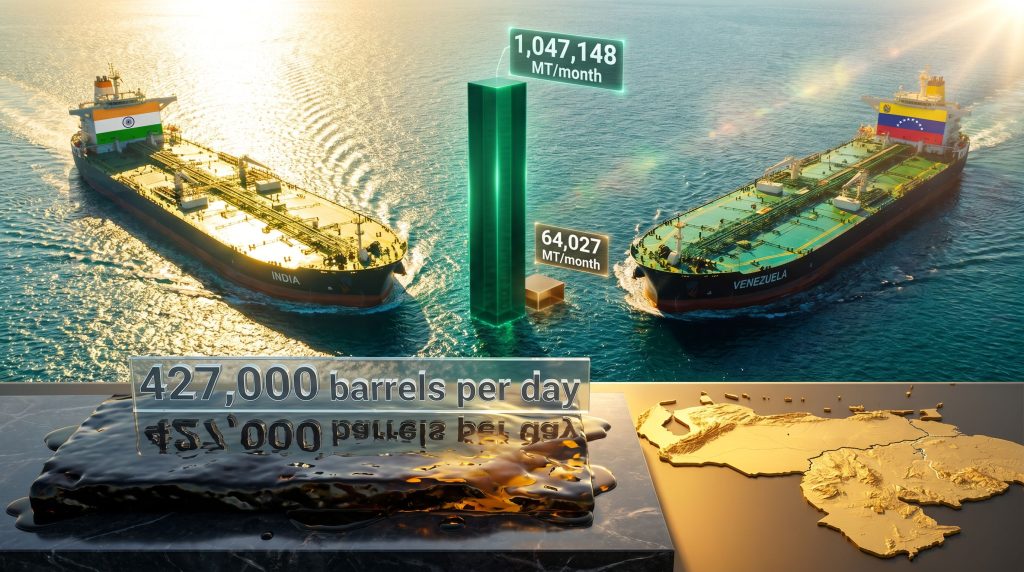
During FY2025-26, average monthly Venezuelan crude imports into India stood at approximately 64,027 metric tonnes. In the first two months of FY2026-27, covering April and May 2026, that figure surged to approximately 1,047,148 metric tonnes per month. This represents a more than 16-fold increase in average monthly volumes within a single fiscal year transition, according to data from India's Ministry of Petroleum and Natural Gas as reported by ET EnergyWorld.
India's position in the global Venezuelan crude import rankings shifted correspondingly. In May 2026, India ranked as the second-largest importer of Venezuelan crude globally, absorbing approximately 427,000 barrels per day according to Reuters trade flow data. Venezuela simultaneously emerged as one of India's largest crude suppliers during April and May 2026, a structural repositioning from its historically marginal role in India's import portfolio.
Data Perspective: A 16-fold increase in monthly import volumes within a single fiscal year transition is not a gradual strategic shift. It reflects a rapid and deliberate reorientation of India's sourcing decisions that has already produced measurable change in global Venezuelan crude trade flows, not merely a diplomatic aspiration.
Contextualising the Volume Shift Within India's Broader Import Architecture
India is one of the world's three largest crude oil importers, consistently sourcing over 80% of its domestic oil requirements from international markets. Its historical import concentration across Middle Eastern suppliers, particularly Iraq, Saudi Arabia, and the UAE, has created a structural vulnerability to regional geopolitical disruption. The West Asian conflict environment of 2025-2026 intensified institutional pressure within India's energy establishment to accelerate geographic diversification across its supply base.
However, Venezuela, despite its own complex geopolitical profile, offers a supply corridor that is geographically and politically distinct from the conflict-affected regions currently generating uncertainty. Consequently, these oil price movements driven by regional instability have reinforced India's motivation to secure alternative supply channels. This distinction is itself a strategic asset from India's energy security perspective, independent of the pricing or volume considerations.
The $1 Billion Foundation: India's Upstream Presence in Venezuela Since 2008
What distinguishes the current diplomatic engagement from a purely transactional trading relationship is the pre-existing institutional and capital foundation that Indian public sector energy companies have built in Venezuela over nearly two decades.
Indian state-owned enterprises established an upstream presence in Venezuela as early as 2008, predating the current wave of diplomatic momentum by almost twenty years. The key operational assets that form this foundation include:
- Participation in the San Cristóbal project within Venezuela's Orinoco Belt
- A stake in the Petrocarabobo-1 block, another major upstream asset in the same formation
- ONGC Videsh (OVL) holding a 40% equity stake in Petrolera Indovenezolana SA, a joint venture with Venezuela's state oil company CVP, focused on the San Cristóbal field
- A cumulative capital deployment estimated at approximately $1 billion across Venezuela's upstream sector
This existing investment architecture is significant for several reasons that are not immediately obvious from the headline figures. First, it means India's technical teams already possess operational knowledge of Venezuelan reservoir characteristics, production challenges, and on-the-ground logistics. This institutional knowledge base reduces the due diligence burden and learning curve associated with any expanded cooperation.
Second, it establishes a legal and contractual framework upon which new agreements can be structured more efficiently than initiating entirely fresh relationships. Third, it creates a shared financial interest between both governments in maintaining cooperative bilateral relations, since both carry existing positions in jointly owned upstream assets. For further context on this history, the India–Venezuela relations overview provides useful background on how this energy diplomacy has evolved.
The Joint Venture Structure: Understanding Petrolera Indovenezolana SA
The San Cristóbal field joint venture between ONGC Videsh and Venezuela's CVP illustrates the depth of institutional integration that already exists beneath the diplomatic surface. OVL's 40% equity stake in Petrolera Indovenezolana SA represents a material upstream commitment, not a passive minority position.
Equity participation of this scale typically involves operational involvement, technical contribution, and direct exposure to production outcomes, all of which mean Indian energy companies have genuine engineering and operational experience working within Venezuela's upstream environment. This positions India's technical delegation, when it travels to Venezuela, not as a new entrant conducting exploratory due diligence, but as an experienced operator evaluating incremental expansion opportunities within a known operating environment.
Benchmarking Venezuela Within India's Crude Supply Portfolio
To appreciate the strategic logic of the India Venezuela oil partnership, it is useful to position Venezuela within the context of India's broader import relationships and the differentiated risk and opportunity profiles each supplier carries.
| Supplier Country | Crude Grade | India's Processing Compatibility | Primary Strategic Risk |
|---|---|---|---|
| Iraq | Medium, sour | High | Regional instability |
| Saudi Arabia | Light-medium, sour | High | Concentration risk |
| Russia | Medium-heavy, sour | High | Geopolitical and sanctions risk |
| UAE | Light-medium | High | Moderate geopolitical risk |
| USA | Light, sweet | Moderate (simple refineries) | Low geopolitical risk |
| Venezuela | Extra-heavy, high-sulfur | High (complex refineries only) | Sanctions and political risk |
Venezuela occupies a structurally unique position within this portfolio. It is the only major supplier offering extra-heavy crude grades at scale, and India's complex refinery investments mean this crude can be processed at a cost efficiency that most other importing nations cannot match. The pricing dynamic for heavy crude also tends to involve steeper discounts relative to light crude benchmarks, which can translate into attractive refining margins for operators with the right configuration.
The differentiated risk profile, centred on U.S. sanctions and domestic political uncertainty in Venezuela, is real and should not be understated. However, from a portfolio diversification standpoint, this risk profile is largely uncorrelated with the geopolitical risks driving instability in West Asia, which is precisely the characteristic that makes Venezuela valuable as a structural hedge within India's import architecture. Indeed, the broader trade war and oil markets dynamic has further underscored the value of supply relationships outside traditional Western-aligned channels.
Navigating the U.S. Sanctions Landscape
Venezuela has operated under a layered U.S. sanctions regime administered by the Treasury Department's Office of Foreign Assets Control (OFAC). This framework has historically constrained international oil trade with Venezuela, complicated payment mechanisms, deterred shipping and insurance providers, and created significant compliance complexity for foreign buyers and investors.
India's engagement with Venezuelan crude has required careful structuring of commercial arrangements to navigate this environment. The evolving US policy on Venezuela has been particularly relevant, with the U.S. government periodically issuing licensing adjustments and waivers that modify the permissible scope of commercial activity. Any further structural relaxation of sanctions would materially expand the commercial opportunity set for Indian upstream and trading participation, potentially accelerating both volume growth and the scope of equity investment.
Risk Consideration: The sanctions environment governing Venezuela-related oil trade remains fluid and subject to change based on U.S. foreign policy decisions. This article does not constitute legal or compliance advice. Readers, investors, and commercial operators must independently verify current OFAC guidance and seek qualified legal counsel before drawing conclusions about the permissibility of any specific commercial arrangement involving Venezuelan entities or assets.
The next major ASX story will hit our subscribers first
What the Technical Mission Signals About Future Cooperation Scope
The decision by India's petroleum ministry to send a technical delegation to Venezuela in the near term is a concrete signal of intent that extends well beyond incremental crude purchasing. Technical missions of this nature typically serve multiple functions simultaneously, and the scope of what India's delegation is likely to evaluate reflects the full breadth of the bilateral opportunity.
Potential areas of expanded cooperation include:
- New upstream block allocations within the Orinoco Belt and additional Venezuelan hydrocarbon provinces
- Enhanced production agreements for existing joint venture assets at San Cristóbal and Petrocarabobo-1
- Refinery-to-field integration models that create structural linkages between Indian downstream capacity and Venezuelan upstream production streams
- Technology and engineering workforce transfer, leveraging India's substantial technical human capital to support Venezuelan production rehabilitation efforts
- Critical minerals and broader resource cooperation that extends the partnership beyond hydrocarbons into the wider natural resource sector
Venezuela's government has indicated a structural opening of its oil and gas sector to foreign participation under a reformed regulatory framework, and Indian companies are being explicitly identified as preferred participants. As analysts have noted, India and Venezuela are deepening energy ties in response to shifting global supply pressures, reinforcing the strategic logic on both sides.
Building a South Atlantic Supply Corridor: The Long-Term Strategic Logic
If India successfully transitions from a predominantly spot-based Venezuelan crude buyer to a long-term equity and offtake partner, the strategic implications extend well beyond any individual commercial arrangement. India would effectively consolidate what energy security analysts describe as a South Atlantic supply corridor, a geographically distinct supply axis that is fundamentally uncorrelated with the Middle Eastern and Russian supply channels that currently dominate India's import portfolio.
This corridor diversification addresses a structural vulnerability in India's energy security architecture that has been exposed repeatedly by regional conflicts, sanctions episodes, and supply disruptions. Building a durable South American supply relationship transforms India's energy security posture from reactive diversification during crises to proactive structural resilience built during periods of relative stability.
From Venezuela's perspective, the India Venezuela oil partnership represents an exceptionally valuable long-term commercial relationship precisely because of India's combination of scale demand, refining capability, political non-alignment, and demonstrated willingness to maintain commercial relationships across complex geopolitical environments. This mutual dependency dynamic creates the conditions for a durable bilateral relationship that is less susceptible to short-term political fluctuations than many comparable energy partnerships.
The existing $1 billion investment base reinforces this durability. Both countries now carry shared financial exposure to the success of jointly operated upstream assets, creating a tangible economic incentive to sustain cooperative relations that operates independently of any given administration's diplomatic priorities. For a broader perspective on how supply shifts are influencing benchmarks, the latest crude oil price analysis provides additional context on how these bilateral developments intersect with global market dynamics.
Key Takeaways
- India's average monthly Venezuelan crude imports accelerated from approximately 64,027 metric tonnes in FY2025-26 to over 1,047,148 metric tonnes in April-May FY2026-27, a more than 16-fold increase confirmed by India's Ministry of Petroleum and Natural Gas
- India ranked as the second-largest global importer of Venezuelan crude in May 2026, absorbing approximately 427,000 barrels per day according to Reuters data
- India's complex refinery configurations, including hydrocracking and coking capacity, create a technical processing advantage for extra-heavy Venezuelan crude that few other large-scale importers can replicate at comparable cost efficiency
- India's cumulative upstream investment in Venezuela stands at approximately $1 billion, anchored by ONGC Videsh's 40% equity stake in Petrolera Indovenezolana SA alongside Venezuela's CVP
- The forthcoming technical delegation represents a potential transition from transactional spot purchasing to long-term equity and offtake partnership, a shift that would fundamentally alter the strategic character of this bilateral relationship
- The U.S. sanctions landscape remains dynamic, and commercial operators should independently verify current OFAC guidance before drawing conclusions about permissible arrangements
This article is intended for informational purposes only and does not constitute financial, investment, or legal advice. Forecasts, projections, and references to potential future cooperation reflect publicly available information and analytical assessments, not confirmed commercial commitments. Readers should conduct independent due diligence and consult qualified advisers before making investment or commercial decisions.
Want to Stay Ahead of the Next Major Resource Discovery?
Discovery Alert's proprietary Discovery IQ model scans ASX announcements in real time, instantly identifying significant mineral discoveries across more than 30 commodities — including those tied to the energy and resources sectors reshaping global supply chains — and translating complex data into clear, actionable investment insights. Explore how historic discoveries have generated exceptional returns and begin your 14-day free trial today to position yourself ahead of the broader market.