June 5, 2026
The Hidden Steel Crisis Inside the Hormuz Blockade
When geopolitical analysts model the consequences of a Hormuz closure, the dominant narrative centres on stranded oil tankers and spiking energy prices. This framing, while valid, obscures a parallel crisis unfolding in the world's steel supply chains. The strait is not merely an energy artery. For steelmakers, project financiers, and construction supply chains across the Gulf Cooperation Council (GCC), it is the single most critical inbound logistics corridor for the raw materials and semi-finished products that underpin industrial production across the entire region.
Understanding the Hormuz closure impact on the Middle East steel market requires shifting the analytical lens from outbound energy flows to inbound metals logistics, and the picture that emerges is considerably more complex than headline commodity traders typically appreciate.
When big ASX news breaks, our subscribers know first
The Strait as a Steel Trade Artery: More Than Just Oil
The Strait of Hormuz, at its narrowest point roughly 33 kilometres wide, channels approximately 20–21% of global petroleum liquids according to the U.S. Energy Information Administration. What receives far less attention is the volume of steel-related cargo that transits the same corridor. Iron ore pellets destined for Gulf-based direct-reduced iron (DRI) plants, ferrous scrap arriving from Europe and North America, imported billets and slabs feeding re-rolling mills, and finished flat products serving GCC construction and manufacturing sectors all share the same navigational chokepoint.
The asymmetry of risk is striking. Energy exporters in the region can, in theory, divert shipments through the Abu Dhabi Crude Oil Pipeline (ADCO pipeline) to Fujairah on the Gulf of Oman. Steel importers have no equivalent bypass. The infrastructure simply does not exist to reroute meaningful volumes of ferrous inputs around a Hormuz blockage within any operationally relevant timeframe.
The Middle East's transition from a purely steel-consuming region to a significant re-export hub compounds this vulnerability. Countries like the UAE have developed sophisticated distribution and warehousing ecosystems that process imported steel from Chinese mills, Indian producers, and CIS suppliers before redistributing product across the broader region. A strait closure does not merely interrupt local consumption. It severs the hub-and-spoke model that much of regional steel distribution depends upon.
How the Gulf Built a Steel Import Dependency
The structural evolution of GCC steel demand over the past two decades has been shaped by two forces pulling in opposite directions. On one side, massive infrastructure investment programmes, including Saudi Arabia's Vision 2030 megaprojects, UAE urban expansion, and Qatari post-World Cup construction consolidation, have driven sustained and growing demand for rebar, flat products, and structural steel. On the other side, domestic steelmaking capacity has not kept pace with consumption growth.
The rise of DRI-based electric arc furnace (EAF) steelmaking in the Gulf, pioneered largely by Saudi Arabia's Hadeed and the UAE's Emirates Steel (now Emirates Steel Arkan), represents one of the most technically interesting developments in regional metallurgy. DRI production, which converts iron ore pellets into a highly metallised feedstock using natural gas as the reducing agent, allows Gulf producers to leverage cheap domestic gas resources rather than depending on coking coal. However, this model creates its own import dependency: iron ore pellets, the primary feedstock for DRI plants, are almost entirely sourced from overseas, primarily from Brazil and Sweden, and arrive through Hormuz.
Foreign steelmakers from China, Europe, Turkey, and India have recognised this structural demand story and have been positioning aggressively in the region. The China steel and iron ore market has, in particular, treated Gulf markets as a critical release valve for surplus flat product capacity. A Hormuz closure effectively shuts this release valve, creating simultaneous pressure on Chinese export economics and GCC import availability.
What Actually Happens When the Strait Closes
Phase 1: The First Two Weeks
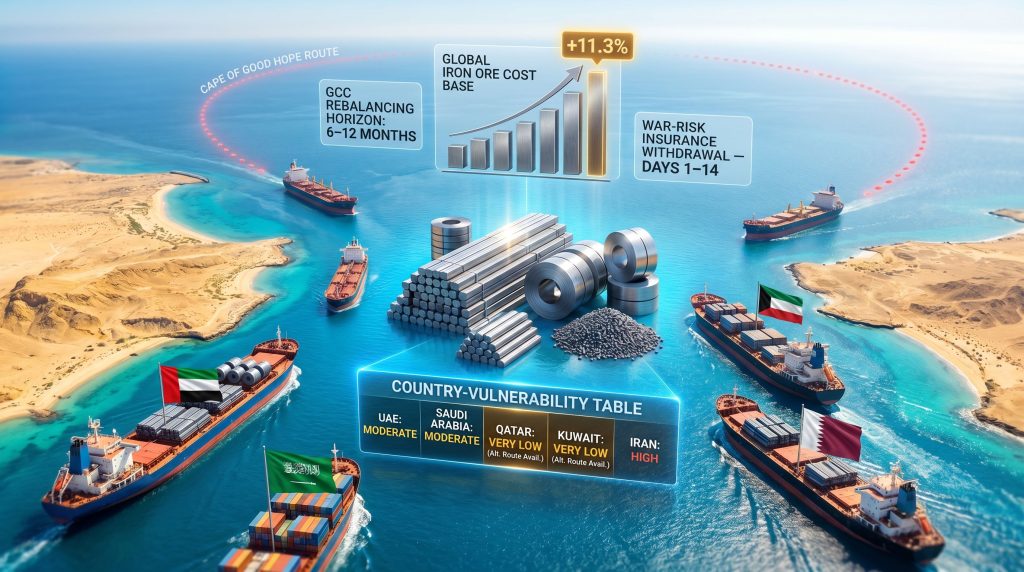
The fastest-acting mechanism in any Hormuz disruption scenario is not physical supply depletion. It is the near-instantaneous withdrawal of war-risk insurance coverage by Protection and Indemnity (P&I) clubs and marine underwriters. When active conflict makes transit risk unquantifiable, insurers withdraw rather than price. Without insurance, commercial vessels cannot legally enter the zone, and vessel movements freeze within days regardless of cargo type.
The knock-on effects move quickly:
- Chinese mills suspend export offers to Gulf buyers when route certainty disappears, as pricing a cargo with no viable delivery mechanism is commercially meaningless
- Freight rates for alternative routing via the Cape of Good Hope escalate sharply, adding approximately 7,000 to 8,000 nautical miles to voyages from East Asian origins to Gulf ports and extending transit times by three to four weeks
- Spot scrap and DRI markets in the Gulf go into immediate holding pattern, as buyers cannot confirm inbound cargo schedules and sellers cannot confirm vessel availability
- Steel stockpiles at GCC ports, typically carrying four to six weeks of forward cover under normal operating conditions, begin their countdown
Phase 2: Price Discovery Across Weeks Two Through Eight
As the market absorbs the physical reality of supply interruption, price discovery mechanisms activate across multiple product categories. Hot-rolled coil (HRC) import assessments for Gulf buyers reprice sharply upward as the seaborne supply premium expands. Furthermore, rebar and billet pricing follows a similar trajectory, reflecting both the supply shock and the speculative positioning that accompanies any major disruption event.
A scenario with particular significance involves Iran. Under a full Hormuz closure coinciding with or triggered by conflict involving Iranian forces, Iranian finished steel and semi-finished product effectively exits the regional market overnight. Iran has been a meaningful regional supplier of billets and rebar to neighbouring markets. The simultaneous removal of Iranian supply alongside the interruption of all seaborne imports creates a compounding scarcity that single-variable models consistently underestimate.
Historical precedent offers partial guidance. During periods of heightened Hormuz tension in 2019 and 2020, steel and metals pricing in Gulf markets demonstrated measurable sensitivity to geopolitical escalation signals even without physical closure. According to Fastmarkets, conflict halts steel trade through Hormuz, a full closure represents a step-change in magnitude rather than a continuation of the same dynamic.
Phase 3: Structural Rebalancing Over Six to Twelve Months
The medium-term consequences extend well beyond initial price shock. Market analysts model a 6 to 12-month horizon for meaningful rebalancing of GCC steel supply and demand following a sustained closure, accounting for restocking cycles, freight normalisation, and the gradual unwinding of supply chain disruption across scrap, DRI, and finished product segments.
One of the most significant but least-discussed transmission mechanisms operates through the global iron ore cost base. A major Hormuz disruption affecting the shipping economics of bulk commodity routes through the region could push the global iron ore cost base up by approximately 11.3%, with elevated shipping costs serving as the primary driver. Consequently, this is not a localised GCC price event. It is a global cost structure shift with implications for the global crude steel outlook from Germany to South Korea.
Country-Level Vulnerability: A Comparative Assessment
The Hormuz closure impact on the Middle East steel market is not distributed evenly. Country-level exposure varies significantly based on import dependency, alternative routing feasibility, and the nature of domestic steelmaking capacity.
| Country | Primary Exposure | Key Steel Input at Risk | Alternative Route Availability |
|---|---|---|---|
| UAE | Import and re-export hub disruption | Finished coil, rebar, semis | Moderate (Fujairah bypass limited) |
| Saudi Arabia | DRI-based steelmaking input costs | Iron ore pellets, scrap | Low for Hormuz-dependent routes |
| Qatar | Finished steel import dependency | Flat products, structural | Very Low |
| Kuwait | Rebar and construction steel supply | Finished rebar, billets | Very Low |
| Iran | Export revenue loss and input blockage | Finished steel, semis outbound | Effectively zero |
Qatar and Kuwait occupy the most exposed positions in this framework. Both countries lack meaningful domestic steelmaking capacity and have very limited alternative import routing options. Qatar's construction and infrastructure sector, still active in post-tournament development consolidation, carries particular project finance risk when import flows are interrupted. Delays to steel-intensive projects translate directly into cost overruns that lenders and contractors must absorb.
Saudi Arabia's DRI-based production model creates a different type of vulnerability. Disrupting iron ore pellet supply does not immediately halt steel output, but it starts depleting feedstock inventories that typically cover 60 to 90 days of production. Beyond that window, DRI plants face curtailment decisions with significant downstream consequences for the kingdom's construction sector.
The Semi-Finished Products Blind Spot
An underappreciated dimension of Hormuz supply risk involves billets and slabs. Across the GCC, a network of re-rolling mills depends on imported semi-finished products as their primary feedstock. These mills lack the integrated steelmaking capacity to produce their own billets. When seaborne semi-finished supply is disrupted, re-rollers face the choice of running down stockpiles or curtailing production.
In either case, downstream rebar and section output contracts, creating second-order price pressure throughout the regional construction supply chain. This semi-finished vulnerability is structurally more acute than finished product risk because re-rollers have fewer substitution options. A buyer of finished HRC can potentially source from multiple origins through alternative routes, albeit at a premium. A re-roller without billets cannot produce rebar regardless of how much finished steel is theoretically available elsewhere.
Risk Mitigation Strategies for Steel Traders and Project Financiers
Inventory and Sourcing Positioning
Sophisticated regional buyers have been watching Hormuz escalation signals carefully, and pre-disruption stockpiling behaviour follows a recognisable pattern. As geopolitical tension rises, buyers accelerate procurement to build buffer inventory beyond normal stock cover levels. Bonded warehouse facilities in free-trade zones located outside the strait's immediate risk corridor, particularly in Oman's Salalah port and Egypt's Port Said, offer partial mitigation for traders able to position product in advance.
Alternative sourcing pathways exist but carry meaningful constraints:
- Turkey offers billet and rebar supply accessible via Red Sea routing, though capacity is finite and Turkish mills face their own input cost pressures
- India represents a viable flat products alternative for certain GCC buyers, with Red Sea access partially insulated from Hormuz disruption
- CIS and Black Sea suppliers face Red Sea routing constraints of their own, and transit costs escalate under high-tension scenarios
- Southeast Asian mills in Vietnam and Malaysia can partially substitute for Chinese supply, though product mix compatibility varies by end-use application
Freight and Insurance Frameworks
War-risk insurance structures operate on mechanisms that most steel traders and project financiers understand in principle but rarely model in practice. P&I clubs typically issue 72-hour withdrawal notices once a zone is classified as a war-risk area, giving cargo holders very limited time to make vessel deployment decisions. Freight hedging instruments, including Forward Freight Agreements (FFAs) and dry bulk index derivatives, provide some protection for traders with exposure to Cape of Good Hope rerouting costs, however liquidity in these instruments can thin precisely when they are needed most.
Furthermore, the China steel outlook adds another dimension to this complexity, as Chinese mills represent a disproportionate share of GCC flat product imports, making Chinese export pricing behaviour a key variable in any Hormuz disruption scenario.
The Resumption Window: Risk and Opportunity
When the strait reopens, the first weeks of resumed trade present a specific risk and opportunity profile that experienced traders position for deliberately. Pent-up import demand from GCC buyers who have been working through stockpiles creates a surge in procurement activity. This demand concentration pushes spot prices for HRC, rebar, and billets sharply higher in the short term before normalising as restocking cycles complete.
Project financiers and construction procurement teams that lock in forward pricing or derivatives-based cost protection at the point of resumption, before the restocking surge is fully priced in, can achieve materially better outcomes than those who wait for market normalisation. The Red Sea disruption cycle of 2023 and 2024 provided a partial rehearsal for this dynamic, and the Hormuz scenario, given greater magnitude, would likely see even sharper initial repricing at reopening.
The next major ASX story will hit our subscribers first
The Long-Term Architecture Question
The recurring spectre of Hormuz disruption has begun prompting serious strategic conversations about the long-term architecture of GCC steelmaking. If access to seaborne raw material and semi-finished supply cannot be guaranteed, the economic logic of expanding domestic integrated steelmaking capacity becomes considerably stronger.
Investment in additional DRI and EAF capacity, using domestically abundant gas as the reduction agent, reduces dependence on imported iron ore pellets and semi-finished feedstock over time. However, this transition requires a decade-scale investment horizon and cannot address near-term supply chain vulnerability. The iron ore market disruptions already observed through trade tariff cycles in 2025 have underscored just how quickly feedstock economics can shift under external pressure.
In addition, the global iron ore market impact of sustained Hormuz disruption would extend well beyond the GCC itself. According to the World Economic Forum's analysis of commodities impacted by Hormuz closure, the ripple effects across bulk shipping, raw material pricing, and downstream manufacturing could reshape trade flows across multiple continents for years.
What the Hormuz closure impact on the Middle East steel market ultimately reveals is that the region's steel trade architecture was built for a stable, open-access maritime environment. Recurring geopolitical disruption to that environment does not simply create temporary price volatility. It creates a sustained structural incentive to reorganise how steel is sourced, processed, and distributed across one of the world's fastest-growing construction and industrial markets.
Disclaimer: This article contains forward-looking analysis, scenario modelling, and market projections. All figures, timelines, and assessments are based on publicly available data and analytical frameworks as of the publication date. This content does not constitute financial or investment advice. Market conditions may change materially from scenarios described. Readers should conduct independent due diligence before making any commercial or financial decisions.
For complementary analysis on steel supply and demand dynamics in the post-Hormuz era, Argus Media has published a dedicated insight paper available at argusmedia.com.
Want to Stay Ahead of the Commodity Disruptions Reshaping Mining Markets?
When geopolitical shocks like a Hormuz closure ripple through global iron ore and steel supply chains, the flow-on effects can create significant opportunities for investors positioned early — Discovery Alert's proprietary Discovery IQ model scans ASX announcements in real time, instantly identifying significant mineral discoveries across iron ore, steel feedstocks, and 30+ other commodities before the broader market reacts. Explore historic discovery outcomes and the returns they generated, then begin your 14-day free trial to ensure the next major opportunity doesn't pass unnoticed.