June 5, 2026
The Quiet Restructuring of a $132-Billion Market
Commodity markets rarely shift power overnight. The transitions that matter most happen gradually, through accumulated contract cycles, institutional changes, and structural reforms that only become visible in hindsight. The seaborne iron ore market is currently undergoing exactly this kind of slow-motion realignment, and the consequences extend well beyond any individual mining company or annual price negotiation.
At the centre of this shift is a contest between two deeply asymmetric forces: a group of competing private mining giants, and a single, state-backed Chinese procurement entity with an explicit mandate to reshape how the world's most traded bulk commodity is priced and settled. Understanding the mechanics of this contest, and what Australia's response reveals about the limits of commodity export dependence, is essential for anyone tracking the Australia iron ore price fight with China.
When big ASX news breaks, our subscribers know first
How Iron Ore Pricing Actually Works and Why It's Being Challenged
Iron ore does not trade on a centralised exchange the way crude oil or gold does. Instead, pricing is governed by benchmark index systems, most notably those published by Platts and Metal Bulletin, which aggregate spot transaction data to generate daily reference prices. Annual contract negotiations between miners and steel mills use these benchmarks as anchors, with premiums or discounts applied based on grade, moisture content, and product specifications.
This system has historically served producers well. Benchmark indices reflect actual market transactions, which during periods of supply constraint tend to favour seller-side pricing power. The four dominant Australian exporters, BHP, Rio Tinto, Fortescue, and Hancock Prospecting, have collectively shaped global supply dynamics for decades, and the benchmark system has reflected that structural reality.
What China's procurement reform has done is attack the demand side of this equation with equal force.
Iron Ore Grade and Quality: Why Does Product Differentiation Matter?
One layer of complexity that rarely receives attention in mainstream coverage is the role of iron ore grade in pricing negotiations. Not all iron ore is equal, and the gap between product types has significant commercial implications.
-
High-grade iron ore demand (above 65% iron content) commands meaningful premiums because it improves blast furnace efficiency and reduces coking coal consumption per tonne of steel produced.
-
Mid-grade ore (around 62% Fe) represents the benchmark standard and forms the basis of most index pricing.
-
Lower-grade ore (below 58% Fe), which forms a larger share of Fortescue's product mix, trades at a discount that widens during periods of oversupply or when steel mills can afford to be selective.
This grade differentiation is directly relevant to any discussion of export coordination. BHP's premium Pilbara Blend products and Fortescue's lower-grade fines have fundamentally different market positions, meaning any collective negotiating strategy would need to reconcile divergent commercial interests from the outset.
China Mineral Resources Group: The Architecture of Consolidated Buying Power
China Mineral Resources Group (CMRG) was established specifically to consolidate the fragmented purchasing behaviour of hundreds of Chinese steel mills into a single procurement vehicle. Before CMRG, individual steelmakers negotiated independently, which undermined China's theoretical leverage as the world's dominant iron ore consumer. CMRG was designed to fix that structural weakness.
The impact has been rapid and demonstrable. The table below summarises the key tactics deployed against Australian miners in the current contract cycle:
| Tactic | Target | Reported Outcome |
|---|---|---|
| Temporary volume blacklisting | BHP | Approximately seven months of suspended purchases on certain products |
| Restricting steelmaker engagement | Fortescue | Direction to mills not to discuss a new Fortescue product |
| Yuan-denominated settlement | BHP | Incorporated into the deal reached in April 2026 |
| Annual contract renegotiation | Rio Tinto | Negotiations scheduled for later in 2026 |
"The fundamental asymmetry here is structural, not tactical. Four competing companies with different cost bases, product grades, and shareholder obligations are negotiating against a single entity with a unified mandate and state backing. The negotiating math was never going to favour the sellers."
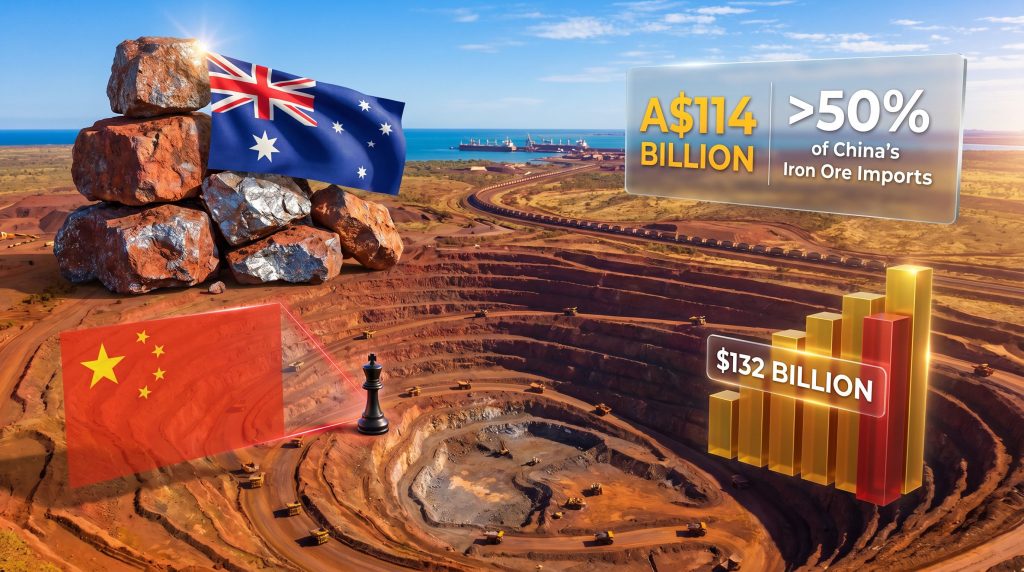
The BHP blacklisting episode deserves particular attention. A seven-month suspension of purchases is not a minor commercial dispute. It represents a sustained pressure campaign designed to demonstrate that CMRG can absorb supply disruption better than miners can absorb revenue loss. Furthermore, given that iron ore revenues are projected to contribute approximately A$114 billion (~$81 billion USD) to Australia's export earnings in the current financial year, this is leverage with genuine national fiscal consequences. As the Guardian's analysis of the BHP dispute highlighted, the ramifications extend far beyond any single commercial relationship.
Australia's Fiscal Exposure: When a Commodity Becomes a Sovereign Vulnerability
Australia's dependence on iron ore revenue is extraordinary by any measure. Consider the concentration risk embedded in the following figures:
| Metric | Figure |
|---|---|
| Australia's share of China's iron ore imports | More than 50% |
| Projected iron ore export revenue (current financial year) | A$114 billion (~$81 billion USD) |
| Global seaborne iron ore market size | ~$132 billion |
| Number of major Australian iron ore exporters | 4 (BHP, Rio Tinto, Fortescue, Hancock) |
| CMRG blacklist duration (BHP products) | ~7 months |
The numbers reveal a commodity relationship where Australia supplies the majority of China's iron ore needs, and iron ore in turn funds a disproportionate share of Australia's federal budget receipts. A sustained, even modest, reduction in realised prices would translate into billions of dollars in lost government revenue with limited short-term policy levers available to offset the impact.
What makes this doubly complex is the dual nature of the risk. Pricing pressure from CMRG's consolidated buying tactics operates alongside a separate, structural demand risk: China-driven iron ore weakness stemming from the ongoing property sector contraction. Steel consumption in construction applications has declined as major developers have restructured debt and reduced new project pipelines. If structural steel demand falls materially, iron ore prices face downward pressure entirely independent of bilateral commercial disputes.
The Strategic Constraint: Repairing Relations While Protecting Revenue
Australia's policy response to the Australia iron ore price fight with China is constrained by a fundamental strategic tension. China is simultaneously the country's largest trading partner and the primary source of pricing pressure on its most important export. Any aggressive policy response risks damaging the very relationship that makes iron ore revenues possible.
This tension is not theoretical. The 2020 to 2023 period demonstrated exactly how costly bilateral deterioration can be, with Australian agricultural exporters bearing the commercial cost of diplomatic friction through Chinese tariffs on barley, wine, beef, and other products. Canberra has invested significant diplomatic capital in repairing that relationship and is understandably reluctant to introduce new friction points.
Industry sources indicate that at least one senior executive at a major iron ore miner raised the issue with government but acknowledged that Australia's current diplomatic posture toward Beijing limits the appetite for an assertive response.
What the Senate Inquiry Revealed About Government Engagement
A Senate panel formally examined the government's role in the iron ore pricing dispute in June 2026, questioning Department of Foreign Affairs and Trade (DFAT) officials about the nature of industry engagement.
DFAT Assistant Secretary Steven Yates confirmed that engagement had occurred with miners including BHP, Rio Tinto, Fortescue, Hancock, and the Minerals Council. He indicated that during those discussions, industry had raised specific suggestions for how the government might advance the issue, whilst declining to elaborate further on grounds of commercial confidence. Yates noted that his department engages regularly with Australian miners and works to support their ability to export at the best achievable prices.
Deputy Secretary George Mina addressed the specific question of whether export-side coordination, sometimes described as a single selling desk, could serve as a structural counterweight to CMRG. He acknowledged that previous attempts to coordinate agricultural supply had not been well received by trading partners, but noted a key distinction in the current situation: unlike agricultural markets, iron ore already faces a single, established buyer on the Chinese side. That asymmetry, Mina suggested, changes the long-term strategic calculus. Consequently, the broader discussion around China steel and iron ore market dynamics has moved firmly into the realm of national policy rather than purely commercial strategy.
The Single Selling Desk Proposal: Mechanics, Precedents, and Problems
A single selling desk is a coordinated export mechanism through which competing producers agree to negotiate collectively with buyers rather than independently. In theory, it creates a producer-side counterweight to a consolidated buyer. In practice, the concept carries significant legal, commercial, and diplomatic complications.
Historical precedents offer mixed guidance:
| Model | Sector | Outcome | Relevance |
|---|---|---|---|
| Australian Wheat Board (AWB) | Agriculture | Dismantled following corruption scandal; trading partners resistant | Cautionary precedent cited by DFAT |
| OPEC+ | Oil | Effective at price management; politically complex | Demonstrates viability of producer coordination |
| BPC potash cartel | Fertilisers | Collapsed in 2013 following member defection | Highlights fragility of informal arrangements |
| De Beers | Diamonds | Historically effective; eroded over decades | Shows long-term sustainability challenges |
Beyond precedent, there are structural barriers specific to iron ore:
-
Competition law constraints: Formal coordination among competing exporters may conflict with Australian competition law and World Trade Organization obligations, requiring careful legal architecture to implement lawfully.
-
The free-rider problem: Any coordination framework only works if all participants maintain unified positions under commercial pressure. Given that BHP, Rio Tinto, Fortescue, and Hancock have different cost structures, product grades, and shareholder obligations, maintaining cohesion during prolonged negotiations would be genuinely difficult.
-
Grade-driven divergence: As noted earlier, BHP's premium products and Fortescue's lower-grade fines serve different market segments and command different pricing dynamics. A coordinated desk would need to manage these internal differences without creating internal price competition.
The next major ASX story will hit our subscribers first
The Yuan Settlement Dimension: A Structural Concession With Long-Term Implications
BHP's April 2026 agreement with CMRG included acceptance of yuan-denominated sales, a development that has attracted less attention than it deserves. This is not simply a currency preference. It represents a meaningful structural shift in how one of the world's most important commodity trade relationships is financially settled.
Yuan-denominated settlement serves several Chinese strategic objectives simultaneously:
-
It reduces the role of USD-based benchmark pricing in determining iron ore transaction values.
-
It advances China's broader renminbi internationalisation strategy by embedding the currency in high-volume commodity flows.
-
It creates currency risk for Australian miners that did not previously exist in the same form, requiring adjustments to hedging strategies and revenue reporting frameworks.
If yuan settlement becomes normalised across successive contract cycles with BHP, it creates a precedent that will likely be repeated in negotiations with Fortescue and Rio Tinto. The cumulative effect would be a gradual erosion of Western financial infrastructure's role in the world's largest bulk commodity market. Indeed, global iron ore trade pressures are compounding these dynamics from multiple directions simultaneously.
Three Scenarios for the Australia-China Iron Ore Relationship
The trajectory of the Australia iron ore price fight with China is genuinely uncertain. Three plausible scenarios frame the range of outcomes:
Scenario 1: Status Quo Erosion
CMRG continues applying incremental pressure across successive contract cycles. Miners make concessions on pricing terms, currency settlement, and product access without a coordinated policy response from Canberra. Over five to ten years, pricing authority gradually shifts toward the Chinese side.
Scenario 2: Coordinated Producer Response
The Australian government facilitates some form of export coordination, either through formal legislation or diplomatic backing for collective negotiations. Miners present a more unified front. This stabilises pricing terms but introduces new diplomatic friction with Beijing. However, iron ore tariff impacts in the broader trade environment could accelerate pressure on both sides to reach a durable arrangement sooner rather than later.
Scenario 3: Demand Collapse Supersedes the Dispute
China's property sector downturn deepens materially. Structural steel demand falls below the level at which CMRG's tactical leverage even matters. Iron ore prices decline as a market phenomenon rather than a bilateral policy contest, and Australia's fiscal position deteriorates independently of negotiation outcomes. Reuters has reported that the Australian government is actively monitoring these talks precisely because of this budgetary exposure.
Frequently Asked Questions
What is China Mineral Resources Group and why does it matter for iron ore pricing?
CMRG is China's centralised state iron ore procurement entity, established to consolidate the previously fragmented buying behaviour of hundreds of individual steel mills. Its significance lies in converting China's theoretical demand dominance into actual negotiating leverage by presenting a single unified counterparty to competing Australian miners.
Why did CMRG blacklist some of BHP's iron ore?
The blacklisting, which lasted approximately seven months, occurred during protracted contract negotiations and served as a demonstration of CMRG's willingness to absorb supply disruption in order to extract better terms. It resolved with BHP reaching a deal that included agreement to some yuan-denominated sales.
What is a single selling desk and has Australia used one before?
A single selling desk is a coordinated export mechanism where competing sellers negotiate collectively with buyers. Australia previously operated such a system for wheat through the Australian Wheat Board, which was eventually dismantled. The concept is under long-term consideration for iron ore but has not been adopted as policy.
How significant is iron ore to Australia's economy?
Iron ore is Australia's most valuable commodity export, with government estimates projecting revenues of approximately A$114 billion in the current financial year. The commodity underpins a substantial share of federal budget receipts, making pricing dynamics a matter of direct national fiscal importance.
Could Australia find alternative buyers for its iron ore?
India, Southeast Asian steelmakers, and Middle Eastern industrial consumers represent potential diversification opportunities over the medium term. However, none currently offer demand at a scale comparable to China's, which absorbs more than half of Australia's total iron ore exports. Meaningful demand diversification would require years of market development and significant infrastructure investment by both miners and potential buyer nations.
What does yuan-denominated settlement mean for Australian miners?
It introduces currency risk that previously did not exist in the same form, requiring changes to hedging strategies and financial reporting. More broadly, it advances China's renminbi internationalisation agenda and reduces the role of USD-based benchmark indices in determining iron ore transaction values, with long-term implications for pricing architecture across the entire seaborne market.
Want to Track the Next Major ASX Mineral Discovery Before the Market Does?
Discovery Alert's proprietary Discovery IQ model delivers real-time alerts on significant ASX mineral discoveries, transforming complex commodity data into clear, actionable investment insights for both short-term traders and long-term investors. Explore Discovery Alert's discoveries page to understand how historic mineral finds have generated substantial market returns, and begin your 14-day free trial today to position yourself ahead of the broader market.