
June 5, 2026
The Structural Fault Lines Beneath Global Potash Pricing
Commodity markets are rarely shaped by a single actor, but potash is an exception. When a market participant simultaneously produces more than most nations can dream of, imports more than anyone else does, and then sits down to negotiate a price that the rest of the world watches closely, the resulting dynamics deserve careful examination. The China potash market operates exactly this way, and understanding its mechanics is essential for anyone tracking global fertiliser trade, agricultural input costs, or soft commodity supply chains.
What makes this market genuinely unusual is not just the scale, but the architecture. China's approach to potash procurement, pricing, and distribution involves institutional structures and policy frameworks that create observable disconnects between different layers of the market. These disconnects, in turn, generate both risk and opportunity for participants across the entire global supply chain — dynamics that mirror broader commodity price impacts seen across resource sectors.
When big ASX news breaks, our subscribers know first
Why China's Import Dependency Is Structural, Not Cyclical
China's domestic potash production is not insignificant. Output is concentrated in the Qinghai and Xinjiang provinces, where evaporite deposits and brine lake systems provide the geological foundation for the country's mining operations. Qinghai's Chaidamu Basin, in particular, hosts some of the most significant potash-bearing brine deposits in Asia.
However, the mineralogy of these deposits, combined with remote geography, high-altitude operating conditions, and water scarcity constraints, imposes a natural ceiling on how much production can realistically be expanded.
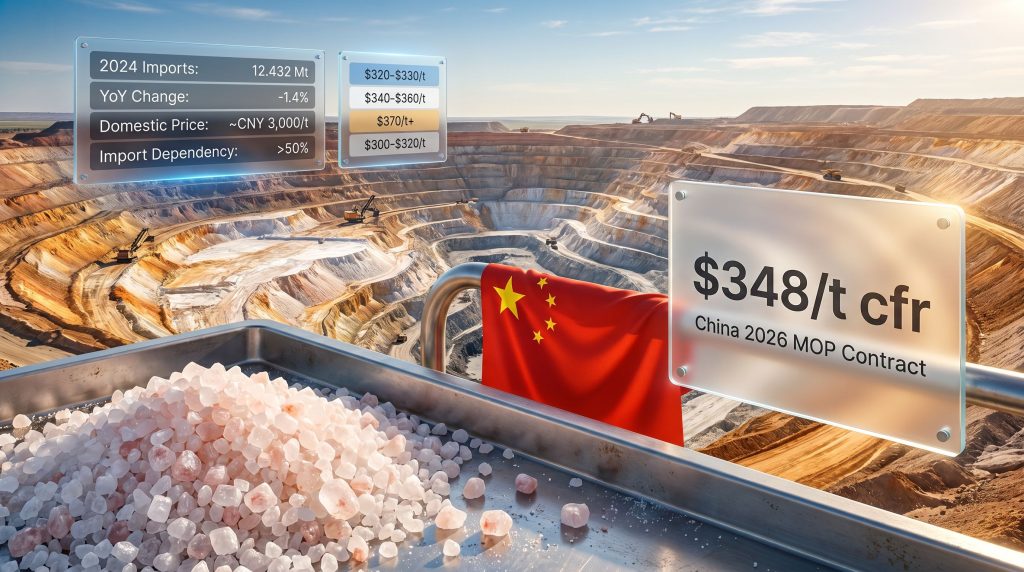
This geological reality underpins a key structural truth: China's import reliance for potash has persistently exceeded 50% of domestic consumption, and no amount of domestic capital allocation has managed to close that gap over the past two decades. Total potash imports reached 12.432 million tonnes in 2024, a figure that declined 1.4% year-on-year but remains among the highest single-country import volumes in the world.
Agricultural applications account for roughly 95% of all potash consumed domestically, meaning the demand base is tied directly to planting cycles, crop prices, and food security imperatives rather than industrial fluctuations. Furthermore, the critical raw materials conversation increasingly intersects with fertiliser supply security, adding another policy dimension to procurement decisions.
The combination of geologically constrained domestic supply and agriculturally driven demand makes China's potash import requirement structurally sticky. Unlike industrial commodity demand, which can be moderated through technological substitution or economic slowdowns, food production creates a baseline floor that does not compress easily.
The Mechanics of China's Domestic Dual Pricing System
How Does the Two-Tier Structure Work?
One of the least-understood features of the China potash market is the domestic dual pricing system that governs how imported material flows through the distribution chain. This is not simply a matter of different buyers paying different prices due to volume or timing. It reflects a deliberate institutional separation between state-affiliated major importers and the broader community of independent traders.
The table below illustrates how this two-tier structure functions in practice:
| Pricing Tier | Key Participants | Price Characteristics | Institutional Role |
|---|---|---|---|
| Major Importer Prices | State-linked procurement entities | Stable, contract-anchored | Agricultural affordability, national supply security |
| Trader-Level Prices | Independent distributors | More responsive to spot conditions | Real-time demand and logistics signals |
| Domestic Production Benchmark | Qinghai, Xinjiang producers | ~CNY 3,000/t (2025-2026 range) | Domestic supply floor reference |
This structure creates a phenomenon that confuses outside observers: major importer prices remain steady even when trader-level prices soften slightly. The reason is institutional insulation. State-affiliated buyers operate under frameworks that prioritise supply security and price stability over short-term market optimisation.
Independent traders, by contrast, bear the full force of spot market dynamics, making their pricing a more sensitive indicator of real supply-demand balance at any given moment. This also contributes to commodity market volatility that participants across the supply chain must account for in their hedging strategies.
The persistence of steady major importer pricing alongside modest softening at the trader level is not a contradiction. It is the system working exactly as designed, with policy objectives and commercial objectives occupying separate pricing lanes.
China's 2026 MOP Contract: Anatomy of a Global Price Anchor
What Drove the $348/t Settlement?
The 2026 Muriate of Potash (MOP) import contract was finalised at $348 per tonne cost-and-freight (cfr) in November 2025. This settlement level matters far beyond China's borders. When the world's largest potash importer sets an annual contract price, it establishes a reference point that influences spot market negotiations across Southeast Asia, South Asia, and Latin America.
According to Argus Media's potash market coverage, the India MOP contract is the only other settlement that carries comparable benchmark weight globally.
Three converging factors supported the $348/t outcome:
- Below-average port inventories at Chinese receiving terminals reduced buyers' negotiating leverage, eliminating the option of delaying procurement to wait for price corrections.
- Border trade supply constraints, particularly from Central Asian overland corridors, tightened the domestic supply picture beyond what maritime imports alone could easily compensate for.
- Seasonal demand patterns, including winter storage procurement ahead of spring planting cycles, created predictable demand pressure that exporters were able to leverage during negotiations.
From a historical perspective, the $348/t settlement represents a meaningfully firmer pricing environment than the multi-year trough experienced between 2015 and 2020, when contract prices periodically dipped below the $300/t threshold. Market analysts broadly interpret the current level as reflecting structural supply tightness rather than a temporary demand-driven spike — a distinction with significant implications for how the 2027 cycle will be approached.
Geopolitical Risk and the Middle East Conflict's Fertiliser Supply Chain Impact
How Are Importers Responding to Logistics Uncertainty?
The ongoing Middle East conflict has introduced a layer of complexity into Chinese importers' supply chain calculations that extends well beyond headline commodity prices. Shipping routes transiting through affected corridors have faced insurance cost escalation, freight rate volatility, and periodic routing uncertainty. For a commodity like potash, where cost-and-freight pricing is the standard contract basis, logistics cost changes feed directly into delivered value calculations.
Chinese importers have consequently been reassessing their source diversification strategies. Historically, the Former Soviet Union corridor, encompassing Russian and Belarusian supply, has represented a major share of China's potash import mix alongside Canadian and Jordanian material. The geopolitical risks in mining that now characterise fertiliser supply chains were once considered peripheral concerns but have become central to procurement planning.
The conflict has reinforced a pre-existing strategic preference for domestic production investment in China, but the timeline realities of Qinghai and Xinjiang capacity expansion mean that meaningful additional output remains measured in years rather than months. Import dependency is not a problem that domestic policy can solve quickly, regardless of how pressing the strategic motivation becomes.
The broader lesson from the current geopolitical environment is that supply chain disruptions in fertiliser markets now routinely incorporate political scenario modelling alongside traditional supply-demand balance analysis. This is a relatively recent development in how institutional buyers approach annual contract negotiations.
FSU Supply Dynamics and the Concentration Risk Problem
A feature of global potash markets that deserves more attention than it typically receives is the extraordinary degree of supply concentration among a small number of exporting countries. Canada, Russia, and Belarus collectively account for the dominant share of globally traded potash, with Jordan and Israel contributing meaningful but smaller volumes. This oligopolistic supply structure means that disruptions affecting even a single major producer carry outsized pricing implications.
For China specifically, FSU supply uncertainty — whether driven by sanctions regimes, export policy changes, or logistics constraints — creates a recurring vulnerability that contract negotiations cannot fully hedge. The $348/t 2026 settlement partly reflects the market's pricing of this risk, with exporters retaining leverage that would not exist in a more fragmented supply landscape.
This concentration dynamic also explains why the China potash market's role as the largest consumer does not straightforwardly translate into price-setter status. Monopsony power requires either genuine supply alternatives or the credibility to delay purchase indefinitely, and China's agricultural calendar and inventory levels constrain both options during active negotiation windows.
The next major ASX story will hit our subscribers first
Outlook for the 2027 MOP Contract: Scenarios and Variables
Early market positioning for the 2027 MOP contract cycle has already begun, with participants closely monitoring port inventory levels, FSU export trajectories, and the evolution of the Middle East conflict's logistics impact. Analysis from Grand View Research's potash market outlook further highlights how demand fundamentals in China will shape global pricing trajectories over the medium term. The following scenario framework outlines the most probable pricing pathways:
| Scenario | Key Enabling Conditions | Probable Price Direction | Relative Likelihood |
|---|---|---|---|
| Supply Recovery | FSU export normalisation, inventory rebuild | Downward toward $320-$330/t | Moderate |
| Continued Tightness | Supply constraints persist, seasonal demand firm | Flat to marginal increase, $340-$360/t | High |
| Supply Shock Event | Geopolitical escalation, major export disruption | Significant upside, $370/t+ | Low to moderate |
| Demand Softening | Agricultural slowdown, substitution or input reduction | Downward, $300-$320/t | Low |
The dominant variable in this framework is likely to be FSU export capacity rather than Chinese agricultural demand, which is relatively inelastic on a one-to-two year horizon. If Belarusian and Russian export volumes recover toward pre-disruption levels, Chinese buyers will have stronger grounds to push for price concessions. If supply tightness persists, the $348/t floor established in 2026 could prove to be a launching pad rather than a ceiling.
China's Role as a Global Potash Price Transmitter
The ripple effects of China's MOP contract settlement extend well beyond its own agricultural sector. When the 2026 contract settled at $348/t cfr, it effectively lifted the reference floor for spot market negotiations across import-dependent markets in Southeast Asia and South Asia. Countries without the institutional purchasing power to negotiate their own annual contracts use Chinese and Indian settlements as anchors for their own procurement pricing.
This transmission mechanism means that tightness in the China potash market does not stay in China. It propagates through regional spot markets, influences the cost of food production across multiple continents, and ultimately affects the economics of agricultural systems that billions of people depend upon. The policy, geological, and geopolitical factors shaping China's potash procurement decisions are, in this sense, genuinely global in their consequence.
Key Market Data at a Glance
| Metric | Current Data Point |
|---|---|
| 2026 MOP Contract Settlement | $348/t cfr |
| China Total Potash Imports (2024) | 12.432 million tonnes |
| Year-on-Year Import Change (2024) | -1.4% |
| Import Dependency Rate | Over 50% of domestic consumption |
| Agricultural Share of Domestic Use | Approximately 95% |
| Domestic Benchmark Price (2025-2026) | ~CNY 3,000/t |
| Primary Domestic Producing Regions | Qinghai Province, Xinjiang |
| Major Import Origins | Canada, Russia, Belarus, Jordan |
Disclaimer: Market price projections, scenario analyses, and forward-looking assessments contained in this article represent analytical frameworks based on available data and are not financial advice. Commodity markets are subject to rapid change driven by geopolitical, weather, policy, and supply factors beyond the scope of any model. Readers should conduct independent due diligence before making any investment or commercial decisions based on this information.
Want to Stay Ahead of ASX Mineral Discoveries Before the Broader Market Does?
Discovery Alert's proprietary Discovery IQ model delivers real-time alerts on significant ASX mineral discoveries — including those across the fertiliser and critical minerals supply chain — turning complex data into actionable insights for traders and investors at every experience level. Explore Discovery Alert's discoveries page to understand how historic mineral discoveries have generated substantial returns, and begin your 14-day free trial today to position yourself ahead of the market.