August 6, 2026
When the Loading Buoy Becomes the Target: Gulf Energy Infrastructure Under Siege
The global oil market has spent years stress-testing its assumptions about where the next supply shock will originate. Analysts have modelled tanker blockades through the Strait of Hormuz, simulated pipeline sabotage scenarios across the Arabian Peninsula, and priced in the risk of onshore refinery strikes. What fewer risk models adequately accounted for was the vulnerability of the offshore loading systems themselves — the quiet mechanical intermediaries that sit between a country's crude reserves and the supertankers that carry them to market. The reported Oman Mina al Fahal terminal explosion on June 5, 2026, has abruptly forced that blind spot into view.
When big ASX news breaks, our subscribers know first
What the Explosion at Mina al Fahal Actually Disrupted
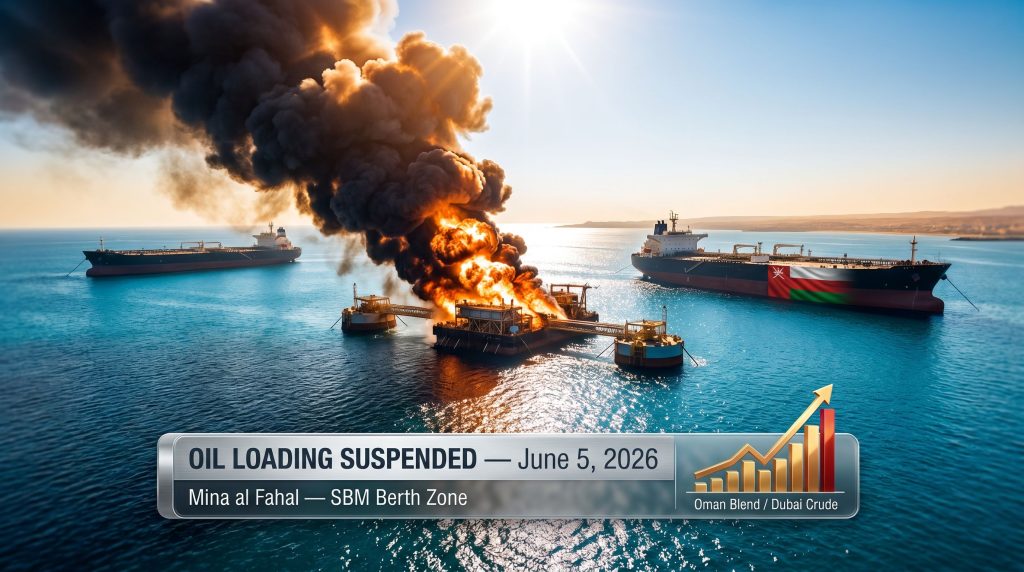
The Oman Mina al Fahal terminal explosion halted all oil loading operations at what is unambiguously the country's most critical crude export facility. According to two sources familiar with the situation and cited in Arab News reporting, the blast occurred in the zone between the terminal's Single-Buoy Mooring Berth 1 and Berth 2. Furthermore, sources indicated the cause may have been a drone strike, though no official confirmation from Omani authorities had been issued as of initial reporting.
Shipping data from LSEG corroborated the operational impact: multiple supertankers were observed at anchor offshore near the port on the same day, a visible and measurable consequence of a loading suspension that had effectively frozen cargo scheduling across the terminal.
The terminal operator was unreachable for comment outside office hours, leaving significant informational gaps in the early hours following the incident. That silence, combined with the unresolved question of attribution, created the kind of uncertainty that energy markets find most difficult to price.
Understanding the SBM System: Why Offshore Buoys Are Strategic Assets
To appreciate why the Oman Mina al Fahal terminal explosion carries such outsized significance, it helps to understand how single-buoy mooring infrastructure actually functions. SBM systems are not simple loading platforms. They are sophisticated offshore assemblies that connect onshore crude storage tanks to deep-water loading points via subsea pipelines, enabling Very Large Crude Carriers (VLCCs) and supertankers to take on cargo without requiring a deep-draft berth inside a port.
The technical architecture of an SBM system includes several interdependent components:
- A floating buoy anchored to the seabed by mooring chains and equipped with a rotating fluid transfer mechanism (known as a swivel)
- Flexible submarine hoses connecting the buoy to subsea pipelines running back to onshore storage
- Tanker mooring hawsers that attach the vessel's bow to the buoy during loading
- Pressure and flow control systems managing crude transfer rates
Each of these components represents a potential point of failure. Damage to the swivel assembly or the flexible hoses connecting the buoy to the subsea pipeline infrastructure can require weeks to months of specialist repair work, often involving saturation diving teams or remotely operated underwater vehicles operating in open-water conditions.
The open-water location that makes SBM systems operationally efficient is precisely the characteristic that makes them tactically accessible. Unlike hardened onshore facilities, they cannot be fenced, fortified, or easily defended against aerial threats.
Oman's Position in the Gulf Crude Export Architecture
Oman occupies a distinctive position in the regional energy landscape. Unlike its Gulf Cooperation Council neighbours, Oman is not a member of OPEC, though it participates in the OPEC+ production coordination framework. The country produces approximately 1 million barrels of crude oil per day, the majority of which is exported rather than consumed domestically.
Mina al Fahal, located near Muscat on the northeastern coastline, handles the bulk of these export volumes. The primary crude grade produced, known as Oman Blend, serves as a key pricing benchmark for Middle Eastern crude traded into Asian markets. Oman Blend and Dubai crude together function as the principal references against which Gulf-origin cargoes are priced for buyers in China, India, Japan, and South Korea.
This Asian export dependency has a critical implication for supply disruptions. When Mina al Fahal cannot load, there is no simple domestic fallback. The volumes simply do not reach market on schedule, and Asian refiners must either wait, draw down inventories, or source alternative crude grades at potentially elevated spot prices. Consequently, understanding current crude oil prices in this context becomes essential for market participants tracking regional exposure.
Key Characteristics of Oman's Crude Export Profile
| Factor | Detail |
|---|---|
| Production Volume | Approximately 1 million bpd |
| OPEC Membership | Non-member (OPEC+ participant) |
| Primary Export Destination | Asian markets (China, India, Japan, South Korea) |
| Benchmark Grade | Oman Blend |
| Primary Export Facility | Mina al Fahal terminal |
| Loading Mechanism | Single-Buoy Mooring (SBM) system |
The Regional Escalation Context: Hormuz Crisis and Its Spillover
The Oman Mina al Fahal terminal explosion did not occur in a vacuum. It happened against the backdrop of what Arab News has described as the Hormuz crisis — a deteriorating maritime security environment in the Gulf of Oman and the Strait of Hormuz that had already been generating global concern before June 5. The broader geopolitical landscape had been shifting for months, with energy infrastructure increasingly becoming a focal point of regional tensions.
Days before the Mina al Fahal incident, Iranian state media reported that Tehran had conducted a strike against a US military vessel it described as approaching Iranian territorial waters in the Gulf of Oman. US Central Command publicly denied the claim. The conflicting narratives, regardless of their factual accuracy, reflected the degree to which the information environment in the region had become as volatile as the physical one.
What makes this period strategically significant is the apparent shift in targeting logic:
- Phase 1 targeting: Vessel interdiction and harassment in transit lanes (mid-2019 to 2024 pattern)
- Phase 2 targeting: Strikes on vessels at anchor or in port approaches
- Phase 3 targeting (emerging): Attacks on fixed export infrastructure, including SBM berths and terminal approach zones
If the drone attack attribution for the Mina al Fahal explosion is confirmed, it would represent an escalation to Phase 3 — a materially different threat environment with much longer recovery timelines and more severe supply consequences than vessel-level interdiction.
Attacks on transit vessels disrupt individual cargoes. Attacks on loading infrastructure can disrupt an entire country's export capacity for weeks or months at a time. The leverage ratio is fundamentally different.
Comparative Infrastructure Vulnerability: What Gets Targeted and Why
Not all energy infrastructure carries equal risk. The table below synthesises publicly available analytical frameworks on attack complexity, recovery timelines, and strategic impact for different infrastructure categories operating in elevated-threat environments.
| Infrastructure Type | Attack Complexity | Estimated Recovery Time | Strategic Supply Impact |
|---|---|---|---|
| Subsea pipeline (offshore) | Moderate | Weeks to months | Very High |
| Single-buoy mooring (SBM) | Low to Moderate | Weeks to months | Very High |
| Onshore storage tank farm | High | Weeks to months | Very High |
| Onshore pipeline | Moderate | Days to weeks | High |
| Vessel in transit | Low | Days (if vessel survives) | Moderate |
| Onshore pump station | Moderate | Days to weeks | Moderate to High |
SBM infrastructure scores particularly poorly on this risk matrix because it combines high strategic impact with relatively low attack complexity. The open-water positioning eliminates most passive defensive advantages available to onshore infrastructure, and the specialist repair requirements mean that even limited damage can extend recovery timelines significantly.
The next major ASX story will hit our subscribers first
Drone Warfare and the Repricing of Maritime Energy Risk
The alleged use of a drone in the Mina al Fahal attack reflects a broader technological shift that has been reshaping the risk calculus for energy infrastructure across the Middle East. Commercial and military-grade drone systems have materially lowered the cost and technical complexity of conducting precision strikes at distances that would have been prohibitive for conventional delivery systems a decade ago.
For insurance and shipping markets, this shift has already been translating into tangible cost increases. War-risk insurance premiums for vessels operating in the Gulf of Oman and Red Sea corridors had been rising well before the Mina al Fahal incident. A confirmed attack on terminal infrastructure would be expected to accelerate that repricing, with oil price movements likely reflecting heightened uncertainty across the broader Gulf of Oman transit zone.
The practical consequences flow through multiple channels simultaneously:
- Demurrage costs: Supertankers anchored offshore Mina al Fahal on June 5 were accruing daily demurrage charges, with VLCC demurrage rates historically running at tens of thousands of dollars per day
- Cargo rescheduling: Asian refinery intake schedules are typically planned weeks in advance; even a short-term loading suspension creates downstream operational disruption
- Force majeure risk: Extended suspensions could trigger contractual force majeure declarations, shifting financial liability and creating legal complexity across supply chains
- Spot market tightening: Buyers forced to source replacement crude on the spot market may face a compressed supply pool, exerting upward pressure on benchmark prices
Three Scenarios for What Comes Next
The trajectory of the Mina al Fahal situation depends heavily on factors that remained unresolved as of initial reporting. Three plausible pathways exist, each carrying distinct implications for markets and regional stability.
Scenario 1: Rapid Resumption (1 to 7 Days)
If the structural damage to the SBM berths was limited and no follow-on strikes materialise, emergency diving and repair teams could restore partial loading capacity within days. Market impact would be limited to near-term spot price volatility, with longer-term implications absorbed quickly.
Scenario 2: Extended Suspension (2 to 6 Weeks)
Confirmed drone damage to subsea hose connections or the swivel assembly would likely push repair timelines into multi-week territory. Asian crude buyers would need to source alternative supply, Oman Blend pricing would widen against competing grades, and force majeure declarations could ripple through cargo contracts. In addition, analysts tracking crude oil geopolitical factors would likely revise supply forecasts downward for affected Asian import corridors.
Scenario 3: Sustained Escalation
If attribution is confirmed and the attack is identified as part of a coordinated infrastructure targeting campaign, the risk environment changes qualitatively rather than quantitatively. Insurance markets, vessel operators, and downstream buyers would need to reassess Gulf of Oman exposure on a structural rather than episodic basis. Furthermore, an oil price rally could materialise if market participants begin pricing in a persistent disruption premium across the region.
What Remains Unconfirmed and Why It Matters
The information environment surrounding the Oman Mina al Fahal terminal explosion was characterised by significant gaps as of early June 5, 2026. Several critical facts remained unverified:
- The precise timing of the explosion had not been officially established
- No Omani government body, including the Ministry of Energy and Minerals or the Royal Oman Police, had issued a public statement confirming the cause
- Casualty status remained unconfirmed
- The physical extent of damage to SBM infrastructure had not been independently assessed
- No party had claimed responsibility for the alleged drone attack
- No timeline for resumption of loading operations had been communicated
These gaps are not merely procedural. In a market environment already sensitised to Gulf of Oman risk, the absence of official information can amplify price volatility as much as confirmed bad news. Traders and analysts operating without verified data default to worst-case assumptions, and that psychological dynamic alone can move benchmark prices before any physical supply disruption has been fully established.
FAQ: Oman Mina al Fahal Terminal Explosion
What is the Mina al Fahal terminal and what role does it play in Oman's oil exports?
Mina al Fahal is Oman's primary crude oil export facility, located near Muscat. It uses a single-buoy mooring system to load supertankers offshore, handling the majority of the country's crude export volumes destined for Asian and European markets.
What caused the explosion at Mina al Fahal on June 5, 2026?
Two sources familiar with the matter, cited in Arab News reporting, indicated the explosion may have resulted from a drone attack targeting the SBM berth zone. As of initial reporting, no official confirmation from Omani authorities had been issued and no party had claimed responsibility. Social media reports from Al Jazeera and others were among the earliest sources to circulate news of the suspension.
How does damage to an SBM buoy affect loading operations?
SBM systems are the physical connection point between onshore crude storage and offshore tanker loading. Damage to the buoy assembly, flexible hoses, or subsea pipeline connections prevents tankers from receiving cargo, effectively suspending exports until repairs are completed. Depending on severity, this can take weeks to months.
Which crude oil benchmarks are most directly affected by disruptions at Mina al Fahal?
Oman Blend and Dubai crude are the benchmarks most directly affected. Both are primary pricing references for Middle Eastern crude sold into Asian markets. Traders should monitor the spread between these benchmarks and Brent as an indicator of regional supply risk perception.
Is this incident connected to the broader Hormuz crisis?
The explosion occurred during a period of elevated maritime tension in the Gulf of Oman, which Arab News has characterised as the Hormuz crisis. Iranian state media had days earlier reported a strike on a US military vessel in the same waterway — a claim denied by US Central Command. No direct operational link between that report and the Mina al Fahal explosion has been confirmed. However, the ceasefire and conflict dynamics across the broader region continue to shape the threat environment in which this incident must be assessed.
This article reflects information available as of June 5, 2026. Multiple key facts, including the cause of the explosion, casualty figures, and infrastructure damage assessment, remained unconfirmed at the time of publication. Readers are advised to monitor official statements from Omani authorities and verified news sources for developments. Nothing in this article constitutes investment or trading advice.
Want To Stay Ahead of Supply Shocks That Move Energy and Commodity Markets?
Discovery Alert's proprietary Discovery IQ model delivers real-time alerts on significant ASX mineral discoveries — the kind of actionable intelligence that empowers investors to identify opportunities before the broader market reacts. Explore how historic discoveries have generated substantial returns, and begin your 14-day free trial today to position yourself ahead of the next major market-moving event.