June 5, 2026
When Rallies Run Out of Steam: Understanding LME Aluminium's June 4 Correction
Commodity markets have a rhythm that experienced participants learn to read not through individual sessions, but through the cumulative tension between momentum and mean reversion. When a metal posts a multi-year price high, the question is rarely whether a correction will follow, but when, how deep, and what signal it sends about underlying fundamentals. The behaviour of LME aluminium prices on June 4, 2026 offers a precise case study in exactly this dynamic, one where the numbers tell a story that is more nuanced than a simple headline decline suggests.
When big ASX news breaks, our subscribers know first
The Context Behind the June 4 Pullback
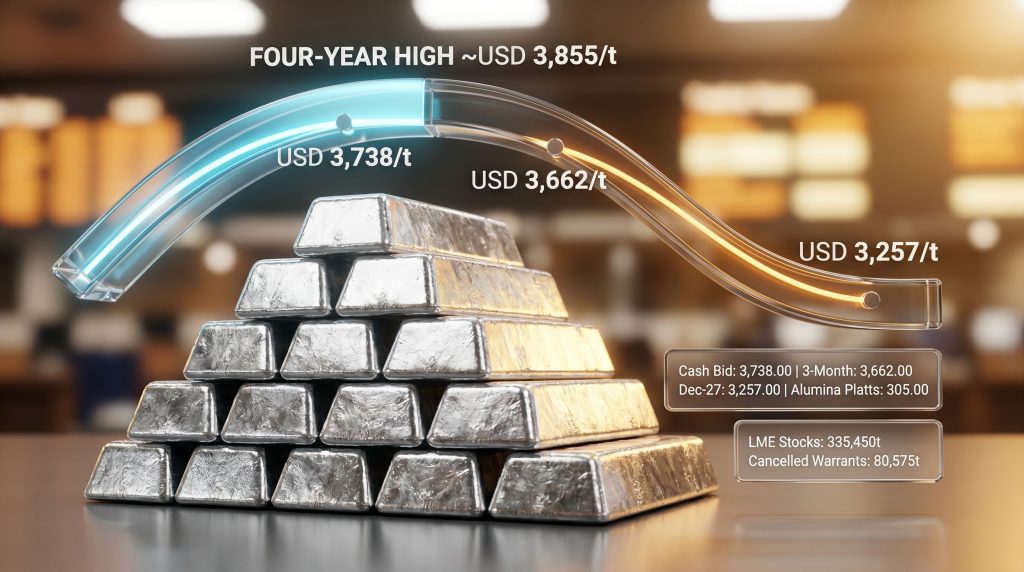
In the days leading up to June 4, 2026, LME aluminium had reached a cash price of approximately USD 3,855 per tonne, a level not seen in roughly four years. That kind of vertical move compresses risk tolerance across the trading community. Long positions accumulated during the rally become increasingly expensive to hold, and incremental buyers at elevated levels face asymmetric downside. The result is nearly predictable: a technical correction that unfolds not because demand has collapsed, but because price has moved too far, too fast, relative to near-term positioning comfort.
The June 3 session already reflected this tension, with the cash bid closing at USD 3,796.50 per tonne, already retreating from the four-year peak. June 4 continued that unwind, pushing prices lower across every contract on the curve.
The cumulative two-session retreat from the recent peak totalled approximately USD 117 per tonne, equivalent to roughly 3% from the high. In the context of a commodity that had just rewritten its own multi-year price history, this represents orderly profit-taking rather than a structural breakdown in demand.
Importantly, the price correction occurred without any corresponding deterioration in physical market indicators. LME on-exchange stocks remained flat, alumina prices held steady, and cancelled warrants declined only marginally. These are not the fingerprints of a demand crisis.
A Full Breakdown of LME Aluminium Contract Prices on June 4, 2026
Cash Settlement and Spot Market Performance
The spot market delivered the clearest signal of the session's corrective tone.
| Contract | June 3 Price (USD/t) | June 4 Price (USD/t) | Change (%) |
|---|---|---|---|
| Cash Bid | 3,796.50 | 3,738.00 | -1.54% |
| Cash Offer | 3,797.00 | 3,739.00 | -1.53% |
The cash bid declined by approximately USD 58.50 per tonne in a single session, landing at USD 3,738 per tonne. Data from Westmetall and Alumeco independently confirmed the cash settlement price at USD 3,739 per tonne on June 4, cross-validating the AL Circle figures. Trading Economics reported a figure of USD 3,667.60 per tonne, a minor divergence attributable to differences in instrument definition and the timing of data capture across platforms.
Despite the day-on-day decline, the June 4 cash price remained well above the USD 3,700 per tonne psychological threshold, a level that had previously acted as a resistance ceiling before the recent breakout. Holding above this floor preserves the structural bullish case for the medium term.
3-Month Forward Contracts: Reading the Forward Curve
The three-month segment of the LME aluminium curve is the most actively traded and most closely watched by both physical hedgers and speculative participants.
| Contract | June 3 Price (USD/t) | June 4 Price (USD/t) | Change (%) |
|---|---|---|---|
| 3-Month Bid | 3,721.00 | 3,662.00 | -1.59% |
| 3-Month Offer | 3,723.00 | 3,663.00 | -1.61% |
The near-lockstep decline of -1.59% and -1.61% across bid and offer respectively is a hallmark of uniform selling pressure rather than selective positioning. When bid-offer spreads remain tight while prices fall symmetrically, it indicates that sellers are not being forced to widen spreads to find liquidity. The market was orderly throughout the session.
Both Westmetall and Alumeco independently confirmed the three-month close at USD 3,663 per tonne, providing strong data integrity across independent sources.
Asian Reference Price: Regional Pricing Dynamics
One of the less-discussed but analytically significant data points from the June 4 session was the behaviour of the LME aluminium three-month Asian Reference Price.
- June 3 Asian Reference Price: USD 3,707.50 per tonne
- June 4 Asian Reference Price: USD 3,666 per tonne
- Day-on-day decline: -1.12%
The Asian Reference Price declined at a meaningfully smaller rate than the global three-month offer, which fell -1.61%. This divergence, while modest in absolute terms, suggests that regional physical demand in Asia provided a marginal cushion against the selling pressure that characterised the global benchmark session. Furthermore, the China metals demand outlook remains a key variable in how quickly regional pricing converges with global benchmarks during corrective sessions.
On June 4, the spread between the Asian Reference Price (USD 3,666/t) and the three-month offer (USD 3,663/t) narrowed to just USD 3 per tonne, indicating that regional Asian pricing was almost fully converged with the global benchmark. This tight spread reflects efficient price discovery across geographies.
For procurement teams sourcing aluminium across Asian markets, this convergence signals that regional premiums were not offering meaningful protection or arbitrage opportunity on this particular session.
December 2027 Contracts: What Long-Dated Futures Signal
The behaviour of longer-dated contracts on June 4 is arguably the most instructive element of the entire session for medium-term market positioning.
| Contract | June 3 Price (USD/t) | June 4 Price (USD/t) | Change (%) |
|---|---|---|---|
| Dec-27 Bid | 3,292.00 | 3,257.00 | -1.06% |
| Dec-27 Offer | 3,297.00 | 3,262.00 | -1.06% |
The December 2027 contracts declined at roughly half the rate of near-term cash and three-month contracts. This compression in the rate of decline across the forward curve carries a specific structural message: the market interprets near-term weakness as temporary, not as a signal to reprice aluminium's long-run value.
If bearish fundamentals were genuinely re-entering the picture, long-dated contracts would typically fall faster than near-term ones, as participants rushed to exit multi-year exposure. The opposite occurred here.
What the Forward Curve Structure Reveals About Aluminium's Outlook
Decoding the Price Ladder on June 4
When the full price curve from June 4, 2026 is laid out sequentially, a clear structural picture emerges:
| Price Point | USD per Tonne |
|---|---|
| Recent 4-Year High | ~3,855 |
| June 3 Cash Bid | 3,796.50 |
| June 4 Cash Bid | 3,738.00 |
| June 4 3-Month Bid | 3,662.00 |
| June 4 Asian Reference Price | 3,666.00 |
| June 4 Dec-27 Bid | 3,257.00 |
| LME Alumina Platts (June 4) | 305.00 |
The curve reveals a structure known as normal backwardation transitioning into contango as contract dates extend further into the future. Cash prices sit well above long-dated forward prices, a configuration that typically reflects current tightness in the physical spot market unwinding over time as supply conditions are expected to normalise.
The December 2027 contract on June 4 traded at approximately USD 481 per tonne below the cash bid price. This discount represents the market's collective expectation that supply additions and demand moderation will erode the current price premium over an 18-month horizon.
For downstream manufacturers and industrial buyers, this curve structure presents a genuine strategic opportunity: locking in forward purchases at December 2027 prices offers significant savings compared to current spot procurement, provided hedging costs and counterparty risk are acceptable.
For primary aluminium producers, the same curve means that forward revenue hedging comes at a steep discount to current spot realisations, creating a classic tension between price certainty and upside capture.
Why Contango Structures Matter for Warrant and Inventory Financing
A less-discussed but practically important aspect of LME forward curve structures is their interaction with inventory financing strategies. When forward prices are higher than spot, it can be economically rational for warehouse participants to purchase physical metal, store it in LME-registered warehouses, and simultaneously sell forward contracts to lock in a profit equal to the forward premium minus storage and financing costs.
This dynamic, sometimes called a cash-and-carry trade, can actually act as a floor under spot prices during corrections. As spot prices fall, the economics of cash-and-carry trades improve for those with warehouse access and financing capacity, generating incremental buying demand that buffers the downside. The stability of LME opening stocks at 335,450 tonnes on June 4 is consistent with this dynamic being operationally active in the market.
LME Aluminium Inventory Position on June 4, 2026
Opening Stocks and Warrant Structure
| Inventory Metric | June 3 Level (Tonnes) | June 4 Level (Tonnes) | Change |
|---|---|---|---|
| Opening Stocks | 335,450 | 335,450 | No change |
| Live Warrants | 254,625 | 254,625 | No change |
| Cancelled Warrants | 80,825 | 80,575 | -0.31% |
The complete stability of opening stocks and live warrants across the two sessions is a fundamental finding. It eliminates several bearish hypotheses that would otherwise need to be tested: there was no sudden influx of metal into LME warehouses (which would suggest producers dumping unsellable inventory), and there was no dramatic withdrawal of live warrants (which would suggest a loss of confidence in LME delivery mechanisms).
Cancelled warrants represent metal that has been formally earmarked for physical delivery out of LME-registered warehouses. At 80,575 tonnes on June 4, cancelled warrants represent approximately 24% of total LME opening stocks. This remains an elevated proportion in historical context, indicating that genuine physical demand for immediate delivery is still present in the market.
When cancelled warrants remain at elevated levels while prices decline, it typically reflects a market where financial sellers are temporarily dominating price discovery rather than a true deterioration in end-user demand. This distinction is critical for procurement managers making near-term purchasing decisions.
The marginal decline of 250 tonnes in cancelled warrants (a -0.31% change) is operationally insignificant. It does not constitute evidence of a broad withdrawal from physical demand.
Understanding the Difference Between Warrants and Cancelled Warrants
For readers less familiar with LME market mechanics, the distinction between warrant types is important:
- Live warrants represent metal held in LME-registered warehouses that has not yet been designated for delivery. This metal is freely available as collateral or for future delivery.
- Cancelled warrants represent metal that has been designated for physical pickup. Once cancelled, a warrant cannot be re-listed without the metal being re-warranted, which involves physical inspection and re-registration.
High levels of cancelled warrants relative to total stocks can sometimes signal tightening physical availability, creating upward pressure on nearby cash prices and contributing to the backwardation observed in near-term contracts.
Alumina Prices on June 4: Upstream Cost Pressures and Smelter Margin Dynamics
A Steady Feedstock Price Amid a Falling Metal Price
LME alumina Platts held firm at USD 305 per tonne on June 4, completely unchanged from the June 3 session. On the surface this appears benign, but it carries an important implication for the primary aluminium production economics. The alumina market pressures that weighed on producers through much of 2025 appear to have stabilised, at least in the near term.
Alumina is the principal raw material input for aluminium smelting. It is produced by refining bauxite ore through the Bayer process, and typically represents between 30% and 40% of the total cash cost of primary aluminium production, depending on energy prices, labour costs, and regional logistics. When the aluminium price falls but alumina prices remain stable, smelter operating margins compress in the short term.
On June 4, the alumina-to-aluminium price ratio was approximately 8.2% (305 divided by 3,738). This ratio, sometimes called the alumina price ratio, sits within historically normal ranges and does not signal structural upstream cost pressure. During periods of severe margin compression, this ratio can spike toward 12-15% as alumina prices remain sticky while aluminium prices fall sharply.
Smelter Cost Curve Dynamics
A nuanced perspective on why alumina price stability matters more than it might first appear:
- Global primary aluminium smelting operates across a wide cost curve, ranging from sub-USD 1,500 per tonne for the most efficient hydropower-backed Chinese and Middle Eastern facilities to above USD 2,800 per tonne for marginal-cost producers in high-energy-cost regions.
- When aluminium spot prices fall while alumina costs remain unchanged, marginal-cost smelters face the most acute pressure. These are typically older facilities in high-cost jurisdictions.
- Curtailment of high-cost smelting capacity during price corrections acts as a natural supply-side stabiliser, tightening the available supply of primary metal and ultimately supporting a price floor.
- If the June 4 correction deepens materially without a corresponding alumina price decline, industry observers would watch closely for curtailment announcements from European and North American smelters operating near their cost floors.
The next major ASX story will hit our subscribers first
Key Structural Demand Drivers Supporting Aluminium's Long-Term Price Floor
Why Demand-Side Fundamentals Argue Against a Structural Reversal
The June 4 correction, while real, should be evaluated against the structural demand forces that have underpinned the broader multi-year aluminium price recovery. These include:
- Electric vehicle production growth: EVs consume roughly two to three times more aluminium than conventional internal combustion engine vehicles, driven by battery enclosures, structural lightweighting, and thermal management components. Global EV production volumes continue to accelerate across both Western and Asian markets.
- Renewable energy infrastructure: Solar panel mounting frames, wind turbine nacelles and towers, and high-voltage transmission infrastructure all rely heavily on aluminium. The global buildout of renewable generation capacity represents a sustained multi-decade demand tailwind.
- Aerospace sector recovery: Commercial aviation's post-pandemic recovery continues to drive demand for aerospace-grade aluminium alloys, particularly in fuselage and wing structures.
- Emerging market construction: Urbanisation-driven construction activity across Southeast Asia, India, and Sub-Saharan Africa supports ongoing demand for aluminium in window frames, facades, and structural applications.
Supply-Side Variables That Could Amplify or Dampen Price Movements
On the supply side, several factors warrant attention when interpreting LME aluminium prices on June 4 and in subsequent sessions:
- Chinese production capacity additions remain the single largest swing variable in global aluminium supply. China accounts for over 55% of global primary aluminium output, and any policy-driven curtailment or expansion in Chinese smelting activity can move global prices significantly.
- Energy price dynamics in major smelting regions, particularly electricity costs in Europe and the Middle East, directly influence production economics and capacity utilisation rates.
- Constraints on global bauxite supply, including regulatory changes governing bauxite exports from Guinea (which holds approximately 24% of global bauxite reserves) and shipping logistics through West African ports, represent upstream vulnerability that can rapidly alter alumina availability and pricing.
- Canada's ongoing discussions regarding the extension of steel and aluminium tariffs under CUSMA renewal negotiations introduce policy risk into North American pricing. The broader aluminium tariff impacts from US trade policy continue to feed back into global LME price discovery, consequently adding a layer of geopolitical uncertainty to what would otherwise be a purely supply-demand driven correction.
Frequently Asked Questions: LME Aluminium Prices on June 4, 2026
What was the LME aluminium cash price on June 4, 2026?
The LME aluminium cash bid price closed at USD 3,738 per tonne on June 4, 2026, declining approximately 1.54% from the prior session's close of USD 3,796.50 per tonne. The cash offer settled at USD 3,739 per tonne, down 1.53% from USD 3,797 per tonne on June 3.
What was the LME aluminium 3-month price on June 4, 2026?
The three-month bid closed at USD 3,662 per tonne and the three-month offer at USD 3,663 per tonne on June 4, representing declines of 1.59% and 1.61% respectively from June 3 levels. These figures were independently confirmed by Westmetall and Alumeco.
Did LME aluminium inventory levels change on June 4, 2026?
Opening stocks held steady at 335,450 tonnes and live warrants remained unchanged at 254,625 tonnes. Cancelled warrants declined marginally by 0.31% to 80,575 tonnes, pointing to a slight easing in physical withdrawal demand rather than any structural shift.
What was the LME alumina Platts price on June 4, 2026?
LME alumina Platts remained unchanged at USD 305 per tonne on June 4, consistent with the June 3 session, suggesting stability in upstream feedstock costs.
Why did LME aluminium prices fall on June 4, 2026?
The decline followed an exceptional period of price strength that had recently pushed aluminium to a four-year high near USD 3,855 per tonne. The two-session retreat is consistent with profit-taking and technical retracement behaviour after an extended rally, rather than any deterioration in physical demand fundamentals. Stable inventory levels and unchanged alumina prices support this interpretation.
What does the December 2027 contract price indicate about long-term aluminium outlook?
At USD 3,257 to USD 3,262 per tonne, the December 2027 contract traded approximately USD 481 per tonne below the June 4 cash bid price. This discount reflects market expectations that current elevated spot prices will moderate over the medium term as global supply conditions, including capacity additions from the top aluminium producers in China and the Middle East, gradually normalise.
Summary: What the June 4 LME Aluminium Session Tells Us
The data from June 4, 2026 presents a coherent and internally consistent picture. LME aluminium prices on June 4 declined across every segment of the forward curve, but the pattern of that decline is as informative as the decline itself. Longer-dated contracts fell at roughly half the rate of near-term cash prices. Physical inventory was completely stable. Alumina costs held firm. Cancelled warrants remained elevated in absolute terms.
Taken together, these signals point to a market in technical correction following an exceptional rally, not a market repricing its fundamental view of aluminium demand. For long-term investors and industrial procurement teams, the structural demand drivers that supported the rally to USD 3,855 per tonne remain intact. The June 4 session represents a pause, not a pivot.
Disclaimer: This article is intended for informational purposes only and does not constitute financial advice. Commodity prices are subject to rapid change and involve significant risk. Past price performance is not indicative of future results. Readers should conduct their own due diligence and consult qualified financial advisors before making investment or procurement decisions based on commodity market data.
Want to Stay Ahead of the Next Major ASX Mineral Discovery?
Discovery Alert's proprietary Discovery IQ model delivers real-time alerts on significant ASX mineral discoveries, transforming complex market data into clear, actionable insights for investors at every level of experience — start your 14-day free trial today and position yourself ahead of the market, or explore Discovery Alert's dedicated discoveries page to understand how historic mineral discoveries have generated substantial returns.