June 5, 2026
The Structural Architecture of a Modern Commodity Crisis
Few market dislocations reveal the hidden fragility of global supply chains as clearly as a simultaneous geopolitical shock combined with a structural production ceiling. Aluminium, often described as the workhorse metal of industrial civilisation, is currently experiencing precisely this convergence. The aluminium price rally from Middle East crisis and China capacity cap dynamics of 2026 represents more than a temporary price spike — it exposes deep-seated vulnerabilities in how the world sources, trades, and prices one of its most consumed industrial metals.
Understanding this market requires examining not just the immediate triggers but the foundational conditions that transformed manageable supply pressures into a full-scale pricing crisis.
When big ASX news breaks, our subscribers know first
What Is Structurally Driving the Global Aluminium Supply Deficit?
Five Years of Accumulated Market Tightness
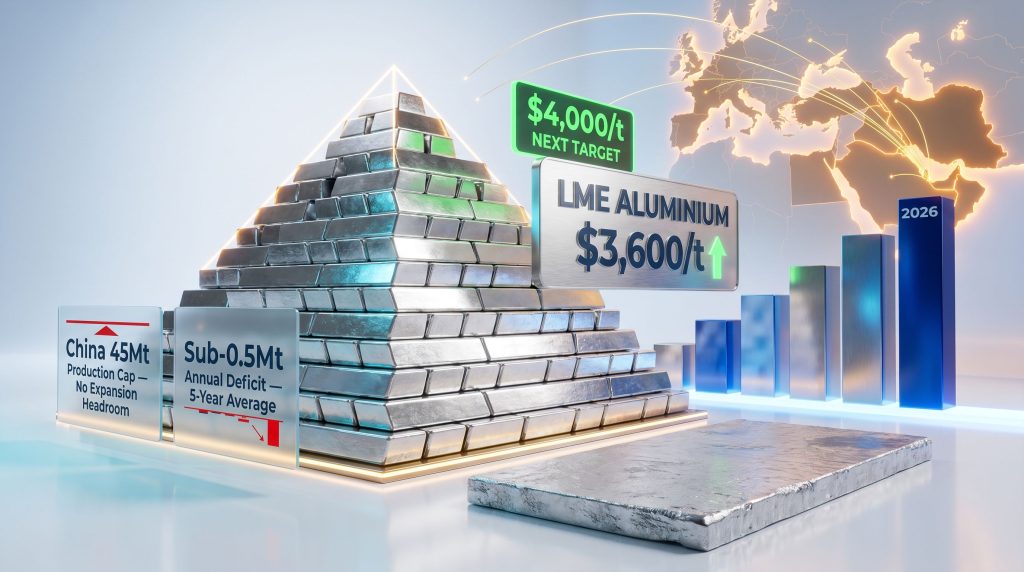
The current price environment did not emerge suddenly. Global aluminium markets have operated with an average annual supply deficit of less than 0.5 million tonnes over the preceding five years — a figure that sounds modest against total annual production of approximately 70 million tonnes but carries disproportionate market significance when inventory buffers are thin.
This sustained deficit has progressively eroded the market's ability to absorb external shocks. Unlike oil, which maintains strategic reserves measured in months of consumption, or gold, which exists in vast above-ground stocks, aluminium's storage economics discourage the accumulation of meaningful inventory buffers. Just-in-time procurement practices across automotive, packaging, and construction sectors have further stripped the supply chain of its shock-absorbing capacity.
The deficit has accumulated for reasons that are structural rather than cyclical:
- Accelerating green technology demand: Electric vehicle platforms consume significantly more aluminium per unit than conventional vehicles, driven by lightweighting requirements and battery enclosure designs
- Renewable energy infrastructure growth: Solar panel mounting systems, wind turbine components, and electrical transmission infrastructure all rely heavily on primary aluminium
- Capacity investment lag: The 4-7 year timeline for greenfield smelter development means supply cannot respond to demand signals in real time
- Energy-driven curtailments: Higher electricity costs in Europe and parts of Asia have forced the closure or curtailment of higher-cost smelting capacity over this period
Structural Insight: A market operating in persistent deficit has no tolerance for supply disruption. When the buffer between supply and demand is measured in days rather than months of consumption, even a moderate geopolitical event can trigger a pricing crisis of disproportionate scale.
How Deficits Amplify Price Responses
The mechanics of price formation in a deficit market differ fundamentally from those in a balanced or surplus environment. In a balanced market, price spikes attract additional supply and encourage demand substitution, creating natural stabilising forces. In a deficit market operating near minimum viable inventory levels, these stabilising mechanisms are either slow to respond or structurally impaired.
When buyers compete for scarce physical metal, two price layers simultaneously escalate:
- The LME benchmark price — reflecting the global marginal cost of production
- Physical delivery premiums — the surcharge above the benchmark that buyers in import-dependent regions must pay to secure actual metal
During the current supply squeeze, European and North American buyers have faced physical premiums rising sharply alongside the LME benchmark, creating a compounding cost burden for downstream manufacturers. This dual-layer price escalation is a characteristic feature of deficit markets under stress and explains why reported LME prices alone understate the true cost increase absorbed by consuming industries. Furthermore, factors such as US aluminium tariffs have added additional layers of complexity to procurement cost calculations for North American buyers.
How Has the Middle East Crisis Disrupted Global Aluminium Supply?
The GCC's Underappreciated Role in Global Metal Flows
The Gulf Cooperation Council region's contribution of approximately 9% of global primary aluminium supply has historically been treated as a reliable, low-risk source of cost-competitive metal for Western markets. This assumption has been thoroughly stress-tested by the current regional conflict. According to Reuters reporting on how Iran war rattles global aluminium supply chains, the disruption extends well beyond temporary logistics friction into fundamental production impairment.
GCC producers — concentrated in the UAE, Saudi Arabia, and Bahrain — built their competitive position on three structural advantages:
| Advantage | Detail | Vulnerability Under Conflict |
|---|---|---|
| Low-cost energy | Natural gas-powered smelting at preferential rates | Gas infrastructure disruption raises input costs |
| Logistical position | Proximity to Strait of Hormuz shipping lanes | Transit risk elevates freight costs and reduces cargo availability |
| Quality consistency | Established long-term offtake relationships with Western buyers | Supply chain reconfiguration takes years, not weeks |
| Export orientation | Majority of production destined for European and North American markets | Import-dependent buyers lack alternative sources at scale |
The region's export orientation is a critical detail often overlooked in market commentary. Unlike Chinese aluminium, which is predominantly consumed domestically, GCC production is structurally integrated into Western supply chains through long-term offtake agreements. Consequently, when this supply is disrupted, affected buyers cannot simply redirect to alternative sources without significant lead time and premium costs.
Three Simultaneous Disruption Channels
The crisis has not operated through a single mechanism. Three distinct but reinforcing channels have combined to produce a market impact greater than the sum of their individual parts:
-
Smelter operational disruptions — Security concerns, workforce availability constraints, and infrastructure damage have reduced capacity utilisation rates across the affected region, directly reducing production volumes available for export
-
Shipping route constraints — Strait of Hormuz transit risk has increased freight costs on key aluminium export corridors while simultaneously reducing the pool of vessels willing to operate on affected routes, compressing physical availability in destination markets
-
Regional energy supply volatility — Aluminium smelting requires approximately 13,000-15,000 kilowatt-hours of electricity per tonne of metal produced, making it one of the most energy-intensive industrial processes in existence. Disruptions to natural gas supply infrastructure in the GCC region directly threaten production continuity at facilities that depend on gas-fired power generation
The compounding nature of these three channels means that even partial normalisation in one area does not restore full supply functionality. A smelter operating at reduced capacity due to workforce constraints still cannot fully export its output if shipping routes remain elevated-risk zones.
What Is China's 45 Million Tonne Capacity Cap and Why Does It Matter?
Understanding the Structural Ceiling on Global Supply Elasticity
China's self-imposed ceiling of 45 million tonnes per year on primary aluminium production stands as perhaps the most consequential single policy variable in global metal markets today. With China accounting for more than 55% of global aluminium output, the country has historically served as the market's swing producer — the supplier of last resort capable of ramping production to offset global shortfalls.
That role is no longer available. In addition, China's industrial demand outlook suggests that domestic consumption will continue absorbing the bulk of any marginal output, further limiting the metal available to international markets.
The 45Mt cap reflects a deliberate convergence of long-term policy priorities:
- Carbon neutrality commitments — Aluminium smelting is among China's most carbon-intensive industries, and the government's net-zero pathway requires constraining, not expanding, primary production
- Energy security management — Power grid stability concerns have repeatedly triggered smelter curtailments in provinces like Yunnan, where hydroelectric power constraints create seasonal production ceilings
- Domestic overcapacity prevention — Historical cycles of overinvestment in Chinese smelting capacity have been identified as a structural market distortion that the cap is designed to prevent from recurring
Why Chinese Production Cannot Fill the Supply Gap
A common misconception in coverage of the current aluminium price environment is the assumption that Chinese producers could, if permitted, rapidly scale output to address global supply shortfalls. The reality is considerably more constrained:
Production Reality: Most Chinese smelters are already operating at or near optimal utilisation rates within the policy constraint. There is no meaningful idle capacity waiting to be switched on in response to a price signal.
The following table illustrates the shift in China's production trajectory:
| Period | Chinese Production Trajectory | Policy Context |
|---|---|---|
| Pre-2017 | Rapid capacity expansion, double-digit annual growth | Minimal output restrictions, subsidised power |
| 2017-2020 | Growth plateau as environmental regulations tighten | Capacity approvals suspended in multiple provinces |
| 2021-2025 | Output approaching 45Mt ceiling | Active enforcement of production cap |
| 2026 | Operating near ceiling with minimal expansion headroom | Cap maintained; carbon commitments reinforce constraint |
Beyond the capacity ceiling, China's aluminium is fundamentally oriented toward domestic consumption. The country is largely self-sufficient in aluminium, meaning that even surplus production at the margin does not automatically flow to international markets. Export pathways for primary aluminium are constrained by trade measures, logistics costs, and domestic demand absorption that collectively prevent Chinese output from serving as a meaningful buffer for global markets experiencing supply stress.
How High Have Aluminium Prices Risen and What Are the Key Price Levels to Watch?
The Price Rally in Context
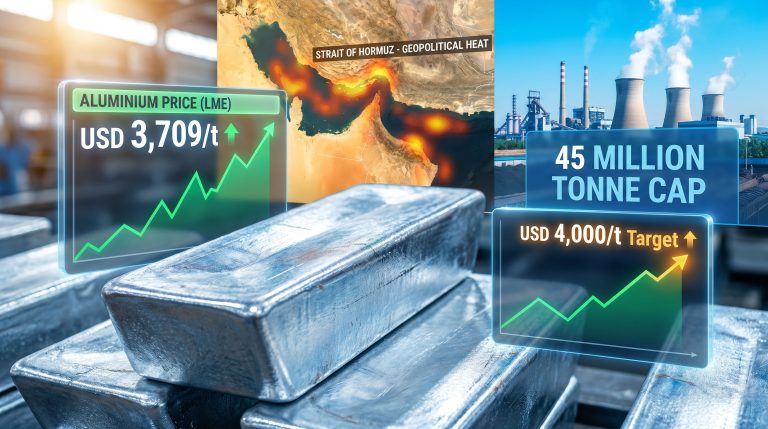
LME aluminium has surged past $3,600 per tonne during the most recent phase of the current market disruption, representing a multi-year high described by AL Circle's market reporting as a four-year peak driven by the confluence of Middle East supply disruption and Chinese production constraints. The aluminum and alumina markets have both registered significant repricing pressure as a result of these converging forces.
The psychological and technical significance of the $4,000 per tonne threshold cannot be overstated. This level represents:
- A roughly 11% premium above the current $3,600 trading range
- A price point last sustained during the commodity supercycle conditions of 2021-2022
- A threshold that, if breached, would significantly alter procurement strategies across downstream manufacturing sectors
- A level at which demand destruction in price-sensitive applications may begin to provide limited natural relief
Price Scenario Analysis
| Scenario | Key Conditions | Estimated LME Range |
|---|---|---|
| Base case | GCC supply partially impaired; China maintains ceiling; deficit persists | $3,600-$3,800/t |
| Bull case | Full GCC export interruption; no compensatory supply emerges | Approaching $4,000/t |
| Bear case | Middle East flows resume; demand softens; inventory rebuilds | $3,000-$3,200/t |
| Structural bull | Conflict extends beyond 2026; downstream demand remains resilient | Above $4,000/t |
Disclaimer: Price scenario modelling involves significant uncertainty. These ranges reflect analytical frameworks based on current market conditions and should not be construed as investment advice or price forecasts. Actual market outcomes may differ materially from any projected scenario.
Who Benefits From the Aluminium Price Rally? Producer Margin Dynamics
The Cost-Price Spread That Is Reshaping Producer Economics
For aluminium producers with stable, contracted cost structures, the current price environment represents a significant earnings expansion opportunity. The fundamental driver is straightforward: when input costs remain anchored through long-term contracts while realised prices rise sharply, the spread between cost-of-production and revenue per tonne widens directly.
Q1 2026 financial results from major global aluminium producers — including names like Alcoa, Hydro, Hindalco, Vedanta, Chalco, and Century Aluminum — have begun reflecting these dynamics through improved margins, stronger cash generation, and upgraded earnings guidance. For context on how leading aluminium producers are positioned across the value chain, the competitive landscape varies considerably by geography and energy access.
The margin expansion is not uniform across all producers. Several factors determine the degree to which individual operators capture the benefit of higher LME prices:
- Energy cost structure: Producers with access to long-term power purchase agreements or hydroelectric energy sources — common among Scandinavian operators like Hydro, and Canadian producers — benefit most from price rallies because their input costs are structurally decoupled from spot energy markets
- Hedge ratio: Producers carrying lower hedge books against future production capture more upside from spot price increases; those with higher hedge ratios may experience delayed earnings improvement as existing contracts roll off
- Premium capture: Beyond the LME benchmark, producers are capturing elevated physical delivery premiums that add a secondary revenue layer on top of benchmark price gains
- Vertical integration: Integrated producers controlling the full bauxite-alumina-aluminium value chain benefit from margin protection at multiple stages, as higher aluminium prices are not offset by rising input costs from their own upstream operations
Margin Mechanics: The aluminium industry's cost structure typically includes 30-40% energy costs, 25-30% raw material inputs (alumina, coke, pitch), and 30-35% labour and overhead. Producers with long-term energy contracts experience the most direct leverage to benchmark price increases, as rising revenues flow through to EBITDA with minimal offsetting cost increases.
Regional Producer Advantages in the Current Environment
Not all producers benefit equally from the current price environment. A distinct geographic hierarchy has emerged:
- Nordic and Canadian producers (hydropower-dependent) achieve the highest margin expansion, combining cost stability with elevated realised prices
- GCC-adjacent producers outside the conflict zone benefit from supply displacement as their product commands elevated premiums in markets previously served by now-disrupted Gulf exporters
- Indian and Russian producers with access to captive energy sources have seen improved export economics as Western buyers seek alternative supply sources
- European producers face a more complex picture, as higher aluminium revenues are partially offset by elevated energy costs and physical supply constraints affecting their own operations
The next major ASX story will hit our subscribers first
What Are the Broader Market Implications for Aluminium Through 2026?
The New Supply Pipeline Problem
One of the most underappreciated aspects of the current aluminium supply crisis is the structural impossibility of a rapid supply-side response. Unlike some industrial commodities where mothballed production can be restarted within weeks, primary aluminium smelting requires:
- Greenfield smelter development: 4-7 years from investment decision to first metal production
- Brownfield expansion: 2-4 years for meaningful capacity additions at existing facilities, constrained by power availability and permitting requirements
- Secondary/recycled aluminium: Growing but fundamentally limited in its ability to substitute for primary metal in applications requiring specific metallurgical properties, such as aerospace alloys and automotive sheet
This timeline mismatch between price signals and supply responses means that even if the current disruption triggers new investment commitments today, the market will not benefit from additional capacity until well beyond the 2026 horizon. However, longer-term structural shifts — including the broader green metals transition — are beginning to reshape where and how new smelting capacity is developed, prioritising low-carbon energy sources over pure cost minimisation.
Downstream Industry Exposure by Sector
The cost pressures created by the current price rally are distributed unevenly across consuming industries based on their aluminium intensity, pricing power, and substitution options. As end-user sectors worldwide grapple with the present aluminium chaos, the range of exposure across industries is striking:
| End-Use Sector | Aluminium Intensity | Price Sensitivity | Substitution Availability |
|---|---|---|---|
| Automotive (EV platforms) | Very High | High | Limited — weight-critical applications |
| Aerospace structures | High | Moderate | Very Limited — regulatory constraints |
| Construction and infrastructure | Moderate-High | Moderate | Partial steel substitution possible |
| Beverage can packaging | High | High | Limited at scale |
| Electrical transmission cable | High | High | Copper — cost-dependent switching |
| Consumer electronics | Moderate | Low-Moderate | Some polymer substitution |
Electric vehicle manufacturers face particularly acute exposure given the structural role aluminium plays in lightweighting strategies. Reducing vehicle weight through aluminium-intensive body structures and battery enclosures is central to extending driving range — a non-negotiable performance metric for EV competitiveness. This demand cannot easily be reduced in response to higher material costs without compromising product performance, making automotive aluminium demand highly inelastic in the short term.
Strategic Takeaways: What the Aluminium Market Signals for Investors and Industry
Three Structural Conclusions From the 2026 Price Environment
The current aluminium price rally from Middle East crisis and China capacity cap dynamics delivers three durable structural lessons that extend beyond the immediate market cycle:
-
Geographic supply concentration is a systemic risk that markets have chronically underpriced — The GCC's 9% share of global supply is large enough to create significant market dislocations when disrupted, yet this concentration risk was rarely reflected in long-term procurement strategies or risk management frameworks before the current crisis
-
China's production ceiling is a permanent structural feature, not a temporary policy position — The 45Mt cap reflects interlocking commitments to carbon neutrality, energy security, and domestic capacity management that carry policy timelines measured in decades, not quarters. Investment models and procurement strategies that assume Chinese output growth as a market stabiliser are fundamentally flawed
-
Deficit baseline conditions amplify all subsequent shocks non-linearly — A market already operating below supply-demand equilibrium responds to additional disruption with disproportionate price moves, as the usual dampening mechanisms of inventory drawdown and demand substitution are unavailable
Investment and Procurement Implications
For investors, the current environment presents differentiated risk-reward profiles across different exposure types:
- Energy-advantaged producers with hydroelectric or long-term contracted power offer the highest-quality exposure to the price rally, combining cost stability with revenue upside
- Integrated value chain operators provide more defensive exposure, as margin protection across multiple production stages reduces earnings volatility relative to single-stage smelters
- Long aluminium futures exposure has been rewarded in the current environment, though the risk-reward of initiating new positions at prices above $3,600/t requires careful scenario analysis given the potential for rapid normalisation if geopolitical conditions stabilise
For procurement and supply chain professionals, the strategic implications are equally significant:
- Long-term supply agreements entered now, while physical availability remains accessible, provide meaningful protection against further price escalation
- Strategic inventory building above just-in-time levels represents a defensible capital allocation given the structural tightness and extended supply response timeline
- Supplier diversification away from GCC-concentrated supply chains toward Nordic, Canadian, and Indian sources reduces geographic concentration risk at the cost of potentially higher baseline procurement prices
Disclaimer: This article presents market analysis and structural commentary for informational purposes only. It does not constitute financial, investment, or procurement advice. Forward-looking statements regarding aluminium prices and market conditions involve significant uncertainty. Readers should conduct independent research and consult qualified advisors before making investment or business decisions based on the information presented here.
Want to Capitalise on the Next Major Commodity Discovery Before the Broader Market Reacts?
The structural forces reshaping aluminium and other critical metal markets underscore just how quickly supply dynamics can reprice commodities — and the companies that produce them. Discovery Alert's proprietary Discovery IQ model scans ASX announcements in real time, instantly identifying significant mineral discoveries and translating complex data into actionable opportunities across more than 30 commodities, as demonstrated by historic discoveries like those from De Grey Mining and WA1 Resources. Explore Discovery Alert's dedicated discoveries page to see how major mineral finds have historically generated exceptional returns, and begin your 14-day free trial today to position yourself ahead of the next market-moving announcement.