June 18, 2026
When Price Levels Become Market Signals: Decoding Aluminium's 2026 Rally
Commodity markets have a way of compressing years of structural change into a single price level. The threshold of USD 3,750 per tonne for London Metal Exchange aluminium is one such level, carrying weight that extends well beyond a simple number on a trading screen. It represents the convergence of technical momentum, macro repositioning, and a fundamental reshaping of how global markets price the metal that underpins electrification, transportation, and industrial infrastructure.
Understanding why LME aluminium prices above USD 3,750 per tonne matter, and what sustains them, requires looking across the entire value chain, from bauxite mines to automotive assembly lines, and examining the layered forces that brought the market to this point in 2026.
When big ASX news breaks, our subscribers know first
What Makes USD 3,750/t a Technically and Psychologically Significant Level
Price levels in commodity markets are not arbitrary. They accumulate significance through repeated testing, prior breakouts, and the collective memory of traders who have positioned around them across multiple cycles. The USD 3,750 per tonne zone in LME aluminium carries this kind of layered importance.
Historically, this level was approached but not sustained during the 2021 to 2022 post-pandemic commodity supercycle, when supply chain disruptions, energy shocks in Europe, and China's production curtailments briefly pushed aluminium into territory that had rarely been occupied in the prior decade. After that peak faded and prices corrected sharply through 2023 and 2024, the road back to USD 3,750/t required a new set of catalysts.
The technical foundation for the 2026 move was established when aluminium achieved a confirmed monthly close above USD 3,200 per tonne, which commodity analysts broadly viewed as the critical trigger unlocking the next resistance band. That breakout opened a projected trading range of USD 3,500 to USD 3,850 per tonne for H1 2026, with USD 3,750/t sitting near the midpoint of that upper target band rather than at an extreme outlier level.
"A confirmed monthly close above a key resistance level is not just a technical event in commodity markets. It recalibrates institutional positioning, triggers algorithmic buy signals, and shifts the narrative from recovery to sustained bull phase."
Breaking Down the 26 May 2026 Session: Prices, Contracts, and What the Data Shows
The trading session of 26 May 2026 captured meaningful upward movement across all LME aluminium contract types, following market closure on 25 May for a public holiday. The data tells a nuanced story about where price pressure is concentrated and what it signals about underlying dynamics. You can track live aluminium prices via Trading Economics for real-time context alongside LME session data.
| Contract Type | Price (22 May 2026) | Price (26 May 2026) | % Change |
|---|---|---|---|
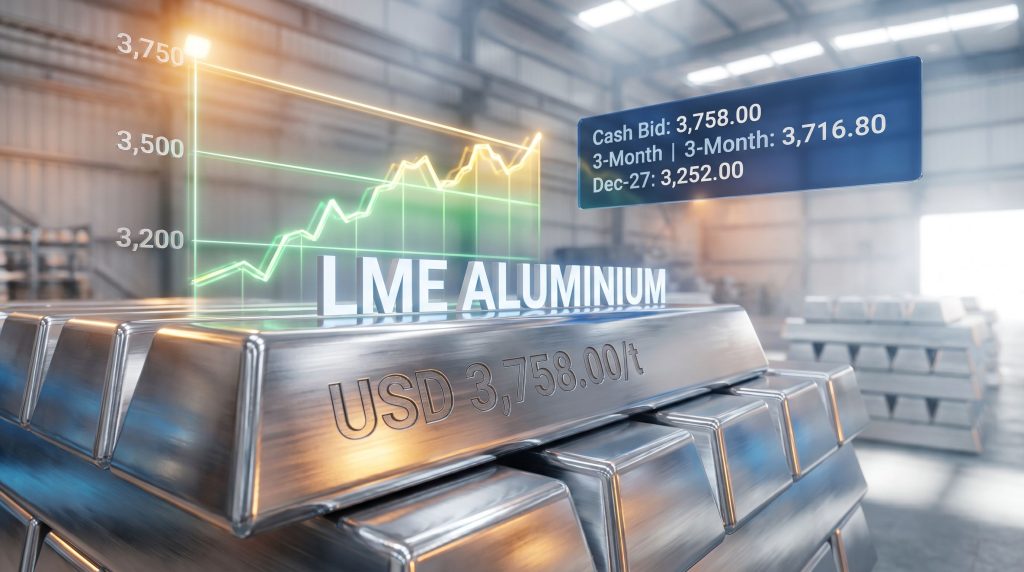
| Cash Bid | USD 3,705.50/t | USD 3,758.00/t | +1.42% |
| Cash Offer | USD 3,706.00/t | USD 3,759.00/t | +1.43% |
| 3-Month Bid | USD 3,641.50/t | USD 3,680.00/t | +1.06% |
| 3-Month Offer | USD 3,642.00/t | USD 3,682.00/t | +1.10% |
| 3-Month Closing Ref. | USD 3,672.50/t | USD 3,716.80/t | +1.21% |
| Dec-27 Bid | USD 3,233.00/t | USD 3,252.00/t | +0.59% |
| Dec-27 Offer | USD 3,238.00/t | USD 3,257.00/t | +0.59% |
Several patterns in this data deserve closer examination:
-
The cash price gains (+1.42% to +1.43%) materially outpaced the 3-month gains (+1.06% to +1.10%), a divergence consistent with near-term physical tightness or concentrated short-term positioning.
-
The Dec-27 contracts gained only +0.59%, roughly half the spot rate of gain, indicating that the market views elevated near-term pricing as a temporary condition rather than a permanent structural shift.
-
The 3-month closing reference price reached USD 3,716.80/t, placing it within striking distance of the USD 3,750/t psychological level that many technical frameworks had identified as a key target.
Post-Holiday Dynamics: Why Market Reopenings Amplify Price Moves
A consistent pattern in commodity markets is the tendency for accelerated price movement in the first session after an exchange holiday. During the closure period, participants cannot execute trades in response to macroeconomic news, currency movements, or shifts in equity market sentiment. When the market reopens, deferred order flow, particularly from algorithmic systems and institutional desks that track cross-asset correlations, executes simultaneously, compressing what might have been spread across two or three sessions into a single opening.
The 26 May session gains of +1.21% to +1.43% across contract types are notably above the typical daily volatility range for LME aluminium, which in calmer periods tends to average between 0.3% and 0.8% per session. This amplification effect does not necessarily indicate a structural shift on its own, but it does reflect the genuine accumulation of bullish sentiment during the holiday period.
What Stable Warehouse Stocks Tell Us About the Nature of This Rally
Perhaps the most analytically important data point from the 26 May session was what did not change: LME-registered warehouse stocks remained flat at 339,475 tonnes, with live warrants holding steady at 263,900 tonnes, representing approximately 77.7% of total registered inventory. Cancelled warrants edged only marginally lower, declining by 0.17% from 75,575 tonnes to 75,450 tonnes.
"When cash prices rise sharply while visible inventory remains stable, the price move is far more likely to reflect financial market positioning and macro sentiment than a genuine physical supply emergency. This distinction is critical for assessing whether a price rally is durable or vulnerable to reversal."
The flat alumina Platts price of USD 307.67 per tonne reinforces this interpretation. Furthermore, alumina is the direct upstream input for primary aluminium production, and in cycles driven by real physical tightness, alumina prices typically move in anticipation of or alongside aluminium price strength. The absence of any movement in alumina suggests that upstream cost pressures are not yet the primary driver of the aluminium price rally at this stage.
This does not make the move illegitimate, but it does shift the analytical weight toward macro positioning, speculative long accumulation, and possibly currency-related flows as the dominant near-term forces. These dynamics are also closely linked to broader alumina market pressures that have been reshaping the upstream sector throughout 2025.
The Structural Drivers Behind Aluminium's 2026 Price Environment
Energy Costs and Smelter Economics
Primary aluminium production is extraordinarily energy-intensive. Smelting one tonne of aluminium requires approximately 13 to 15 megawatt-hours of electricity, making power costs the single largest input variable for most smelters globally. In Europe, persistent elevated electricity prices have constrained the restart of idled smelting capacity, removing a supply buffer that would otherwise moderate price strength.
In China, ongoing power rationing policies in energy-stressed provinces continue to limit production growth despite strong domestic demand. This supply-side rigidity has structural rather than cyclical characteristics, meaning it cannot be resolved quickly even if aluminium prices rise enough to theoretically justify increased output.
Energy Transition Demand
Aluminium's role in decarbonisation infrastructure is expanding rapidly across multiple application vectors:
-
Electric vehicle manufacturing requires roughly 20% to 40% more aluminium per unit than equivalent internal combustion engine vehicles, driven by battery enclosures, structural lightweighting, and thermal management systems.
-
Solar photovoltaic installations depend on aluminium for panel frames, mounting systems, and inverter housings, with global solar deployment continuing to accelerate through 2026.
-
Grid infrastructure upgrades, particularly high-voltage transmission lines and cable systems required for renewable energy integration, use aluminium extensively as a lower-cost alternative to copper conductors.
-
Aerospace and defence demand has strengthened as both sectors increase production rates following post-pandemic backlogs.
Trade Policy and Import Flow Disruptions
U.S. tariff policy has introduced significant complexity into global aluminium trade flows since 2018, with the Section 232 framework and subsequent modifications continuing to redirect metal from traditional export markets toward LME and regional premium structures. The US aluminium and steel tariffs introduced in this period have been a key catalyst reshaping where and how metal is priced and distributed globally. When tariff barriers prevent the most cost-efficient metal from reaching end-use markets freely, price premiums and LME benchmarks absorb the resulting tension.
Scenario Analysis: Can USD 3,750/t Be Sustained?
| Scenario | Key Trigger | Price Implication |
|---|---|---|
| Bullish Continuation | Physical demand acceleration + constrained smelter restarts | USD 3,800 to 3,850/t range |
| Base Case Consolidation | Stable stocks + neutral macro + seasonal demand patterns | USD 3,650 to 3,750/t range |
| Bearish Correction | Demand softness + USD strengthening + Chinese export surge | Below USD 3,500/t |
The bearish case, however, should not be dismissed. A material strengthening of the U.S. dollar reduces the purchasing power of non-USD buyers, compressing demand in price-sensitive markets including Southeast Asia and South Asia. Additionally, any acceleration in Chinese aluminium export volumes, which have been a periodic source of global supply pressure, could quickly rebalance the market and unwind speculative long positions.
Readers should note that commodity price forecasts carry inherent uncertainty, and the scenarios above represent analytical frameworks rather than investment recommendations. Price outcomes will depend on factors that cannot be fully anticipated.
The next major ASX story will hit our subscribers first
How Elevated LME Prices Transmit Through the Aluminium Value Chain
Upstream: Bauxite and Alumina Producers
The alumina price holding flat at USD 307.67/t while aluminium trades above USD 3,750/t creates a widening spread that is directly meaningful for primary smelter margins. The alumina-to-aluminium price ratio, which typically sits in the range of 12% to 15% under normalised conditions, has effectively compressed as aluminium prices have risen faster than alumina. This margin expansion benefits smelters in the short term, but the relationship historically self-corrects as alumina contract negotiations adjust.
The broader bauxite supply landscape is also a factor, with significant concentration in Guinea, Australia, and Brazil introducing a latent geopolitical premium that can accelerate upstream price transmission when political or logistical disruptions occur in key mining regions.
Midstream: Smelter Margin Dynamics
For primary smelters with long-term power contracts and favourable energy cost structures, particularly those in the Middle East, Canada, and parts of China, aluminium prices above USD 3,750/t represent highly profitable operating conditions. The margin expansion at these levels incentivises:
-
Restart of mothballed capacity that was idled during the 2022 to 2024 price downcycle.
-
Acceleration of capital expenditure decisions for greenfield and brownfield capacity expansions.
-
Increased hedging activity using LME forward contracts to lock in margins at currently elevated prices, which can paradoxically increase forward supply.
Downstream: Fabricators and End Users
Companies that purchase aluminium as a raw material rather than producing it face direct margin pressure when LME aluminium prices above USD 3,750 per tonne persist. The sectors most exposed include:
-
Automotive manufacturers sourcing aluminium sheet for body panels, structural components, and battery trays.
-
Aerospace manufacturers purchasing aluminium alloys for airframe structures and interior systems.
-
Packaging producers using aluminium foil and can sheet, where thin margins make input cost volatility difficult to absorb.
-
Electrical cable manufacturers dependent on aluminium rod for medium and low-voltage distribution systems.
Companies with robust hedging programmes using LME futures and options can significantly reduce their exposure to spot price volatility. However, smaller fabricators and manufacturers with limited treasury resources often have minimal hedge cover, making them directly exposed to benchmark price moves.
What the Forward Curve Structure Reveals About Market Expectations
The approximately USD 500 per tonne discount between current cash prices near USD 3,758/t and the Dec-27 forward contracts trading near USD 3,252 to 3,257/t is one of the most instructive data points in the current market structure. This steep forward discount indicates that the market collectively expects prices to moderate significantly over the next 18 months.
Several interpretations are possible:
-
The market anticipates new smelting capacity coming online, particularly from projects in the Middle East and Southeast Asia, that will ease supply constraints.
-
Speculative positioning that has elevated near-term prices is expected to unwind as macro catalysts fade.
-
Long-dated industrial buyers are actively selling forward contracts to hedge future procurement, creating selling pressure on the back end of the curve.
This forward curve structure is valuable for industrial procurement teams. Companies with flexibility to lock in Dec-27 pricing near USD 3,252/t effectively purchase a significant discount to current spot levels, representing a meaningful cost management opportunity if physical demand at that point is assured.
Frequently Asked Questions: LME Aluminium Prices Above USD 3,750 Per Tonne
What does a cash price above USD 3,750/t signal for the aluminium market?
It marks a multi-year high threshold that reflects a combination of physical market tightness, macro sentiment, and technical momentum. Sustained trading above this level is typically interpreted by analysts as a bullish confirmation signal, though durability depends on whether physical supply-demand fundamentals support the move or whether it is primarily financially driven.
Why is the LME cash price trading at a premium to the 3-month contract?
When spot prices exceed near-term forward prices, the market structure is described as backwardation. This condition signals that buyers are willing to pay a premium for immediate delivery, reflecting urgency in physical procurement or a shortage of readily available metal. The cash-to-3-month spread observed in May 2026 is consistent with this dynamic.
What does stable warehouse stock data tell investors during a price rally?
Stable LME warehouse stocks alongside rising prices suggest that the price move is not driven by a visible physical shortage. Instead, it points toward off-warrant inventory management, financial positioning, or macro sentiment as the primary forces. This distinction matters because financially-driven rallies can reverse more quickly than those underpinned by genuine physical shortfalls.
How should downstream buyers respond to aluminium above USD 3,750/t?
Buyers with significant aluminium exposure should consider the forward curve structure carefully. With Dec-27 contracts offering pricing near USD 3,252/t, approximately USD 500/t below current spot, there is a meaningful opportunity to manage procurement costs for future periods through exchange-based hedging or fixed-price supply agreements. Understanding the broader aluminium tariff impacts is equally important for companies assessing their regional sourcing strategies at this price level.
Key Takeaways: What the May 2026 Aluminium Rally Means for Markets
-
LME aluminium prices above USD 3,750 per tonne represent a technically significant level that has historically functioned as both resistance and, once breached, potential support for sustained bull phases.
-
The +1.21% to +1.43% single-session gain across all contract types on 26 May 2026 reflects deferred post-holiday order flow combined with genuine underlying bullish momentum.
-
Stable warehouse stocks at 339,475 tonnes and flat alumina prices at USD 307.67/t indicate the current rally is predominantly macro and sentiment-driven rather than a response to acute physical supply shortage.
-
The ~USD 500/t gap between spot cash prices and Dec-27 forwards signals market expectations of price normalisation over the 18-month horizon, presenting hedging opportunities for forward-looking industrial buyers.
-
Energy transition demand, smelter energy cost constraints, and ongoing trade policy complexity form a structural backdrop that gives the current price environment more fundamental support than prior speculative cycles. In addition, the top aluminium producers globally are closely monitoring margin conditions at these elevated price levels to inform capacity and investment decisions.
This article is intended for informational purposes only and does not constitute financial or investment advice. Commodity prices are subject to significant volatility, and all investment and procurement decisions should be made with appropriate professional guidance.
Want To Stay Ahead of Major ASX Mineral Discoveries Driving the Next Commodity Supercycle?
As aluminium's structural bull case strengthens alongside accelerating energy transition demand, Discovery Alert's proprietary Discovery IQ model delivers real-time alerts on significant ASX mineral discoveries — instantly transforming complex commodity data into actionable investment insights. Explore how historic mineral discoveries have generated substantial market returns and begin your 14-day free trial today to position yourself ahead of the broader market.