June 30, 2026
When Commodity Markets Meet Geopolitical Reality
The history of industrial metals pricing reveals a recurring pattern: supply chains that appear robust during peacetime expose profound structural vulnerabilities the moment geopolitical stability fractures. Aluminium, more than almost any other base metal, carries a unique set of dependencies that make it acutely sensitive to regional conflict. Understanding why requires looking beyond simple trade disruption narratives and examining the underlying architecture of how this metal is produced, refined, and shipped across a globally interconnected supply web.
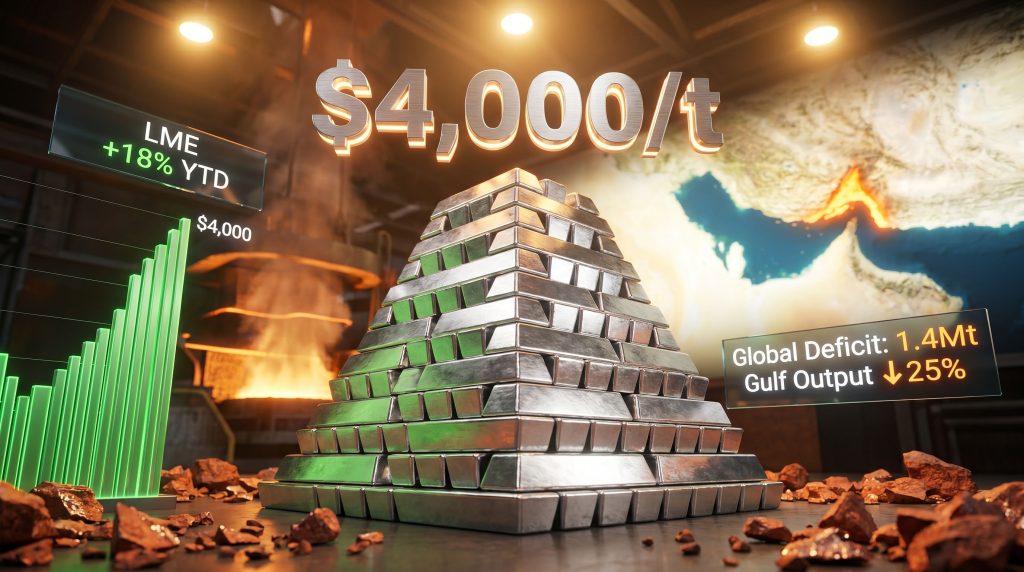
The events unfolding across the Middle East in 2026 have brought those vulnerabilities into sharp focus. With aluminium prices above $4,000 due to the Iran war now emerging as a credible near-term scenario according to commodity research analysts, markets are confronting a deficit cycle that industry veterans describe as structurally harder to resolve than previous supply shocks.
When big ASX news breaks, our subscribers know first
The Gulf Region's Outsized Role in Global Aluminium Supply
To understand the scale of the current disruption, it helps to first appreciate why the Middle East became such a significant node in global primary aluminium production. The region's competitive advantage was not built on bauxite reserves, which are largely absent across the Gulf states. Instead, Gulf producers leveraged access to low-cost energy, specifically abundant natural gas, to power the extraordinarily energy-intensive electrochemical reduction process that transforms alumina into primary aluminium metal.
Aluminium smelting is one of the most energy-demanding industrial processes on earth, typically consuming between 13,000 and 15,000 kilowatt-hours of electricity per tonne of finished metal. For perspective, that is roughly 40 times the energy required to produce a tonne of steel through electric arc furnace methods. Gulf producers, with subsidised or competitively priced energy inputs, achieved cost structures that made their operations globally competitive even against more geographically advantaged producers in Canada, Norway, and China.
This creates a structural problem that is rarely discussed in commodity price commentary: when Gulf smelting capacity goes offline, it cannot be rapidly substituted by higher-cost producers elsewhere. The economics simply do not allow it. A Norwegian smelter operating on hydropower at Nordic electricity prices is already running at or near full capacity. A Chinese aluminium producer constrained by energy quotas and environmental compliance requirements cannot simply fill a 2.1-million-tonne global gap overnight.
According to data cited at CRU's World Aluminium Conference in London in May 2026, the Middle East accounts for approximately 9% of total global aluminium supply, as reported by Mining Weekly. While that percentage may seem modest in isolation, its strategic significance is amplified by the fact that this production is geographically concentrated, energy-advantaged, and, critically, heavily dependent on imported raw materials — specifically bauxite and alumina shipped through maritime routes now subject to disruption.
The Mechanics of the Current Supply Shock
Infrastructure Damage Versus Trade Disruption
Not all commodity supply shocks are created equal. The distinction between a trade-flow disruption and physical infrastructure damage is one of the most important concepts in commodity market analysis, yet it receives relatively little attention in mainstream financial coverage.
When the Russia-Ukraine conflict triggered the aluminium price spike to a record $4,073.50 per tonne on March 7, 2022, the primary mechanism was trade-flow disruption: sanctions uncertainty, shipping insurance complications, and financing problems for Russian aluminium exports. The physical smelting infrastructure in Russia remained largely intact. Once market participants adapted, pricing mechanisms adjusted relatively quickly.
The 2026 disruption presents a fundamentally different recovery dynamic. Two Gulf smelters were struck by Iranian airstrikes in late March 2026, according to reporting from Mining Weekly on May 12, 2026. Physical damage to electrolytic reduction cells, power supply systems, and associated processing infrastructure is not resolved through diplomatic channels or trade rerouting. Smelter restoration following serious physical damage typically requires many months at minimum, and in cases of severe structural damage, years of rebuilding before nameplate capacity returns.
This is the structural persistence that Paul Williams, head of aluminium value chain at CRU, referred to at the World Aluminium Conference when he characterised the current deficit as being far more difficult to resolve than previous market dislocations of similar magnitude. Furthermore, the aluminum and alumina markets had already been showing signs of tightening before the conflict escalated, compounding the impact.
The Upstream Vulnerability: Bauxite and Alumina Import Dependency
Adding a further layer of complexity is the upstream supply chain exposure of Gulf aluminium producers. Because the region lacks domestic bauxite reserves, every tonne of alumina feed material required for smelting must be imported, predominantly from Australia, Guinea, and Indonesia. Understanding bauxite supply chains is consequently essential to grasping why these shipping disruptions carry such outsized consequences for global production.
The compounding effect here is significant. Even smelters that have not experienced direct physical damage face potential input shortages if raw material shipments are delayed, rerouted, or blocked. The alumina-to-aluminium conversion ratio is approximately 1.9 to 2.0 tonnes of alumina per tonne of primary aluminium produced. Supply chain disruptions to alumina imports therefore translate rapidly into further production shortfalls at the smelter level.
Quantifying the Supply Gap
CRU's assessment, as presented at the World Aluminium Conference and reported by Mining Weekly, points to the following core metrics:
| Supply Disruption Metric | Estimated Impact | Source |
|---|---|---|
| Gulf regional production decline (year-on-year) | Approximately 25% | CRU / Mining Weekly, May 12, 2026 |
| CRU projected global market deficit (2026) | 1.4 million tonnes | CRU / Mining Weekly, May 12, 2026 |
| Middle East share of global aluminium supply | Approximately 9% | CRU / Mining Weekly, May 12, 2026 |
| Global capacity disrupted (analyst estimates) | Approximately 2.1 million tonnes | Various analyst estimates |
Disclaimer: The 2.1-million-tonne disrupted capacity figure reflects broader analyst estimates referenced in market commentary. Readers should note that figures beyond those directly sourced from CRU and Mining Weekly's May 12, 2026 reporting require independent verification.
Aluminium Prices Above $4,000: Where the Forecasts Point
Current Pricing Trajectory
As of mid-May 2026, LME aluminium was trading at approximately $3,559 per tonne, representing an 18% year-to-date gain on the London Metal Exchange, according to Mining Weekly. The metal had already touched a four-year high of $3,672 per tonne in mid-April 2026, reflecting the market's early pricing of the Gulf disruption.
That trajectory places the current price roughly $500 per tonne below the all-time record established on March 7, 2022. The question markets are now wrestling with is whether the Iran war disruption represents a shorter, sharper spike, or a more prolonged structural reset that could sustain prices at or above record levels for an extended period.
CRU's Price Forecast: The Core Scenario
CRU's base case projections, as presented by Paul Williams at the World Aluminium Conference and reported by Mining Weekly on May 12, 2026, provide the most directly attributable price forecasts available. According to CRU's analysis of Middle East smelter cuts, the supply disruption could push prices to levels not seen since the 2022 record:
- Q3 2026 base case price target: $4,020 per tonne
- Q2 2027 peak price forecast: $4,105 per tonne
These projections explicitly link the price trajectory to the 1.4-million-tonne global deficit, which CRU attributes primarily to the Gulf production losses stemming from the Iran war. Critically, the $4,105 per tonne peak would represent a new all-time record for aluminium, surpassing the previous wartime high set during the Russia-Ukraine conflict by approximately $32 per tonne.
"CRU projects that aluminium prices will exceed $4,000 per tonne between the third quarter of 2026 and the second quarter of 2027, driven by a projected 1.4-million-tonne global market deficit caused primarily by Gulf production losses related to the Iran war." (Source: Mining Weekly, May 12, 2026, citing CRU World Aluminium Conference presentation by Paul Williams)
Analyst Consensus: The $4,000 Threshold as a Focal Point
Multiple financial institutions have identified the $4,000 per tonne level as a realistic bull-case target under conditions of prolonged disruption. The following table summarises reported forecasts. Readers should note that, with the exception of CRU's figures sourced directly from Mining Weekly, independent primary source verification of individual institution forecasts was not available within the source materials provided for this article.
| Institution | Base Case Estimate | Elevated Disruption Scenario | Timeframe |
|---|---|---|---|
| CRU | $4,020/t (Q3 2026) | $4,105/t (Q2 2027) | 12-month horizon |
| Citi | ~$3,600/t | ~$4,000/t | Near-term (2 months) |
| Goldman Sachs | ~$3,600/t | Up to $4,000/t | Prolonged disruption |
| JP Morgan | Not disclosed | ~$4,000/t | Calendar year 2026 |
| ING | Not disclosed | Above $4,000/t | Near-term |
Disclaimer: The above forecasts for Citi, Goldman Sachs, JP Morgan, and ING are drawn from market commentary referenced in the article outline. These figures have not been independently verified against primary institutional research reports and should not be relied upon as confirmed institutional guidance.
Why the $4,000 Level Matters Beyond Psychology
Price thresholds in commodity markets carry significance both as psychological reference points and as functional economic boundaries. The $4,000 per tonne level matters for several structural reasons:
- At or above $4,000/t, the cost of aluminium as an input becomes material enough to trigger substitution behaviour in certain downstream industries
- Beverage can manufacturers, automotive lightweighting engineers, and construction systems specifiers begin reassessing material choices when primary aluminium prices sustain above this range
- Capital allocation decisions for new smelting capacity, which carry 5-to-10-year build timelines, only become economically justified at sustained elevated price levels
- Demand destruction historically acts as a natural price ceiling in commodity cycles, but the current structural supply deficit may delay that mechanism
The difference between the 2022 spike and a potential 2026–2027 sustained plateau lies in that distinction between demand-response-driven moderation and physical supply recovery timelines. In 2022, prices retreated relatively quickly because trade flows normalised. In 2026, however, physical infrastructure damage means recovery is measured in construction timelines rather than shipping schedules.
Regional Premium Signals: The Markets Within the Market
Understanding Physical Premiums as Early Warning Indicators
LME benchmark prices represent a standardised reference point, but physical aluminium buyers and sellers transact at prices that include regional premiums, which reflect the actual cost of sourcing and delivering metal to specific markets. When these premiums surge, they signal acute tightness in physical availability that the futures market may not yet fully reflect.
Two premium markets deserve particular attention in the current cycle:
- US Midwest Premium: Reported at record levels of $1.06 to $1.08 per pound in the current disruption period, according to market commentary. The US is heavily reliant on aluminium imports and has limited domestic primary smelting capacity. A record Midwest premium indicates that North American buyers are competing intensely for scarce physical supply. In addition, the aluminium tariff impacts already in place have amplified this squeeze on available supply.
- European P1020 Duty-Paid Premiums: Reported at $410 to $440 per tonne, reflecting elevated costs for importing primary aluminium into Europe. European smelting capacity has been structurally reduced over the past decade following energy price shocks that rendered numerous plants uneconomical.
Disclaimer: The specific premium figures cited above are drawn from market commentary in the article outline. Readers requiring precise, current premium data for trading or procurement decisions should consult specialist commodity pricing services including Fastmarkets, Argus Media, or Platts.
The 2022 Versus 2026 Premium Comparison
An instructive dimension of the current market is how physical premiums compare to the previous supply shock episode. In 2022, LME cash prices briefly hit $4,073.50 per tonne but physical premiums, while elevated, did not reach the levels now being observed in some regional markets. The implication is that physical scarcity in 2026 may be more acute on the ground than during the Russia-Ukraine crisis, even before LME prices have reached their previous record.
This divergence between cash price trajectory and physical premium behaviour is a sophisticated indicator that commodity analysts use to assess whether market tightness is primarily financial or genuinely physical. Current evidence points toward genuine physical tightness in both North American and European markets.
Downstream Exposure: Which Industries Carry the Greatest Risk
Mapping Cost Sensitivity Across End-Use Sectors
Aluminium's remarkable versatility as an industrial material — valued for its strength-to-weight ratio, corrosion resistance, and recyclability — means that elevated prices propagate across a wide range of manufacturing sectors. The exposure profile differs significantly by industry based on aluminium's share of total production costs and the availability of substitution options.
Transport and Automotive Manufacturing
The vehicle lightweighting trend, which has driven significant aluminium content growth in automobiles and light commercial vehicles over the past decade, now represents a cost headwind for manufacturers committed to that strategy. Electric vehicle platforms have increased aluminium content relative to internal combustion designs due to battery enclosure and structural requirements. These manufacturers face input cost pressures precisely as they navigate already-compressed margins in the EV transition period.
Packaging and Consumer Goods
Beverage can manufacturers represent one of the most direct and visible downstream consumers of primary aluminium. Aluminium sheet for can body stock is a commodity-priced input where price increases flow directly to packaging costs. With the global beverage can market expanding, driven by sustainability-driven conversion away from plastic, producers in this segment face meaningful margin compression at current price levels.
Construction and Infrastructure
Architectural aluminium systems, including curtain wall facades, structural framing systems, and roofing products, incorporate significant quantities of extrusion-grade aluminium. Some commentary has cited production cost escalation approaching 20% for certain construction product categories, though readers should seek independent verification of this figure for specific applications.
Aerospace
High-grade aluminium alloys used in aircraft structural components and fuselage applications are subject to both tighter supply conditions and elevated pricing. Aerospace-grade aluminium specifications are narrow, limiting substitution options even when commodity-grade alternatives might nominally be available.
The Cost Pass-Through Lag
A characteristic feature of commodity cost increases in manufacturing supply chains is the lag between input price rises and downstream price adjustments. Contractual structures, hedging programmes, and competitive dynamics typically mean that cost increases take between three and twelve months to flow fully through to end consumers. Smaller manufacturers with limited hedging capability face more immediate margin compression, while large integrated producers can smooth the impact over longer periods.
This lag creates a second-order effect worth monitoring: even if aluminium prices moderate from current levels, the inflationary impact on manufactured goods will continue to materialise for months after any price peak.
The next major ASX story will hit our subscribers first
The Duration Question: Temporary Shock or Structural Reset?
The Bear Case for Sustained High Prices
Several structural factors argue against a rapid return to pre-conflict price levels:
- Physical smelter infrastructure damage requires months to years to restore, not weeks
- Pre-existing capacity constraints in Europe, driven by energy costs, and in Russia, driven by sanctions, leave no readily available buffer production to absorb a 1.4-million-tonne deficit
- Aluminium demand growth from energy transition applications — including electric vehicles, solar panel frames, and grid infrastructure — is structurally independent of conflict dynamics and continues regardless of geopolitical resolution
- New smelting capacity projects require five to ten years from investment decision to full production
The Bull Case for Price Moderation
Counterarguments for a price retreat include:
- Demand destruction at price levels approaching $4,000 per tonne historically limits commodity spikes
- Top aluminium producers outside the conflict zone in Canada, Norway, Australia, and China face economic incentives to maximise output at current price levels
- Diplomatic resolution or ceasefire scenarios could rapidly reduce the geopolitical risk premium embedded in current prices
- Inventory builds during the price spike period may create overhang that accelerates any subsequent retreat
Furthermore, the China industrial demand picture remains a critical variable, given China's dominant share of global aluminium output and its ability — in theory — to influence supply balances if domestic policy conditions allow.
Three Scenarios for 2026 to 2027
| Scenario | Core Assumption | Indicative Price Range |
|---|---|---|
| Base Case | Conflict persists with partial production recovery | $3,800 to $4,020/t through Q3 2026 |
| Extended Disruption | Infrastructure damage expands; shipping constraints deepen | $4,000 to $4,105/t peak by Q2 2027 |
| Diplomatic Resolution | Ceasefire achieves rapid normalisation of Gulf operations | Retracement toward $3,000 to $3,200/t |
Disclaimer: Scenario projections are illustrative analytical frameworks and do not constitute investment advice. Commodity price forecasting involves significant uncertainty, and actual outcomes may differ materially from any projected range.
Who Stands to Benefit From Elevated Aluminium Prices?
Supply-Side Winners in a Deficit Market
Not every participant in the aluminium ecosystem suffers when prices rise. Primary producers operating outside the conflict zone stand to capture substantially improved margins at current price levels. According to Argus Media's analysis of the Iran conflict's metals impact, the beneficiary landscape is broader than many investors initially assumed:
- Non-Gulf primary smelters in Canada, Norway, Iceland, and Australia are receiving record or near-record revenue per tonne of production without corresponding input cost increases
- Aluminium recyclers and secondary producers gain competitive advantage when primary supply tightens, since secondary aluminium production requires only approximately 5% of the energy consumed in primary smelting
- Bauxite and alumina mining operations supplying feedstock to non-Gulf smelters benefit from increased demand for raw materials previously directed toward Gulf facilities
- Diversified mining companies with aluminium divisions, such as Rio Tinto through its Pacific Aluminium and Alumar operations, capture improved earnings from the elevated price environment
Investor Positioning Considerations
Institutional investors have historically responded to commodity supply shocks by rotating toward producers with direct exposure to the affected metal. The current disruption has driven elevated interest in aluminium futures markets, with open interest and options volume data reflecting increased institutional hedging and speculative positioning.
For investors evaluating aluminium market exposure, the key variables to monitor include the pace of Gulf infrastructure restoration, the status of maritime shipping through affected regional corridors, and Chinese domestic production response dynamics. China represents approximately 57% of global primary aluminium output and retains theoretical capacity to influence global supply balances, though domestic policy constraints and energy limitations have historically capped Chinese production responses to external price signals.
Frequently Asked Questions
Why are aluminium prices rising because of the Iran war?
Iranian military strikes on Gulf smelting infrastructure in late March 2026 caused direct physical damage to production facilities in a region that accounts for approximately 9% of global aluminium supply. Combined with disruption to maritime shipping routes used for raw material imports, the conflict has produced a projected global aluminium deficit of 1.4 million tonnes for 2026, according to CRU analysis reported by Mining Weekly on May 12, 2026.
What is the current aluminium price in 2026?
As of mid-May 2026, LME aluminium was trading at approximately $3,559 per tonne, up approximately 18% year-to-date, having reached a four-year high of $3,672 per tonne in mid-April 2026. (Source: Mining Weekly, May 12, 2026.)
Will aluminium prices reach $4,000 per tonne?
CRU projects aluminium prices above $4,000 due to the Iran war will materialise as early as the third quarter of 2026, reaching $4,020 per tonne, and peaking at $4,105 per tonne in the second quarter of 2027 under current disruption assumptions. This would establish a new all-time high, exceeding the previous record of $4,073.50 per tonne set on March 7, 2022.
How does the current situation compare to the 2022 Russia-Ukraine aluminium shock?
The 2022 event was primarily a trade-flow disruption, where the physical smelting infrastructure remained intact and market adjustment came through trade rerouting and sentiment shifts. The 2026 disruption, however, involves direct physical damage to smelting assets, which carries a substantially longer structural recovery timeline. Industry analysts note this distinction as the primary reason the current deficit may prove harder to resolve than previous comparable episodes.
Which industries are most exposed to elevated aluminium prices?
Transport and automotive manufacturing, beverage and food packaging producers, construction material manufacturers, and aerospace component producers carry the most direct exposure. Cost pass-through to end consumers typically occurs over a three-to-twelve-month lag period, meaning inflationary impacts on consumer goods will continue materialising even after any eventual price peak.
This article is intended for informational purposes only and does not constitute financial or investment advice. Commodity price forecasts are inherently uncertain and subject to rapid change based on geopolitical, economic, and market developments. Readers are encouraged to consult independent commodity research providers including Argus Media and CRU for current market data and analysis.
Want to Stay Ahead of Commodity-Driven ASX Mineral Discoveries?
When geopolitical shocks reshape commodity markets this rapidly, early identification of high-potential ASX opportunities becomes critical — Discovery Alert's proprietary Discovery IQ model delivers real-time alerts on significant mineral discoveries the moment they hit the ASX, turning complex market signals into actionable investment insights. Explore Discovery Alert's dedicated discoveries page to understand how historic mineral discoveries have generated substantial returns, and begin your 14-day free trial today to position yourself ahead of the broader market.