May 12, 2026
The Geopolitical Risk Premium: How Diplomatic Fragility Moves Energy Markets
Energy markets have long functioned as a forward-looking mechanism, pricing not just present reality but anticipated futures. When diplomatic negotiations between major powers falter, crude oil futures do not wait for physical barrels to disappear from the market before reacting. Traders reprice risk in real time, and the result is a premium embedded in every barrel traded globally. This dynamic sits at the heart of why oil prices rise on US-Iran talks developments, and why the current diplomatic impasse is sending both Brent crude and West Texas Intermediate toward multi-month highs.
Understanding this mechanism requires separating two distinct forces simultaneously compressing global oil supply. The first is the forward-looking risk premium, a price adjustment that reflects the probability of future disruption rather than disruption that has already occurred. The second is an actual supply contraction already underway, driven by export curtailments from Persian Gulf producers responding to near-closure conditions at the Strait of Hormuz. Both forces are active simultaneously, which is precisely what makes the current market environment structurally different from previous geopolitical flare-ups. The broader picture of crude oil trade geopolitics helps contextualise just how layered these pressures have become.
When big ASX news breaks, our subscribers know first
Where Brent and WTI Stand Right Now
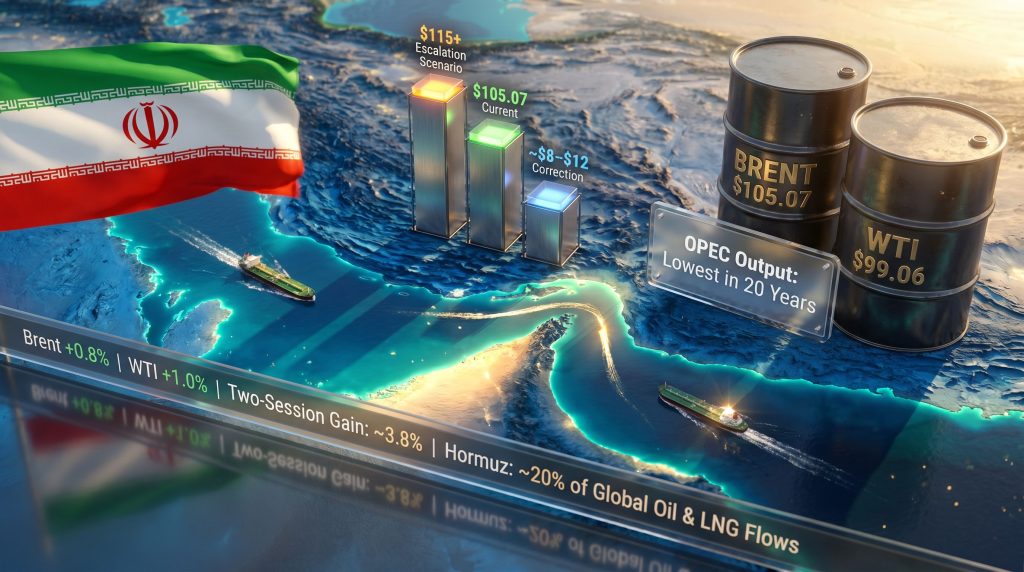
As of Tuesday, May 12, 2026, both major crude benchmarks had extended a strong two-session rally. Brent crude futures were trading at $105.07 per barrel, up $0.86, or 0.8%, while West Texas Intermediate climbed $0.99, or 1.0%, to reach $99.06 per barrel. Both benchmarks had already gained approximately 2.8% during Monday's session, meaning cumulative gains across two consecutive trading days exceeded 3.8% for each benchmark.
| Benchmark | Price (May 12) | Daily Move | Prior Session Gain | Escalation Scenario | Peace Deal Scenario |
|---|---|---|---|---|---|
| Brent Crude | $105.07/bbl | +0.8% (+$0.86) | ~+2.8% | $115+/bbl | -$8 to -$12/bbl |
| WTI | $99.06/bbl | +1.0% (+$0.99) | ~+2.8% | Proportional upside | Proportional correction |
The velocity of these moves is itself informative. A combined gain of nearly 4% across 48 hours reflects markets assigning a rapidly increasing probability to adverse diplomatic outcomes, rather than simply tracking incremental changes in physical supply. When futures markets move this quickly in response to diplomatic language rather than confirmed supply events, it signals that traders are pricing risk premium, not scarcity.
Tim Waterer, Chief Market Analyst at KCM Trade, has outlined the two extreme scenarios clearly: a genuine diplomatic breakthrough before the end of May could trigger a sharp $8 to $12 per barrel correction in Brent, while any escalation or renewed blockade threats would rapidly push Brent back toward and potentially beyond $115 per barrel.
What Is Actually Being Negotiated and Why It Matters for Oil Supply
The sticking points in the current US-Iran framework are not superficial disagreements that can be resolved through minor concessions. The structure of the Washington proposal reportedly encompasses multiple interlocking demands, and Tehran's response has exposed fundamental divergences on virtually every element. Furthermore, the trade war impact on oil adds yet another dimension of complexity to an already fraught negotiating environment.
The core demands attributed to the US framework include:
- A complete cessation of hostilities across all active conflict fronts
- Removal of a US naval blockade currently constraining Iranian maritime access
- Full resumption of Iranian oil export operations
- Financial compensation for war-related damage
Tehran has not only contested these conditions individually but has simultaneously asserted its strategic authority over the Strait of Hormuz. By framing sovereignty over the strait as non-negotiable, Iran has elevated a chokepoint that handles roughly one fifth of all global oil and liquefied natural gas flows into a central bargaining chip in the negotiations.
US President Donald Trump publicly characterised the ceasefire as being on life support, a rhetorical escalation that immediately amplified market anxiety. Diplomatic language of this kind functions as a price signal. When a sitting US president frames active negotiations in terminal terms, futures traders recalibrate the probability distribution of outcomes toward the bearish supply scenarios.
The Strait of Hormuz: Why One Waterway Controls Global Energy Security
The Strait of Hormuz is a narrow maritime passage separating Iran from Oman, and it serves as the only exit route for crude oil exported from the Persian Gulf by Saudi Arabia, Iraq, Kuwait, the UAE, and Qatar. There is no viable large-scale alternative routing for Persian Gulf producers. The strait handles an estimated 20% of global oil and LNG flows, making it the single most consequential chokepoint in the global energy supply chain.
Tehran's assertion of sovereign control over this waterway is both a diplomatic posture and a credible supply threat. Unlike most diplomatic leverage claims, this one is physically grounded. Iran's geographic position means that any genuine military escalation or deliberate restriction of the strait carries an immediate and measurable impact on global crude availability. Markets understand this, and the pricing behaviour in recent sessions reflects that understanding directly.
OPEC Output Collapses to a Two-Decade Low
The supply disruption is not hypothetical. A Reuters survey published Monday confirmed that OPEC's market influence translated into OPEC oil output in April 2026 declining to its lowest level in more than two decades. The mechanism connecting this data point to the Hormuz situation is straightforward: disruptions linked to near-closure conditions at the strait prompted regional producers to curtail their exports proactively, reducing total OPEC output to levels not seen since the early years of this century.
This is a critical distinction worth emphasising. OPEC producers were not mandated to cut output through a formal production agreement. The curtailment was operationally driven, a response to the logistical reality that export pipelines through the strait were facing interruption risk. Consequently, the result is a supply reduction that compounds the forward-looking risk premium already embedded in prices.
How Severe Could the Supply Disruption Become?
Three distinct scenarios capture the range of outcomes traders and analysts are currently weighing.
Scenario 1: Diplomatic Breakthrough Before End of May
A credible and comprehensive peace agreement would trigger rapid unwinding of the geopolitical risk premium. Brent crude would likely correct by $8 to $12 per barrel in the immediate aftermath, as Iranian oil exports resume and OPEC producers restore curtailed volumes. The speed of this correction would depend on the robustness of the agreement and the pace of physical supply restoration.
Scenario 2: Prolonged Stalemate Without Resolution
If no deal materialises by month-end, upside price risks become structurally embedded in forward curves. Brent sustaining above the $100 per barrel threshold becomes the baseline rather than the extreme. Suvro Sarkar, energy sector team lead at DBS Bank, has articulated this directly, stating that fading optimism about an imminent deal places upside risks for oil prices firmly on the table if May passes without resolution.
Scenario 3: Full Escalation and Strait Disruption
This scenario represents the most severe outcome and is now being discussed at the highest levels of the energy industry. Saudi Aramco CEO Amin Nasser warned on Monday that sustained disruptions to oil exports through the Strait of Hormuz could delay a return to market stability until 2027, with losses estimated at approximately 100 million barrels of oil per week under a full disruption scenario.
| Scenario | Trigger Condition | Brent Price Impact | Market Stability Timeline |
|---|---|---|---|
| Peace Breakthrough | Comprehensive deal before May end | -$8 to -$12/bbl correction | Rapid premium unwind |
| Prolonged Stalemate | No deal by month-end | Sustained above $100/bbl | Uncertainty embedded in forward curves |
| Full Escalation | Active strait disruption | Push toward $115+/bbl | Potentially delayed until 2027 |
Saudi Aramco CEO Amin Nasser's warning that market stability could be delayed until 2027 represents one of the most significant assessments of disruption severity made by a senior energy industry executive during the current crisis. A loss of 100 million barrels per week would constitute a supply shock with no modern precedent.
The scale of the potential weekly supply loss referenced by Nasser deserves particular attention. Global crude demand currently runs at roughly 100 to 105 million barrels per day. A weekly loss of 100 million barrels represents a sustained daily deficit equivalent to roughly 14 to 15 million barrels, or approximately 13 to 15% of total global daily consumption. No strategic petroleum reserve drawdown or non-OPEC supply response could absorb a shock of that magnitude in the short term.
What Is Happening on the US Domestic Supply Side?
While the geopolitical storyline dominates headlines, US domestic supply dynamics are quietly adding a secondary layer of price pressure. According to reporting on recent market movements, a Reuters analyst poll has forecast that US crude stockpiles declined by approximately 1.7 million barrels in the most recent reporting week.
Walt Chancellor, Energy Strategist at Macquarie Group, has contextualised this drawdown within a broader export-driven framework, noting that it occurs against a backdrop of continued strong net waterborne export flows for crude and refined products expected to persist across the coming weeks.
The implication is significant. US crude inventory buffers are being simultaneously compressed by:
- Strong domestic refinery demand entering the summer driving season
- Robust export flows absorbing available crude that might otherwise build domestic stockpiles
- Reduced Iranian supply entering global markets, redirecting demand pressure toward US and other non-sanctioned barrels
This trifecta of pressures means that the domestic US supply cushion available to absorb any external shock from a Middle East disruption is smaller than it would otherwise be. Markets are pricing this reduced buffer capacity, and it compounds the upward pressure already generated by the Iran negotiations.
US Sanctions Enforcement: Tightening the Iranian Supply Corridor to China
Washington has simultaneously imposed sanctions on three individuals and nine companies identified as facilitating Iranian oil shipments into China. The timing of this enforcement action, coinciding with an upcoming meeting between President Trump and Chinese President Xi Jinping, is unlikely to be accidental. The broader dynamics of US-China oil tensions have been escalating for some time, and this latest move represents a significant hardening of that posture.
This dual-track approach, applying diplomatic pressure on Iran while simultaneously enforcing sanctions against Chinese intermediaries, signals a hardening of US policy on Iranian crude trade. For energy markets, the operational consequence is that the discount channel through which sanctioned Iranian barrels have historically reached Chinese refiners is being actively disrupted, potentially forcing Chinese buyers to seek replacement barrels from market-priced sources.
The China Variable: Why the Trump-Xi Meeting Is an Oil Market Event
China's role in global oil markets extends well beyond its domestic consumption. As the world's largest crude importer, China's purchasing decisions shape price dynamics across multiple benchmarks. The country has historically absorbed a meaningful share of sanctioned Iranian crude through informal trade channels, benefiting from significant price discounts relative to market rates.
The Trump administration's decision to sanction Chinese intermediaries directly ahead of the bilateral summit with Xi introduces a sharp negotiating dynamic. Traders are watching this meeting as a potential inflection point for several interconnected reasons:
- A constructive summit outcome could ease trade tensions broadly, boosting Chinese economic activity and oil demand expectations
- A confrontational outcome, particularly if sanctions discussions escalate, could further restrict Chinese access to Iranian crude and redirect demand toward conventional market pricing
- Any easing of the broader US-China trade dispute could partially offset geopolitical supply fear by improving demand-side fundamentals
The asymmetric risk here is notable. A positive diplomatic development at the bilateral summit provides only partial downside relief for crude prices, since it addresses demand expectations rather than supply fears. A breakdown in summit discussions, by contrast, would compound supply-side pressure by adding demand-side uncertainty, creating a more severe bullish price scenario than either factor alone would generate.
The next major ASX story will hit our subscribers first
How Oil Markets Have Historically Responded to Hormuz Crises
Historical analysis of crude price behaviour during previous Hormuz-related and broader Middle East conflict episodes reveals a consistent pattern: markets typically build a risk premium in the weeks leading up to peak tension, then partially unwind on any credible de-escalation signal. In addition, the geopolitical oil price factors at play today are more numerous and interconnected than in most prior episodes.
| Conflict Event | Approximate Brent Premium Added | Duration of Elevated Premium |
|---|---|---|
| 2019 Abqaiq Infrastructure Attack | +$10 to $15/bbl | 2 to 3 weeks |
| 2022 Russia-Ukraine Escalation | +$20 to $30/bbl | 6 to 8 weeks |
| Current US-Iran Ceasefire Breakdown Risk | +$8 to $15/bbl (estimated) | Ongoing, open-ended |
What distinguishes the current episode from previous crises is the simultaneous convergence of multiple supply-negative factors. In 2019, the Abqaiq attack created a sharp but isolated production disruption that was partially restored within weeks. In the current situation, OPEC output is already at a two-decade low, US inventory buffers are being drawn down, Iranian export channels are under active sanctions pressure, and a US naval blockade is reportedly constraining Persian Gulf access. The layering of these factors creates a supply risk environment with fewer natural circuit breakers than previous episodes.
What Does This Mean for Energy Consumers and Downstream Markets?
The transmission of upstream crude price movements into consumer-facing costs follows a reasonably predictable lag structure. When crude sustains above $100 per barrel, the downstream effects typically materialise across several economic channels within four to eight weeks. Analysis from Arab News has similarly highlighted the cascading economic consequences of sustained elevated crude prices across regional and global economies:
- Retail fuel prices at the pump rise, directly increasing transportation costs for households and businesses
- Freight and logistics rates increase, pushing up the cost of goods across supply chains
- Petrochemical feedstock prices rise, compressing margins for manufacturers of plastics, fertilisers, and synthetic materials
- Aviation fuel surcharges return, increasing ticket prices and reducing airline profitability
For central banks in economies already managing inflationary pressures, a sustained crude price above $100 per barrel introduces a complicating variable. Energy-driven inflation is supply-side in origin and cannot be addressed through demand-side monetary tightening without causing disproportionate economic collateral damage. This puts policymakers in a structurally uncomfortable position where standard tools provide limited relief.
Emerging market economies with high energy import dependency face an additional vulnerability. Sustained crude price elevation drains foreign currency reserves, widens current account deficits, and pressures exchange rates, creating a compounding inflationary dynamic that extends well beyond the direct cost of crude imports.
Frequently Asked Questions: Oil Prices, US-Iran Talks, and Supply Risks
Why do oil prices rise on US-Iran talks deteriorating?
When negotiations between Washington and Tehran stall or show signs of collapse, traders increase the probability they assign to sustained or worsening supply disruptions through the Strait of Hormuz. Since roughly 20% of global oil and LNG flows through that waterway, even a partial disruption scenario carries enormous supply implications, and markets price that risk in advance of it materialising.
What is the Strait of Hormuz and why does it matter so much?
The Strait of Hormuz is the narrow maritime passage between Iran and Oman through which virtually all Persian Gulf crude oil exports must transit. Major producers including Saudi Arabia, Iraq, Kuwait, and the UAE have no viable alternative large-scale export route. Any closure or significant restriction of this passage would immediately remove a substantial fraction of global oil supply from market, with no short-term replacement mechanism available.
How high could Brent crude go if no peace deal is reached before month-end?
Market analysts have projected Brent could push toward $115 per barrel or higher in an escalation scenario involving renewed blockade activity or active military conflict. Saudi Aramco's leadership has warned that full disruption could delay market stability until 2027, implying sustained price elevation across an extended timeframe rather than a brief spike.
What would happen to oil prices if a peace deal is agreed?
A credible and comprehensive agreement would likely trigger a rapid correction of $8 to $12 per barrel as the risk premium unwinds and Iranian export volumes begin returning to market. OPEC producers who curtailed exports would also restore output, adding further supply and compounding the downside price adjustment.
Why are US crude inventories relevant to this situation?
US crude stockpiles are forecast to have declined by approximately 1.7 million barrels in the most recent week, shrinking the domestic buffer available to absorb any external supply shock. Strong export flows are simultaneously drawing down reserves that would otherwise be available as a near-term stabiliser, making the US market more sensitive to external disruptions than it might otherwise be.
Disclaimer: This article is intended for informational purposes only and does not constitute financial or investment advice. Oil price forecasts, scenario projections, and analyst estimates involve inherent uncertainty and should not be relied upon as predictions of future market outcomes. Past price behaviour during geopolitical events is not necessarily indicative of future price responses. Readers should conduct their own research and consult qualified financial advisers before making investment decisions.
Want To Stay Ahead of the Next Major Resource Discovery Driving Market Moves?
While geopolitical tensions are reshaping energy markets in real time, significant mineral discoveries on the ASX can generate equally dramatic price movements — and Discovery Alert's proprietary Discovery IQ model ensures subscribers receive instant notifications the moment those opportunities emerge. Explore historic examples of exceptional discovery-driven returns and begin your 14-day free trial today to position yourself ahead of the broader market.