August 1, 2026
Commodity Markets at a Crossroads: Understanding the Aluminium Price Surge
Few commodity markets reveal the fragility of global supply chains quite as vividly as aluminium. Unlike oil, which commands daily headlines during geopolitical crises, aluminium operates in a quieter corner of the metals complex, yet its price signals carry enormous weight for industries ranging from aerospace and automotive manufacturing to packaging and construction. When physical supply chains tighten and warehouse inventories shrink, the London Metal Exchange becomes a pressure gauge for the entire global industrial economy. In mid-2026, that gauge is flashing at levels not seen in four years, and the reasons behind the move tell a story that extends well beyond a single geopolitical event.
When big ASX news breaks, our subscribers know first
What the LME Aluminium Price Is Telling Markets Right Now
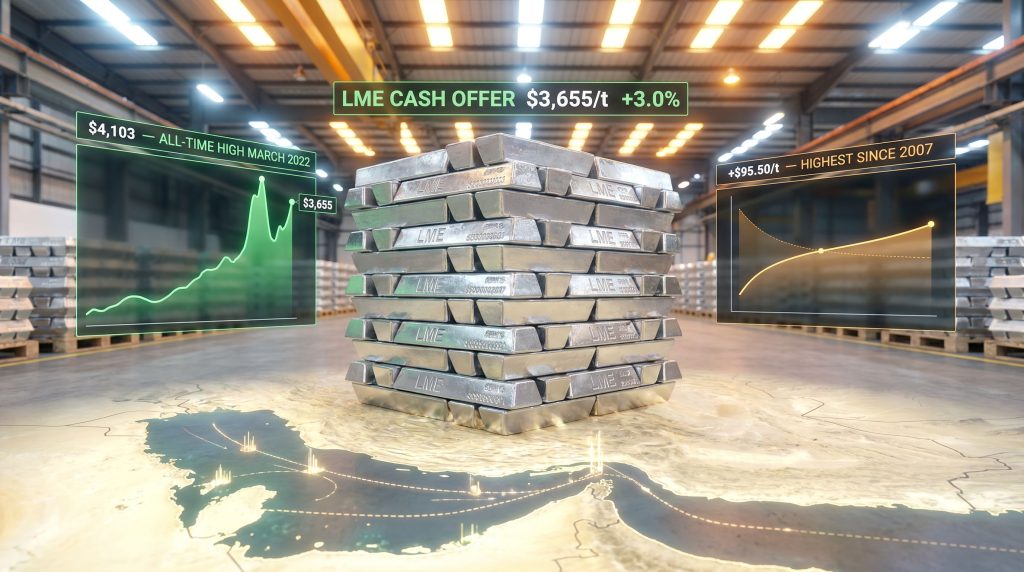
The headline figure from May 11, 2026 is striking on its own terms. The LME aluminium cash offer settled at $3,655 per tonne, rising by $94.50 per tonne from the prior session's close of $3,560.50 per tonne. That represents a 3% single-session gain, a move that, in a market as large and liquid as primary aluminium, reflects genuine dislocation rather than routine volatility.
The full picture across the LME forward curve on that date is captured below:
| Contract Type | Previous Price (USD/t) | Current Price (USD/t) | Change (USD/t) | % Change |
|---|---|---|---|---|
| LME Cash Bid | $3,560.00 | $3,654.00 | +$94.00 | +3.0% |
| LME Cash Offer | $3,560.50 | $3,655.00 | +$94.50 | +3.0% |
| LME 3-Month Bid | $3,511.00 | $3,570.00 | +$59.00 | +2.0% |
| LME 3-Month Offer | $3,511.50 | $3,571.00 | +$59.50 | +2.0% |
| LME Dec 2027 Bid | $3,118.00 | $3,153.00 | +$35.00 | +1.0% |
| LME Dec 2027 Offer | $3,123.00 | $3,158.00 | +$35.00 | +1.0% |
| Asian Reference Price | $3,503.00 | $3,579.50 | +$76.50 | +2.0% |
One of the most analytically significant features of this data is not the absolute price level but the shape of the move across time horizons. Cash contracts surged by 3%, three-month contracts gained 2%, and the December 2027 forward only moved 1%. This cascading decline in percentage gains as you move further out the curve is the hallmark of a near-term supply shock, not a structural repricing of aluminium's long-run value.
"When the cash market moves harder and faster than futures, traders are effectively saying that the problem is happening right now, not gradually over the next 12 to 24 months. This kind of curve shape is a reliable indicator of acute physical tightness concentrated in the near term."
The Four-Year High in Historical Context
To appreciate the significance of the LME aluminium price four-year high being approached in May 2026, it helps to understand where aluminium has traded historically. The metal's all-time LME high was $4,103 per tonne, reached in March 2022 during a convergence of post-pandemic demand recovery, the Russia-Ukraine conflict's commodity shock, and energy crisis-driven smelter curtailments across Europe. As Reuters reported, LME aluminium was already nearing this four-year peak following Iranian attacks on Gulf smelters earlier in 2026.
Current cash prices in the $3,654 to $3,665 per tonne range represent approximately 89% of that all-time high, and on an annualised basis, the price rally represents roughly a 44.82% gain year-over-year. The $3,600 to $3,665 range has historically functioned as a zone of significant technical resistance, making any sustained break above it psychologically important for market participants who use chart-based trading signals to guide their positioning.
The Hormuz Disruption: Why This Supply Shock Is Different
The proximate cause of the current aluminium price spike centres on disrupted shipping routes through the Strait of Hormuz following a US-ordered blockade. For most commodities, this strait is primarily associated with oil exports from the Persian Gulf. However, a less commonly understood dimension of the Hormuz situation is its critical role as an exit corridor for Gulf Cooperation Council aluminium exports.
The GCC region has spent decades building some of the world's most energy-intensive industrial infrastructure, with primary aluminium smelting forming a cornerstone of economic diversification strategies across several member states. These facilities benefit from access to low-cost hydrocarbon energy, giving Gulf smelters a structural cost advantage in global aluminium production. However, that same geography creates a concentration risk that, when activated by geopolitical disruption, can remove substantial volumes of metal from global supply chains almost instantaneously.
The cascading sequence of disruptions runs as follows:
- Vessel movement restrictions prevent loaded aluminium carriers from transiting Hormuz, stalling physical delivery to Asian and European buyers.
- Energy supply uncertainty for Gulf smelters raises operating cost risk and forces some facilities to reassess production schedules.
- Stalled US-Iran negotiations extend the timeline of the disruption beyond initial market expectations, causing traders to reprice the probability of a rapid resolution downward.
- Physical delivery uncertainty on the LME drives buyers to compete for already-limited warrant positions, pushing spot premiums sharply higher.
The disruption of a major Gulf smelting operation of the scale of Aluminium Bahrain, one of the world's largest primary aluminium producers outside China, illustrates how the removal of even one anchor supplier from the market can create a supply gap that takes months rather than weeks to fill from alternative sources.
Why Chinese Supply Cannot Simply Substitute
An important counterargument to the bullish aluminium narrative is that China, as the world's dominant primary aluminium producer, could theoretically step in to offset Gulf supply losses. April 2026 data showing Chinese aluminium exports rising 15% amid Gulf turmoil appears to support this view at first glance. However, several structural barriers prevent this substitution from being seamless:
- Tariff and trade barriers: Chinese aluminium exports face tariff headwinds in key consuming markets, adding cost layers that partially offset any price advantage. Furthermore, US aluminium tariffs have reshaped global trade flows, making substitution increasingly complex.
- Quality and specification differences: Many industrial buyers, particularly in aerospace and automotive sectors, operate to tight alloy specifications that are not always met by all grades of Chinese-origin primary aluminium.
- Logistical lead times: Rerouting supply chains from GCC to Chinese sources involves weeks of adjustment in shipping contracts, port handling arrangements, and buyer certification processes.
- Chinese domestic demand absorption: Rising domestic Chinese consumption limits the degree to which export volumes can be sustainably increased without drawing down domestic inventories.
These frictions explain why a 15% jump in Chinese exports has not been sufficient to cap the aluminium price rally. Geopolitical risk premiums, when they take hold in physical commodity markets, tend to overshoot what supply-side arithmetic alone would justify.
LME Inventory Dynamics: The Hidden Amplifier
Beyond the geopolitical narrative, the aluminium market's vulnerability to sharp price moves has been building for some time through a less visible mechanism: warehouse inventory depletion. LME-registered aluminium stocks act as a physical buffer between supply disruptions and spot price spikes. When those buffers are thin, any additional supply shock hits prices with amplified force.
The inventory picture on May 11, 2026 reveals a market operating with very limited cushion:
| Inventory Metric | Previous Level (Tonnes) | Current Level (Tonnes) | Change (Tonnes) | % Change |
|---|---|---|---|---|
| Opening Stock | 358,225 | 355,775 | -2,450 | -1.0% |
| Cancelled Warrants | 24,050 | 21,625 | -2,425 | -10.0% |
| Live Warrants | 331,725 | 331,725 | 0 | 0.0% |
"A cancelled warrant is a formal instruction to withdraw metal from an LME-registered warehouse. When cancelled warrants are high relative to total stock, it signals that physical buyers are actively pulling metal out of the exchange system, which tightens available supply for the spot market. The 10% decline in cancelled warrants seen on May 11 may indicate that the most acute wave of physical withdrawals is stabilising, but total inventory levels remain critically compressed by historical standards."
The relationship between inventory levels and the cash-to-three-month spread is one of the most technically important dynamics in the aluminium market, and one that is rarely explained clearly to non-specialist observers. When LME stocks are abundant, the market typically trades in contango, meaning three-month futures trade at a premium to spot, reflecting storage and financing costs. When stocks tighten, the market can shift into backwardation, where spot prices exceed futures, signalling that immediate physical supply is scarcer than future supply.
The cash-to-three-month premium widening to approximately $95.50 per tonne in the current environment is particularly significant. This represents the widest such premium since 2007, a data point that underscores just how physically tight the market has become. Historically, similar spread configurations have preceded sustained price breakouts in the aluminium complex.
Decoding the Forward Curve: What Longer-Dated Prices Reveal
While the near-term price action dominates headlines, the LME aluminium forward curve offers a more nuanced view of market expectations. December 2027 contracts trading in the range of $3,153 to $3,158 per tonne sit approximately $500 below the current cash price. This substantial discount tells a clear story: the market does not believe current conditions will persist indefinitely.
The flattening and downward slope of the forward curve beyond 12 months reflects a collective market judgement that the Hormuz disruption is likely to eventually resolve, that GCC smelter capacity will return to normalised operation, and that the structural supply-demand balance for aluminium, while tighter than historical norms, does not justify permanently elevated prices.
Analyst scenario modelling across major investment banks captures the range of possible outcomes:
| Scenario | Price Target (USD/t) | Key Assumption |
|---|---|---|
| Base Case | $3,600 | Hormuz disruption resolves within 30 days |
| Bull Case | $4,000 | Blockade extends beyond one month; GCC supply remains offline |
| Bear Case | $3,200 to $3,300 | Chinese export surge offsets Gulf supply loss |
| Historical Ceiling | $4,103 | March 2022 all-time high benchmark |
Major financial institutions including Citi and Goldman Sachs have raised near-term aluminium price targets to $3,600 per tonne, with upside scenarios approaching $4,000 per tonne should the strait remain closed beyond 30 days.
Alumina Stability: What the Feedstock Market Is Signalling
An often-overlooked dimension of the current aluminium price rally is the behaviour of LME alumina prices. On May 11, 2026, the LME alumina platts price held steady at $307.15 per tonne with no movement recorded. Consequently, shifts in the aluminum and alumina markets have become a critical barometer for broader commodity sentiment.
This stability carries important analytical significance. Alumina is the primary feedstock for primary aluminium smelting, produced from bauxite ore through the Bayer process. When aluminium prices rise sharply but alumina prices remain flat, it indicates that the price rally is being driven by supply shock and demand-pull dynamics rather than input cost inflation. This is sometimes described as a margin expansion event for smelters, where the revenue side of the equation improves while the cost side holds steady.
For investors analysing the profitability of aluminium producers, the widening gap between aluminium output prices and alumina input costs represents a direct margin improvement. Smelters with fixed or locked-in alumina supply contracts stand to benefit most from exactly this type of price configuration. In addition, understanding the bauxite supply chain is essential for contextualising how upstream disruptions can eventually filter through to finished metal pricing.
The full bauxite-to-aluminium value chain operates across three distinct stages:
- Bauxite mining: The raw ore, extracted primarily in Guinea, Australia, Brazil, and Indonesia.
- Alumina refining: The conversion of bauxite to aluminium oxide through the Bayer process.
- Aluminium smelting: The electrolytic reduction of alumina to primary aluminium metal, an extremely energy-intensive process.
Disruptions at any single stage can cascade through the entire chain, but the current situation is unusual in that the disruption is occurring primarily at the distribution and export stage rather than the production stage, which explains why alumina prices remain anchored while aluminium spot prices surge.
The next major ASX story will hit our subscribers first
Downstream Consequences: Who Pays When Aluminium Prices Spike
The industrial consequences of aluminium trading near four-year highs extend well beyond commodity trading floors. Aluminium is one of the most widely used industrial metals globally, embedded across a diverse range of manufacturing sectors:
- Automotive: Aluminium-intensive vehicle platforms, particularly electric vehicles with battery enclosures and structural components, face direct cost pressure from spot price increases.
- Aerospace: Long-term supply contracts provide some insulation, but renegotiation cycles mean that sustained price elevation eventually flows through to airframe manufacturing costs.
- Packaging: Beverage can manufacturers and flexible packaging producers typically hedge aluminium exposure but face mark-to-market losses on unhedged positions.
- Construction: Curtain wall systems, window frames, and structural profiles all incorporate significant aluminium content, with project cost estimates sensitive to current metal prices.
One important buffer that downstream manufacturers increasingly rely on during price spikes is recycled aluminium, also known as secondary aluminium. Recycled aluminium requires approximately 95% less energy to produce than primary smelted metal and is often priced at a discount to LME primary aluminium during supply shocks. Manufacturers with flexible feedstock sourcing that can shift toward secondary metal gain a meaningful cost advantage during episodes like the current one.
The CBAM Dimension: A New Cost Layer for Cross-Border Buyers
The European Union's Carbon Border Adjustment Mechanism (CBAM) introduces an additional analytical layer that was not present during the 2022 aluminium price spike. As LME aluminium prices rise, the absolute financial impact of CBAM charges on high-carbon imported aluminium grows proportionally. Buyers importing aluminium into the EU from regions with higher carbon-intensity smelting operations face a total landed cost that includes both the LME price premium and the CBAM carbon obligation.
This dynamic creates a structural advantage for low-carbon aluminium producers, particularly those powered by hydroelectric or renewable energy sources, whose products carry lower embedded carbon and therefore lower CBAM obligations. In a high-price, high-regulation environment, the spread between low-carbon and high-carbon aluminium pricing is likely to widen, representing a secondary market dynamic that commodity-focused analysts are beginning to price into long-term supply agreements.
Geopolitical Risk Premium: Duration Is Everything
Historical analysis of commodity price spikes driven by geopolitical disruption reveals a consistent pattern: markets tend to overprice the immediate shock and underprice the structural aftermath. The initial panic-buying and short-covering that drives sharp price increases is typically followed by a reassessment phase once the physical reality of supply rerouting becomes clearer. Furthermore, the metals tariff impact of recent US trade policy has compounded existing supply-side pressures, leaving markets with fewer buffers against sudden shocks.
For LME aluminium in mid-2026, the critical variable is the duration of the Hormuz disruption:
- A resolution within 30 days would likely see prices retreat toward the $3,200 to $3,400 range as GCC supply resumes and the backwardation in the forward curve unwinds.
- An extension beyond 60 days would begin to stress downstream inventory buffers more seriously, potentially driving prices toward the $4,000 bull-case target.
- A structural rerouting of GCC export flows through alternative shipping corridors could partially cap price gains if buyers successfully adapt to new supply logistics.
"Geopolitical commodity premiums are inherently unstable. They compress rapidly when the triggering event resolves and linger only when the disruption forces genuine structural change in supply chains. The aluminium market's current backwardation structure suggests traders are not yet pricing in a permanent rerouting scenario."
Frequently Asked Questions: LME Aluminium Price Four-Year High
What is the LME aluminium cash price as of May 2026?
On May 11, 2026, the LME aluminium cash offer settled at $3,655 per tonne, reflecting a gain of $94.50 per tonne or 3% from the prior session's close of $3,560.50 per tonne.
Why is the LME aluminium price at a four-year high?
The primary driver is disruption to Gulf aluminium export routes following the US-ordered blockade of the Strait of Hormuz, compounding already-thin LME warehouse inventory levels and triggering a sharp near-term supply premium in cash contracts. The top aluminium producers outside of China have been most acutely affected, given their geographic exposure to Hormuz transit routes.
What was the all-time high for LME aluminium?
The LME aluminium all-time high was $4,103 per tonne, recorded in March 2022 during the convergence of post-pandemic commodity demand and the Russia-Ukraine conflict's energy and supply chain shocks. According to LME aluminium price data, the cash offer reaching $3,655 per tonne marks a significant milestone in the metal's post-pandemic recovery trajectory.
What is the LME aluminium 3-month price?
As of May 11, 2026, the LME 3-month aluminium offer stood at $3,571 per tonne, up $59.50 per tonne or 2% from the previous session.
What is the LME alumina platts price?
The LME alumina platts price remained unchanged on May 11, 2026 at $307.15 per tonne, suggesting that raw material input costs are not yet contributing to the aluminium price rally.
How do cancelled warrants affect aluminium prices?
Cancelled warrants represent instructions to withdraw physical metal from LME-registered storage. A high level of cancellations signals accelerating physical demand, which tightens the cash-to-futures spread and pushes spot prices higher. The 10% decline in cancelled warrants on May 11 may indicate a temporary stabilisation in physical withdrawal pressure, though overall stock levels remain historically compressed.
Key Price Levels and Market Outlook
For participants navigating the current aluminium market environment, three price levels deserve close attention:
- $3,665 per tonne: The recent cash high and the upper boundary of the current four-year high resistance zone.
- $4,000 per tonne: The bull-case analyst target conditional on the Hormuz disruption extending beyond 30 days.
- $4,103 per tonne: The March 2022 all-time high, representing the ultimate technical ceiling for the current rally.
The LME aluminium price four-year high serves as a case study in how physical commodity markets price tail risks. The combination of geopolitical disruption, structurally thin LME inventories, and a forward curve tilted sharply into backwardation has created conditions where buyers, sellers, investors, and downstream manufacturers are all simultaneously reassessing their exposure to aluminium price risk.
Disclaimer: This article contains forward-looking analysis, scenario projections, and references to analyst price targets. These represent market estimates and speculative frameworks, not guaranteed outcomes. Commodity prices are subject to rapid change based on geopolitical, logistical, and macroeconomic developments. Nothing in this article constitutes financial or investment advice. Readers should conduct independent research and consult qualified financial professionals before making investment or purchasing decisions based on commodity price analysis.
Want to Capitalise on the Next Major Commodity Discovery Before the Broader Market?
Discovery Alert's proprietary Discovery IQ model delivers real-time alerts on significant ASX mineral discoveries — instantly cutting through complex data to surface actionable opportunities in aluminium, bauxite, and beyond. Explore historic examples of exceptional discovery returns and start your 14-day free trial at Discovery Alert to position yourself ahead of the next major move.