May 12, 2026
The Spare Capacity Illusion: How a Single Number Shapes Global Oil Markets
Every few years, the global oil market confronts a moment that forces traders, policymakers, and energy planners to reassess assumptions they had taken for granted. These inflection points rarely arrive with advance notice. They emerge from the collision of geopolitical stress, physical supply constraints, and the psychology of market participants who have built their models on figures that may never have been rigorously tested. The question of Saudi Arabia's true production ceiling sits precisely at this intersection, and understanding Aramco oil production capacity 12 million bpd requires more than accepting official statements at face value.
When big ASX news breaks, our subscribers know first
Why Maximum Sustainable Capacity Is More Than an Engineering Number
The Technical Definition and Its Strategic Implications
Maximum Sustainable Capacity, or MSC, is a specific term of art in petroleum engineering. It refers to the highest rate of crude oil production that a producing country or company can maintain continuously for an extended period, typically defined as at least 90 days, without causing damage to reservoir integrity or requiring incremental infrastructure investment beyond what is already in place.
This distinction matters enormously. MSC is not peak production, which can be achieved briefly by drawing down storage or pushing wells beyond their sustainable operating parameters. It is also not installed capacity, which measures what the physical infrastructure could theoretically handle. MSC sits between these two concepts, representing a rate that is both achievable and maintainable without accelerating reservoir depletion.
For Saudi Arabia, this number has been officially stated at 12 million barrels per day (bpd) for several years. Aramco's CEO confirmed in May 2026 that the company could reach the Aramco oil production capacity 12 million bpd threshold within approximately three weeks if geopolitical or market conditions required it, and sustain that level for up to one year without new capital expenditure.
Why This Figure Functions as a Geopolitical Instrument
The MSC figure is not merely a production planning metric. It operates as a form of energy market signalling, a public commitment designed to influence the behaviour of other producers, consuming nations, and financial markets simultaneously.
When Saudi Arabia asserts it can add multiple millions of barrels per day to global supply within weeks, this claim functions as a de facto ceiling on speculative oil price spikes. Traders who believe the kingdom can flood the market at will are less likely to push prices into extreme territory during disruptions. The credibility of the 12 million bpd figure, therefore, has direct consequences for oil price volatility entirely independent of whether the barrels are ever actually produced.
This is why the designation of Saudi Arabia as the world's primary swing producer carries systemic weight far beyond its market share. No other producer combines the stated volume, the speed of potential activation, and the political willingness to deploy spare capacity as a stabilisation tool. Furthermore, the OPEC influence on oil markets amplifies this dynamic considerably, as coordinated production decisions reinforce the signalling power of individual member states.
Saudi Arabia's Output Gap: Official Numbers Against Market Reality
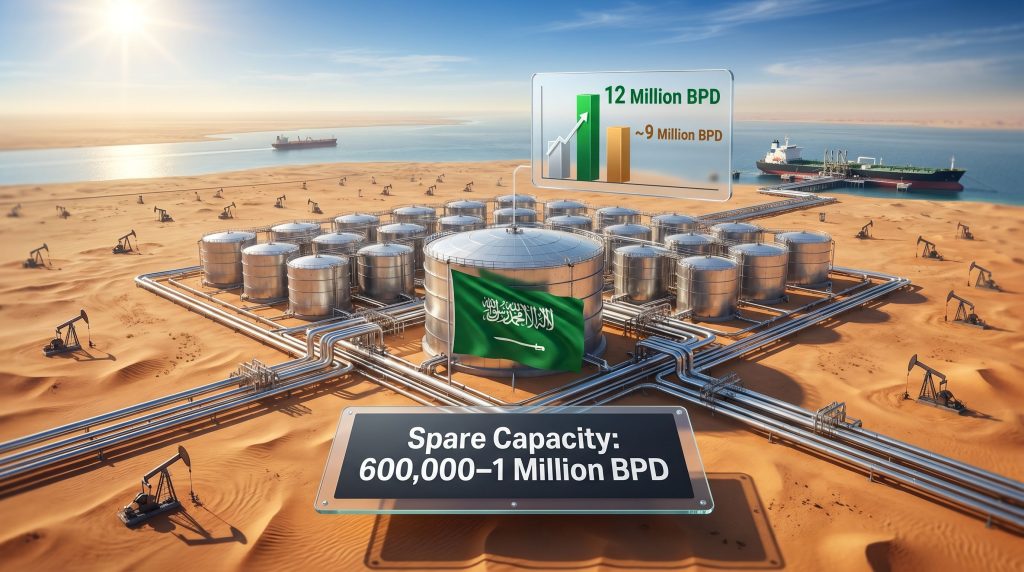
Saudi Arabia has been producing at approximately 9 million bpd in recent periods, meaning the kingdom is operating roughly 3 million bpd below its official MSC ceiling. On paper, this implies a substantial spare capacity buffer, the kind of cushion that gives consuming nations and international energy agencies confidence in supply security.
The official and independent views of this gap diverge considerably:
| Metric | Official Figure | Independent Analyst Range |
|---|---|---|
| Maximum Sustainable Capacity | 12 million bpd | Disputed |
| Current Production Level | ~9 million bpd | ~9 million bpd |
| Rapid Ramp-Up Spare Capacity | ~3 million bpd | 600,000 to 1 million bpd |
| Time to Reach Full MSC | ~3 weeks | Unverified |
| Sustained Duration at MSC | Up to 1 year | Unverified |
The divergence between the official spare capacity figure and independent assessments is not a minor rounding difference. It represents a 2 million bpd gap in credible rapid-ramp-up capacity, which at current prices translates to hundreds of billions of dollars in economic and strategic value.
The January 2024 directive from Saudi Arabia's Ministry of Energy formally instructed Aramco to maintain its MSC at 12 million bpd rather than pursue the previously announced expansion target of 13 million bpd. This decision was codified under Saudi Arabia's Hydrocarbons Law, giving the 12 million bpd ceiling regulatory permanence and effectively closing the door on the expansion ambitions that had been in place since before 2020.
This policy shift is significant for two reasons. First, it signals that Saudi Arabia has concluded the incremental capital required to add another million bpd of capacity does not generate sufficient return under current market conditions and OPEC+ quota discipline. Second, it locks the ceiling in place through legislation rather than commercial discretion, making any future upward revision a political as well as an operational decision. Consequently, the OPEC demand forecast revisions for 2025 and beyond must be understood against this fixed production ceiling.
The Strait of Hormuz: When a Chokepoint Becomes a Stress Test
Why Geography Amplifies the Capacity Debate
Approximately 20 to 21 percent of global seaborne oil trade passes through the Strait of Hormuz each day, making this narrow waterway one of the most consequential pieces of geography in the global economy. Under normal conditions, this concentration of traffic is simply a feature of Middle Eastern export geography. Under conditions of active U.S.-Iran conflict, it becomes the central variable in global energy security modelling.
Aramco's CEO characterised the energy supply disruption that began in early 2026 as the largest the world had experienced in the modern era, a significant statement from the leader of the world's largest oil exporting company. Crucially, he also indicated that if Hormuz shipping disruptions linked to the U.S.-Iran conflict persist for several more weeks, a return to normal market conditions may not occur until 2027.
Quantifying the Supply Shock Arithmetic
The mathematics of a sustained Hormuz closure are stark. A full interruption to Hormuz shipping would remove roughly 100 million barrels per week from global supply flows. Even a partial disruption affecting a significant fraction of this volume would represent a supply shock that no single producer could offset alone.
OPEC's total output reportedly reached a new low in April 2026, driven in part by export disruptions attributable to the Hormuz situation. Against this backdrop, Saudi Arabia's stated spare capacity becomes the central variable in every model attempting to forecast where oil prices stabilise and when. In addition, the broader crude oil price trends emerging throughout 2025 had already primed markets for heightened volatility before the Hormuz tensions escalated.
Scenario Analysis: What Spare Capacity Deployment Actually Achieves
| Scenario | Saudi Output Increase | Offset of Hormuz Loss | Timeline to Stabilisation |
|---|---|---|---|
| Partial disruption (20-30% of traffic) | +500,000 to 800,000 bpd | Partial | 4 to 6 weeks |
| Extended partial closure | +1.5 to 2 million bpd | Insufficient | 2027 or later |
| Full MSC activation at 12 million bpd | +3 million bpd above current | Significant but incomplete | Uncertain |
The table above illustrates a structural problem: even if Aramco's 12 million bpd claim is entirely accurate, full activation of Saudi spare capacity cannot compensate for a complete Hormuz closure. The kingdom's geographic position also means that a meaningful portion of its own exports would be affected by the same disruption it is attempting to offset.
The Credibility Problem: Can 12 Million BPD Be Verified?
The Case Supporting Aramco's Claims
Saudi Arabia operates some of the world's most productive and lowest-cost conventional oil reservoirs. The Ghawar field in the Eastern Province, the largest conventional oil field on Earth, alone has produced more than 65 billion barrels over its operational life and continues to be a cornerstone of Saudi output. The kingdom's reservoir infrastructure, pipeline network, and export terminal capacity have received sustained capital investment over decades.
The International Energy Agency and other major energy institutions have historically accepted Saudi government production data and Aramco's audited reserve figures as the basis for global supply modelling. This institutional acceptance reflects both the absence of contradicting evidence and the systemic importance of treating the figures as credible for planning purposes.
The Sceptical Case: A Deeper Look at the Numbers
The core challenge for those who question the 12 million bpd figure is the absence of independent verification. Saudi Arabia has never publicly produced at or near 12 million bpd under independently audited conditions. The gap between what is claimed and what has been empirically demonstrated is substantial.
Several structural concerns underpin this scepticism:
-
Reservoir flow rates versus reported production: Some independent petroleum geologists have argued that active reservoir extraction from Saudi fields may be considerably lower than headline production figures suggest, with a portion of reported output potentially reflecting inventory drawdowns from storage rather than live extraction.
-
Static reserve estimates: Aramco's proven reserve figures have remained largely unchanged for decades despite sustained high production rates. Under conventional reservoir physics, continuous production should produce gradual reserve depletion that shows up in official estimates. The stability of these figures is considered by some analysts to be geologically implausible.
-
Export data signals: Saudi crude exports to China, the kingdom's largest customer, were reportedly tracking toward a record low in June 2026 according to industry sources, attributed to elevated price levels. Some analysts interpret declining export volumes as a discretionary pricing decision, while others view it as a potential indicator of structural supply limitations rather than commercial preference.
-
No third-party field audits: Saudi Arabia does not permit independent verification of production at the individual field level. This opacity makes it structurally impossible to resolve the capacity debate through publicly available information.
The verification problem is not unique to Saudi Arabia. National oil companies across the Gulf have historically operated with limited external scrutiny of their reserve and production data. What makes the Saudi case distinctive is the systemic importance of the figures involved. When a number underpins global energy security planning, the absence of independent verification carries unusually high consequences.
How Saudi Capacity Compares Across the Global Producer Landscape
Understanding the Aramco oil production capacity 12 million bpd figure requires benchmarking it against other producers who hold meaningful spare capacity positions.
| Producer | Stated Spare Capacity | Estimated Actual | Key Constraints |
|---|---|---|---|
| Saudi Aramco | ~3 million bpd | 600,000 to 2 million bpd | Verification opacity |
| UAE (ADNOC) | ~1 million bpd | ~800,000 bpd | Infrastructure lead times |
| Iraq | Minimal | Minimal | Political fragmentation |
| Russia | Negative (sanctions-impaired) | Declining | Western sanctions regime |
| United States | Not applicable (market-driven) | Shale surge potential | 6 to 12 month lead time |
The table highlights an uncomfortable reality for global energy security planners: outside of Saudi Arabia, credible short-notice spare capacity is almost nonexistent. The UAE holds some buffer, but at a fraction of Saudi scale. The United States has the resource base to expand shale output meaningfully, but the lead time required runs to months rather than weeks, far too slow to address an acute supply shock.
This concentration of swing producer capability in a single nation, located in the same geopolitical theatre as the current disruption, represents a structural vulnerability in the global energy supply architecture that no amount of strategic petroleum reserve drawdown fully resolves. Furthermore, the geopolitical tensions reshaping trade across the Middle East and beyond have made this vulnerability increasingly difficult to manage through conventional policy tools.
The next major ASX story will hit our subscribers first
Market Implications and the Road to 2027
How Capacity Signals Influence Price Behaviour
Oil markets respond to capacity signals even when those signals are never physically tested. The mere assertion that Saudi Arabia can add 3 million bpd within three weeks introduces a psychological ceiling into forward pricing. Traders weighing whether to push Brent crude to extreme levels must factor in the probability that Saudi output could materially change the supply picture before their positions expire.
This mechanism, sometimes called the credibility premium in energy economics, explains why the credibility of the 12 million bpd figure matters beyond its physical accuracy. If market participants begin to doubt the claim, the dampening effect on speculative price behaviour diminishes, and volatility expands. The oil prices and US-China trade dynamic adds another layer of complexity, as demand signals from China's industrial sector directly influence how aggressively traders price in supply risk.
The Aramco CEO's warning about a potential 2027 normalisation timeline carries significant downstream consequences across multiple industries:
-
Refinery planning and feedstock contracting across Asia and Europe faces extended uncertainty over crude availability and price benchmarking.
-
Strategic petroleum reserve drawdown decisions in the United States and among IEA member states become more complex when the restoration timeline for commercial supply is unclear.
-
Energy transition investment economics shift when high oil prices persist for multi-year periods, accelerating the relative attractiveness of renewable alternatives in some markets while creating fiscal windfalls that sustain fossil fuel investment in others.
The China Demand Signal and What It Tells Us
Saudi crude exports to China reaching a record low in June 2026 deserves careful interpretation. The official explanation attributes this to price sensitivity, with Chinese refiners opting for alternative suppliers or drawing down existing stockpiles rather than purchasing Saudi barrels at prevailing prices. This is a plausible commercial explanation.
However, a competing interpretation exists. If Saudi production were genuinely unconstrained at the volumes officially claimed, competitive pricing pressure to maintain market share in China, the world's largest crude importer, would be a rational response. The combination of record-low export volumes and an active supply shock environment raises questions about whether price preference alone fully explains the data.
This article contains analysis of publicly available information and independent perspectives on energy market dynamics. It does not constitute financial or investment advice. Projections and timelines referenced herein involve inherent uncertainty and should not be relied upon for commercial decision-making. Readers are encouraged to consult primary sources and professional advisers before acting on any information contained herein.
Want to Profit From the Commodity Disruptions Reshaping Global Energy Markets?
When geopolitical shocks like the Hormuz crisis expose vulnerabilities in global supply chains, the ripple effects reach ASX-listed resource and energy companies fast — and Discovery Alert's proprietary Discovery IQ model ensures subscribers receive real-time alerts the moment significant mineral and resource discoveries are announced on the ASX, turning complex market signals into actionable investment opportunities. Explore how historic discoveries have generated exceptional returns and begin your 14-day free trial today to position yourself ahead of the market.