August 5, 2026
The Supply Architecture Beneath the Price Signal
Industrial metals rarely move in isolation. Behind every sustained price rally lies a structural story, and for aluminium in 2026, that story begins not with the first missile strike or the first force majeure declaration, but with years of quiet vulnerability accumulating inside the global supply chain. Understanding why Middle East conflict aluminium prices above $4,000 a tonne are now within reach requires tracing that vulnerability back to its foundations.
Aluminium is, at its core, an energy-intensive metal production process. Producing one tonne of primary aluminium requires roughly 14 to 16 megawatt-hours of electricity, making smelter location and energy cost the dominant variables in global competitiveness. Gulf-region producers built their advantage on precisely this calculus: access to subsidised hydrocarbon-based energy, proximity to Indian Ocean bauxite shipping lanes, and deep integration with logistics corridors serving European, Asian, and North American manufacturers.
The result was a regional production base contributing approximately 9% of total global primary aluminium supply — a share that is large enough to be systemically significant but concentrated enough to be acutely vulnerable to single-point disruption. What the market failed to adequately price before 2026 was just how thin the margin for error had become.
When big ASX news breaks, our subscribers know first
A Market Already Running on Empty
The conflict did not arrive into a well-supplied, buffer-rich aluminium market. It detonated inside a structure that was already under stress from multiple directions simultaneously. Three intersecting constraints had pre-tightened the global aluminium balance heading into 2026:
- Chinese smelter capacity had been effectively capped by domestic energy rationing policies and increasingly stringent emissions controls, limiting the world's largest producer from serving as a meaningful swing supplier.
- Indonesian smelter expansion projects, intended to partially offset Chinese supply constraints, were delayed by power infrastructure bottlenecks that prevented new capacity from coming online within the originally anticipated timelines.
- Global LME warehouse inventories entered 2026 at chronically depressed levels, leaving the market with minimal physical buffer to absorb any exogenous supply disruption.
These conditions meant the aluminium market was already in the early stages of structural deficit formation before hostilities escalated. The Gulf disruption did not manufacture a crisis from surplus conditions — it accelerated a deficit that was independently forming.
This layering of pre-existing vulnerabilities onto a geopolitical shock is precisely what distinguishes the 2026 aluminium situation from more transient commodity disruptions. The shock found no cushion.
How the 2026 Gulf Disruption Unfolded
Armed conflict involving Iran intensified through the opening months of 2026, with the most consequential industrial damage occurring in late March. Iranian strikes directly targeted two Gulf-region aluminium smelters, forcing both facilities into operational shutdown. The physical destruction of production capacity, rather than the mere threat of sanctions or supply uncertainty, immediately removed contracted volumes from the market.
Compounding the direct production loss was the effective closure of the Strait of Hormuz to normal commercial traffic. This single chokepoint handles a critical share of the Gulf's aluminium export volumes and, crucially, the inbound raw material flows — principally alumina and other process inputs — that Gulf smelters depend on to operate. The Strait disruption, furthermore, created a simultaneously export-blocked and import-starved situation for regional producers.
This dual-sided supply shock is technically distinct from prior geopolitical disruptions in the aluminium market. In most historical cases, a geopolitical event affects either the export side or the import side of a supply chain. The 2026 crisis severed both channels at once, leaving Gulf smelters unable to ship product out or receive raw materials in. Force majeure declarations from multiple regional producers followed, formally removing contracted supply commitments from the global balance.
The Price Response: From Fragility to Four-Year Highs
LME aluminium markets responded swiftly and significantly once the scale of the disruption became clear. The price trajectory through the first five months of 2026 tells a story of accelerating tightness.
| Price Milestone | Value (USD/t) | Timeframe |
|---|---|---|
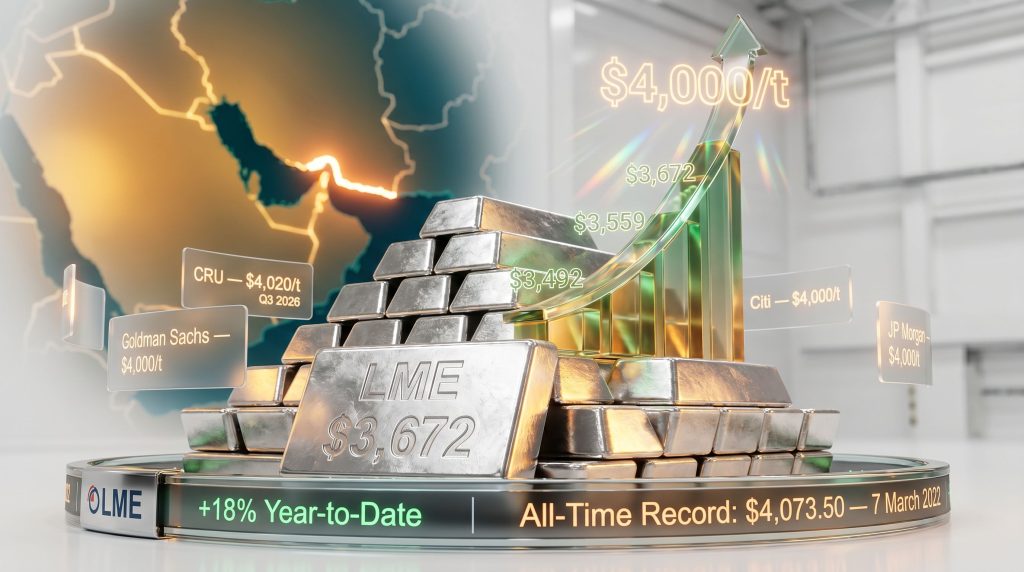
| LME 3-month futures (mid-March 2026) | ~$3,492 | Post-conflict escalation |
| LME benchmark (recent trading) | ~$3,559 | May 2026 |
| Four-year high reached | $3,672 | Mid-April 2026 |
| Year-to-date LME price increase | +18% | January to May 2026 |
| China SunSirs benchmark | 24,526.67 RMB/t (+4.78% MoM) | March 2026 |
| All-time LME record (Russia-Ukraine crisis) | $4,073.50 | 7 March 2022 |
The 18% year-to-date price increase has positioned aluminium as the strongest-performing major industrial metal of the current cycle. The mid-April peak of $3,672 per tonne reflects genuine physical tightness rather than purely speculative positioning — a distinction that experienced commodities traders treat as highly significant.
Speculative rallies tend to fade rapidly when commercial demand signals contradict the price move. Structural supply deficits, however, provide durable price support as downstream buyers compete for diminishing available tonnage. Prices consolidating above $3,500 per tonne have established a new technical floor that analysts broadly expect to hold given the scale of the confirmed deficit.
What Major Institutions Are Forecasting Through 2027
The institutional response to the 2026 crisis has been notable for both the breadth and the convergence of bullish price targets. According to CRU Group analysis, multiple major research houses and banks have independently arrived at the $4,000 per tonne threshold as a credible outcome under sustained disruption conditions.
| Institution | Price Target | Scenario or Conditions |
|---|---|---|
| Commodities Research Unit (CRU) | $4,020/t (Q3 2026), $4,105/t (Q2 2027) | Base case with sustained Gulf disruption |
| Citi | $4,000/t | Force majeure conditions; bull case within 2 months |
| Goldman Sachs | $4,000/t | Significant and prolonged supply chain disruption |
| JP Morgan | $4,000/t | Severe Middle East strike scenario |
| ING | Above $4,000/t | Severe Iran war escalation (short-lived; demand destruction risk) |
| Morgan Stanley | $3,700/t | 2026 bull case incorporating Chinese and Indonesian constraints |
| Argus Media | $4,000/t | Ongoing conflict continuation |
CRU's analysis, presented by its head of aluminium value chain at the World Aluminium Summit in London, projects aluminium reaching approximately $4,020 per tonne in Q3 2026 and climbing further to around $4,105 per tonne by Q2 2027. These levels would represent the highest sustained pricing environment since the 2022 Russia-Ukraine supply shock and would approach the metal's all-time LME record of $4,073.50 per tonne set on 7 March 2022.
The CRU assessment acknowledged that while global aluminium markets have experienced comparable deficit scales in prior cycles, the current disruption is meaningfully harder to resolve because of the compounded nature of simultaneous supply chain failures and the depth of geopolitical uncertainty surrounding resolution timelines.
Three Scenarios for Aluminium Reaching $4,000 Per Tonne
Scenario 1: Prolonged Strait Closure (Worst Case)
If the Strait of Hormuz remains effectively closed to commercial shipping through the second half of 2026 and Gulf smelter restarts are delayed beyond Q3 2026, the global deficit would deepen materially past CRU's base-case estimate of 1.4 million tonnes for 2026. Prices would breach $4,000 per tonne and potentially approach or challenge the all-time LME record of $4,073.50 per tonne. The primary risk in this scenario is demand destruction, where downstream manufacturers absorb sufficient margin pressure to reduce aluminium consumption, thereby providing a self-limiting ceiling on the price rally.
Scenario 2: Partial Resumption (Base Case)
Under this pathway, hostilities persist but Strait logistics partially normalise by Q4 2026, allowing Gulf production to recover to between 50 and 75 percent of pre-conflict capacity. CRU's projected trajectory of $4,020 per tonne in Q3 2026 rising to $4,105 per tonne by Q2 2027 holds. Prices remain structurally elevated above $3,800 per tonne even during the recovery phase as the market works through inventory deficits accumulated during the disruption period.
Scenario 3: Rapid De-escalation (Bull Reversal)
A ceasefire or diplomatic resolution before Q3 2026 would accelerate smelter restarts and normalise Strait logistics, triggering a price retracement toward the $3,200 to $3,400 per tonne range as the geopolitical premium dissipates. Importantly, however, the underlying structural deficit would persist even in this scenario, providing a longer-term price floor above pre-conflict levels.
The next major ASX story will hit our subscribers first
How 2026 Compares to Previous Aluminium Price Shocks
Historical context helps calibrate the severity and duration of what the market is now navigating.
| Crisis Event | LME Aluminium Peak | Duration of Elevated Pricing | Primary Driver |
|---|---|---|---|
| Russia-Ukraine War (2022) | $4,073.50/t (7 March 2022) | Approximately 3 to 4 months above $3,500/t | Russian supply sanctions risk |
| COVID-19 Supply Disruption (2021) | ~$3,200/t | Approximately 6 months | Logistics collapse and demand rebound |
| Middle East Conflict (2026) | $3,672/t (April 2026 peak) | Projected 12 or more months above $3,800/t | Gulf production shutdown and Strait closure |
The 2026 disruption is considered structurally more persistent than the 2022 Russia-Ukraine spike for several reasons:
- Physical production capacity has been destroyed, not merely threatened by potential sanctions.
- Raw material import disruption is occurring simultaneously with export disruption, creating a compounded supply chain failure with no near-term workaround.
- Pre-existing global inventory deficits eliminate the usual buffer that historically allowed markets to absorb geopolitical shocks over a transition period.
The 2022 LME spike, while dramatic, resolved relatively quickly as the market priced in that Russian smelters would continue operating despite the geopolitical environment. The 2026 situation involves actual physical shutdowns of operating capacity — a fundamentally different and harder-to-reverse dynamic.
Quantifying the Supply Deficit
CRU's projection of a global aluminium market deficit of approximately 1.4 million tonnes in 2026 provides the essential context for understanding why the institutional price consensus has converged so strongly around the $4,000 per tonne threshold. Gulf-region aluminium production is forecast to decline by approximately 25% year-on-year, representing one of the largest single-region supply contractions in modern aluminium market history.
To understand the scale of this in global terms: the Middle East supplies roughly 9% of world primary aluminium output, so a 25% regional production decline translates to the removal of more than 2% of total global supply in a single disruption event. For context, aluminium price forecasts from leading analysts note that a 2% reduction in global supply in a market already running a structural deficit does not produce a proportional price response.
Markets operating near the margin between surplus and deficit react non-linearly to supply shocks. Small percentage reductions in available supply can drive disproportionately large price moves when inventory buffers are minimal and substitution options are limited. This non-linear price sensitivity is precisely what is now manifesting in LME pricing, and why institutional forecasters are treating $4,000 per tonne not as a tail risk but as a base-case outcome.
Which Industries Face the Greatest Cost Exposure
The downstream implications of sustained Middle East conflict aluminium prices above $4,000 a tonne are unevenly distributed across end-use sectors, with some industries facing existential margin pressure and others discovering unexpected competitive advantage.
Transport and Automotive: Aluminium-intensive manufacturing — spanning electric vehicles, aerospace components, and commercial vehicles — faces direct and material input cost inflation. Producers holding long-term supply contracts at pre-crisis pricing have partial insulation, but spot buyers face immediate and severe margin compression.
Construction and Infrastructure: Architectural aluminium products, curtain walling systems, and structural components will experience cost pass-through pressure throughout supply chains. Infrastructure project timelines may extend as procurement costs rise and contractors seek to renegotiate fixed-price contracts.
Packaging: Beverage can manufacturers and flexible packaging producers operate on structurally thin margins and are acutely exposed to primary aluminium cost escalation. At sustained $4,000 per tonne primary prices, recycled aluminium becomes significantly more economically attractive, and secondary market premiums are expected to widen considerably.
Energy Transition Supply Chains: Solar panel frames, battery enclosures, grid-scale transmission infrastructure, and EV charging network components all carry substantial aluminium intensity. In addition, renewable energy in mining and adjacent industries faces meaningful cost escalation risk if prices remain elevated through 2027, which has broader implications for the energy transition sector.
Forces That Could Limit the Upside
Balanced analysis requires acknowledging the structural constraints that could prevent prices from reaching or sustaining levels above $4,000 per tonne, even under continued disruption.
- Demand destruction represents the most significant self-correcting mechanism. At sustained price levels above $4,000 per tonne, downstream manufacturers increasingly seek material substitution options, defer aluminium-intensive capital projects, or absorb losses to the point where volume reductions in end-use markets begin to reduce metal demand.
- Chinese export dynamics present a potential wildcard. Any policy shift that relaxes Chinese aluminium export restrictions or facilitates capacity additions could partially offset Gulf production losses, though domestic energy and emissions constraints have not been resolved.
- Speculative short positioning on LME futures can temporarily suppress price momentum even during genuine physical supply shortfalls, as algorithmic trading strategies respond to technical price levels rather than fundamental supply-demand dynamics.
- Strategic inventory releases from national stockpiles or coordinated LME warehouse builds could moderate spot tightness in the near term.
ING analysts have flagged that while $4,000 per tonne is achievable under severe escalation, the very conditions that drive prices to that level simultaneously suppress industrial demand, creating an inherent self-limiting dynamic in the most extreme scenarios.
Who Benefits From a $4,000 Per Tonne Aluminium Market
Not every participant in the aluminium value chain suffers from elevated pricing. Several categories of producers and investors stand to benefit materially:
- North American and European primary smelters operating entirely outside the conflict zone gain significant margin expansion at current price levels. For instance, European aluminium investment decisions made prior to the conflict now look considerably more favourable as higher realised prices flow through to revenues.
- Aluminium recyclers and secondary producers benefit as the cost differential between primary and recycled metal widens, making scrap-based production increasingly competitive and driving demand for post-consumer aluminium.
- Diversified mining companies with aluminium exposure, including Rio Tinto — whose Gladstone aluminium operations stand to benefit from elevated pricing — and South32, may receive meaningful earnings upgrades as higher realised prices flow through to margin calculations.
- Bauxite and alumina producers benefit from upstream demand as ex-Gulf smelters aggressively seek to secure alternative raw material supply chains, tightening the alumina market and potentially driving upstream price appreciation as well.
Frequently Asked Questions
Why is the Middle East conflict pushing aluminium prices so high?
The conflict has simultaneously shut down Gulf smelter production capacity through direct strikes and disrupted the Strait of Hormuz, cutting off both aluminium exports and the raw material imports that regional smelters require to operate. Combined with a pre-existing global supply deficit and historically low LME warehouse inventories, these factors have created acute physical tightness in the market.
When are aluminium prices expected to exceed $4,000 per tonne?
CRU forecasts aluminium reaching approximately $4,020 per tonne in Q3 2026, with prices potentially climbing to around $4,105 per tonne by Q2 2027, assuming Gulf disruptions persist through that period.
How does the 2026 situation compare to the 2022 aluminium price record?
The all-time LME high of $4,073.50 per tonne was set on 7 March 2022 during the Russia-Ukraine crisis. The 2026 disruption is considered potentially more durable because it involves physical destruction of production capacity rather than sanctions-based supply uncertainty, which historically resolves faster as markets adapt.
What share of global aluminium supply comes from the Middle East?
The Middle East contributes approximately 9% of global primary aluminium supply, making disruptions in the region large enough to have measurable global price implications, particularly when overlaid on existing market tightness.
Could aluminium prices fall back below $3,000 per tonne if the conflict ends?
This is considered unlikely in the near term. Structural global deficits, depleted inventories, and the time required to physically restart damaged smelter capacity mean prices would likely remain elevated well above pre-conflict levels even following a resolution of hostilities.
What industries are most exposed to aluminium prices above $4,000 per tonne?
Transport, construction, packaging, and energy transition supply chains face the greatest input cost exposure. Aluminium recyclers, ex-Gulf primary smelters, and diversified miners with aluminium production are among the key beneficiaries in an elevated-price environment. Consequently, the aluminum and steel tariffs already weighing on global manufacturers compound the cost pressure for industries navigating this elevated pricing environment.
Key Takeaways: Aluminium's Strategic Outlook Through 2027
- LME aluminium prices have risen 18% year-to-date in 2026, driven by the dual disruption of Gulf smelter production and Strait of Hormuz logistics.
- CRU projects a global aluminium deficit of approximately 1.4 million tonnes in 2026, with Gulf production declining by an estimated 25% year-on-year.
- Institutional consensus from CRU, Goldman Sachs, Citi, JP Morgan, ING, Morgan Stanley, and Argus Media converges on $4,000 per tonne as a credible and achievable price target under sustained disruption conditions.
- CRU's base-case forecast projects prices reaching $4,020 per tonne in Q3 2026 and $4,105 per tonne by Q2 2027, approaching the all-time LME record of $4,073.50 per tonne set during the 2022 Russia-Ukraine crisis.
- The 2026 disruption is structurally more persistent than prior geopolitical price shocks because physical production capacity has been destroyed rather than threatened, raw material access and export logistics are simultaneously disrupted, and pre-existing inventory deficits provide no recovery buffer.
- Key monitoring variables include Strait of Hormuz normalisation timelines, Gulf smelter restart progress, Chinese aluminium export policy developments, and the trajectory of global industrial demand. The Middle East conflict aluminium prices above $4,000 a tonne scenario represents a genuine base case rather than a tail risk for 2026 and into 2027.
This article contains forward-looking statements, price forecasts, and institutional projections that are subject to significant uncertainty. Commodity price forecasts from third-party research institutions do not constitute investment advice. Readers should conduct independent research and consult qualified financial advisors before making investment decisions. Past performance of commodity prices is not indicative of future results.
Want To Stay Ahead of the Next Major ASX Minerals Discovery?
Whilst institutional forecasters debate aluminium's path to $4,000 per tonne, Discovery Alert's proprietary Discovery IQ model is scanning ASX announcements in real time, instantly alerting subscribers to significant mineral discoveries — including those tied to commodities facing structural supply disruptions like aluminium. Explore historic discoveries and the returns they generated, then begin your 14-day free trial to ensure you're positioned ahead of the broader market when the next major discovery is announced.