June 25, 2026
The Hidden Architecture Behind Every Aluminium Product You Use
Few industrial systems rival the complexity embedded in something as familiar as an aluminium beverage can, a car door panel, or a window frame. Before any of these products reaches a consumer, raw material extracted from tropical soils must pass through a gauntlet of chemical refinement, electrochemical transformation, and precision fabrication. The mine to market aluminium producers and manufacturers landscape is not a simple pipeline; it is a globally distributed network of interdependent processes, each carrying its own energy demands, geopolitical exposures, and efficiency thresholds.
Understanding this chain in full reveals why aluminium pricing can surge overnight, why some producers command structural cost advantages over rivals, and why the next decade will reshape production hierarchies in ways not seen since China's rapid capacity expansion of the 2000s.
When big ASX news breaks, our subscribers know first
How the Aluminium Value Chain Works: Stage by Stage
Stage 1: Bauxite Extraction
Everything begins with bauxite, a reddish-brown ore found predominantly in tropical and subtropical geographies. Australia, Guinea, Brazil, and Jamaica hold the bulk of commercially viable reserves, and the concentration of supply in a handful of nations creates the first layer of geopolitical risk embedded in every aluminium product. Furthermore, global bauxite production patterns continue to shift as new deposits are developed and existing mines mature.
Open-cut mining dominates extraction methodology. Ore grades above 45% aluminium oxide (Al₂O₃) are generally considered commercially preferable, and strip ratios — the volume of waste material removed per tonne of ore — are a primary driver of mine-level operating costs. ESG frameworks are increasingly mandating large-scale land rehabilitation programmes post-extraction, adding a cost dimension that many older operational models did not account for.
Stage 2: Alumina Refining via the Bayer Process
Extracted bauxite travels to a refinery where the Bayer Process dissolves aluminium-bearing minerals in hot caustic soda, separates impurities, and crystallises aluminium oxide, yielding the fine white powder known as alumina. The conversion ratio is significant: it takes approximately 4 to 5 tonnes of bauxite to produce 2 tonnes of alumina, and the process consumes roughly 14 to 15 gigajoules of energy per tonne of alumina produced.
The major by-product at this stage is red mud, a caustic slurry of iron oxides, titanium dioxide, silica, and residual alkali. For decades it was treated as a purely problematic waste stream requiring costly storage. That perception is shifting. Red mud is now actively evaluated as a secondary source of rare earth elements, iron, and titanium dioxide, transforming a liability into a potential revenue stream for integrated operators with the processing infrastructure to extract value from it.
Stage 3: Primary Smelting and the Hall-Héroult Process
Alumina becomes metal through electrolysis. The Hall-Héroult process dissolves alumina in molten cryolite within large electrolytic cells and passes a direct current through the bath, reducing aluminium ions to metallic form. The resulting molten metal is cast into ingots, billets, slabs, or T-bars depending on downstream requirements.
This is the most energy-intensive stage in the entire value chain. Electricity costs typically represent 30 to 40% of total smelting costs, and best-practice facilities target direct current energy consumption of approximately 13,000 to 14,000 kilowatt-hours per tonne. Operations above this threshold face structural cost disadvantages that compound through commodity downturns.
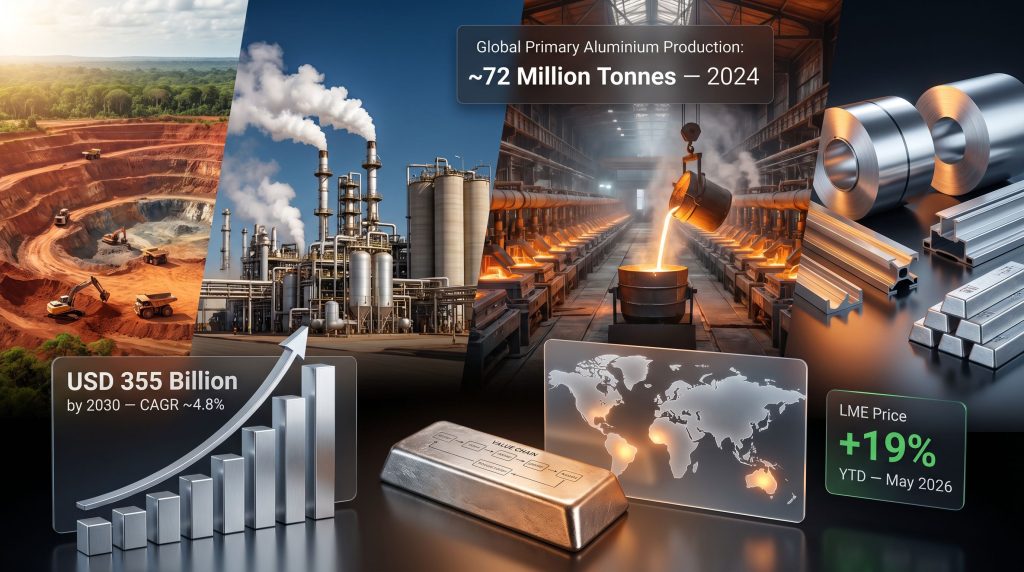
Global primary aluminium production reached approximately 72 million tonnes in 2024, with China accounting for roughly 43 million tonnes, or around 60% of world output. That single statistic explains much of the pricing and competitive dynamics that define the industry today. For additional context on who dominates production volumes, the top aluminium producers reveal the scale of competition shaping global supply.
Stage 4: Downstream Fabrication
Primary metal enters rolling mills, extrusion presses, and casting facilities to become the finished forms that manufacturers actually purchase. Each product category serves distinct end markets:
- Rolled sheet and foil: Automotive body panels, food and pharmaceutical packaging, building cladding
- Extruded profiles: Structural window frames, heat sinks, transportation components
- Drawn wire and cable: High-voltage electrical transmission infrastructure
- Forged and cast components: Aerospace airframes, automotive powertrain parts, defence applications
Recovery yield in downstream rolling operations — measured against the volume of input metal versus saleable output — is a critical efficiency metric. Advanced facilities target recovery yields above 95%, with melt loss below 3% in secondary processing operations.
The World's Leading Integrated Mine to Market Aluminium Producers
True vertical integration — controlling bauxite mining, alumina refining, primary smelting, and downstream fabrication under a single corporate structure — is rarer than industry commentary often implies. Fewer than ten global operators achieve meaningful integration across all four stages at scale. For a comprehensive overview of the aluminium industry's full supply chain, the depth of integration required becomes even clearer.
Vertical integration provides more than cost efficiency. It delivers supply chain resilience during commodity shocks, pricing power across multiple margin pools, and the ability to capture value at whichever stage of the chain is currently most profitable.
| Rank | Company | Headquarters | Integration Depth |
|---|---|---|---|
| 1 | China Hongqiao Group | China | Smelting, captive power, recycling |
| 2 | CHALCO (Aluminum Corp of China) | China | Bauxite through rolled products |
| 3 | UC RUSAL | Russia | Hydro-powered smelting, ~4.0Mt capacity |
| 4 | Rio Tinto | UK/Australia | Weipa → Yarwun → Bell Bay/Boyne |
| 5 | Norsk Hydro ASA | Norway | Paragominas → Alunorte → Norwegian smelters |
| 6 | Hindalco Industries | India | Indian mines → Utkal → Smelters + Novelis |
| 7 | Alcoa Corporation | USA | Australia/Brazil/Canada → Alumina → Smelting |
| 8 | Vedanta Aluminium | India | Lanjigarh alumina → Jharsuguda smelting |
| 9 | Aluminium Bahrain (Alba) | Bahrain | Primary metal; energy efficiency focus |
| 10 | National Aluminium Company (NALCO) | India | Damanjodi → Angul integrated complex |
China Hongqiao Group's competitive position stems in large part from its captive power generation model, which insulates smelting costs from grid electricity price volatility. This structural advantage, combined with China's broader state-backed energy and infrastructure investment, explains why Chinese producers have maintained dominance despite rising scrutiny over carbon intensity. Chinese operators are also moving upstream internationally, acquiring bauxite assets in Guinea and Indonesia to secure long-term ore supply independent of domestic reserves.
Low-Carbon Differentiation: Where Western Producers Are Competing
Energy source is the decisive variable in aluminium's carbon footprint, and Western producers are leveraging hydroelectric-powered smelting as a credible differentiator in markets where procurement decisions increasingly incorporate carbon intensity metrics.
Canadian smelters operate with among the lowest carbon intensities globally due to near-total reliance on hydroelectric power. Norsk Hydro has constructed an integrated model running from its Paragominas bauxite mine in Brazil through the Alunorte refinery — also in Brazil and one of the world's largest alumina refineries — and through to its Norwegian smelting operations, which are substantially powered by renewable hydroelectricity.
Rio Tinto and Alcoa are advancing what could become the most transformative development in primary smelting in over a century: the ELYSIS process, a joint venture targeting the complete elimination of direct CO₂ emissions from the Hall-Héroult stage by replacing carbon anodes with inert alternatives that produce oxygen rather than greenhouse gases. In addition, the Alcoa joint venture represents another strategic move to strengthen the company's long-term competitive positioning.
The Aluminium Stewardship Initiative (ASI) certification is emerging as a procurement prerequisite for major automotive OEMs and consumer electronics manufacturers. Certified supply chains must demonstrate responsible, low-carbon sourcing across the complete mine to market pathway, not just at a single production stage.
The green aluminium premium — a price differential paid by manufacturers for certified low-carbon primary metal — is transitioning from a niche voluntary payment to a commercially structural pricing factor as carbon border adjustment mechanisms tighten across major importing economies.
Supply Chain Disruptions Reshaping the 2026 Market
The aluminium value chain has absorbed a sequence of compounding shocks over recent years: European energy crises that forced smelter curtailments, sanctions affecting Russian metal supply, and maritime route instability. In 2026, disruption centred on the Strait of Hormuz region has delivered the most acute near-term supply shock.
According to Vista Metals President and CEO Kelly Thomas, the effective disruption of Gulf smelting operations — including facilities operated by Emirates Global Aluminium and Aluminium Bahrain — removed an estimated 3% of global aluminium supply from the market in a compressed timeframe. London Metal Exchange aluminium prices surged approximately 19% year-to-date through May 2026 as a consequence of this supply contraction combined with sustained demand momentum. However, it is worth noting that US aluminium tariffs have added a further layer of complexity to an already disrupted trade environment.
Producers across the value chain are responding through a set of structural adaptations:
- Accelerating vertical integration to reduce spot market price exposure
- Diversifying bauxite sourcing to eliminate single-country dependency vulnerabilities
- Scaling secondary aluminium capacity to reduce reliance on energy-intensive primary production
- Formalising long-term offtake agreements with downstream customers to stabilise revenue visibility
The Secondary Aluminium Revolution: Dross, Scrap, and the Circular Economy
One of the most economically compelling and underappreciated dynamics in the mine to market aluminium producers and manufacturers landscape is the growing strategic importance of secondary production. Recycling aluminium requires approximately 5% of the energy consumed in producing primary metal from ore, a ratio that makes secondary production both economically and environmentally transformative at scale.
Dross — the oxide-laden material that forms on the surface of molten aluminium during smelting and casting operations — has historically been treated as a low-value residue. Advanced dross processing technologies are rewriting that calculus. A single tonne of dross, properly processed, can yield:
- Recovered metallic aluminium for re-entry into the production cycle
- Alumina-rich residues usable in refractory and cement manufacturing
- Salt flux residues for chemical industry applications
- Soda ash derivatives for industrial processing
As TAHA International CEO Ammar Awach has stated, dross recovery represents one of the aluminium industry's most chronically underutilised opportunities. Every tonne of aluminium recovered from dross processing directly displaces the need for primary production, reducing both energy consumption and associated carbon emissions across the value chain.
Red mud valorisation represents a similarly under-exploited frontier. Rare earth element recovery from bauxite residue is technically feasible and increasingly commercially viable as rare earth supply chains face their own geopolitical pressures, consequently creating an unexpected intersection between the aluminium and critical minerals industries.
The next major ASX story will hit our subscribers first
Global Aluminium Market Outlook to 2030
Despite near-term price volatility, the structural demand case for aluminium through the end of the decade remains robust. The global aluminium market is projected to reach USD 355 billion by 2030, expanding at a compound annual growth rate of approximately 4.8%. For instance, Rio Tinto's investment in its Gladstone aluminium operations illustrates how major producers are positioning themselves to capture this long-term demand growth.
| Growth Driver | Sector | Key Aluminium Application |
|---|---|---|
| Vehicle lightweighting | Automotive | Body panels, battery enclosures |
| Urban infrastructure expansion | Construction | Curtain wall, structural profiles |
| Renewable energy deployment | Energy | Solar frames, wind components, cable |
| Sustainable packaging transition | Consumer goods | Beverage cans, pharmaceutical foil |
| Defence modernisation | Aerospace and Defence | Airframes, armoured vehicle structures |
The industry directly and indirectly supports approximately 7.5 million jobs worldwide, and its contribution to global GDP — measured at 1.2 to 1.3% in direct terms — expands considerably when the downstream manufactured goods that depend on aluminium are included in the calculation.
India is emerging as a critical growth market, with NALCO's Damanjodi-to-Angul integrated complex, Vedanta's Lanjigarh-Jharsuguda corridor, and Hindalco's expanding domestic operations all positioned to serve rising infrastructure and automotive demand as the country accelerates industrialisation.
The U.S. Push to Rebuild Domestic Mine-to-Market Capability
A structural vulnerability in the U.S. aluminium industrial base has been its dependence on imported alumina, meaning domestic smelting capacity lacks equivalent upstream self-sufficiency. A memorandum of understanding between Century Aluminum and Brimstone aims to address this gap directly, establishing a pathway toward the first fully domestic U.S. mine-to-metal aluminium supply chain.
This initiative reflects a broader industrial strategy to reduce dependence on overseas alumina refineries, which expose domestic smelters to both pricing risk and supply disruption. The U.S. currently possesses smelting expertise and infrastructure but has historically lacked the upstream integration that makes Chinese, Russian, and Gulf region competitors more structurally resilient through commodity cycles. Furthermore, detailed industry production data from the International Aluminium Institute underscores just how significant this integration gap remains for Western producers.
Key Operational Benchmarks Across the Value Chain
| Stage | Primary Efficiency Metric | Industry Benchmark |
|---|---|---|
| Bauxite Mining | Ore grade (% Al₂O₃) | >45% preferred |
| Alumina Refining | Energy per tonne of alumina | ~14-15 GJ/t |
| Primary Smelting | DC energy consumption | ~13,000-14,000 kWh/t |
| Downstream Fabrication | Rolling recovery yield | >95% |
| Secondary/Recycling | Melt loss percentage | <3% in advanced operations |
Frequently Asked Questions
What does mine to market mean in the aluminium industry?
Mine to market describes complete vertical integration across the aluminium supply chain, from bauxite extraction through alumina refining, primary smelting, downstream fabrication, and delivery to end-use manufacturers. Producers controlling multiple stages hold structural cost and resilience advantages.
Which country produces the most primary aluminium?
China is the dominant producer, accounting for approximately 43 million tonnes in 2024, representing roughly 60% of global output. India, Russia, and Canada are the next largest producing nations by volume.
Why does electricity cost matter so much in aluminium production?
The electrolytic smelting stage consumes approximately 13,000 to 14,000 kilowatt-hours per tonne of aluminium produced, making electricity the largest single cost input. Operations with access to low-cost renewable power, particularly hydroelectricity, hold permanent competitive advantages over those dependent on grid or fossil-fuel-based electricity.
What is the difference between primary and secondary aluminium?
Primary aluminium originates from bauxite ore processed through the Bayer and Hall-Héroult systems. Secondary aluminium is produced by remelting scrap or recovering metal from dross. Secondary production requires approximately 95% less energy than primary production, making it both economically and environmentally preferred wherever sufficient scrap supply exists.
Why is aluminium critical to the energy transition?
Aluminium's combination of low density, high tensile strength, corrosion resistance, and electrical conductivity makes it structurally irreplaceable across renewable energy systems. Solar panel frames, wind turbine nacelles, electric vehicle battery enclosures, and high-voltage transmission cable all depend on aluminium in forms that no economically viable substitute currently replicates.
What is ASI certification?
The Aluminium Stewardship Initiative is an independent certification standard verifying responsible sourcing, production practices, and chain-of-custody management across the aluminium value chain. Automotive OEMs and consumer electronics manufacturers increasingly require ASI certification as a supply condition, making it a commercially significant differentiator for certified producers.
Disclaimer: Market projections, price figures, and production statistics referenced in this article represent estimates drawn from publicly available industry sources and analyst forecasts. Forward-looking statements involve inherent uncertainty, and actual outcomes may differ materially from projections. This article does not constitute financial or investment advice.
Want to Invest in the Commodities Powering the Global Economy?
Discovery Alert's proprietary Discovery IQ model delivers real-time alerts on significant ASX mineral discoveries — including the bauxite and aluminium sector plays that underpin industries worth hundreds of billions of dollars — instantly translating complex market data into actionable investment opportunities for traders and long-term investors alike. Explore Discovery Alert's dedicated discoveries page to see how major mineral discoveries have historically generated substantial returns, and begin a 14-day free trial to position yourself ahead of the broader market.