June 25, 2026
Gulf Energy Markets at an Inflection Point
Few forces reshape global commodity markets as decisively as the simultaneous reopening of a strategic chokepoint and the restoration of a major producer's export capacity. When those two events coincide across an entire region, the ripple effects extend well beyond spot prices and tanker schedules. The Qatar Mideast oil trade rebound now unfolding across the Persian Gulf represents precisely this kind of structural reset, one with implications for Asian refinery procurement strategies, LNG offtake economics, and the long-term architecture of global energy supply chains.
Understanding why this moment matters requires looking beyond the headline recovery numbers and examining the mechanics of how Gulf energy flows actually work, what disrupted them, and what their restoration signals for market participants operating across different time horizons.
When big ASX news breaks, our subscribers know first
How Severe Was the 2025 Gulf Energy Contraction?
From Chokepoint Closure to Regional Production Collapse
The 2025 disruption to Middle East energy markets was not a routine geopolitical shock. At its peak, regional oil and gas production contracted to levels approaching half of pre-conflict output, a compression rarely seen outside of full-scale armed conflict affecting core producing infrastructure.
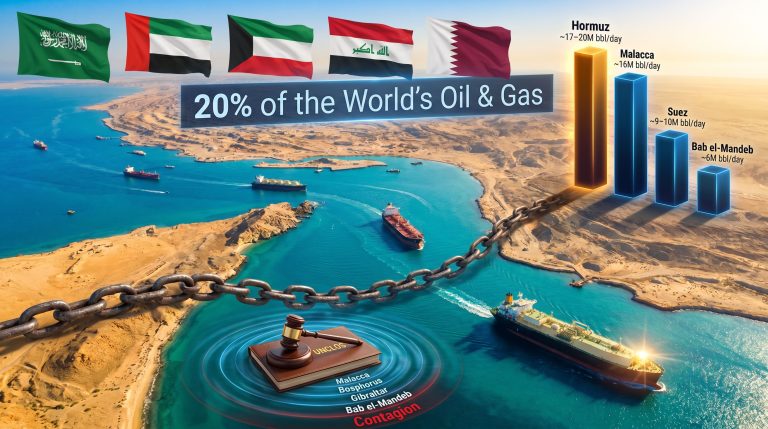
The central mechanism was access denial through the Strait of Hormuz, the 21-mile-wide passage through which approximately 20% of globally traded oil moves on any given day. According to the EIA's analysis of world oil transit chokepoints, when this corridor becomes impassable or commercially unviable for very large crude carriers (VLCCs), the downstream consequences are near-instantaneous. Refineries in Asia operating on just-in-time crude procurement models face feedstock shortfalls within weeks, not months.
The fiscal damage across the Gulf Cooperation Council was substantial:
- Qatar recorded its largest budget deficit since 2017 as hydrocarbon revenues contracted sharply
- Commodity market volatility during the disruption period created forecasting paralysis for both producers and buyers
- Analyst modelling produced a wide range of Brent crude scenarios, from approximately $90 per barrel as a 2025 average through to worst-case projections approaching $150 per barrel under prolonged conflict conditions
- Asian refiners scrambled to source alternative crude grades from West Africa, the Americas, and Russia to compensate for absent Gulf barrels
"The Strait of Hormuz is not merely a shipping lane. It is the single most concentrated point of energy market vulnerability on the planet, and its closure creates simultaneous supply shocks across every crude-importing economy in Asia."
Why Gulf Producers Face Asymmetric Recovery Timelines
One underappreciated dimension of the Qatar Mideast oil trade rebound is that not all Gulf producers recover at the same pace or through the same mechanisms. Qatar occupies a structurally advantaged position for several reasons that distinguish it from purely oil-dependent GCC neighbours.
Qatar operates a dual-revenue export model combining crude oil with liquefied natural gas, which accounted for a dominant share of the country's hydrocarbon export earnings even before the conflict period. This matters because LNG and crude oil recovery timelines differ. LNG infrastructure requires coordinated plant restart sequences, tanker scheduling, and destination terminal coordination, but once operational, it generates revenue streams that are partially insulated from crude oil price swings.
Qatar's Re-Entry Into Asian Crude Markets
The First Post-Conflict Transactions and What They Signal
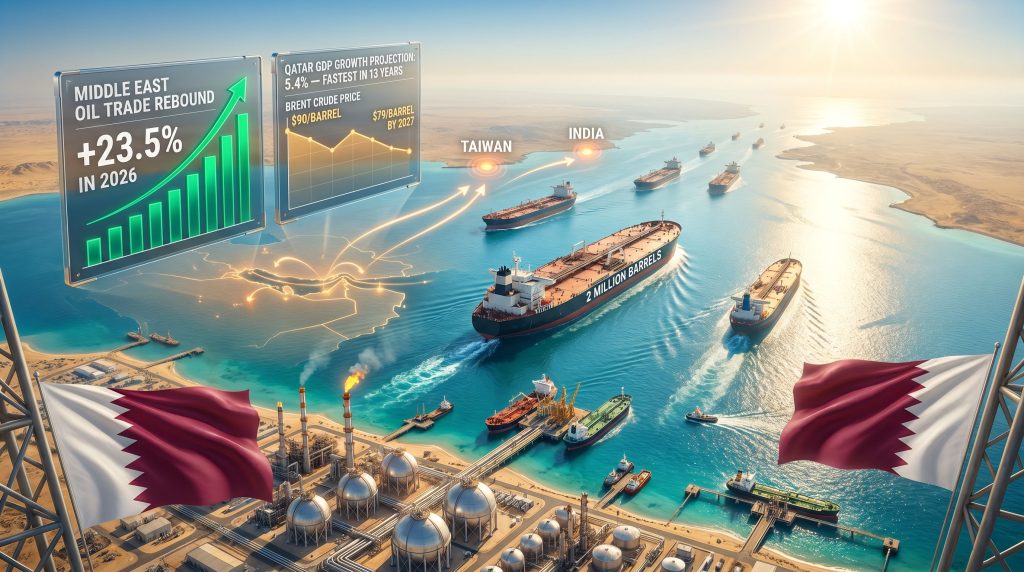
The commercial intelligence emerging from mid-2026 crude trading activity reveals a market moving with deliberate speed to re-establish Gulf supply relationships. Qatar's Al-Shaheen grade, sourced from the country's largest offshore oilfield, was transacted with Taiwan's Formosa Petrochemical Corporation for August to September delivery, arranged through commodity trading house Mercuria Energy Group. Separately, Al-Shaheen, Marine, and Land crude varieties were sold to an Indian refiner in the same period.
These deals carry significance beyond their individual volumes. They represent the first confirmed Asian refinery purchases of Qatari crude since the conflict began, functioning as a commercial proof-of-concept that Gulf supply chains are operationally restored. Furthermore, they demonstrate that Asian buyers have sufficient confidence to re-enter procurement relationships.
Key operational indicators supporting the recovery thesis include:
- Increased tanker movements near Qatar's Ras Laffan industrial complex, the country's primary energy export hub
- The Greek-owned supertanker Kiku, a VLCC, loading approximately 2 million barrels of Qatari crude from the Al-Shaheen floating storage and offloading (FSO) terminal
- The Kiku entered the Persian Gulf on June 19, 2026, after last broadcasting from the Gulf of Oman on June 13, making it one of the first mainstream tankers to transit the gulf following US-Iran diplomatic progress
- QatarEnergy offering a gasoline cargo for export from its Mesaieed refinery, confirming that broader downstream processing operations are ramping up alongside crude export resumption
The Role of Trading Houses in Bridging Market Uncertainty
The involvement of major commodity trading intermediaries in facilitating the first post-conflict Qatari crude transactions deserves specific attention. Trading houses function as critical liquidity providers during periods of market dislocation, absorbing counterparty risk and bridging informational gaps between producers uncertain about offtake and refiners uncertain about supply reliability.
When a firm like Mercuria intermediates the first Qatari crude sales into Asian refinery supply chains, it signals something beyond simple transaction facilitation. It indicates that commercial confidence in Gulf supply continuity has reached a threshold sufficient to support near-term contract execution, even before full diplomatic normalisation is confirmed. Trading houses carry reputational and balance sheet risk on these transactions, meaning their willingness to participate functions as an implicit market endorsement of supply route stability.
LNG Recovery: Qatar's Strategic Differentiator
Why LNG Restoration Amplifies the Broader Rebound
Qatar's plan to restore the majority of its LNG export capacity within approximately two months of full Strait of Hormuz reopening is central to the broader Qatar Mideast oil trade rebound narrative. The LNG supply outlook for Asian markets is consequently shifting, given that roughly 80% of Qatar's LNG exports are directed toward Asian buyers.
The significance of LNG within Qatar's recovery strategy reflects a longer-term structural reality. Qatar has for years been executing a strategy to expand its LNG production capacity, and the post-conflict recovery period effectively compresses that expansion timeline by incentivising rapid infrastructure restart. For Asian importers, the return of Qatari LNG supply offers an alternative to both pipeline-dependent Russian gas and more expensive spot LNG from Atlantic Basin suppliers.
The Asian Demand Equation
Trade Flows, Buyer Behaviour, and the Structural Corridor
The Gulf-to-Asia energy corridor is not simply a trade route. It is the backbone of Asian industrial civilisation's energy security architecture. Asia House's research on the Middle East pivot to Asia provides important context for understanding the scale of this relationship:
| Metric | Value |
|---|---|
| Gulf-Asia bilateral trade volume (2024) | $516 billion |
| Year-on-year Gulf-Asia trade growth (2024) | +14.4% |
| Qatar LNG exports directed to Asian markets | ~80% |
| Middle East oil trade rebound forecast (2026) | +23.5% |
| Qatar GDP growth projection (2026) | 5.4% |
| Brent crude price forecast (2027, normalised) | ~$79/barrel |
Taiwan and India as the first confirmed re-entry points for Qatari crude is analytically meaningful. These are not speculative buyers testing the market. Formosa Petrochemical is one of Asia's largest independent refiners, and India's refining sector has been aggressively expanding capacity. Their re-engagement with Gulf crude signals that alternative supply arrangements adopted during the disruption period are already being unwound in favour of restoring lower-cost Middle Eastern barrels.
Asian refiners who shifted to alternative crude grades during the Gulf disruption will now face a structural repricing decision. Middle Eastern crude grades typically offer competitive netback economics for Asian refinery configurations optimised around their sulphur content and API gravity profiles. As Gulf barrels return with competitive pricing, refiners will need to evaluate whether to blend, substitute, or phase out the alternative grades they adopted during the disruption.
Oil Price Dynamics: From War Premium to Normalization
Reading the Brent Price Signal
The crude oil price trends emerging from Brent crude's erasure of all wartime price gains following the Hormuz reopening reflect a market that was pricing geopolitical risk premium rather than fundamental supply shortage throughout much of 2025. This distinction matters for forward price forecasting.
When prices fall as rapidly as they rose, it typically indicates that physical supply was never as constrained as headline sentiment suggested, or alternatively, that demand destruction from high prices was greater than anticipated. In the Gulf context, both dynamics were likely operating simultaneously.
The forward price trajectory presents three distinct scenarios for market participants to evaluate:
| Scenario | Brent Price Outlook | Gulf Export Recovery Profile |
|---|---|---|
| Full diplomatic normalisation | ~$79/barrel by 2027 | Rapid, sustained rebound |
| Partial normalisation (current base case) | ~$90/barrel average | Moderate, phased recovery |
| Renewed conflict escalation | Up to $150/barrel | Sharp reversal of current gains |
"The speed at which Brent erased its wartime premium following Hormuz reopening should be interpreted carefully. It reflects market efficiency in repricing geopolitical risk, but it does not eliminate the underlying vulnerability. A single adverse diplomatic development can reignite that premium within trading sessions."
Qatar's Fiscal Resilience and Sovereign Buffer Capacity
Qatar entered the conflict period with sovereign wealth fund resources and fiscal reserves that provided meaningful insulation against the revenue shock experienced by smaller, less-diversified Gulf producers. The 2025 budget deficit, while historically significant, was absorbed without the kind of structural fiscal adjustment that would indicate lasting damage to the country's economic foundations.
Qatar's economic diversification strategy, encompassing financial services, tourism infrastructure, and technology investment, provides a secondary revenue floor that purely hydrocarbon-dependent regional peers cannot replicate. As oil price movements stabilise and LNG revenues recover through 2026 toward a projected 5.4% GDP growth rate — the fastest expansion Qatar is expected to record in 13 years — the convergence of hydrocarbon recovery and diversification income creates a compounding growth dynamic.
The next major ASX story will hit our subscribers first
Structural Lessons and Long-Term Implications
Supply Chain Vulnerabilities Exposed by the Disruption
The 2025 Gulf crisis functioned as a live stress test of global energy supply chain resilience, and the results revealed specific architectural weaknesses that market participants and policymakers will be responding to for years. Consequently, several structural responses are already visible or highly probable:
-
Strategic reserve acceleration: Asian importing nations are likely to increase domestic storage capacity targets in response to the demonstration that Gulf supply can be severed with limited warning.
-
Long-term LNG offtake agreements: The disruption demonstrated the volatility risk embedded in spot crude procurement. Energy security-focused importers will increasingly pursue long-dated LNG agreements to lock in supply diversity.
-
Route diversification investment: Infrastructure investment in alternative crude transport routes and terminal capacity will attract increased attention from both private capital and sovereign planning frameworks.
-
Trading house balance sheet expansion: The critical role played by commodity trading intermediaries in bridging the market during disruption will encourage refiners to deepen and broaden their trading counterparty relationships.
The Floating Storage Dimension
One technically significant aspect of the Qatar Mideast oil trade rebound is the operational role of floating storage and offloading terminals, such as the Al-Shaheen FSO, in enabling rapid export resumption. FSO units allow crude to be accumulated and loaded onto VLCCs without requiring full onshore terminal infrastructure to be operational, providing a critical buffer between production restart and export pipeline capacity restoration.
Furthermore, OPEC's market influence on broader Gulf recovery dynamics remains a key variable, as coordinated production decisions will shape how quickly regional export volumes normalise. The fact that the Kiku was loading from the Al-Shaheen FSO within days of re-entering the Persian Gulf illustrates how FSO infrastructure compresses the lag between Hormuz reopening and first export delivery. This operational detail is often overlooked in macro-level recovery analysis but is central to understanding why Qatar was able to re-engage Asian buyers so rapidly after the strait reopened.
This article contains forward-looking projections and forecasts drawn from analyst consensus and third-party reporting. Oil price forecasts, GDP growth projections, and trade recovery estimates involve inherent uncertainty and should not be construed as investment advice. Readers should conduct independent research before making any financial or commercial decisions based on the information presented here.
Want to Capitalise on the Next Major Commodity Discovery Before the Market Does?
While Gulf energy markets reset and Asian refiners scramble to secure supply, the biggest gains in commodities often come from being first — and Discovery Alert's proprietary Discovery IQ model delivers real-time ASX mineral discovery alerts straight to subscribers, turning complex data across 30+ commodities into clear, actionable opportunities. Explore how historic discoveries have generated extraordinary returns and begin your 14-day free trial today to position yourself ahead of the broader market.