June 25, 2026
The Quota Trap: How OPEC's Production Governance Model Is Being Tested From Within
Few structural tensions in global energy markets are as quietly consequential as the one playing out between a major oil-producing nation and the organisation it helped found more than six decades ago. The Iraq OPEC quota dispute has moved well beyond theoretical debate — it is now a live institutional crisis with real consequences for global supply and price stability. When the architecture of production governance was designed in the early 1960s, the notion that a founding member might one day have its own capacity outstrip the limits its peers were willing to grant seemed almost theoretical.
Today, that scenario is playing out in real time, and the implications for global oil supply, price stability, and the long-term credibility of OPEC as an institution are profound.
The Iraq OPEC quota dispute is not a routine bureaucratic disagreement. It is a stress fracture running through the foundation of the world's most influential oil cartel, exposed by a collision between sovereign economic need and collective output discipline.
When big ASX news breaks, our subscribers know first
The Structural Mismatch at the Core of the Dispute
To understand why the Iraq OPEC quota tension has escalated to the point where an exit is being internally evaluated, the production arithmetic must be examined directly.
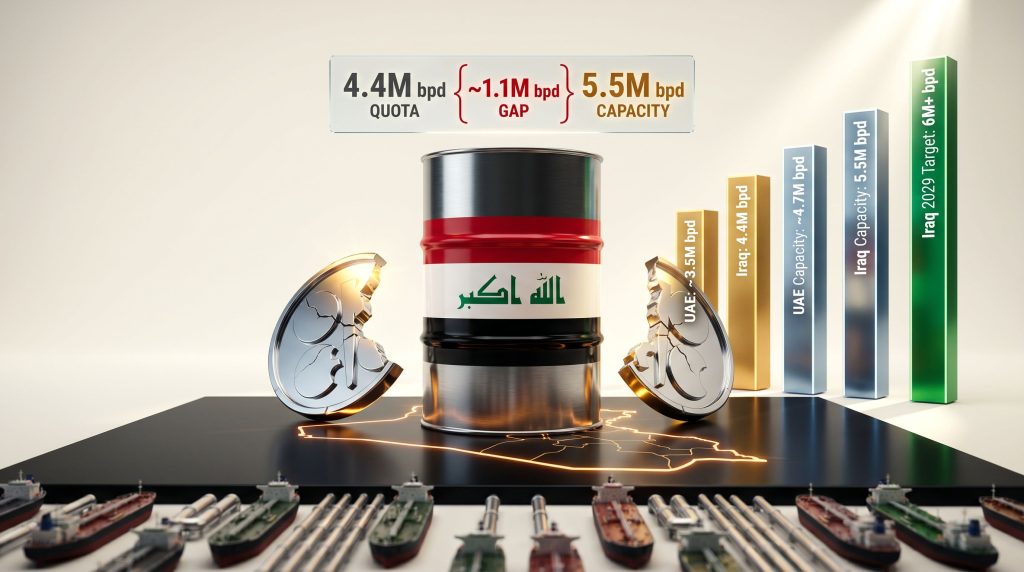
Iraq's current OPEC-assigned quota sits at 4.4 million barrels per day (bpd). Against that figure, the country's verified production capacity stands at approximately 5.5 million bpd, creating a structural gap of roughly 1.1 million bpd between what Iraq can physically extract and what it is permitted to export under the group's collective framework. Actual crude exports average around 3.6 million bpd, reflecting both quota compliance and ongoing logistical constraints in the country's export infrastructure.
Looking further ahead, Baghdad has established an ambitious production capacity target of exceeding 6 million bpd by 2029, a goal that makes the current quota framework not only restrictive in the present but structurally incompatible with Iraq's medium-term energy strategy.
This is not a minor calibration issue. A 1.1 million bpd gap between permitted and possible output translates directly into forgone government revenue at a scale that few economies could absorb without consequence. For Iraq, where oil exports are the dominant source of fiscal income, it represents a compulsory budget shortfall embedded into the OPEC governance model itself.
| Metric | Volume (bpd) |
|---|---|
| Current OPEC Quota | 4,400,000 |
| Compensation Reduction (until June 2026) | -100,000 |
| Effective Permitted Output (compensation period) | ~4,300,000 |
| Verified Production Capacity | 5,500,000 |
| Capacity-to-Quota Gap | ~1,100,000 |
| Average Crude Exports | 3,600,000 |
| Target Production Capacity by 2029 | 6,000,000+ |
Fiscal Crisis as Accelerant: The Iran Conflict's Economic Consequences
How Baghdad's Revenue Floor Has Collapsed
The quota dispute did not emerge in isolation. It is being driven to a breaking point by a compounding fiscal emergency that has materially reduced the Iraqi government's capacity to absorb prolonged revenue suppression.
Senior Iraqi oil ministry officials have characterised the country's current financial situation as a critical crisis, directly linked to the economic disruption caused by the Iran conflict. Iraq's government budget is structurally dependent on crude export revenues in a way that few other OPEC members are. Unlike Gulf Cooperation Council (GCC) members such as Saudi Arabia or the UAE, which maintain large sovereign wealth fund buffers providing fiscal cushion during periods of constrained output, Iraq operates with significantly less financial redundancy.
The consequence is that quota-imposed production limits are not felt primarily as a strategic inconvenience. They are felt as an immediate shortfall in the government's ability to fund public services, reconstruction obligations, and social spending commitments, all of which carry their own political fragility in the Iraqi domestic context.
The Compensation Mechanism Deepening the Crisis
A further layer of fiscal pressure derives from the OPEC+ compensation mechanism, a standard governance tool used to penalise members that have previously exceeded their assigned quotas. Iraq, alongside Kazakhstan and Russia, was found to have overproduced relative to its allocation in prior periods. As a consequence, Baghdad has been bound by a compensation schedule requiring it to produce approximately 100,000 bpd below its already-constrained quota until June 2026, effectively reducing its permitted output during this period to closer to 4.3 million bpd.
While the mechanism is technically equitable within OPEC's own governance framework, its application at a moment of acute fiscal crisis for Iraq has acted as an accelerant. The combination of a constrained base quota, a further compensation deduction, suppressed global oil prices, and the economic fallout from regional conflict has created a compounding revenue shortfall that has sharpened Baghdad's urgency around quota renegotiation to a considerable degree. Furthermore, crude oil price geopolitics continue to complicate the broader pricing environment in which Iraq must operate.
The compensation mechanism, while a legitimate OPEC governance tool, is being applied to a member facing an acute fiscal crisis. That combination of simultaneous pressures is what has transformed a routine quota dispute into a potential existential question for Iraq's OPEC membership.
Three Scenarios: What an Iraq OPEC Exit Actually Looks Like
Scenario 1: Negotiated Quota Expansion Within OPEC (Base Case)
Iraq's clearly stated preference is to remain within OPEC+ while securing a materially higher quota aligned with its 5.5 million bpd production capacity. A successful renegotiation would most likely involve phased quota increases tied to verified production milestones, a model that mirrors approaches used in previous OPEC capacity review processes.
For this outcome to materialise, OPEC's dominant members, particularly Saudi Arabia, would need to accommodate Iraq's expanded allocation without triggering a broader unravelling of the quota framework among other capacity-constrained members. The risk of a precedent-setting cascade is real: if capacity-based quota demands are validated for Iraq, similar arguments from other members with spare capacity become structurally harder to resist.
Scenario 2: Exit Threat as Strategic Leverage (Most Likely Near-Term)
Multiple informed sources indicate that Iraqi officials have already conducted internal analysis of what an exit from OPEC would look like, even as the official position remains one of engagement and negotiation. This gap between internal modelling and external positioning is a classic feature of institutional bargaining, and it serves a clear strategic function.
The credible threat of exit allows Baghdad to apply maximum diplomatic pressure without incurring the immediate costs of departure. It signals to OPEC leadership that Iraq's tolerance for quota constraints has a defined ceiling, while preserving the option of a negotiated resolution. This dynamic closely mirrors the trajectory the UAE followed in the period preceding its formal departure, where exit discussions were modelled and signalled well before official action was taken. OPEC production meetings in the coming months will be critical in determining whether this leverage translates into meaningful reform.
Scenario 3: Full OPEC Exit Following Quota Rejection (Tail Risk)
If OPEC declines to meaningfully raise the Iraq OPEC quota, Baghdad has made clear it will evaluate all available options. An Iraqi departure would represent a compounding institutional blow to the organisation, following the UAE's exit in May 2026. The volume consequences would be significant: a ramp-up toward Iraq's 5.5 million bpd capacity would add approximately 900,000 to 1.1 million bpd above current export levels to global supply, with no OPEC production discipline constraining the increase.
What makes this scenario particularly consequential is not purely the volume. Iraq is one of five founding members of OPEC, and the organisation was formally constituted in Baghdad in September 1960. An Iraqi exit would carry institutional and symbolic weight far exceeding any proportional volume calculation.
The UAE Precedent: A Blueprint Baghdad Is Watching Closely
Why the First Departure Matters So Much
The UAE's formal exit from OPEC in May 2026 established something that had not previously existed in the organisation's history: a proof of concept for departure by a major, capacity-rich producer. Prior to that event, the practical and diplomatic costs of OPEC exit had functioned as a meaningful deterrent. The UAE's departure demonstrated that those costs, while real, are manageable for producers with strong independent fiscal positions.
The UAE left citing an irreconcilable gap between its assigned quota of approximately 3.5 million bpd and its actual production capacity of 4.7 to 4.8 million bpd. The structural logic of Iraq's position is directly analogous, and the proportional magnitude of the capacity-to-quota gap is similar. According to Iraq's crude oil production data, the divergence between assigned quotas and actual capacity has been a persistent and widening feature of Iraq's production profile.
| Factor | UAE | Iraq |
|---|---|---|
| Quota at Exit | ~3.5 million bpd | 4.4 million bpd (current) |
| Production Capacity | ~4.7-4.8 million bpd | ~5.5 million bpd |
| Capacity-Quota Gap | ~1.2-1.3 million bpd | ~1.1 million bpd |
| Fiscal Pressure | Moderate | Severe |
| Founding Member Status | No | Yes |
| Official Exit Stance | Confirmed departure | Denied but internally modelled |
A critical and underappreciated dimension of the UAE's departure is that global oil markets did not immediately destabilise in its wake. That relative market resilience has likely reduced Baghdad's perception of exit risk. If the first major departure was absorbed without crisis, the psychological and diplomatic barrier to a second departure is materially lower.
What Is Structurally Different About Iraq
Despite the clear parallels, Iraq's situation carries distinct features that amplify both the stakes and the complexity. The UAE, whatever its OPEC tenure, was not a founding member. It did not host the organisation's founding conference. Its departure, while significant, did not carry the institutional symbolism of a founding signatory's withdrawal.
Iraq's role as both a founding member and the nation in whose capital the organisation was established in 1960 alongside Saudi Arabia, Iran, Kuwait, and Venezuela means that any Iraqi exit would reverberate through the organisation's identity as an institution, not merely its production arithmetic.
Global Oil Market Consequences: Supply, Price, and Cartel Cohesion
Immediate Price and Supply Implications
A full Iraqi exit from OPEC, followed by a production ramp toward its 5.5 million bpd capacity ceiling, would inject approximately 900,000 to 1.1 million bpd of additional supply into global markets above current export levels. The directional effect on Brent crude prices would almost certainly be negative, with the magnitude depending on concurrent demand conditions, the pace of Iraqi production scaling, and whether other OPEC+ members respond by adjusting their own output.
The most direct beneficiaries of increased unencumbered Iraqi supply would likely be Asian refiners, particularly in China and India, which are already Iraq's largest crude export customers. Both countries have demonstrated a persistent preference for discounted crude, and unrestricted Iraqi volumes would strengthen their negotiating leverage over pricing. However, oil price stagnation driven by tariff pressures and weak demand already clouds the outlook, making the price consequences of an Iraqi exit even harder to predict.
For OPEC+ members continuing to honour quota discipline, an Iraqi exit creates a classic free-rider problem: Baghdad would capture market share gains by producing at capacity while constrained members continue to absorb the price-supporting cost of output restriction.
Long-Term Consequences for OPEC+ Architecture
Two major capacity-rich exits within a single calendar year would fundamentally test OPEC+'s ability to credibly enforce production discipline. The organisation's governance model depends on the belief that quotas are binding commitments with real consequences for non-compliance. If founding members can and do exit when quotas become inconvenient, that belief is materially weakened.
Other members with significant spare capacity, including Kuwait, would face intensified internal debate about the cost-benefit calculation of continued membership. Meanwhile, the Russia-led non-OPEC component of OPEC+ faces its own compliance pressures, creating simultaneous governance stress from multiple directions. The trade war impact on oil markets adds yet another layer of instability to an already fragile production management environment.
If two major producers exit OPEC within twelve months, the organisation enters a different institutional reality. It transitions from a question of how to manage quota compliance to a more fundamental question of what value membership provides to capacity-rich producers.
The next major ASX story will hit our subscribers first
Geopolitical Dimensions: Oil, Sovereignty, and Regional Power
Iraq's Unique Structural Vulnerability
Iraq's negotiating position differs from most OPEC members in one critical respect: it has no meaningful fiscal alternative to oil revenue. The country's extreme revenue concentration in crude exports, combined with substantial domestic spending obligations and limited sovereign wealth fund buffers, means that quota constraints are not absorbed strategically. They are absorbed painfully, with direct consequences for government solvency.
This structural vulnerability simultaneously weakens and strengthens Baghdad's hand. It weakens it because Iraq has less capacity to strategically absorb short-term revenue loss as a negotiating tactic. It strengthens it because the existential nature of the fiscal pressure makes Iraq's exit threat fundamentally credible. A country that genuinely cannot afford to stay constrained is a more credible exit threat than one for which departure is merely preferable.
Saudi Arabia's Pivotal Role
Any resolution of the Iraq OPEC quota dispute will ultimately require accommodation from Saudi Arabia, which has historically anchored the organisation's production management strategy. OPEC's market influence over global prices depends heavily on Riyadh's willingness to make concessions that preserve collective cohesion, even at some cost to the integrity of the quota framework itself.
Riyadh faces a difficult calculation: accommodating Iraq's capacity-based quota demands risks normalising a framework that other members could invoke, while refusing accommodation risks losing a founding member and accelerating the organisation's fragmentation. The diplomatic friction that any Iraqi exit would generate between Baghdad and Riyadh carries implications beyond oil markets. Saudi Arabia and Iraq share a complex bilateral relationship spanning economic, security, and regional political dimensions.
Key Indicators to Watch as the Standoff Develops
For market observers and analysts tracking the Iraq OPEC quota situation, several concrete indicators will signal whether the standoff is moving toward resolution or escalation:
- OPEC+ production review meeting agendas: Any formal inclusion of Iraq's quota request as a substantive agenda item signals negotiating progress; its absence signals stalling.
- Iraqi post-compensation output behaviour: Once the June 2026 compensation obligation concludes, whether Iraq returns to its 4.4 million bpd quota or tests higher production levels will be the most direct behavioural signal of intent.
- Language shifts in Iraqi Oil Ministry communications: A transition from language focused on seeking higher quotas to language evaluating membership options would represent a meaningful public escalation.
- Saudi Arabia's diplomatic posture: Riyadh's willingness to formally engage with capacity-based quota reform will largely determine whether a negotiated outcome is achievable within the current governance structure.
- Global oil price trajectory: Sustained low prices increase Baghdad's urgency and reduce the opportunity cost of exit. A meaningful price recovery could temporarily relieve fiscal pressure and reduce the immediacy of exit calculations.
The Iraq-OPEC standoff is most accurately understood not as a bilateral quota dispute, but as a systemic stress test of whether OPEC's governance model can accommodate producing nations whose capacity growth has structurally outpaced the allocation framework designed in a different era of global oil production.
Frequently Asked Questions: Iraq, OPEC, and the Quota Crisis
What is Iraq's current OPEC production quota?
Iraq's formally assigned OPEC quota is 4.4 million barrels per day. During its active compensation period for prior overproduction, this was further reduced by 100,000 bpd, bringing effective permitted output to approximately 4.3 million bpd.
Has Iraq officially decided to leave OPEC?
No. Iraqi officials have explicitly denied any current plan to exit the organisation. However, multiple sources confirm that withdrawal has been internally evaluated as a contingency should quota negotiations fail to deliver a meaningful increase.
Why does Iraq want a substantially higher quota?
Iraq's verified production capacity of approximately 5.5 million bpd significantly exceeds its current quota, and the country is targeting capacity above 6 million bpd by 2029. Severe fiscal pressures linked to the Iran conflict have made higher permitted export volumes a matter of budget necessity rather than strategic preference.
What happened when the UAE exited OPEC?
The UAE formally departed OPEC in May 2026, citing a structural mismatch between its assigned quota of approximately 3.5 million bpd and its production capacity of 4.7 to 4.8 million bpd. The exit did not immediately destabilise global markets, a fact that has reduced Baghdad's perceived risk of following a similar path. Furthermore, analysts tracking Iraq's OPEC production framework have noted that the UAE precedent has materially lowered the institutional barrier for a second major departure.
What would an Iraqi OPEC exit mean for global oil prices?
An exit followed by a ramp-up toward Iraq's 5.5 million bpd capacity would likely add approximately 900,000 to 1.1 million bpd to global supply above current export levels. The probable directional consequence would be downward pressure on Brent crude prices, with magnitude depending on demand conditions and the response of remaining OPEC+ members. According to reporting on Iraq's quota negotiations, the country's leverage in these discussions is being taken seriously at the highest levels of the organisation.
Is Iraq a founding member of OPEC?
Yes. Iraq is one of five founding members, and OPEC was formally constituted in Baghdad in September 1960. This historical role amplifies the institutional weight of any Iraqi exit scenario significantly beyond its volume implications alone.
This article is intended for informational purposes only and does not constitute financial or investment advice. Forecasts, scenario projections, and market impact assessments involve inherent uncertainty and should not be relied upon as predictions of specific outcomes. Readers are encouraged to conduct independent research and consult qualified advisers before making investment decisions.
Want to Track the Resource Discoveries Reshaping Global Commodity Markets?
While geopolitical forces like the Iraq–OPEC quota dispute reshape oil supply dynamics, significant mineral discoveries on the ASX are creating their own high-impact investment opportunities — and Discovery Alert's proprietary Discovery IQ model delivers real-time alerts the moment they are announced, turning complex data across 30+ commodities into clear, actionable insights. Explore historic discoveries and their market returns on Discovery Alert's dedicated discoveries page, and begin a 14-day free trial to position yourself ahead of the broader market.