June 25, 2026
The Structural Fault Line in Global Oil Markets That No One Is Talking About
For years, the architecture of global crude oil trade has rested on a deceptively fragile assumption: that the commercial relationships severed by sanctions could be rebuilt quickly once the political conditions changed. The reality, as China's state refining giants are now discovering, is considerably more complicated. Diplomatic windows open and close in days. Institutional machinery moves in months.
The gap between those two timescales is where the most consequential decisions in the oil market are being made right now. China state refiners resuming Iran oil imports is not simply a matter of political willingness. It sits at the intersection of sanctions law, banking infrastructure, insurance markets, shipping logistics, and a Chinese domestic economy consuming fuel at a structurally lower trajectory than at any point in the past decade.
When big ASX news breaks, our subscribers know first
A Diplomatic Opening With a Hard Expiry Date
The sequence of events that triggered the current window was both rapid and consequential. A memorandum of understanding ending the U.S.-Israeli conflict with Iran was concluded in the week prior to June 25, 2026. The United States subsequently issued a sanctions waiver permitting global buyers to purchase Iranian crude oil and petrochemical products, with settlements authorised in U.S. dollars. That waiver window runs through August 21, 2026, creating a roughly 30-day commercial opening with significant implications for energy markets.
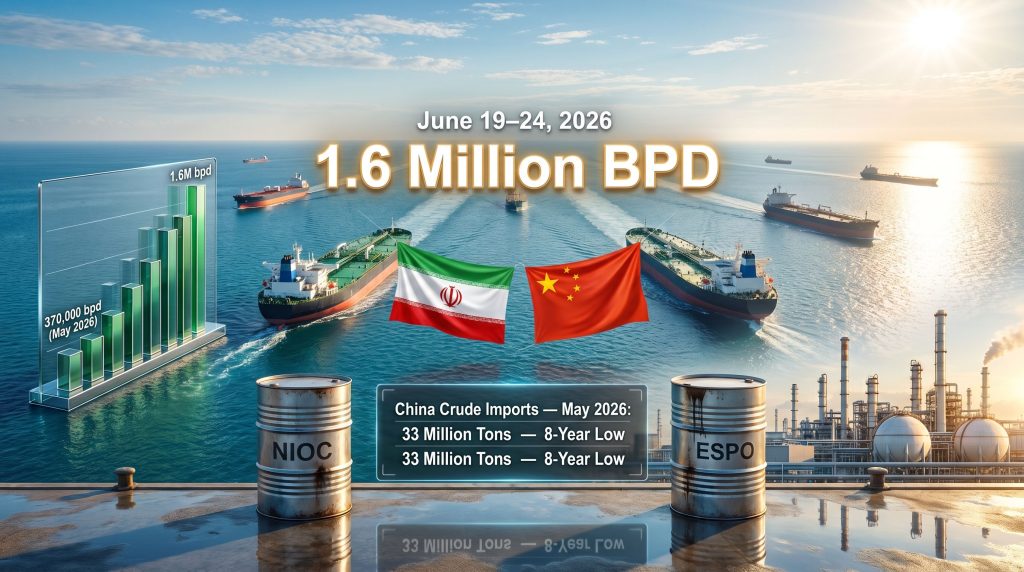
The immediate market response from the Iranian side was striking. According to tanker tracking firm Vortexa, Iranian oil loadings accelerated to approximately 1.6 million barrels per day (bpd) between June 19 and June 24, 2026. That figure represents a near-fivefold increase from the 340,000 bpd recorded during the first 18 days of June and the 370,000 bpd seen across the entirety of May 2026.
Tehran moved with considerable speed to capitalise on the diplomatic opening, signalling that export infrastructure was ready to be reactivated far faster than the commercial and institutional frameworks required to absorb those volumes.
Furthermore, the reopening of the Strait of Hormuz under the interim peace agreement is expected to normalise Middle East cargo flows, benefiting Gulf producers and Iranian exporters alike. However, the speed of export resumption on the Iranian side contrasts sharply with the deliberate pace at which Chinese state enterprises are approaching the re-engagement question. Broader shifts in Venezuela sanctions policy offer a useful parallel for how quickly diplomatic conditions can reverse.
China's Import Collapse: Eight Years of Context Compressed Into One Month
To understand why the current moment matters, it is necessary to appreciate how severe the supply disruption became for Chinese refiners during the conflict period. China's total crude oil imports fell to 33 million tons in May 2026, the lowest monthly figure recorded in eight years. The primary driver was the effective closure of the Strait of Hormuz and the broader disruption to Middle Eastern supply chains triggered by the conflict.
The scale of that disruption was amplified by China's pre-existing dependence on Iranian supply. In 2025, China was importing an average of 1.38 million bpd from Iran, a volume that represented more than 80% of Iran's total crude exports. When that supply was severed, the structural importance of the Iran-China crude corridor became impossible to ignore.
Chinese refiners responded through two primary mechanisms:
- Drawing down strategic petroleum reserves (SPR), which had been built up to approximately 1.4 billion barrels prior to the disruption
- Pivoting to alternative supply origins including West Africa, Brazil, and Russia to maintain refinery throughput
The combined effect has left Asian refiners, including Chinese operators, well-stocked relative to the severity of the disruption. This inventory buffer is a critical variable in assessing state refiner urgency, because it directly reduces the commercial pressure to resume Iranian purchases immediately. In addition, crude oil price trends heading into mid-2026 reflect the compounding uncertainty created by both the supply shock and the diplomatic reopening.
| Supply Metric | Pre-War 2025 Average | Conflict Peak May 2026 |
|---|---|---|
| China total crude imports | Elevated baseline | 33 million tons (8-year low) |
| Iran exports to China | ~1.38 million bpd | Severely disrupted |
| Iran's share of own exports to China | Over 80% | Minimal |
| Iranian loading volumes | Stable | 370,000 bpd (May) rising to 1.6M bpd (June 19–24) |
The Bifurcated Refining Sector: Why Teapots and State Majors Play by Different Rules
One of the least understood dynamics in China's oil import ecosystem is the structural divide between its two classes of refinery operator. Independent Chinese refiners, widely known as teapots, have remained the dominant buyers of Iranian crude throughout the entire sanctions era. They operate through networks of intermediary traders, settle the vast majority of their purchases in Chinese yuan, and are structurally insulated from the international banking and legal exposure that constrains their state-owned counterparts.
According to reporting from Al Jazeera, the U.S. has previously sanctioned teapot refineries for purchasing Iranian oil, highlighting the persistent regulatory risk even for smaller independent operators. State-owned majors Sinopec and PetroChina inhabit an entirely different institutional environment. Both companies halted Iranian crude purchasing in 2019, when the Trump administration's first-term reimposition of sanctions on Iranian petroleum exports created legal, financial, and reputational risks incompatible with the global operational footprints of internationally active state enterprises.
The decision calculus for resumption is therefore fundamentally asymmetric:
- Teapots face relatively low incremental risk in resuming or expanding Iranian purchases under the waiver framework
- State majors must resolve banking clearing arrangements, insurance coverage, and shipping logistics before any transaction can proceed
- The institutional preparation required for state majors cannot be compressed into a 30-day window without precedent
This asymmetry explains why teapots will almost certainly absorb the initial surge in available Iranian supply, while the more commercially significant question of state major re-engagement remains genuinely unresolved. Consequently, understanding the broader US-China trade impacts is essential context for interpreting Chinese refiner behaviour in this environment.
Sinopec's Position: Historical Weight and Current Inventory Pressure
Is Sinopec the Most Likely First Mover Among State Majors?
Among the state majors, Sinopec occupies a distinctive position in any assessment of likely first movers. The company was historically Iran's single-largest crude customer before its 2019 exit, and that commercial history creates both institutional familiarity and residual infrastructure that could accelerate re-engagement relative to other buyers.
Critically, Sinopec has been drawing down commercial stockpiles since May 2026 to sustain refinery throughput, a sign of tighter supply positioning compared to other operators. This inventory depletion creates a more concrete commercial incentive than peers who managed the supply shock with less drawdown.
The company's prior engagement with this exact scenario is also instructive. During a previous 30-day sanctions waiver in March 2026, Sinopec made preliminary enquiries with the National Iranian Oil Company (NIOC) before ultimately declining to proceed. The reason cited by an industry official close to NIOC was that the timeline was too compressed to complete a transaction within the waiver window.
The current diplomatic framework, while similarly time-limited, arrives with the institutional benefit of that earlier scoping exercise already completed. PetroChina is conducting parallel internal assessments but is widely characterised as adopting a more cautious posture. Neither company had publicly confirmed any intention to resume purchases as of June 25, 2026.
The Three Bottlenecks That Will Determine the Outcome
For state-owned Chinese refiners, the decision to resume Iranian oil imports is not a simple commercial calculation. It is a multi-dimensional institutional risk assessment that must resolve three distinct operational constraints simultaneously.
Banking and Financial Clearing
Dollar-denominated settlement is now technically permissible under the waiver, which removes one significant historical barrier. However, institutional risk appetite among major international banks remains cautious. The question of which financial institutions are willing to provide clearing and financing for Iran-linked transactions remains genuinely open. Teapots sidestep this problem through yuan settlement and opaque intermediary structures, options that are structurally less accessible to internationally exposed state majors with correspondent banking relationships in Western financial centres.
Insurance Coverage
International marine insurance markets have historically been reluctant to extend coverage to Iranian crude shipments during sanctions periods. A 30-day waiver window creates a challenging environment for underwriters to recalibrate risk models, complete actuarial assessments, and issue coverage on a commercially viable timeline. Without adequate insurance, state refiners face cargo liability exposure that is institutionally unacceptable regardless of the underlying commercial economics.
Shipping and Iranian Tanker Capacity
The shadow tanker fleet that has historically serviced Iranian exports operated under very different conditions from those required by state major procurement standards. Questions remain about whether Iran currently possesses the verified, insurably compliant tanker fleet capacity to deliver large-volume cargoes to Chinese ports on a timeline consistent with the waiver window.
The next major ASX story will hit our subscribers first
NIOC's Pricing Framework and the ESPO Reference Benchmark
NIOC will serve as the sole contractual counterparty for all oil transactions conducted under the sanctions waiver. The company operates dedicated marketing teams in both Beijing and Shanghai and was actively anticipating renewed interest from state refiners in the days following the ceasefire announcement, according to an industry official close to the Iranian company.
For pricing, NIOC has indicated that Russia's ESPO (East Siberia-Pacific Ocean) blend will be used as the reference benchmark for new deal negotiations. The selection of ESPO as a reference point is commercially logical: it is a well-established benchmark in Asian crude markets, widely understood by Chinese refinery planners, and reflects the competitive pricing environment in which Iranian crude must operate.
Historically, Iranian crude has traded at a discount to mainstream benchmarks, compensating buyers for sanctions risk and logistical complexity. Under the current waiver framework, that discount dynamic may narrow if the geopolitical risk premium is partially removed. The resulting oil price movements will be closely watched by market participants navigating the transition from conflict-era pricing to a potentially normalised supply environment.
Demand-Side Structural Weakness: The Constraint That Outlasts Any Diplomatic Window
Perhaps the most underappreciated constraint on state refiner re-engagement is not sanctions mechanics but the trajectory of Chinese domestic fuel demand. Multiple industry sources have identified tepid domestic consumption as a significant factor tempering enthusiasm for additional crude volumes across both state and independent operators.
The pattern is structurally concerning for oil market bulls: declines in Chinese consumption of gasoline, diesel, and petrochemical feedstocks have been outpacing recent reductions in crude import volumes and refinery throughput. This divergence suggests that the supply disruption has temporarily masked a more durable demand-side transition.
Several structural forces are compounding this pressure:
- Accelerating electric vehicle penetration reducing gasoline demand at a faster pace than most 2023-era forecasts anticipated
- Industrial efficiency gains reducing energy intensity across manufacturing sectors
- Demographic shifts moderating transportation fuel growth in tier-1 and tier-2 cities
- A competitive domestic petrochemical sector facing overcapacity conditions
Some analysts have raised the possibility that China's crude import volumes may not fully recover to pre-conflict levels, not because of supply constraints, but because the conflict period functioned as an accelerant for an underlying structural transition already in progress. This is a speculative but increasingly credible scenario. Furthermore, the broader dynamics of the trade war oil markets relationship suggest that demand headwinds from geopolitical friction may prove more persistent than diplomatic resolutions alone can offset.
Three Scenarios for State Refiner Re-Engagement
Scenario 1: Early Resumption at Low Volume
Sinopec resolves banking and insurance arrangements within the current waiver window and completes a modest initial purchase, functioning as a proof-of-concept transaction. Teapots continue to dominate volume, but state majors establish a commercial foothold for potential future scaling. This scenario is possible but requires institutional preparation to move faster than the March 2026 precedent suggests is likely.
Scenario 2: Delayed Resumption Following Waiver Extension
The 30-day waiver window proves insufficient for the institutional preparation required by state majors. A waiver extension or renewed diplomatic agreement creates a longer runway for due diligence completion. State refiners begin purchasing in Q3 or Q4 2026. This scenario is assessed as the most probable, given the March 2026 precedent and the known timelines for banking and insurance arrangement.
Scenario 3: No State Major Resumption in the Current Cycle
Banking and insurance barriers prove insurmountable within the current diplomatic framework. Demand-side weakness removes the commercial incentive at the margin. Teapots absorb available Iranian supply; state majors continue sourcing from Gulf producers and diversified alternatives. Iran's export recovery is real but remains concentrated among non-state buyers.
What the Global Market Is Watching
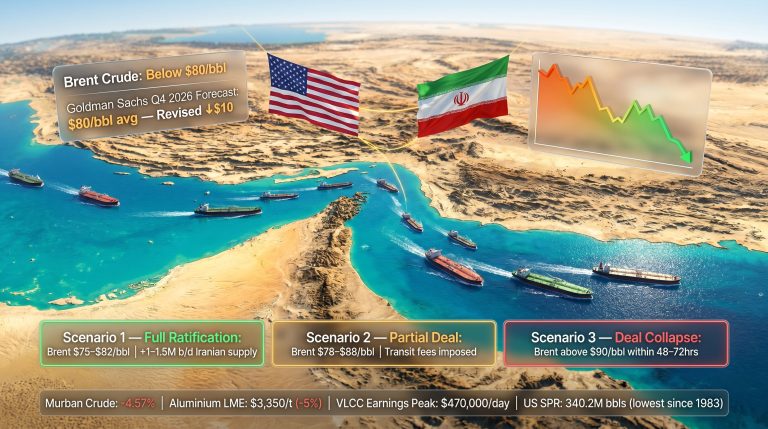
The reopening of the Strait of Hormuz is the single most consequential near-term development for global oil supply flows. Gulf producers including Saudi Arabia, Kuwait, and Iraq are well positioned to recapture market share as shipping routes normalise, and their combined export ramp will add meaningful supply to a market that is already well-stocked.
Iranian crude re-entry at scale would compound that supply addition, placing further downward pressure on benchmark prices. The conflict-era risk premium embedded in oil prices is expected to partially unwind as the peace framework holds, however the 30-day waiver structure introduces its own uncertainty horizon that markets will monitor closely.
Reports from the Economic Times confirm that Chinese state refiners are actively considering resuming Iran oil imports, reinforcing that China state refiners resuming Iran oil imports represents one of the most commercially significant questions currently facing global energy markets. A confirmed Sinopec purchase would be read by markets as a vote of confidence in the sustainability of the ceasefire framework. Continued abstention would suggest institutional uncertainty about whether the window will hold long enough to justify the compliance infrastructure required.
NIOC's long-term strategic interest is clear: re-establishing direct commercial relationships with Chinese state majors, rather than relying exclusively on teapots and intermediary networks, would represent a meaningful upgrade in export infrastructure. Whether the current diplomatic moment is durable enough to support that institutional rebuild remains the defining question for Iran's crude export strategy in the second half of 2026.
This article is intended for informational purposes only and does not constitute financial or investment advice. Forecasts, scenario analyses, and market projections involve inherent uncertainty and should not be relied upon as predictions of future outcomes. Readers seeking additional context on China-Iran energy trade dynamics can explore related reporting from Arab News at arabnews.com.
Want to Stay Ahead of the Next Major Commodity Market Shift?
Discovery Alert's proprietary Discovery IQ model delivers real-time alerts on significant ASX mineral discoveries, instantly translating complex market data into actionable investment opportunities — explore historic examples of exceptional discovery returns to understand the scale of what's possible, and begin your 14-day free trial today to position yourself ahead of the broader market.