June 25, 2026
Sulphur as a Geopolitical Commodity: Why Turkey's Refinery Tenders Now Move Global Markets
Commodities that emerge as unavoidable industrial by-products rarely attract the kind of market attention reserved for crude oil or copper. Sulphur is one of those commodities. Produced in vast quantities as a direct consequence of desulphurising crude oil during the refining process, it has no substitute in several of its primary downstream applications, yet its pricing dynamics are poorly understood outside specialist circles. When geopolitical disruption intersects with domestic policy intervention in a concentrated refinery market, Tupras sulphur award prices can swing in ways that cascade far beyond the original point of production. Turkey's domestic sulphur tender market has become one of the most instructive case studies in how these forces compound.
When big ASX news breaks, our subscribers know first
Understanding Turkey's Position in the Eastern Mediterranean Sulphur Supply Chain
Tupras is Turkey's dominant refining group, operating four major facilities at Izmir, Kirikkale, Izmit, and Batman. Because Turkey processes meaningful volumes of high-sulphur crude, its refineries generate substantial quantities of recovered sulphur as a mandatory operational output rather than a deliberate production decision. Managing the disposal of this sulphur is therefore a continuous requirement for refinery margin optimisation: selling it efficiently at competitive domestic prices reduces the effective cost of crude processing.
What distinguishes Turkey's domestic market from export-oriented sulphur markets is its structural insularity under normal conditions. Domestic buyers operate under Free Carrier (FCA) delivery terms, meaning they take ownership of the product at the refinery gate and bear all onward logistics costs themselves. This stands in contrast to the Cost and Freight (CFR) benchmarks that dominate international trade, where the seller prices in freight to a named destination port.
The result is that Turkish domestic FCA award prices and Mediterranean CFR import prices are not directly comparable without adjusting for freight, insurance, port handling, and risk allocation differences. Furthermore, the broader context of trade wars and supply chains has added additional layers of complexity to how Turkey's refinery output is positioned within global commodity flows.
The E-Tender Mechanism: Price Discovery in a Captive Market
Tupras conducts domestic sulphur sales through an e-tender process that has its own distinct price discovery logic. Understanding how the mechanism works is essential for interpreting what any given award price actually signals about underlying demand.
The process follows a structured sequence:
- Tupras establishes an initial floor price per tonne FCA at each participating refinery, set above what management considers an acceptable minimum.
- If competitive bidding does not materialise at that level, the floor is reduced in stages, with each reduction representing a concession to observed buyer appetite.
- Bidding commences once the floor reaches a level where buyers are willing to compete, and final award prices reflect the outcome of that competitive tension.
- Individual lots within a tender can vary considerably in size, from as small as 100 tonnes to as large as 1,400 tonnes, accommodating buyers with different logistics capacity and risk appetite.
The floor price reduction pattern is far more than an administrative detail. It functions as a real-time demand-side barometer. A floor that requires only one or two reductions before buyers engage signals healthy underlying demand. A floor that must be cut repeatedly and steeply before any bidding starts indicates that buyers are reluctant, oversupplied, or expect further price deterioration.
Tupras Sulphur Award Prices: Mapping the 2026 Price Cycle
The trajectory of Tupras sulphur award prices across recent tender cycles represents one of the most compressed and extreme commodity pricing episodes in the Eastern Mediterranean fertilizer supply chain in recent memory.
| Tender Cycle | Initial Floor Price (FCA) | Final Floor Before Bidding | Award Price Range (FCA) |
|---|---|---|---|
| March 2026 | Not disclosed | Not disclosed | $662–$672/t |
| May 2026 (April-awarded) | $800/t | $400/t | $428–$496/t |
| June 2026 (May-awarded) | Not disclosed | Not disclosed | $690–$730/t |
| July 2026 (June-awarded) | $925/t | $625/t | $650–$804/t |
The April 2026 Price Collapse: Anatomy of a Structural Dislocation
The most dramatic event in this cycle was the collapse of Tupras sulphur award prices to $428–$496/t FCA in the April-awarded tender covering May loadings. This represented a decline of approximately $205/t from the preceding March cycle range of $662–$672/t FCA. A drop of that magnitude within a single tender cycle is extraordinary for a commodity whose production volumes are largely fixed by refinery throughput.
The primary mechanism was Turkey's implementation of a sulphur export ban, which effectively transformed the domestic market into a closed system. With no export outlet available, domestic sellers had no external price floor to anchor their expectations against. Buyers recognised this immediately: captive supply with no alternative destination creates a fundamentally different negotiating dynamic than a market where sellers can redirect volumes internationally if domestic prices disappoint.
The consequence was a pricing inversion that briefly saw Turkish domestic FCA prices fall below Mediterranean CFR equivalent levels when adjusted for freight costs. The Izmit refinery tender cancellation during this period reinforced the message. Even at significantly reduced floors, price discovery failed entirely for certain larger-volume lots, indicating that buyer appetite had collapsed faster than Tupras's willingness to reduce its reserve prices.
According to Argus Media's reporting on the April award, this outcome was one of the starkest pricing dislocations observed in the Eastern Mediterranean sulphur market in recent years.
"The distinction between FCA and CFR pricing is frequently underappreciated in sulphur market analysis. Turkish domestic buyers absorbing all post-gate logistics costs would normally expect to pay below the equivalent CFR landed cost at a Turkish import port. When the export ban eliminated external pricing signals, domestic award prices briefly diverged so severely that the standard premium-discount relationship broke down entirely."
The June Recovery and July Consolidation
The May-awarded tender covering June loadings recovered sharply to $690–$730/t FCA, a rebound of approximately $248/t from the April trough. This recovery reflected partial restoration of competitive tension among buyers as expectations around export channel access began to shift. It also demonstrated how quickly sulphur prices can reprice when the supply captivity effect is perceived to be diminishing.
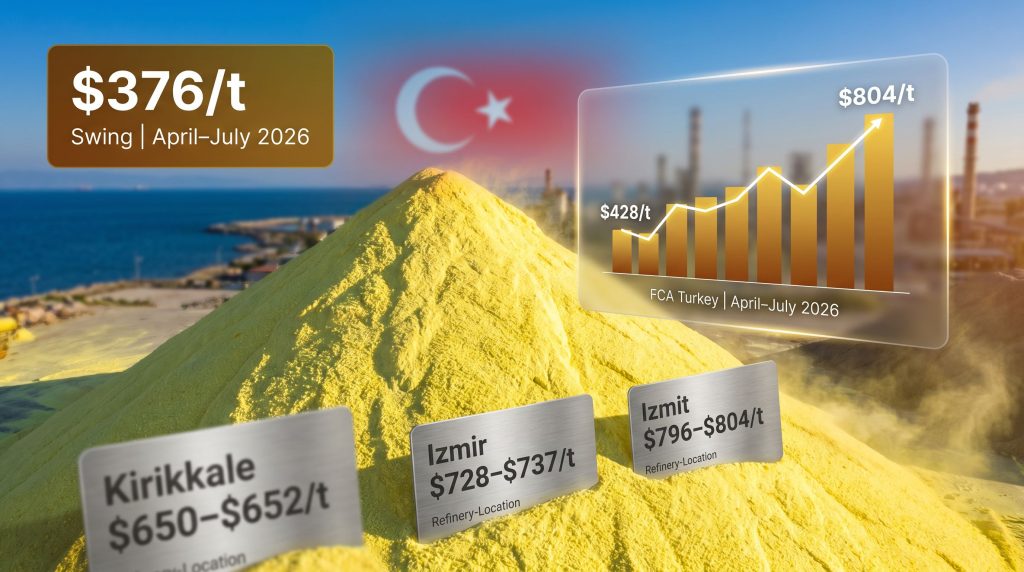
The most recent July-loading tender, awarded across three Tupras refineries on 23 and 24 June 2026, produced a more measured outcome. Overall award prices settled in the $650–$804/t FCA range, representing an average increase of approximately $17/t relative to the preceding tender. The refinery-level breakdown reveals significant intra-tender dispersion:
| Refinery | Total Volume Awarded | Lot Size Range | Award Price Range (FCA) |
|---|---|---|---|
| Izmir | 4,400t | 150–800t | $728–$737/t |
| Kirikkale | 2,850t | 250–750t | $650–$652/t |
| Izmit | Not disclosed | 100–1,400t | $796–$804/t |
The $154/t spread between Kirikkale and Izmit within a single tender cycle deserves particular attention. Kirikkale is situated inland in central Anatolia, imposing substantially higher trucking costs on buyers relative to the Marmara-region Izmit facility, which benefits from proximity to Istanbul and major industrial demand centres. Izmir, a coastal port city, sits between the two in terms of logistical accessibility.
For all three refineries, Tupras set an identical initial floor of $925/t FCA, reducing it to $625/t FCA before competitive bidding commenced. The Kirikkale lots required an additional intermediate reduction to $778/t FCA before reaching that final floor, indicating shallower buyer interest at that location even before the competitive phase began.
"The unanimous floor of $925/t FCA across all three refineries in the July cycle signals that Tupras's management holds price expectations well above current clearing levels. The gap between the $925/t opening floor and the $625/t final floor before bidding starts reflects a structural disconnect between seller aspiration and buyer reality that the market has not yet resolved."
The Hormuz Disruption: The Upstream Driver Behind Everything
No analysis of current Tupras sulphur award prices is complete without examining the Strait of Hormuz supply disruption that has been reshaping global sulphur trade since late February 2026. Consequently, the intersection of geopolitical commodity risks with refinery-level tender dynamics has rarely been more directly observable than in the Turkish domestic sulphur market this cycle.
Since the onset of the US-Iran conflict, an estimated 480,000–500,000 tonnes of sulphur has been effectively immobilised within or near the strait, representing roughly 10% of the typical annual export rate from the Mideast Gulf region. The Mideast Gulf, anchored by facilities at Ruwais in the UAE, Ras Laffan in Qatar, and Al Zour in Kuwait, is the world's largest single source of seaborne sulphur exports. Any sustained disruption to transit through Hormuz therefore removes a disproportionate share of global seaborne supply.
Following a provisional US-Iran peace deal, several sulphur-laden vessels began transiting the strait in late June 2026. Vessels including the Espada X, MV Toro, Yan Dang Shan, and Xin Qi Men, all loaded at Ruwais in the UAE, have departed toward destinations including Morocco, Jordan, Indonesia, and China respectively.
Critically, approximately 500,000 tonnes of sulphur are still believed to remain committed on vessels within or near the strait as of late June 2026, according to Argus Media reporting. Iran's establishment of the Persian Gulf Strait Authority (PGSA) introduces a new and untested administrative layer over transit management, adding regulatory unpredictability to an already fragile operational environment.
How Turkey's Export Ban Amplified Domestic Price Distortion
Turkey's sulphur export restriction created a second, independent layer of supply distortion operating simultaneously with the Hormuz blockage. Where Hormuz constrained global seaborne supply, the export ban constrained Turkish sellers' ability to access export-parity pricing as an alternative to domestic tenders.
Under normal market conditions, domestic sulphur pricing in Turkey is implicitly anchored to export-equivalent values. If domestic buyers offer prices materially below what can be achieved by shipping product to Mediterranean export destinations, sellers divert volumes accordingly. This competitive discipline prevents domestic prices from falling too far below international benchmarks.
The export ban severed this mechanism. Domestic buyers, recognising that sellers had no credible exit option, reduced their bid levels sharply. The result was the $428/t FCA trough in the April-awarded tender — a price level that had no relationship to prevailing international sulphur values. The duration and scope of the export restriction remains a source of ongoing uncertainty. Any relaxation of the ban would immediately restore export-parity pricing as an anchor, likely pushing domestic award prices upward.
Downstream Consequences: Phosphoric Acid and DAP Margins Under Pressure
The significance of Tupras sulphur award prices extends far beyond the Turkish domestic fertilizer sector. Sulphur is the essential feedstock for sulphuric acid production, and sulphuric acid is in turn the critical processing input for phosphate fertilizer manufacturing, particularly for phosphoric acid and downstream diammonium phosphate (DAP).
The Q2 2026 phosphoric acid settlement was reached at $1,360/t P2O5 CFR, a level that market participants are already treating as a baseline rather than a ceiling. Fertilizer producers and traders anticipate a meaningful price increase for Q3 2026, driven by sustained sulphur cost pressure accumulated through the second quarter and the effective drying up of Mideast Gulf supply caused by the Hormuz disruption.
In India, the world's largest DAP importer, the interaction of high phosphoric acid prices and limited import availability has created an unusual situation. Domestic DAP production margins are running approximately $200/t more attractive when using ammonia and phosphoric acid inputs than purchasing imported DAP directly. The India import tax structure has further shaped how Indian producers are navigating procurement decisions in this elevated-cost environment.
Indian DAP stocks reached 1.96 million tonnes in May 2026, according to data from the Fertilizer Association of India, but seasonal demand patterns mean that Q3 and Q4 will require significantly higher import volumes. The apparent de-escalation around Hormuz has introduced some uncertainty about the timing and pricing of Indian import activity, with buyers weighing the prospect of softer prices from vessel transit normalisation against the risk of undersupplying a seasonally critical period.
The next major ASX story will hit our subscribers first
Comparing Tupras Award Prices Against Global Sulphur Benchmarks
One of the most striking features of the 2026 Turkish domestic sulphur price cycle is how dramatically Tupras FCA award prices have diverged from international sulphur benchmarks. Furthermore, in the context of global commodity tariffs reshaping trade flows, these divergences carry implications well beyond Turkey's borders.
| Market / Reference | Price Range | Basis | Period |
|---|---|---|---|
| Tupras domestic (July 2026 tender) | $650–$804/t | FCA Turkey | June 2026 awarded |
| Tupras domestic (April 2026 trough) | $428–$496/t | FCA Turkey | May-loading |
| Global major import markets (April 2026) | $125–$305/t | CFR | April 2026 |
| Tupras domestic (March 2026) | $662–$672/t | FCA Turkey | March cycle |
Even accounting for the freight and handling cost differentials embedded in CFR pricing, the gap between Turkish domestic FCA prices and CFR import prices in major global markets during April 2026 was extraordinary. This spread reflects the compounding effect of Turkey's specific export restriction, which has no counterpart in most other sulphur-producing jurisdictions, combined with the structural concentration of Turkey's domestic sulphur buyer pool.
Procurement Risk Management in a Volatile Tender Environment
For buyers relying on Tupras sulphur as a primary feedstock input, the price history of 2026 represents a significant stress test of procurement risk frameworks. A $376/t swing between the April trough at $428/t and the July Izmit peak at $804/t, occurring within approximately two months, is not a fluctuation that conventional fixed-price procurement models can absorb without material impact on production economics.
In addition, effective commodity volatility hedging strategies are increasingly essential for participants exposed to these kinds of rapid directional price moves. Several risk management approaches merit consideration in this environment:
- Geographic diversification of supply origins, reducing dependence on any single producer or regulatory jurisdiction
- Blended spot-and-contract procurement strategies, capturing some certainty through forward contract structures while retaining exposure to spot downside if prices soften on Hormuz normalisation
- Active monitoring of Hormuz transit data as a leading indicator of Mediterranean sulphur supply relief, using vessel tracking information to anticipate price direction ahead of tender cycles
- Refinery-specific logistics cost modelling, recognising that the choice between Tupras refineries is itself a sourcing decision with material cost implications given the documented intra-tender price spread
Scenario Outlook: Three Possible Trajectories for the August Tupras Tender
| Scenario | Key Assumption | Implied Price Direction |
|---|---|---|
| Bullish | Hormuz remains partially restricted; export ban maintained | Further incremental gains toward $850+/t FCA |
| Base Case | Gradual Hormuz normalisation; export ban partially eased | Prices stabilise in $720–$800/t FCA range |
| Bearish | Rapid vessel transit resumption; export ban lifted | Prices retreat toward $550–$650/t FCA |
The modest $17/t average gain in the July tender, rather than the sharper swings seen in prior cycles, may indicate that the market is entering a period of incremental price building. However, approximately 500,000 tonnes of sulphur still immobilised near Hormuz represents a meaningful volume overhang. Argus Media's ongoing coverage of Tupras tenders has consistently highlighted how this supply backlog continues to weigh on forward price expectations across the Eastern Mediterranean.
"The provisional nature of the US-Iran peace agreement and Iran's stated intention to maintain institutional control of Hormuz navigation through the PGSA introduces a durability risk that markets have not yet fully priced. Any breakdown of the interim arrangement would immediately reverse transit progress and potentially recreate the supply compression conditions that characterised the peak of the crisis."
Frequently Asked Questions: Tupras Sulphur Award Prices
What does FCA mean in Tupras sulphur tenders?
FCA, or Free Carrier, is an Incoterms delivery designation specifying that Tupras's obligation ends when it delivers product to the buyer's nominated carrier at the refinery location. All costs from that point, including road transport, rail, maritime freight, and insurance, fall to the buyer. This makes the physical location of the awarding refinery a material variable in the total landed cost calculation for any given tender lot.
Why do Izmir, Kirikkale, and Izmit receive different prices in the same tender?
The three refineries serve different geographic markets with materially different logistics profiles. Izmir offers coastal access and proximity to Aegean shipping routes. Izmit benefits from its location in the industrialised Marmara region near Istanbul, where buyer concentration and competitive intensity are highest. Kirikkale sits inland in central Anatolia, imposing the highest trucking costs on buyers, which structurally depresses the price they can justify paying at the refinery gate.
How frequently does Tupras conduct domestic sulphur e-tenders?
Based on observable tender history, Tupras operates on an approximately monthly cadence, with each tender covering loading for the following calendar month. The July-loading tender, for example, was awarded in late June. This structure gives the market roughly monthly data points on domestic Turkish sulphur pricing conditions.
What role does the floor price play in the tender outcome?
The floor price is Tupras's minimum acceptable price and functions as the starting point for competitive engagement rather than a signal of where market clearing will occur. When floors must be reduced multiple times before buyers participate, it indicates a significant gap between seller expectations and buyer willingness — which is itself a valuable piece of market intelligence independent of the final award price.
Disclaimer: This article is intended for informational and analytical purposes only. It does not constitute financial advice. All price references, market projections, and scenario analyses involve inherent uncertainty and should not be relied upon as the sole basis for procurement, investment, or trading decisions. Historical price data and current market conditions can change rapidly, and readers should seek independent professional advice appropriate to their specific circumstances.
Want to Track the Commodity Discoveries That Could Reshape Fertiliser Supply Chains?
While sulphur's price volatility is driven by geopolitical disruption and refinery-level tender dynamics, the next major mineral discovery capable of reshaping downstream fertiliser and commodity markets could be announced on the ASX at any moment — Discovery Alert's proprietary Discovery IQ model ensures subscribers receive real-time alerts the moment such discoveries are made, turning complex data across 30+ commodities into actionable investment insights. Explore historic discoveries and the extraordinary returns they have generated — then begin your 14-day free trial to position yourself ahead of the broader market.