
June 18, 2026
The Structural Flaw at the Heart of the UK's Circular Economy
Alupro calls for stronger measures to keep recycled aluminium in the UK, and understanding why requires examining one of the most compelling material economics in manufacturing: secondary production from scrap requires roughly 95% less energy than smelting primary metal from bauxite ore. That single statistic ought to make recycled aluminium the backbone of any serious industrial decarbonisation strategy. Yet the UK finds itself in a paradoxical position, collecting significant volumes of aluminium from households and businesses, only to watch much of that recovered material leave the country before it ever reaches a domestic reprocessor.
This is not a marginal inefficiency. It is a structural vulnerability embedded in the UK's recycling supply chain, one that Alupro calls for stronger measures to keep recycled aluminium in the UK as its central organising principle. Understanding why this gap exists, and what closing it would actually require, demands a closer look at the economics of scrap flows, the design limitations of current policy, and the industrial stakes involved.
When big ASX news breaks, our subscribers know first
Why Recovered Aluminium Keeps Leaving the UK
The Commercial Logic Behind Export-Led Scrap Flows
The reason large quantities of UK-collected aluminium scrap end up in overseas remelting facilities is straightforward: commercial buyers in Asia and continental Europe frequently offer prices that domestic reprocessors cannot or will not match. Without any retention mechanism, recycling operators follow market signals and sell to the highest bidder, regardless of where that buyer is located.
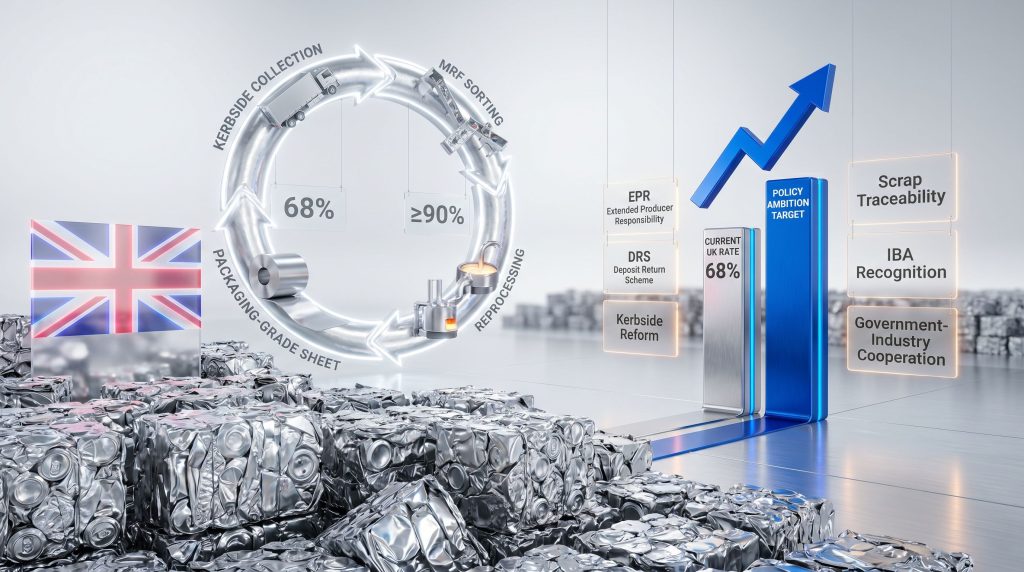
This dynamic creates an important distinction that is often overlooked in public policy discussions. There is a meaningful difference between aluminium that is collected and aluminium that is retained for domestic use. A high national recycling rate can coexist with low domestic material availability, because the two metrics measure entirely different things. The UK's reported aluminium recycling rate of 68% in 2021, as documented by Alupro, reflects collection performance, not domestic supply security.
The Sectors Most Exposed to a Domestic Supply Shortfall
The consequences of persistent scrap export are not evenly distributed across the economy. Several industries face acute exposure:
- Packaging relies heavily on secondary aluminium for beverage can sheet, where closed-loop can-to-can recycling represents the highest-value end use for recovered material
- Automotive and electric vehicles face rapidly growing aluminium intensity per vehicle, with EV platforms requiring significantly more aluminium than equivalent internal combustion designs
- Construction and infrastructure depend on aluminium extrusions and sheet for structural and facade applications, with demand linked to net-zero building retrofits
- Defence and energy infrastructure require specialised aluminium alloys where supply chain provenance and material consistency carry strategic weight
- Transport broadly, including rail and aerospace, where lightweighting imperatives continue to drive aluminium substitution
As demand for aluminium intensifies across multiple high-growth sectors simultaneously, the UK's reliance on imported or re-imported secondary material becomes an increasingly costly structural dependency, both in financial and strategic terms.
What the Alupro Manifesto Actually Proposes
A Multi-Pillar Framework for Domestic Retention
The Aluminium Packaging Recycling Organisation (Alupro) functions as the primary trade body representing the aluminium supply chain in the UK. Its recently published industry manifesto articulates a coordinated set of policy interventions designed to address systemic weaknesses across the recycling value chain, rather than targeting any single point of failure.
The framework spans collection infrastructure, producer incentives, material traceability, and government-industry coordination:
| Policy Measure | Core Objective | Expected Outcome |
|---|---|---|
| Extended Producer Responsibility (EPR) | Shift end-of-life packaging costs to producers | Fund collection infrastructure; reward recyclable materials |
| Deposit Return Scheme (DRS) | Capture at least 90% of drink containers | Boost can recovery; support closed-loop recycling |
| Kerbside and On-the-Go Collection Reform | Standardise national collection infrastructure | Increase volume and quality of recovered aluminium |
| Scrap Classification and Traceability | Improve material tracking across the supply chain | Reduce leakage; direct packaging-grade scrap to domestic reprocessors |
| Incinerator Bottom Ash (IBA) Recognition | Count IBA aluminium in official recycling rates | Incentivise IBA processing investment |
| Government-Industry Cooperation Framework | Align policy design with industrial realities | Coordinate retention strategies across the full value chain |
Why Industry Manifestos Carry Policy Weight
Trade bodies like Alupro occupy a structurally influential position in UK legislative processes. They serve as formal respondents to government consultations, provide the technical data that informs regulatory impact assessments, and often participate directly in the working groups that draft secondary legislation. A manifesto of this kind is not merely a public statement; it functions as a policy roadmap that shapes the terms of debate within Whitehall and across parliamentary committees examining waste and resources legislation.
Alupro's executive director has made clear that the organisation's view is that the UK needs to significantly strengthen its domestic retention capacity rather than continuing to rely on export markets to absorb recovered material. Furthermore, the issue is gaining broader industry attention, with recyclers protesting against measures that allow aluminium scrap leakage to continue unchecked.
The Deposit Return Scheme: Design Details That Determine Outcomes
How a Well-Structured DRS Generates Closed-Loop Material
A Deposit Return Scheme operates on a simple mechanism: consumers pay a small deposit at point of purchase for drinks containers, redeemed in full when the empty container is returned to a designated collection point. The critical policy variable is not whether a DRS exists, but how it is designed.
Markets with mature DRS infrastructure demonstrate what good looks like. Germany, Norway, and Sweden consistently achieve aluminium can collection rates exceeding 90%, with material quality sufficient to support packaging-grade closed-loop reprocessing. These are not incidental outcomes; they result from deliberate scheme design choices, including:
- Deposit level calibration that makes return economically rational for consumers across income brackets
- Return point density sufficient to minimise the friction associated with container return
- Material stream separation that preserves alloy quality and prevents contamination from mixed plastics or glass
- Closed-loop procurement commitments from can manufacturers that create domestic demand pull for recovered material
Alupro's position is that a UK DRS should be designed explicitly around a minimum 90% collection target for drink containers, with scheme architecture that directs recovered aluminium toward closed-loop, packaging-grade reprocessing rather than allowing it to enter lower-value material streams or export channels.
The Risk of Poorly Designed Schemes
Not all DRS implementations deliver these outcomes. Schemes that fragment material streams, use inconsistent container classifications, or fail to create clear commercial pathways for recovered material can actually reduce the quality of aluminium available to domestic reprocessors, even while nominally improving headline collection statistics. This is a technically important distinction that policymakers frequently underestimate.
Extended Producer Responsibility: Rewiring the Economics of Packaging
How EPR Fee Structures Can Favour Aluminium
Extended Producer Responsibility shifts the financial burden of managing packaging waste from local authorities and taxpayers to the producers who place that packaging on the market. In practice, producers pay fees into a system that funds collection, sorting, and reprocessing infrastructure.
The design of those fee structures carries significant implications for material choice. EPR systems modulated to reflect actual recyclability performance create a direct financial incentive for producers to shift toward aluminium over composite materials or multi-layer plastics, because the recyclability-adjusted fee for aluminium is lower. This does not require any subsidy for aluminium specifically; it simply makes the cost of using genuinely recyclable materials accurately reflect their end-of-life economics.
For the domestic recycled aluminium supply chain, a well-designed EPR framework delivers a secondary benefit: it funds the collection and sorting infrastructure that increases the volume of aluminium entering the domestic recycling stream in the first place.
The Hidden Leakage Problem: Scrap Classification and Traceability
Why Inconsistent Grading Standards Enable Export Leakage
One of the less-discussed dimensions of the UK's aluminium retention challenge involves scrap classification. Aluminium scrap is not a single homogeneous commodity; it encompasses dozens of distinct grades differentiated by alloy composition, form factor, contamination level, and end-use suitability. Packaging-grade scrap suitable for can sheet production commands a meaningfully different value than mixed or downgraded material.
When classification standards are inconsistent or poorly enforced, higher-value material can exit the domestic supply chain without being identified as such. Overseas buyers with more sophisticated sorting and remelting capabilities may extract value from material that UK recyclers, lacking equivalent infrastructure, classify as lower-grade and price accordingly.
Alupro has identified improved scrap classification and traceability as foundational requirements for any effective retention strategy. The proposed pathway from collection to reprocessing involves several sequential steps:
- Consumer collection via kerbside bins, on-the-go receptacles, or DRS return points
- Material Recovery Facility (MRF) sorting to separate aluminium from mixed recyclable streams
- Scrap classification and alloy grading to determine composition and end-use suitability
- Reprocessor allocation directing material to domestic remelters, contingent on retention incentives being in place
- Secondary ingot production converting graded scrap into usable aluminium for manufacturers
- Closed-loop return ideally routing packaging-grade material back into equivalent product categories such as beverage can sheet
Each transition point in this chain represents a potential leakage opportunity, and traceability mechanisms need to operate across all of them to be effective.
The next major ASX story will hit our subscribers first
The Policy Tension: Retention vs. Recycler Economics
Why Export Restrictions Carry Commercial Risk
The debate around aluminium scrap retention is not straightforwardly one-sided. A meaningful portion of the recycling industry holds reservations about strict export restrictions or domestic pricing mandates, and the concern is economically coherent.
If export markets are suppressed without simultaneously creating equivalent domestic demand at comparable prices, scrap values fall. Lower scrap prices reduce the margin available to collection and sorting operators, which can in turn reduce their participation in and investment in collection infrastructure. The policy outcome would be counterproductive: fewer collection points, lower volumes entering the recycling system, and ultimately a smaller domestic aluminium supply than the one the policy set out to protect.
Any regulatory mechanism designed to retain aluminium scrap domestically must be carefully calibrated to avoid disincentivising the recycling operators whose participation is essential to achieving higher collection rates in the first place.
Reconciling the Tension Through Demand-Side Policy
The most defensible approach to retention avoids direct export restrictions and instead focuses on building domestic demand capacity. If UK remelters can process more material, operate at competitive cost, and offer prices that reflect the full value of packaging-grade scrap, commercial export incentives diminish naturally. Consequently, the EPR and DRS framework supports this by directing more consistent volumes of higher-quality material to domestic reprocessors, improving their economics without requiring price controls. Broader global aluminium market pressures, however, continue to complicate domestic pricing dynamics and add urgency to building resilient local supply chains.
Measuring the Gap: Where the UK Currently Stands
Performance Benchmarks and Policy Targets
| Metric | Current Position | Policy Ambition |
|---|---|---|
| UK Aluminium Recycling Rate | ~68% (2021, Alupro data) | Greater than 90% closed-loop target |
| Drink Container Collection via DRS | Not yet implemented nationally | Minimum 90% of drink containers |
| Domestic Scrap Retention Rate | Significant export volumes; no published domestic retention figure | Majority of recovered material retained domestically |
| Packaging-Grade Scrap to Domestic Reprocessors | Commercially driven; partial domestic allocation | Incentivised through EPR fee structure |
| Energy Saving vs. Primary Production | ~95% less energy for secondary smelting | Maintained and expanded through closed-loop infrastructure |
The 68% recycling rate, while representing genuine progress compared to historical baselines, needs to be understood in context. European peers with mature DRS infrastructure already exceed 90% for beverage containers specifically. The gap between the UK's current performance and closed-loop ambition is not marginal; it represents a substantial volume of aluminium either lost to landfill, incinerated without energy recovery, or exported in a form that delivers no value to UK manufacturers.
The Broader Industrial Stakes
Supply Chain Resilience in a Volatile Global Environment
The policy case for aluminium retention has strengthened materially in recent years as global supply chain disruptions have made domestic material security a first-order industrial concern. Energy price shocks, geopolitical trade tensions, and logistics volatility have all demonstrated the vulnerability of manufacturing sectors that depend on internationally sourced inputs with limited domestic substitutes.
Secondary aluminium occupies a strategically important position in this context. It is lower-carbon than primary imports, available domestically if retention mechanisms function effectively, and price-competitive when collection and sorting infrastructure operates at scale. For instance, investment in aluminium recycling investment at scale demonstrates how industry leaders are already positioning to capitalise on secondary material demand. Building the infrastructure to retain and process more of it represents an investment in long-term supply chain resilience, not merely an environmental policy commitment.
The timing dimension is also significant. Projected growth in aluminium demand across packaging, electric vehicles, construction, and defence creates a narrowing window for effective policy intervention. Retention infrastructure takes years to build. If legislative action is delayed until demand peaks, the UK risks entering a structural import dependency for secondary aluminium at a point when global competition for recycled material is most intense. Initiatives such as lower-carbon aluminium production further illustrate the direction the industry is moving globally.
Frequently Asked Questions: UK Recycled Aluminium Policy
What is Alupro and what does it do?
Alupro, the Aluminium Packaging Recycling Organisation, is a UK trade body representing the aluminium packaging supply chain. It collects and publishes data on UK aluminium recycling performance and advocates for policy frameworks that improve collection rates, material quality, and domestic retention of recovered aluminium.
What percentage of aluminium is currently recycled in the UK?
Alupro has reported a UK aluminium recycling rate of 68% for 2021. While this represents meaningful progress, the organisation argues that a combination of stronger EPR design, a national DRS, and improved collection infrastructure is needed to push this figure significantly higher and ensure more recovered material stays within the domestic supply chain.
What is a Deposit Return Scheme and how does it benefit aluminium recycling?
A DRS requires consumers to pay a small deposit when purchasing drinks in containers, refunded when the empty container is returned to a designated point. Well-designed schemes in Germany, Norway, and Sweden consistently achieve aluminium can recovery rates above 90%, and the material quality recovered through DRS channels is typically sufficient for closed-loop, packaging-grade reprocessing.
Why is UK-collected aluminium scrap being exported rather than reprocessed domestically?
Commercial dynamics drive the export flow. Overseas buyers, particularly in Asia and continental Europe, frequently offer prices for UK scrap that domestic reprocessors do not match. Without retention mechanisms or domestic demand incentives, recyclers sell to the highest available bidder regardless of geography.
What is closed-loop aluminium recycling?
Closed-loop recycling describes a system in which aluminium is recovered and reprocessed back into the same or functionally equivalent product category. The most cited example is used beverage cans being recycled into new beverage can sheet. This approach preserves alloy quality, maximises material efficiency, and delivers the greatest environmental return from secondary aluminium, including the ~95% energy saving relative to primary smelting.
What is Extended Producer Responsibility in the context of aluminium packaging?
EPR makes producers financially responsible for the end-of-life management of their packaging. Fee structures modulated for recyclability performance can effectively lower the cost burden for aluminium relative to less recyclable materials, while directing funds toward the collection and sorting infrastructure that brings more aluminium into the domestic recycling stream.
What a Comprehensive UK Aluminium Retention Strategy Requires
Key Legislative and Regulatory Levers
A credible retention strategy for the UK involves coordinated action across several policy domains simultaneously. No single intervention is sufficient in isolation. In addition, Alupro calls for stronger measures to keep recycled aluminium in the UK to remain at the centre of any legislative agenda moving forward:
- Align EPR fee design with verified recyclability performance metrics, rewarding aluminium's closed-loop credentials
- Legislate a national DRS with an explicit minimum 90% collection target and closed-loop aluminium recycling architecture built into scheme design
- Standardise kerbside and on-the-go collection infrastructure nationally to reduce the material quality variability that undermines domestic reprocessor economics
- Establish a scrap classification and traceability framework with joint government-industry governance to reduce leakage at every transfer point in the value chain
- Formally recognise aluminium recovered from incinerator bottom ash in official recycling rate calculations to create an investment signal for IBA processing capacity
- Create a standing government-industry working group with a mandate to set, monitor, and report against domestic aluminium material retention targets
The UK possesses the policy architecture to meaningfully transform its recycled aluminium supply chain. The critical variable is whether legislative ambition matches the pace of rising industrial demand across packaging, automotive, construction, and energy sectors.
The structural problem the UK faces is not a lack of recycled aluminium; it is a failure to connect what is collected to what is retained. Closing that gap requires policy design that treats domestic material retention as a measurable outcome in its own right, not simply a byproduct of higher recycling rates. The Alupro manifesto provides a detailed roadmap for achieving that outcome, and the industrial case for acting on it continues to strengthen.
This article contains forward-looking assessments based on publicly available policy proposals, industry data, and structural market analysis. Projections regarding future demand, policy outcomes, and supply chain resilience involve inherent uncertainty and should not be construed as investment advice or guarantees of future conditions.
Want to Stay Ahead of Major Mineral Discoveries Shaping the Materials Economy?
As demand for aluminium and other critical materials intensifies across global supply chains, Discovery Alert's proprietary Discovery IQ model delivers real-time alerts on significant ASX mineral discoveries, transforming complex geological data into actionable investment insights — explore historic discovery returns to see the potential, then begin your 14-day free trial to position yourself ahead of the broader market.