June 18, 2026
When Energy Markets Walk a Tightrope: Understanding the Russian Oil Waiver Crisis
Global energy policy rarely operates in a vacuum. The decisions that govern oil flows between nations are shaped by warfare, diplomacy, inflation anxiety, and the political calculations of sitting governments. Few instruments illustrate this complexity more vividly than the US sanctions waiver on Russian oil expires debate, a narrow but consequential exemption that has repeatedly stood between global energy stability and a supply shock affecting hundreds of millions of people.
As of midnight on June 18, 2026, that waiver expired without a published extension from the US Treasury. What follows is not simply a sanctions enforcement question. It is a test of how Washington balances financial pressure on Moscow against the economic welfare of price-sensitive importing nations, and whether the partial normalisation of Middle Eastern oil supply is sufficient to justify tightening the vice.
When big ASX news breaks, our subscribers know first
What the US Sanctions Waiver on Russian Oil Actually Covers
Before assessing the implications of the waiver's expiry, it is worth being precise about what the instrument actually does and does not permit.
The waiver is a narrow, time-limited exemption issued by the US Treasury's Office of Foreign Assets Control (OFAC) that allows specific transactions involving Russian seaborne oil to proceed without triggering penalties under broader US sanctions frameworks. Critically, it applies only to crude and petroleum products already loaded aboard vessels at sea. It does not authorise the purchase, financing, or shipping of newly extracted or newly contracted Russian oil exports.
This distinction matters enormously for market participants. Shipping companies, financial institutions, and third-party buyers operating in a post-waiver environment face genuine legal exposure if they facilitate transactions outside these narrow parameters. OFAC has historically pursued secondary sanctions on Russian oil trading enforcement against non-US entities that provide material support to sanctioned Russian energy companies, including Rosneft and Lukoil, both of which were sanctioned by the Trump administration as part of its strategy to restrict Moscow's oil revenue.
The Anatomy of a Sanctions Waiver: Key Definitions
- Covered transactions: Russian crude and petroleum products already loaded on vessels at the time of the waiver's validity
- Excluded transactions: Newly produced, newly contracted, or newly loaded Russian oil exports
- Administering body: US Treasury's Office of Foreign Assets Control (OFAC)
- Penalty exposure: Buyers, freight operators, insurers, and financial intermediaries facilitating non-waivered transactions
A Timeline of Deliberate Ambiguity: How the Waiver Has Evolved
The waiver's history is not one of firm policy, but of calculated uncertainty. Understanding its evolution helps explain why the June 18 expiry is significant without necessarily being decisive.
| Period | Waiver Status | Key Development |
|---|---|---|
| March 2026 | Initially Issued | Oil price surge following Iran conflict disruption |
| April 2026 | Extended | Continued supply pressure on vulnerable economies |
| Mid-May 2026 | Lapsed, then extended 30 days | US Treasury Secretary Bessent cited stranded tanker cargoes |
| June 18, 2026 | Expired at midnight | No immediate extension published by US Treasury |
This pattern of expiry followed by quiet reinstatement has not been accidental. Washington has used the mechanism as a calibrated pressure instrument, allowing it to signal displeasure with Russian oil revenues while stopping short of enforcing a full supply disruption on vulnerable importing nations.
The repeated cycle of expiry and renewal suggests the waiver functions less as a straightforward sanctions carve-out and more as a diplomatic pressure valve that Washington can tighten or loosen depending on the geopolitical temperature.
Treasury Secretary Scott Bessent, in justifying the May 2026 extension, specifically framed the decision around protecting the most vulnerable nations, those economies lacking the immediate capacity to substitute Russian crude with alternative supply sources at comparable cost. Furthermore, geopolitical oil price factors have consistently shaped the administration's willingness to renew the exemption rather than allow an abrupt enforcement gap.
The Iran Factor: Why Middle Eastern Oil Is Reshaping Washington's Calculus
The single most important variable in determining whether the June 18 expiry leads to permanent reimposition is the pace at which Iranian oil returns to global markets. The Trump administration's conflict with Iran produced what the head of the International Energy Agency, Fatih Birol, characterised as the most severe disruption to global energy markets in recorded history. That context alone explains why the Russian oil waiver was granted in the first place.
A US-Iran memorandum of understanding to end the conflict has since been reached, and a formal signing ceremony was anticipated later in the week of June 18. A senior US official confirmed that Iran could begin selling oil immediately following the ceremony. However, there is a critical caveat that markets must internalise: returning Iranian oil flows to normal operational volumes could take several months, not days or weeks.
This timeline gap is the core reason Washington has not yet moved decisively to reimpose Russian oil sanctions. The supply substitution logic only holds if replacement barrels are actually available in sufficient volume to absorb the shock.
Comparing Supply Sources: The Substitution Challenge
| Supply Source | Estimated Export Capacity | Time to Full Normalisation |
|---|---|---|
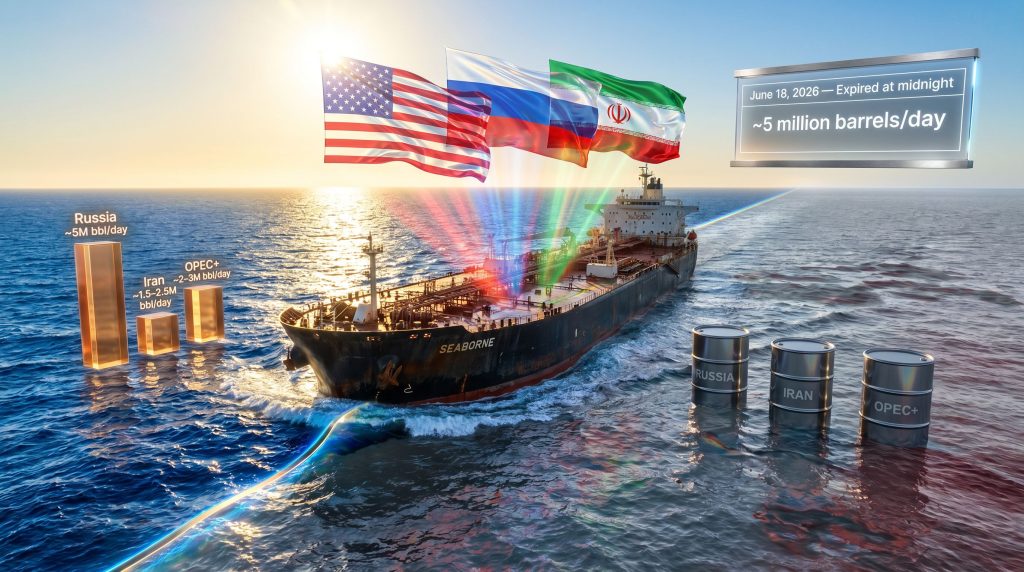
| Russia (currently waivered) | ~5 million barrels/day | Immediate if waiver removed |
| Iran (post-deal) | ~1.5 to 2.5 million barrels/day | Several months minimum |
| OPEC+ spare capacity | ~2 to 3 million barrels/day | Phased over multiple quarters |
Note: Figures are indicative estimates based on publicly available pre-conflict data and analyst projections. Readers should verify against current IEA and OPEC publications for updated assessments.
The arithmetic is sobering. Even combining Iranian re-entry with OPEC+ capacity deployment, the global market faces a potential shortfall if Russian seaborne oil is abruptly removed from supply chains before Iranian volumes normalise.
Trump's G7 Comments and the Oil Price Threshold
Speaking to reporters at the G7 summit in France on June 18, President Trump declined to confirm whether sanctions would be reimposed, instead indicating that the administration was monitoring the trajectory of oil prices. Trump noted that crude prices were declining materially, a signal that the economic preconditions for sanctions reimposition were improving. The day prior, Trump had suggested the pathway to ending the waiver was opening, pointing to the resumption of Middle Eastern oil flows as the trigger condition.
The framing of oil price movements as a de facto trigger for sanctions policy is unusual in formal sanctions law, but it reflects how the Trump administration has consistently treated the waiver as an economic management tool rather than a purely punitive mechanism.
This price-monitoring approach has meaningful implications for market participants. It implies that a sustained decline in benchmark crude prices toward levels that ease inflationary pressure on importing nations would increase the probability of permanent waiver removal. Conversely, any supply shock that pushes prices higher would likely prompt another extension. According to Al Jazeera, the repeated extensions reflect Washington's awareness that abrupt enforcement could rebound against its own economic interests.
Diplomatic Channels and the Ukraine Variable
Sanctions policy on Russian oil cannot be fully understood without reference to the broader US-Russia diplomatic context. US envoys Steve Witkoff and Jared Kushner have been leading negotiations aimed at brokering an end to the conflict in Ukraine. The Kremlin confirmed on Sunday, June 15, that these envoys would visit Russia in the near term, signalling that dialogue remains active.
Russian Presidential envoy Kirill Dmitriev acknowledged in early June that US officials understood the waivers' stabilising role in global energy markets. This acknowledgment from the Russian side is diplomatically significant. It suggests Moscow views the waiver not simply as a sanctions loophole but as a shared interest, one that creates a degree of mutual dependency between the two parties that complicates sudden reimposition.
This diplomatic entanglement makes an unannounced, abrupt sanctions reimposition strategically unlikely in the near term. The more probable pathway is continued ambiguity, potentially followed by a phased tightening once Iranian supply normalises and Ukraine negotiations reach a clearer resolution.
The next major ASX story will hit our subscribers first
Which Economies Face the Greatest Exposure
The countries most exposed to permanent waiver removal are those that have built significant portions of their energy import infrastructure around discounted Russian Urals-grade crude. India is the most prominent example.
Since 2022, Indian refiners have substantially increased their intake of Russian seaborne crude, attracted by discounts to Brent that have at times exceeded $20 per barrel. These discounts emerged precisely because Western sanctions reduced the pool of willing buyers, concentrating demand among price-sensitive importers in Asia. Consequently, the trade war impact on oil pricing dynamics has further complicated the cost calculations for these importers.
The operational consequences of permanent waiver removal for Indian refiners would include:
- Forced reorientation to alternative crude grades, many of which require refinery configuration adjustments
- Increased feedstock costs as Middle Eastern and West African barrels carry Brent-linked pricing
- Potential supply timing disruptions during the transition period, given that Iranian volumes remain months away from full normalisation
- Currency pressure on the rupee if oil import bills rise sharply in a compressed timeframe
Beyond India, other Asian and emerging market economies that have quietly integrated discounted Russian crude into their energy systems face comparable pressures. The waiver's quiet functioning has effectively subsidised energy costs for a significant portion of the developing world over the past several years.
Three Scenarios for What Comes Next
Given the convergence of diplomatic, economic, and supply-side variables, three broad scenarios are plausible from the June 18 expiry point:
Scenario 1: Another Short-Term Extension Within Days
The most historically consistent outcome. The US Treasury issues a further 30-day or similar extension, citing incomplete Iranian supply normalisation and active diplomatic engagement on Ukraine. Markets price in continuity.
Scenario 2: Permanent Expiry Timed to Iranian Market Normalisation
Washington waits for Iranian export volumes to reach a threshold sufficient to partially offset Russian supply withdrawal, then allows the waiver to lapse permanently. This is the most likely medium-term outcome, potentially materialising in Q3 or Q4 2026.
Scenario 3: Partial Reimposition Targeting Specific Vessel Classes or Routes
A more surgical approach in which OFAC reimpose sanctions on particular categories of Russian seaborne oil while maintaining limited carve-outs for the most vulnerable importing economies. This scenario would be complex to administer but would allow Washington to claim enforcement progress without triggering a full supply shock.
The probability distribution across these scenarios is not static. It shifts with every week of Iranian supply recovery, every session of US-Russia diplomatic engagement, and every daily close in benchmark crude oil futures.
The Broader Stakes: Russia's Oil Revenue and War Financing
Understanding why the US imposed these sanctions in the first place is essential context for assessing the stakes of the current waiver expiry. Russia ranks among the world's three largest oil exporters alongside the United States and Saudi Arabia. Oil and gas revenues have historically constituted a substantial share of federal budget receipts, providing the fiscal capacity that underpins military spending.
The Trump administration's logic in sanctioning Rosneft and Lukoil was explicitly tied to depriving Moscow of the financial resources required to sustain its military operations in Ukraine. From this perspective, every barrel of Russian oil that reaches global markets under a waiver represents a partial offset of the sanctions' intended financial effect.
However, enforcement efficacy against non-Western buyers remains a structural limitation. Countries that do not operate within US dollar-denominated financial systems, and that conduct bilateral trade in alternative currencies, present genuine compliance challenges for OFAC. This means that even permanent waiver removal would not translate into a complete cutoff of Russian oil revenue, particularly from buyers in Asia and the Middle East. The US-China trade war impacts have, in addition, demonstrated that geopolitical economic pressure rarely produces clean or predictable results when major non-Western buyers are involved. As Reuters reported, these enforcement complexities have been central to the Treasury's internal deliberations throughout the waiver process.
Frequently Asked Questions
What does it mean when the US sanctions waiver on Russian oil expires?
When the waiver lapses without renewal, all transactions involving Russian seaborne oil, including purchasing, shipping, insuring, and financing, become subject to full US sanctions enforcement. Entities that continue to facilitate these transactions face significant legal and financial penalties from OFAC.
Why has the US repeatedly extended the waiver rather than letting it lapse permanently?
Extensions reflect the administration's use of the waiver as a calibrated policy instrument. Allowing permanent lapse without sufficient alternative supply would risk acute energy cost increases in price-sensitive importing nations, creating political and economic costs that outweigh the sanctions benefits at this stage.
How does the Iran deal change the Russian oil waiver equation?
The US-Iran memorandum of understanding creates the conditions under which Washington can justify permanent removal of the Russian oil waiver. As Iranian supply normalises over coming months, the economic case for maintaining the waiver weakens, making reimposition more feasible.
Which countries face the greatest risk from permanent waiver removal?
Emerging market economies with high dependency on discounted Russian crude, particularly India and several other Asian importers, face the most immediate exposure to supply cost increases and refinery feedstock disruption.
What is OFAC's role in enforcing these sanctions?
The Office of Foreign Assets Control, a division of the US Treasury, issues, administers, and enforces sanctions waivers and restrictions. It is the primary body responsible for investigating and penalising violations by both US and non-US entities.
Has the Trump administration confirmed sanctions will be reimposed?
As of June 18, 2026, no confirmation has been issued. President Trump indicated at the G7 summit that the decision is contingent on monitoring oil price movements and the pace of Middle Eastern supply normalisation.
Key Takeaways
- The US sanctions waiver on Russian oil expires at midnight on June 18, 2026, with no immediate extension announced by the US Treasury
- The waiver covers only Russian oil already loaded at sea, not newly contracted or produced Russian crude
- The Iran conflict created the most severe global energy market disruption in recorded history, justifying the original waiver issuance
- Iran's re-entry into global oil markets is the primary variable reshaping Washington's sanctions timeline, though full volume normalisation remains months away
- India and other Asian importers face material cost and supply disruption risk if the waiver is permanently removed before replacement barrels are available
- Active US-Russia diplomatic engagement on Ukraine makes sudden unannounced reimposition strategically unlikely in the near term
- A permanent reimposition is most likely to materialise in Q3 or Q4 2026, contingent on Iranian export recovery reaching sufficient volume
This article is intended for informational purposes only and does not constitute financial or investment advice. Forecasts and scenario projections involve inherent uncertainty and should not be relied upon as predictions of future events. Readers are encouraged to consult current IEA, OPEC, and US Treasury publications for the most up-to-date data. Further reporting on global energy market dynamics is available at ETEnergyWorld.
Want to Stay Ahead of the Next Major Commodity Discovery Driven by Shifting Energy Markets?
Global energy disruptions like the Russian oil waiver crisis regularly reshape commodity demand and create significant opportunities in mineral exploration and ASX-listed resource companies. Discovery Alert's proprietary Discovery IQ model delivers real-time alerts on significant ASX mineral discoveries the moment they are announced — explore historic discoveries and their extraordinary returns or start your 14-day free trial today to position yourself ahead of the broader market.