
June 28, 2026
The Invisible Race Reshaping Global Metals Strategy
For most of industrial history, the competitive advantage in aluminium was simple to identify: control the bauxite, own the smelter, dominate the market. That framework is now obsolete. A fundamentally different contest is underway, one where the prize is not a mineral deposit buried underground but the millions of tonnes of aluminium already circulating through the global economy in the form of scrap. The aluminium scrap supply and recycling industry has quietly evolved from a marginal waste management function into one of the most strategically contested supply chains on the planet.
Understanding why requires looking beyond individual company decisions and examining the structural forces converging simultaneously: energy economics, carbon regulation, geopolitical competition, and the simple mathematics of an ageing global aluminium stock reaching end-of-life. These forces are not temporary disruptions. They are permanent reconfigurations.
When big ASX news breaks, our subscribers know first
From Waste Stream to Industrial Battleground
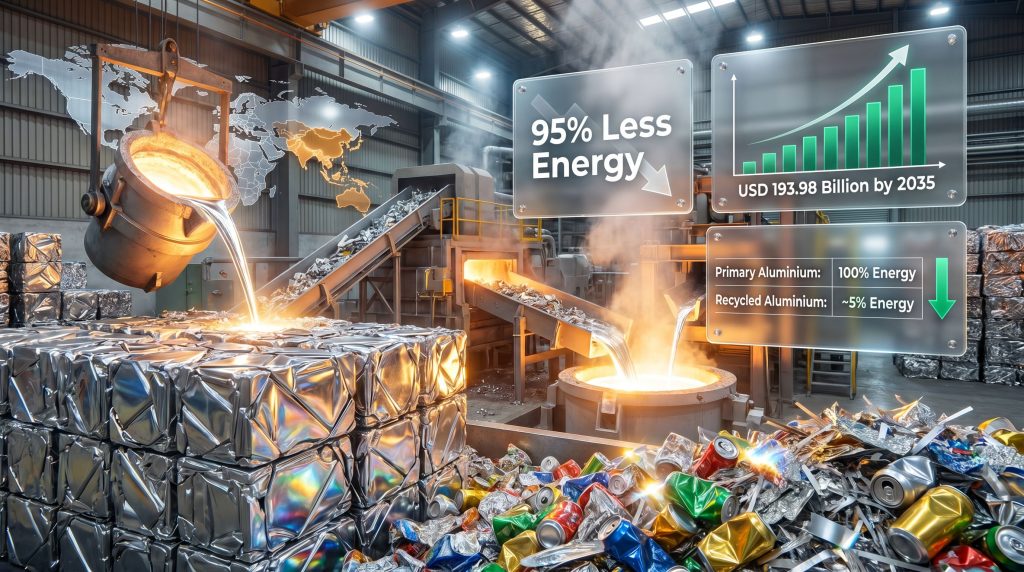
The economic case for recycled aluminium is built on one extraordinary fact: reprocessing aluminium scrap requires roughly 95% less energy than extracting and refining primary metal from bauxite ore. In an era of volatile energy prices and tightening carbon budgets, that figure is not merely impressive. It is commercially decisive.
For manufacturers operating under increasing pressure from carbon pricing mechanisms and sustainability commitments, choosing recycled aluminium over primary production is no longer an ethical preference. It is a cost management strategy. Secondary aluminium production avoids the energy-intensive Bayer and Hall-Heroult processes required to convert bauxite into usable metal, delivering both lower input costs and dramatically reduced emissions intensity.
Critically, aluminium is one of the only industrial metals that can be recycled indefinitely without any measurable degradation in material properties. Unlike many materials where recycling introduces quality penalties, aluminium retains full structural and chemical integrity across unlimited processing cycles. This makes the approximately 75% of all aluminium ever produced that remains in active use today not merely a historical statistic but a recoverable reserve that dwarfs most primary mining projects in both scale and accessibility.
"The aluminium industry is unusual in global metals in that its recycled feedstock base grows larger with every year of primary production. The cumulative stock of recoverable aluminium in the built environment represents a resource that requires no new exploration, no environmental permitting for extraction, and no long-distance ore shipping."
How Big Is the Global Aluminium Scrap and Recycling Industry?
The numbers tell a compelling story of structural growth, not cyclical fluctuation.
| Metric | Data Point |
|---|---|
| Global recycled aluminium output (2015 baseline) | ~27 million tonnes |
| Projected global demand by 2025 | 30 million metric tons |
| Global aluminium scrap market value (projected by 2035) | USD 193.98 billion |
| CAGR (scrap market, 2024-2035) | 4.43% |
| Recycling market incremental growth (2026-2030) | USD 4.88 billion |
| Recycling market CAGR (2026-2030) | 10.8% |
| Global recycling efficiency rate (2020) | 76% |
| Share of all aluminium ever produced still in active use | ~75% |
| US recycled aluminium as share of total production | >80% |
Since 1980, global secondary aluminium output has expanded approximately fivefold, a trajectory driven by industrial deepening across emerging economies and the maturation of collection infrastructure in developed markets. The projected 4.43% compound annual growth rate through to 2035 signals something more durable than a commodity boom: it reflects the structural embedding of secondary aluminium into manufacturing supply chains that previously relied on primary metal.
The United States offers one of the clearest demonstrations of this transition, with recycled aluminium now accounting for more than 80% of total domestic aluminium production. This figure inverts the traditional supply model almost entirely, and similar dynamics are beginning to emerge across European and Asian markets, though at different stages of development.
What the projected 10.8% CAGR between 2026 and 2030 captures is the accelerating phase of this transition, driven by simultaneous demand growth across automotive lightweighting, renewable energy infrastructure, and packaging sectors, combined with tightening carbon regulations that make primary production increasingly expensive to justify. The aluminium industry leaders best positioned for this transition are those who have already begun investing in secondary processing capabilities.
Why Demand Is Accelerating Faster Than Collection Infrastructure Can Scale
One of the least-discussed constraints in the aluminium scrap market is the lag between demand growth and collection system capacity. Building the physical infrastructure required to aggregate, sort, and process scrap at industrial scale involves capital expenditure cycles measured in years, not months. This means that even as demand accelerates, supply response is structurally delayed, creating persistent tightness in scrap availability that supports pricing floors for secondary material.
This infrastructure gap is particularly acute in rapidly industrialising economies where aluminium consumption has grown faster than the recycling ecosystem needed to capture end-of-life material. The consequence is a two-speed market: mature economies with deep scrap collection networks competing for the same feedstock as fast-growing economies building their recycling capacity from a low base.
Understanding the Aluminium Scrap Supply Chain
The recycling ecosystem involves four distinct operational layers, each requiring different technical capabilities and capital investment.
Refiners: Processing Mixed Grades Into Usable Alloys
Refiners accept heterogeneous scrap inputs containing multiple aluminium alloy types, impurities, and contaminants. Their core technical challenge is blending these varied inputs, introducing alloying agents where necessary, and removing unwanted elements through the melting process to produce casting alloys and deoxidation aluminium. Refiners typically operate in markets where scrap sorting infrastructure is less developed, accepting lower-grade feedstock in exchange for more complex processing requirements.
Remelters: Closed-Loop Systems for High-Grade Feedstock
Remelters occupy the higher end of the quality spectrum. They require clean, grade-sorted wrought alloy scrap as input and produce wrought alloys suitable for flat-rolled products and extrusion. The most sophisticated remelter operations are fully closed-loop systems, exemplified by used beverage can (UBC) sheet production where aluminium cans are collected, sorted, melted, and rolled back into new can sheet without entering the open scrap market. These systems deliver the lowest contamination risk and the highest material efficiency.
The distinction between refiners and remelters is more than technical. It reflects the economic value embedded in sorting. A tonne of mixed scrap delivered to a refiner is worth materially less than the same aluminium content delivered as sorted, grade-specific material to a remelter. This quality premium is one of the strongest financial incentives driving investment in advanced sorting technology.
Collectors, Dismantlers, and Metal Merchants
The upstream aggregation layer, composed of collectors, industrial dismantlers, and metal merchants, determines the quality and volume of scrap entering the processing system. Metal merchants manage the majority of cross-border scrap trade flows, functioning as the connective tissue between generation sources and processing facilities. The sophistication of this layer often determines a market's overall aluminium recycling efficiency more than its smelting capacity.
Major Industry Participants
Key global players operating across these segments include Nucor Corporation, Sims Metal Management, Kuusakoski Recycling, RUSAL, Rio Tinto, and Hydro Aluminium AS, among others. These companies represent different points on the value chain, from collection and trading to full processing and alloy production.
Where Does Aluminium Scrap Come From?
Scrap generation occurs across multiple industrial and consumer channels, each with distinct characteristics and growth trajectories.
| Scrap Source | Market Significance |
|---|---|
| Manufacturing sector | Largest current contributor to new scrap generation |
| Construction and demolition | Fastest-growing segment due to infrastructure renovation cycles |
| Used beverage containers | Largest single component of processed consumer scrap |
| End-of-life vehicles | Structurally growing as aluminium-intensive vehicles from two decades ago retire |
The manufacturing sector generates new scrap (also called process scrap or prompt scrap) as a direct by-product of fabrication. This material is typically clean, well-characterised, and easy to recycle efficiently. Its limitation as a supply source is that it scales with manufacturing output rather than independently.
Old scrap, derived from end-of-life products, is where the long-term supply growth story becomes most interesting. The construction and demolition sector is entering a structural expansion phase as buildings, facades, and infrastructure installed during the aluminium-intensive construction boom of the 1980s and 1990s reach end-of-life. This wave of demolition scrap represents a large-scale, predictable supply increase that will continue for decades.
Similarly, the automotive sector is generating growing volumes of old scrap as vehicles manufactured during the early 2000s, when aluminium content per vehicle began rising sharply, now reach the end of their useful lives. The aluminium recovered from a modern vehicle is significantly greater than that from vehicles produced a generation earlier, meaning each retirement cycle delivers more recoverable metal per unit.
Regional Dynamics: Who Controls the Aluminium Scrap Market?
| Region | Market Position |
|---|---|
| Asia-Pacific | 56.9% of incremental growth; led by China and India |
| North America | ~40% of global market share; mature regulatory and collection infrastructure |
| Europe | Traditional recycling hub facing structural supply shortfall |
Asia-Pacific: Demand Pull and Import Competition
Asia-Pacific's dominance in incremental market growth reflects the scale of manufacturing expansion across the region, particularly in China and India. Despite operating one of the world's most developed domestic recycling ecosystems, China expanded its overseas aluminium scrap imports by approximately 4% in the first quarter of 2026. This reflects a fundamental reality: even the largest aluminium economy in the world cannot generate sufficient domestic scrap to satisfy its processing capacity.
India's position is more precarious. The country relies significantly on imported scrap to supply its secondary aluminium sector, and the prospect of European export restrictions has prompted diplomatic engagement at government level. India's initiation of discussions with the European Union over potential scrap export measures signals that secondary raw material access is now a foreign policy concern, not merely an industrial procurement question.
Europe: The One Million Tonne Challenge
Europe presents the most structurally challenging supply picture in the global aluminium scrap market. Demand for aluminium across automotive, construction, and packaging applications continues rising, while primary smelting capacity contracts due to energy costs and carbon obligations. The resulting gap is expected to require sourcing an additional one million tonnes of aluminium scrap to meet the continent's circular economy targets.
Achieving that target is complicated by two simultaneous pressures. European supply chain pressures are intensifying as scrap that might previously have been exported is increasingly being claimed by domestic processors. Furthermore, global competition for the same material is intensifying, meaning any export restriction that protects European supply also risks triggering retaliatory trade responses from import-dependent markets like India.
The Evolving UK-US Trade Corridor
UK aluminium scrap shipments to the United States declined approximately 10% year-on-year in the first quarter of 2026. This shift reflects broader competitive pressures as multiple markets simultaneously compete for available scrap supply. The impact of US aluminium tariffs has contributed to disrupting established bilateral trade flows that developed under conditions of relative scrap abundance, which are now being reshaped by a tighter global supply environment.
The next major ASX story will hit our subscribers first
Barriers to Scaling the Aluminium Scrap Supply Chain
Despite its compelling economics, the aluminium scrap supply and recycling industry faces structural obstacles that resist simple resolution.
- Alloy contamination remains the most significant technical barrier. Mixed-alloy scrap cannot be upgraded back to wrought alloy standards through simple remelting, limiting its applications and value.
- Sorting technology limitations create quality ceilings that prevent much available scrap from accessing the highest-value processing pathways.
- Logistics fragmentation across collection networks drives up costs and reduces the economic viability of processing lower-concentration scrap streams.
- Price opacity in secondary metal markets creates information asymmetries that disadvantage smaller recyclers and complicate investment decisions.
- Geopolitical competition is converting scrap trade into a diplomatic arena, with export restrictions and bilateral negotiations introducing regulatory uncertainty into previously commercial supply relationships.
Warning: As competition for aluminium scrap intensifies globally, producers without secure scrap procurement agreements face compounding exposure: rising input costs, carbon compliance obligations under mechanisms like the EU Carbon Border Adjustment Mechanism (CBAM), and potential supply disruptions as export restrictions become more prevalent.
Decarbonisation Policy and the Commercial Premium on Recycled Aluminium
The EU Carbon Border Adjustment Mechanism
The EU's CBAM is restructuring global aluminium trade by attaching a financial cost to the carbon embedded in imported metal. For aluminium producers operating in export markets, this creates an urgent commercial incentive to reduce production emissions. Producers in countries including New Zealand are actively evaluating CBAM's implications for their cost structures and export competitiveness.
The mechanism effectively creates a low-carbon premium for recycled aluminium. Producers capable of certifying recycled content and reduced emissions intensity gain measurable commercial advantages in European markets, while high-carbon primary producers face an escalating cost burden that compounds existing energy and raw material pressures. The broader mining decarbonisation benefits are becoming increasingly central to how the entire metals sector positions itself competitively.
Hydropower vs. Solar: The Clean Energy Debate in Aluminium
A commonly misunderstood aspect of green aluminium production is the role of different renewable energy sources. Despite the rapid global expansion of solar capacity, hydropower remains the dominant energy source for green primary aluminium production. Solar's intermittency profile is poorly suited to the continuous, high-load energy demands of electrolytic aluminium smelting, whereas hydropower provides the stable baseload supply that the Hall-Heroult process requires.
This distinction matters for investors and policymakers evaluating the credibility of green aluminium claims. A smelter powered by dispatchable hydropower delivers materially different emissions outcomes than one relying on grid electricity supplemented by intermittent solar. The industry's low-carbon future depends on both clean energy for primary production and expanded recycled feedstock use as complementary, not competing, strategies. Green aluminium investment initiatives are increasingly reflecting this dual approach across the sector.
Aluminium Scrap vs. Primary Aluminium: The Definitive Comparison
| Comparison Dimension | Primary Aluminium | Recycled Aluminium |
|---|---|---|
| Energy consumption | Baseline (100%) | ~5% of primary energy required |
| Carbon intensity | High (bauxite mining plus smelting) | Significantly lower |
| Raw material dependency | Bauxite reserves plus refining | End-of-life scrap plus new scrap |
| Quality degradation over cycles | N/A | None, recyclable indefinitely |
| Cost trajectory | Rising (energy and carbon costs) | Increasingly competitive |
| Regulatory exposure (CBAM) | High | Low to moderate |
The infinite recyclability of aluminium without quality loss is arguably the metal's most underappreciated industrial property. Unlike steel, where repeated recycling can introduce tramp element contamination requiring dilution with virgin material, aluminium maintains its properties across unlimited cycles provided alloy purity is managed correctly. This makes the global aluminium stock not a depleting resource but a self-replenishing feedstock base that grows larger with every primary tonne produced.
Scenario: A mid-sized European manufacturer sourcing 60% of its aluminium from primary production faces compounding exposure as CBAM costs escalate and scrap prices rise due to regional shortages. Over a five-year horizon, its production cost base could increase by an estimated 15 to 22% while competitors operating closed-loop recycling systems maintain stable input costs. The structural competitiveness gap that emerges cannot be closed without capital-intensive infrastructure overhaul.
Consumer Behaviour as an Industrial Supply Driver
One of the more counterintuitive aspects of the aluminium scrap supply and recycling industry is how directly it connects to consumer behaviour. Used beverage cans represent one of the highest-purity, highest-value scrap streams available, with collection and reprocessing economics that support closed-loop manufacturing systems at scale. According to the Aluminium Association, aluminium cans are among the most recycled consumer products globally, reinforcing the case for stronger collection programmes.
Large-scale events generate measurable scrap supply pulses. The FIFA World Cup, for example, is expected to generate millions of aluminium beverage cans entering the UK recycling stream. While this may appear to be a peripheral observation, it illustrates a deeper structural point: consumer recycling participation is an industrial supply input, and the gap between consumer collection rates and industrial utilisation efficiency represents one of the sector's most accessible growth opportunities.
Improving household and venue collection rates for aluminium packaging does not merely improve environmental outcomes. It directly increases the availability of a high-value feedstock that manufacturers across multiple continents are actively competing to secure.
Infrastructure Investment and Industrial Strategy
The UAE's Largest Aluminium Recycling Facility
The inauguration of the UAE's largest aluminium recycling plant represents more than a capacity addition. It reflects a deliberate strategic positioning by a region historically dependent on primary smelting, investing ahead of demand in secondary processing infrastructure to capture the commercial premium that certified low-carbon and recycled aluminium will command. The investment logic is clear: securing future market access in carbon-regulated trade regimes requires building recycled content capability now, not when regulatory pressure makes it unavoidable.
Closed-Loop vs. Open-Market Procurement
Companies face a fundamental strategic choice between closed-loop systems, where they control the entire scrap recovery and reprocessing chain, and open-market scrap procurement, where they compete with other buyers for available material. Closed-loop systems deliver supply security and quality consistency but require significant capital investment and long-term planning horizons. Open-market procurement offers flexibility but exposes producers to price volatility and increasing geopolitical uncertainty in scrap trade flows.
As scrap becomes scarcer relative to demand, the value of closed-loop supply security will increase, rewarding early capital investment and penalising companies that deferred infrastructure decisions. The global scrap market analysis confirms that this shift towards secured supply arrangements is already visible in contracting patterns across the industry.
Frequently Asked Questions: Aluminium Scrap Supply and Recycling
What is the difference between a refiner and a remelter in aluminium recycling?
Refiners process mixed-grade, heterogeneous scrap into casting alloys and accept lower-quality inputs. Remelters require sorted, grade-specific wrought alloy scrap to produce high-quality wrought alloys suitable for flat-rolled and extruded products. The key distinction is feedstock quality and output application.
How much energy does aluminium recycling save compared to primary production?
Recycling aluminium consumes approximately 95% less energy than producing primary metal from bauxite ore, making it one of the most energy-efficient material recovery processes in industrial manufacturing.
Why is aluminium scrap becoming a geopolitically sensitive commodity?
Simultaneous demand growth across Asia, Europe, and North America has created competition for finite scrap supply. Countries are now negotiating bilaterally over export restrictions, treating secondary aluminium as a strategic resource rather than a freely traded commodity.
What is driving the projected growth of the aluminium scrap market to USD 193.98 billion by 2035?
Growth is driven by energy cost advantages of secondary production, carbon pricing mechanisms that penalise primary production, rising demand across automotive and renewable energy sectors, and the growing availability of old scrap as aluminium-intensive infrastructure and vehicles reach end-of-life.
Can aluminium be recycled indefinitely without quality loss?
Yes. Aluminium is one of the very few industrial materials that retains full material properties across unlimited recycling cycles, provided alloy composition is managed correctly during reprocessing.
Which regions are growing fastest in aluminium scrap processing capacity?
Asia-Pacific, accounting for 56.9% of incremental market growth, is the fastest-growing region, led by China and India. Investment in recycling infrastructure is also accelerating in the Middle East, exemplified by recent capacity additions in the UAE.
The Strategic Outlook: Who Wins the Scrap Race?
The long-term competitive map of the aluminium industry is being redrawn by three converging forces.
First, the ageing global aluminium stock is moving into its highest-value retirement phase. Decades of primary production have loaded the built environment with recoverable aluminium that is now entering demolition and end-of-life cycles at scale. The volume of old scrap available to the market will grow structurally for the foreseeable future, independent of new production decisions.
Second, advanced sorting and identification technologies, including laser-induced breakdown spectroscopy (LIBS) and sensor-based sorting systems, are beginning to unlock scrap grades previously too contaminated or mixed to process economically. As these technologies scale and reduce in cost, they will expand the effective supply of usable scrap without requiring additional collection.
Third, the regulatory environment is permanently changing the economics of primary versus secondary production. Carbon border mechanisms, circular economy mandates, and recycled content requirements in downstream industries are all pointing in the same direction: recycled aluminium commands a growing commercial premium that will only increase.
"The aluminium industry's next competitive frontier will not be determined by who controls the largest smelter or the richest bauxite deposit. It will be determined by who can reliably secure, sort, and process recyclable aluminium at scale within a regulatory environment that increasingly prices carbon and rewards circularity."
Key Takeaways: The Aluminium Scrap and Recycling Industry at a Glance
- Global recycled aluminium output has grown approximately fivefold since 1980, with demand projected at 30 million metric tons by 2025
- The scrap market is forecast to reach USD 193.98 billion by 2035, growing at a 4.43% CAGR
- Recycling consumes up to 95% less energy than primary production, making it the single most powerful economic driver of the transition
- Asia-Pacific accounts for 56.9% of incremental market growth; North America holds approximately 40% of current global market share
- Europe faces a structural shortfall requiring an additional one million tonnes of scrap to meet circular economy targets
- China increased overseas scrap imports by approximately 4% in Q1 2026, despite operating a mature domestic recycling ecosystem
- UK aluminium scrap shipments to the US declined approximately 10% year-on-year in Q1 2026, reflecting shifting global trade patterns
- The EU CBAM is accelerating the commercial premium on low-carbon and recycled aluminium globally
- Approximately 75% of all aluminium ever produced remains in active use, representing a vast and growing recoverable resource base
Readers seeking additional industry context on aluminium recycling trends and secondary metal market dynamics can explore related reporting and analysis available through industry publications such as AL Circle at alcircle.com, which covers developments across the global aluminium value chain.
Want to Know Which ASX Discoveries Could Rival the Next Major Metals Shift?
As the global aluminium scrap race accelerates and secondary metal markets reshape industrial strategy, Discovery Alert's proprietary Discovery IQ model delivers real-time notifications on significant ASX mineral discoveries — turning complex commodity data into actionable investment insights the moment announcements hit the market. Explore historic discoveries and their exceptional returns, then begin your 14-day free trial to position yourself ahead of the next major opportunity.