July 23, 2026
The Hidden Variable in Aluminium Smelting: Why Lining Materials Determine Profitability
Across the global aluminium industry, enormous attention is paid to energy prices, alumina costs, and LME benchmarks. Yet one of the most consequential variables in smelter economics sits largely out of sight: the carbon and graphite materials lining the electrolysis cells where aluminium is actually made. These materials are not peripheral consumables. They are precision-engineered components whose specifications ripple through every major performance metric a smelter operator tracks, from energy intensity measured in kilowatt-hours per tonne to the frequency of costly pot relining shutdowns.
Understanding why Tokai COBEX carbon and graphite products for aluminium smelting occupy a strategically significant position in the supply chain requires first understanding the electrochemical reality inside a Hall-Héroult cell, and then appreciating how material science choices made at the procurement stage translate into operational outcomes measured in years and millions of dollars.
When big ASX news breaks, our subscribers know first
What Makes Carbon and Graphite Products Indispensable to Modern Aluminium Smelting?
The Electrochemical Foundation: Why Cell Lining Materials Define Smelter Performance
The Hall-Héroult process, which remains the universal method for producing primary aluminium, works by dissolving aluminium oxide in a molten cryolite bath held at approximately 960°C and passing an electrical current through the system to reduce aluminium ions into liquid metal. The cathode lining at the base of the cell is not merely a structural floor: it functions as the counter-electrode through which that current flows.
This electrochemical role means the material properties of cathode blocks have a direct and measurable impact on how efficiently the cell operates. The critical performance metrics that smelter engineers use to evaluate cathode materials include:
- Electrical resistivity (µΩm): Lower resistivity means less energy lost as heat within the lining itself, directly reducing kWh per tonne of aluminium produced
- Thermal conductivity (W/m·K): Determines how effectively the lining manages heat distribution and the formation of a protective frozen bath ledge along the sidewalls
- Corrosion resistance: The ability to withstand continuous contact with molten cryolite and liquid aluminium without degrading prematurely
- Dimensional stability: Resistance to swelling, cracking, or heaving under the thermal cycling that occurs during startup, operation, and occasional process disturbances
A poorly specified cathode block can increase a smelter's energy consumption by several percentage points. At industrial scale, where a single smelter may consume hundreds of megawatts continuously, even a two to three percent increase in energy intensity translates to millions of dollars in annual cost overruns. The material choice is an energy decision as much as it is an engineering one.
Sidewall blocks and ramming paste complete the lining system. Sidewall blocks contain the molten bath and shield the steel shell of the cell from thermal and chemical attack, while ramming paste fills the joints between structural components, sealing the system against bath penetration and minimising electrical resistance at interfaces. All three components must be specified as an integrated system rather than treated as independent commodities.
How Are Carbon and Graphite Cathode Products Classified for Aluminium Electrolysis?
A Technical Breakdown of the Three Core Cathode Block Categories
The cathode product landscape spans a spectrum from conventional amorphous carbon through to fully graphitised blocks, with each category carrying distinct trade-offs between cost, conductivity, and wear performance.
| Cathode Block Type | Carbon Content | Key Characteristic | Typical Application |
|---|---|---|---|
| Amorphous (Non-Graphitised) | High carbon, low crystallinity | Lower cost, moderate conductivity | Older or conventional cell designs |
| Graphitic | Partially graphitised | Balanced conductivity and wear resistance | Mid-range modern smelters |
| Fully Graphitised | High crystallinity (>99% C) | Superior electrical and thermal conductivity | High-amperage, energy-efficient cells |
What Is the Difference Between Graphitic and Graphitised Cathode Blocks?
The terminology here is precise and the distinction matters significantly in procurement conversations. A graphitic cathode block contains carbon with some naturally ordered or partially structured graphite regions, but has not been subjected to the full graphitisation treatment. A fully graphitised block, by contrast, undergoes a high-temperature thermal conversion process typically carried out above 2,500°C, which reorganises the amorphous carbon microstructure into a highly ordered hexagonal crystalline lattice.
This transformation produces measurable improvements in two critical properties:
- Electrical resistivity drops substantially as crystalline order increases, reducing resistive heating losses within the cathode
- Thermal conductivity rises, improving heat management and supporting the formation of stable frozen bath ledges that protect sidewall materials
The result is that fully graphitised cathode blocks are the preferred specification for modern, high-amperage smelting operations where energy intensity reduction is a core operating target. For legacy cell designs operating at lower amperages, the cost premium of full graphitisation may not always be justified, which is why the full product spectrum remains commercially relevant.
Sidewall Blocks and Ramming Pastes: The Supporting Cast That Determines Cell Longevity
Sidewall blocks are engineered to withstand continuous immersion in a chemically aggressive environment at close to 960°C. Their critical material requirements include:
- Low coefficient of thermal expansion to resist cracking during the temperature swings of startup and shutdown cycles
- High resistance to sodium penetration, since dissolved sodium from the cryolite bath can diffuse into carbon materials and cause destructive swelling
- Chemical inertness to the fluoride-rich bath chemistry
Ramming paste functions as the binding and sealing agent between cathode blocks, sidewall blocks, and the steel shell. Available in cold-setting and hot-setting variants depending on cell construction methodology, correctly specified and applied ramming paste minimises electrical resistance at block joints and prevents preferential bath penetration pathways that would accelerate degradation of the steel shell beneath the lining.
Who Is Tokai COBEX and What Is Its Position in the Global Carbon and Graphite Supply Chain?
Corporate Structure and Manufacturing Footprint
Tokai COBEX is a Germany-headquartered manufacturer of carbon and graphite products, with production facilities operating in Poland and France. A sales and technical service office in China extends the company's reach into the Asia-Pacific region, which accounts for the dominant share of global primary aluminium production. In 2019, the COBEX business was acquired by Tokai Carbon of Japan, combining European manufacturing and process engineering expertise with the materials science capabilities of one of Japan's established carbon producers.
This corporate structure gives Tokai COBEX a multinational manufacturing base and a technical development pipeline supported by its Japanese parent, with the French facility playing a particularly important role in both cathode product manufacturing and the company's newer battery materials programme. Furthermore, the aluminium industry leaders who shape global smelting capacity are increasingly reliant on specialist suppliers of this kind to meet energy efficiency and sustainability targets.
Competitive Landscape in Carbon and Graphite Supply
The global market for aluminium cathode materials is served by a relatively concentrated group of specialist manufacturers. The table below provides a comparative overview of key participants:
| Supplier | Headquarters | Key Products for Aluminium | Geographic Strength |
|---|---|---|---|
| Tokai COBEX | Germany | Cathode blocks, sidewall blocks, ramming pastes, Söderberg paste | Europe, Asia |
| Carbone Savoie | France | Graphitised cathodes, sidewall blocks | Europe, Middle East |
| Elkem | Norway | Carbon electrodes, cathode materials | Global |
| SEC Carbon | Japan | Graphite electrodes, cathode blocks | Asia-Pacific |
Note: This comparison is indicative based on publicly available company information. Procurement teams should consult individual supplier technical datasheets and conduct direct qualification processes before specifying materials.
What Does Tokai COBEX's Full Product Portfolio Cover for Aluminium Smelters?
Cathode Block Range: From Amorphous to Fully Graphitised
The company's cathode product development philosophy is structured around three operational outcomes that directly address the priorities of smelter operators:
- Extended pot life: Reducing the frequency of costly relining shutdowns, which can take cells offline for weeks and cost hundreds of thousands of dollars per event in materials, labour, and lost production
- Improved productivity: Supporting operation at higher amperages, which increases metal output per cell without proportional increases in capital expenditure
- Energy efficiency gains: Lowering the kilowatt-hours required per tonne of aluminium produced, which is both a cost reduction lever and an increasingly important sustainability metric
Consequently, the Tokai COBEX carbon and graphite products for aluminium smelting range is engineered to address all three dimensions simultaneously, rather than optimising for any single variable in isolation.
Söderberg Paste: Serving Legacy Smelter Configurations
Tokai COBEX also supplies Söderberg paste, a carbon electrode technology used in older smelting cell designs where the anode is self-baking rather than prebaked. While the prebaked anode technology has become dominant in modern smelter construction due to its superior energy efficiency and environmental profile, a meaningful portion of global smelting capacity still operates Söderberg configurations.
These facilities represent an ongoing market for specialised carbon paste products, and Tokai COBEX's positioning as a supplier to both Söderberg and prebaked anode smelters reflects the continued relevance of the older technology in certain geographies and operating contexts.
Beyond Aluminium: How Carbon Materials Serve Multiple Industrial Sectors
Blast Furnace Linings for Iron and Steel Production
The engineering challenges involved in lining a blast furnace hearth are in many respects analogous to those encountered in aluminium electrolysis cell design. Both applications demand materials that can withstand extreme temperatures continuously, resist chemical attack from aggressive molten phases, and maintain dimensional integrity over multi-year campaigns.
Carbon and graphite blocks used in blast furnace hearth and bosh zones must demonstrate ultra-high thermal conductivity, resistance to alkali attack, and very low porosity to prevent the penetration of molten iron and slag. In addition, these shared material requirements reflect the broader industrial metals market trends driving investment in advanced lining technologies across multiple sectors.
Metallurgical Process Applications Across Multiple Industries
The same material properties that make graphitised carbon blocks effective in aluminium cathodes translate across a wide range of high-temperature industrial processes. Tokai COBEX supplies carbon and graphite materials for:
- Silicon metal production
- Ferroalloy smelting
- Copper refining
- Phosphorus manufacturing
- Titanium dioxide production
This breadth of application reflects a fundamental characteristic of carbon and graphite as engineering materials: their combination of high electrical conductivity, thermal stability, and chemical inertness makes them indispensable across the wider metallurgical and chemical processing industries, not only in aluminium smelting.
The next major ASX story will hit our subscribers first
What Is E3BAM® and How Does Tokai COBEX's Battery Materials Strategy Fit the Energy Transition?
Synthetic Graphite for Lithium-Ion Battery Anodes
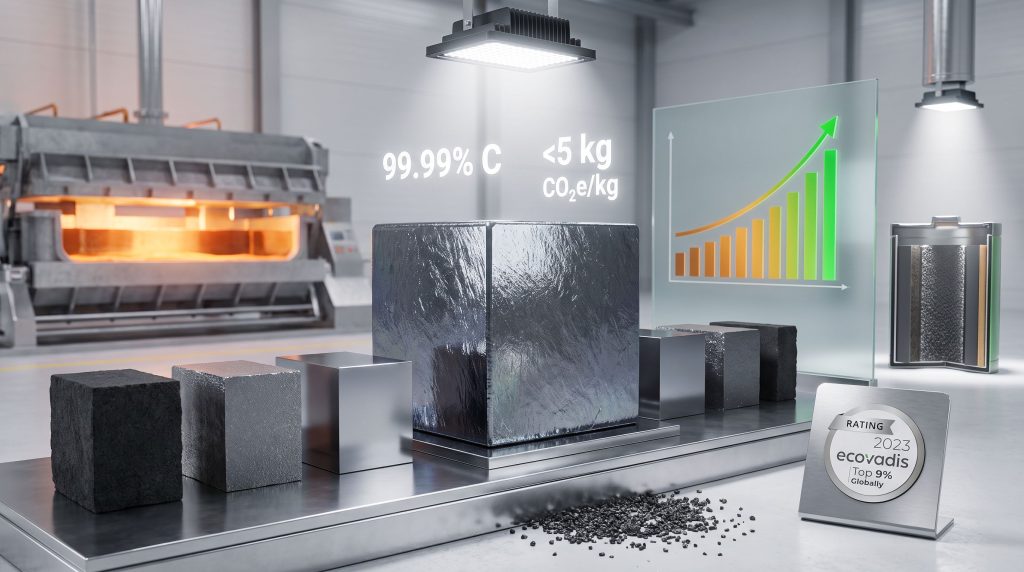
One of the more strategically significant developments in Tokai COBEX's product evolution is E3BAM®, a proprietary synthetic graphite produced at the company's French manufacturing facility in collaboration with Tokai Carbon Japan. The product targets the lithium-ion battery anode market and carries a set of specifications that position it competitively within the context of Western battery supply chain development:
| E3BAM® Specification | Value |
|---|---|
| Carbon purity | 99.99% |
| Carbon footprint | <5 kg CO₂ equivalent per kg of battery anode material |
| Key performance attributes | High energy density, fast-charging capability, extended cycle life |
Why Does Ultra-Low Carbon Footprint Matter in Battery Anode Material Sourcing?
The carbon footprint figure deserves particular attention. Conventional synthetic graphite production, predominantly carried out in China, is estimated to generate roughly 10 to 25 kg of CO₂ equivalent per kilogram of anode material depending on the energy mix and process configuration involved. E3BAM®'s declared figure of less than 5 kg CO₂e/kg represents a substantial reduction, enabled in part by the renewable electricity sourcing at the French production facility.
This matters because battery manufacturers are under growing regulatory and commercial pressure to document Scope 3 emissions throughout their supply chains. European battery regulations are increasingly requiring lifecycle carbon accounting, and automotive customers are beginning to impose supply chain carbon requirements on cell manufacturers. European-produced synthetic graphite with a verified low carbon footprint is therefore not simply a niche environmental proposition, but a commercially strategic positioning in a market undergoing rapid supply chain restructuring.
Sector Insight: The same high-purity carbon manufacturing expertise that underpins metallurgical cathode production is now being leveraged for battery-grade synthetic graphite, representing a convergence between heavy industrial materials science and the energy transition supply chain.
How Does Tokai COBEX Approach Sustainability Across Its Manufacturing Operations?
Emission Control Infrastructure and Energy Management
Carbon and graphite manufacturing involves high-temperature processing steps that generate a range of air quality challenges, including sulphur dioxide emissions, volatile organic compounds from pitch binders, and particulate matter from graphitisation furnaces. Tokai COBEX has invested in a suite of emission control technologies across its facilities:
- Gas desulphurisation systems to reduce SO₂ releases from high-temperature processing
- Regenerative thermal oxidisers (RTOs) to combust volatile organic compounds generated during baking and graphitisation cycles
- Graphitisation fume treatment units to capture particulate and gaseous emissions at the furnace
Beyond emissions control, the company sources the majority of its electricity from renewable energy, and has implemented water conservation and energy management programmes targeting continuous improvement in process energy intensity.
Third-Party Sustainability Validation
Tokai COBEX holds a Silver rating from EcoVadis, the third-party sustainability assessment platform widely used in industrial procurement. This places the company within the top 9% of all companies assessed globally by EcoVadis across environment, labour and human rights, ethics, and sustainable procurement criteria.
Furthermore, the Aluminium Stewardship Initiative recognises Tokai COBEX as a member, further underscoring the company's commitment to responsible practices across the aluminium value chain.
Procurement Signal: As aluminium producers face mounting pressure from downstream customers in automotive, packaging, and aerospace sectors to demonstrate supply chain sustainability credentials, the ESG performance of upstream material suppliers is becoming an increasingly relevant factor in cathode material procurement decisions, not merely a reputational consideration.
Why Does Carbon and Graphite Supply Chain Reliability Matter for Global Aluminium Production?
The Operational Consequences of Cathode Material Failure
When a cathode lining fails prematurely, the consequences extend well beyond the cost of replacement materials. Unplanned pot relining events require cells to be taken offline, cooled, relined, and recommissioned, a process that can take several weeks and involves substantial costs in materials, specialised labour, and foregone metal production.
Industry experience suggests that a single unplanned relining event can cost a smelter hundreds of thousands of dollars per cell, creating strong economic incentives to specify materials that maximise campaign life rather than minimise upfront unit cost. The primary failure mechanisms that operators seek to prevent include:
- Sodium penetration: Dissolved sodium from the cryolite bath diffuses into cathode blocks and causes destructive internal expansion
- Heave cracking: Differential thermal expansion within the lining creates mechanical stress that can fracture blocks and disrupt the cell geometry
- Bath leakage: Penetration of the liquid cryolite bath through failed joints or cracked blocks into the steel shell, potentially causing dangerous metal and bath breakthrough events
Supply Chain Concentration Risks
The raw material inputs for carbon and graphite manufacturing carry their own geographic concentration risks. Calcined petroleum coke, the primary feedstock for carbon products, is predominantly sourced from refinery operations in the United States and the Middle East. Coal tar pitch, the binder used in block manufacture, is largely produced in Asia and Europe. Disruptions to either supply stream can have cascading effects on cathode block availability and pricing.
European manufacturing capacity, such as Tokai COBEX's facilities in Poland and France, offers a degree of supply chain geographic diversification that has become increasingly valued by European and Middle Eastern aluminium producers. This is particularly relevant given the broader aluminium market impact of recent trade policy shifts, which have accelerated the search for stable, regionally proximate supply relationships.
Technical Support as a Competitive Differentiator
Cathode block selection is ultimately not a commodity procurement decision. The optimal specification depends on cell design, operating amperage, thermal management strategy, and the specific bath chemistry and operational practices of each smelter. Suppliers that offer application engineering support, including cell design optimisation, lining installation supervision, and ongoing performance monitoring, provide a service layer that translates into measurable differences in energy intensity and pot life.
This technical partnership dimension is one reason why established relationships between carbon material suppliers and aluminium producers tend to be long-term in character, with switching costs that go well beyond the unit price of individual cathode blocks. For context, the Alcoa aluminium strategy illustrates how major producers are increasingly structuring long-horizon supply and operational partnerships to underpin efficiency gains.
Frequently Asked Questions: Carbon and Graphite Products for Aluminium Smelting
What is the primary function of cathode blocks in an aluminium smelting cell?
Cathode blocks form the hearth lining of the electrolysis cell, functioning as the counter-electrode through which electrical current flows to reduce aluminium ions dissolved in molten cryolite into liquid metal. Their conductivity, thermal properties, and chemical resistance directly determine cell efficiency and operational lifespan.
What is the difference between graphitic and graphitised cathode blocks?
Graphitic blocks contain partially ordered carbon structures, while fully graphitised blocks have been thermally converted above 2,500°C into a highly crystalline graphite lattice. Fully graphitised blocks offer significantly lower electrical resistivity and higher thermal conductivity, making them the preferred choice for modern, energy-efficient smelting cells.
How long do cathode linings typically last in an aluminium smelter?
Cathode lining service life varies based on material specification, operating amperage, bath chemistry management, and cell design. Industry benchmarks typically range from approximately five to over ten years, with premium graphitised cathode systems targeting the upper end of this range under optimised operating conditions.
Why is carbon purity important in battery-grade synthetic graphite?
Battery anode performance, including energy density, charge cycle stability, and fast-charging capability, is sensitive to impurity levels in graphite. At 99.99% carbon purity, synthetic graphite such as E3BAM® minimises internal resistance and electrochemical side reactions, contributing to longer battery service life and more consistent charge and discharge performance.
What sustainability indicators should smelters evaluate when assessing carbon material suppliers?
Key indicators include third-party ESG ratings such as EcoVadis, ISO 14001 environmental management certification, documented renewable energy usage, verified emissions reduction performance covering SO₂, VOCs, and particulate matter, and transparency in raw material sourcing practices.
Key Takeaways: The Strategic Role of Carbon and Graphite Materials in Aluminium Smelting Efficiency
- Carbon and graphite lining materials are precision-engineered components, not commodity inputs, and their specification has a direct and measurable impact on energy consumption, pot life, and productivity at the cell level
- The progression from amorphous to fully graphitised cathode technology represents one of the highest-impact material upgrade pathways available to smelters targeting energy intensity reduction
- European-based manufacturers with integrated technical support capabilities, such as Tokai COBEX with facilities in Poland and France, offer supply chain resilience characteristics increasingly valued by aluminium producers seeking to diversify geographic exposure in their materials supply chains
- The same high-purity carbon manufacturing expertise developed for metallurgical cathode applications is now being extended into battery-grade synthetic graphite production, with E3BAM® representing a low-carbon-footprint European supply option at a time when battery supply chain provenance is attracting regulatory and commercial scrutiny
- Third-party ESG validation, including EcoVadis Silver certification placing Tokai COBEX in the top 9% of assessed companies globally, is transitioning from a reputational differentiator to a functional procurement requirement as aluminium producers face downstream sustainability pressure from automotive, aerospace, and packaging customers
- Aluminium operations repowering initiatives being undertaken by major producers further reinforce why Tokai COBEX carbon and graphite products for aluminium smelting must be evaluated within a broader strategy of decarbonisation and efficiency at the cell level
Further Exploration: Readers seeking additional context on carbon and graphite materials in aluminium production can explore related industry coverage through AL Circle's SupplementAL section at alcircle.com, which publishes ongoing analysis of materials and technology developments across the global aluminium value chain.
Want to Invest Ahead of the Next Major Aluminium or Minerals Discovery?
Discovery Alert's proprietary Discovery IQ model delivers real-time alerts the moment significant ASX mineral discoveries are announced, transforming complex geological and commodities data into clear, actionable investment insights for both short-term traders and long-term investors. Explore Discovery Alert's dedicated discoveries page to understand how historic mineral discoveries have generated substantial market returns, and begin your 14-day free trial today to position yourself ahead of the broader market.