July 8, 2026
The Structural Fragility Hidden Inside America's Most Versatile Metal
Imagine a material so deeply embedded in modern industrial life that its absence would simultaneously ground military aircraft, halt electric vehicle production, stall grid expansion, and empty supermarket shelves of packaged food. That material is aluminium, and the United States currently produces less than a fifth of the primary metal it needs from domestic sources. This is not a recent development triggered by a single policy failure. It is the cumulative result of decades of structural erosion, compounded by energy cost disadvantages, regulatory inertia, and an increasingly aggressive global trading environment shaped by non-market economies.
The Aluminum Association US aluminium supply chain strategy, released as demand projections for 2050 show a potential 80 percent increase over current levels, frames this moment as a turning point. The argument is not that recycling should be abandoned or that primary smelting is obsolete. It is that neither track alone is sufficient, and that treating the two as competing priorities has been one of the costliest conceptual errors in US industrial policy.
When big ASX news breaks, our subscribers know first
Aluminium's Unique Position in the Critical Minerals Hierarchy
Most critical mineral designations apply to a narrow subset of federal agencies. Aluminium is one of the rare materials classified as critical across every major US federal body simultaneously, reflecting its dual role as both an economic workhorse and a national security asset. No other structural metal occupies this position.
The downstream sectors depending on consistent aluminium access span an unusually wide range:
- Defence and aerospace: Airframes, armoured vehicles, munitions components, and naval structures all rely on high-purity primary aluminium grades that secondary recycling cannot consistently replicate without primary metal blending.
- Energy infrastructure: Transmission cables, transformer housings, and renewable energy mounting systems consume enormous volumes of aluminium, and grid modernisation programmes are expected to accelerate this demand significantly through the 2030s.
- Advanced manufacturing and automotive: Lightweighting trends across the passenger vehicle sector, particularly in battery electric vehicles where weight reduction directly extends driving range, have made aluminium a central engineering material.
- Packaging and consumer goods: Beverage cans, food packaging, and pharmaceutical containers represent a high-volume, fast-cycling demand stream that feeds directly into the secondary production loop.
What distinguishes aluminium from steel in a supply chain context is the degree of North American integration. Unlike steel, where domestic production and imports operate in more discrete channels, aluminium moves through a deeply interconnected web of Canadian primary smelting, US downstream fabrication, and a recycling system that spans the continent. Disrupting any single node creates cascading effects across the entire value chain. Furthermore, US aluminium tariffs have added another layer of complexity to these already intricate trade relationships.
Four Decades of Primary Production Collapse
US primary aluminium output peaked in the 1980s. Since then, production has fallen by approximately 80 percent, a contraction so severe that domestic smelters now satisfy less than 20 percent of primary demand. The decline was not driven by a lack of bauxite resources or alumina refining capacity. The single most decisive factor has been electricity cost.
Primary aluminium smelting is extraordinarily energy-intensive. The Hall-Heroult electrolytic process, which converts aluminium oxide dissolved in molten cryolite into pure metal, consumes roughly 13 to 15 kilowatt-hours of electricity per kilogram of aluminium produced. At industrial scale, this makes power pricing the dominant operating cost variable, often accounting for 30 to 40 percent of total production costs.
Canada's competitive advantage is rooted almost entirely in hydroelectric power. Quebec and British Columbia host large smelting complexes supplied by low-cost, low-carbon hydro generation that US competitors simply cannot replicate without equivalent baseload renewable infrastructure. The result is that Canada now fills the primary aluminium gap for US downstream manufacturers, creating a dependency that, whilst geopolitically manageable under normal conditions, represents a structural vulnerability in scenarios involving trade disruption or supply shocks.
"The United States currently sources approximately 75 percent of its projected aluminium demand from foreign suppliers. Without structural intervention across multiple policy tracks, that dependency is expected to deepen as downstream manufacturing scales through the 2030s and 2040s."
Secondary Production's Rise and Its Hidden Limits
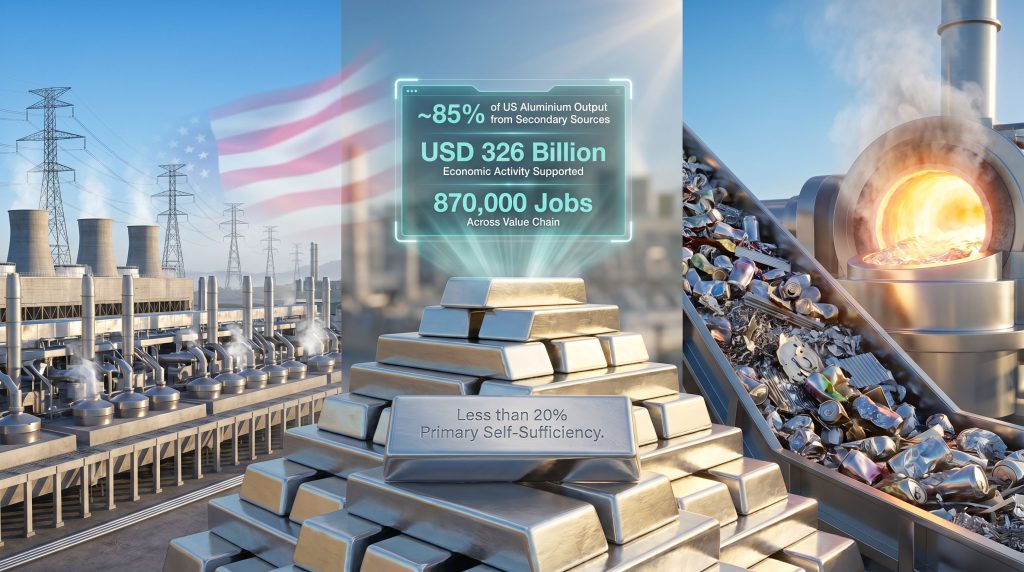
The growth of US aluminium recycling since the 1980s is a genuine industrial success story. Scrap collection has more than doubled over four decades, and secondary production now accounts for roughly 85 percent of total US aluminium output. The energy efficiency argument for recycling is compelling: producing aluminium from scrap requires approximately 95 percent less energy than primary smelting from bauxite-derived alumina.
However, the recycling system's apparent strength masks a serious structural weakness. Used beverage can (UBC) recovery rates remain below 50 percent in the United States, a figure that contrasts sharply with recovery rates exceeding 90 percent in countries like Brazil and several European nations with more developed deposit and collection infrastructure. The consequence is stark: more than USD 1 billion worth of aluminium is discarded annually in the US, lost to landfill rather than recirculated through the remelting system.
More concerning from a strategic standpoint is what happens to the scrap that is collected but not retained domestically. The US exports enough aluminium scrap each year to manufacture more than 9 million passenger vehicles, with a substantial share flowing to China. This represents a net transfer of strategic industrial material to a competing economy, undermining both the domestic recycling sector and the secondary production capacity it is meant to support.
The fundamental reason recycling alone cannot close the supply gap is metallurgical. Secondary aluminium produced from mixed scrap streams contains impurity profiles, particularly elevated levels of copper, iron, and silicon, that limit its application in high-specification end uses. Defence components, aerospace-grade sheet, and certain automotive structural parts require the tight alloy chemistry that only primary metal, or primary-secondary blends with controlled scrap inputs, can reliably deliver. Recycling is essential but not a complete substitute. Consequently, understanding the broader pressures on aluminum and alumina markets helps contextualise why recycling alone cannot shoulder the entire burden.
The Three-Track Supply Chain Framework
The Aluminum Association's recommended approach operates across three parallel capacity tracks, each addressing a distinct dimension of the supply problem.
| Capacity Track | Strategic Action | Projected Impact |
|---|---|---|
| New Primary Smelter Construction | Approximately 5 new facilities at 750,000 MT capacity each | Significant reduction in import dependency by 2029 |
| Idle Smelter Restart Programme | Reopening four existing mothballed facilities | Could offset 15 to 20 percent of current primary imports |
| Scrap Retention and Remelt Expansion | Recovering 1 to 2 million MT of landfilled or exported scrap | Potential to address up to two-thirds of existing imported metal needs |
The capital requirements for new primary smelter construction are formidable. Each facility is estimated to require between USD 4 billion and USD 6 billion in investment, with construction timelines typically extending across five to seven years from site selection to first metal. Locations currently under consideration, including development discussions linked to Oklahoma, must navigate permitting processes, grid connection requirements, and long-term power purchase agreement negotiations simultaneously.
This timeline mathematics creates an urgency that is frequently underappreciated in policy discussions. A decision made today to commission a new smelter would not yield production capacity until the early 2030s at the earliest. Given that demand is projected to grow by 80 percent by 2050, delay in initiating the process compounds the structural gap year by year.
Pillar One: Recycling Infrastructure as a Strategic Asset
Treating used beverage cans and high-grade aluminium scrap as strategic national assets rather than commodity exports requires a reorientation of both trade policy and infrastructure investment priorities. The Aluminum Association has proposed export controls specifically targeting UBC flows in markets where domestic remelting capacity already exceeds available scrap supply, a targeted rather than blanket restriction designed to prioritise in-country value capture.
The infrastructure investment required to close the recycling gap spans several interconnected systems:
- Advanced sorting technology: Sensor-based optical and X-ray fluorescence sorting systems can separate aluminium alloy families with sufficient precision to produce higher-value, cleaner scrap streams suitable for demanding end uses.
- Expanded remelting capacity: Additional secondary smelter capacity, particularly in regions with existing scrap collection density, would reduce the economic incentive to export rather than process domestically.
- Collection network modernisation: Municipal and commercial collection systems, particularly in states without container deposit legislation, consistently underperform relative to states with active return programmes.
- Tax incentive structures: Production tax credits tied to secondary aluminium output, modelled on mechanisms used in other critical materials sectors, could accelerate private investment in remelting facilities.
"Proposed export controls on used beverage containers would function as a targeted supply retention measure in markets where domestic remelting infrastructure is already capable of absorbing available scrap volumes, rather than as a broad trade restriction."
In addition, the Aluminum Association has outlined these recycling priorities as part of a broader policy agenda communicated to both Congress and the incoming administration.
The next major ASX story will hit our subscribers first
Pillar Two: Rebuilding Primary Smelting Capacity
The energy access challenge is the central variable determining whether new primary aluminium smelters in the United States are commercially viable. Current grid conditions in most US regions make baseload power at the cost levels required for competitive smelting difficult to secure, particularly at the gigawatt-scale consumption that a 750,000 MT facility would demand.
What Energy Sources Could Power New US Smelters?
The Association's recommended energy policy approach is explicitly technology-agnostic:
- Small modular reactors (SMRs): Next-generation nuclear technology offering dispatchable, low-carbon power at potentially competitive levelised costs, with several US developers targeting commercial deployment in the late 2020s and early 2030s.
- Geothermal energy: Advanced geothermal systems, including enhanced geothermal, represent a baseload renewable option with significant untapped potential in the western United States, where several proposed smelter locations are geographically proximate to prospective geothermal resources.
- Hydropower expansion: Where feasible through new run-of-river projects or pumped hydro storage, hydropower remains the most cost-effective baseload renewable option and could partially replicate Canada's competitive advantage in specific US regions.
- Natural gas with carbon capture: As a transitional solution where renewable baseload is unavailable at scale, natural gas combined with carbon capture and storage infrastructure could bridge the gap during smelter ramp-up phases.
Permitting reform represents a parallel enabler. Transmission line approvals, grid interconnection queues, and environmental review timelines currently add years to smelter development schedules. Streamlining these processes without compromising environmental standards is a stated priority within the Association's framework. For further context on how energy transition is reshaping production economics, the Association's aluminium operations repower initiatives demonstrate what is achievable when energy strategy and industrial policy align.
Pillar Three: Trade Enforcement and Market Integrity
The competitive environment facing US aluminium producers is materially distorted by the behaviour of non-market economies, primarily China and Russia, whose state-subsidised production enables export pricing that domestic producers operating under market conditions cannot match. Addressing this requires a layered enforcement architecture rather than reliance on any single trade instrument.
| Trade Enforcement Tool | Target Problem | Mechanism |
|---|---|---|
| Targeted Section 232 Tariffs | Unfair pricing by non-market economies | Import duties on primary and derivative products |
| USMCA Rules of Origin | Circumvention through third-country processing | Stricter content and origin verification |
| Anti-Dumping Duties | Below-cost import pricing | Countervailing margin calculations |
| Transshipment Monitoring | Indirect routing to avoid tariffs | Enhanced customs tracking and import surveillance |
Transshipment is a particularly insidious problem. Chinese or Russian aluminium routed through third countries, processed minimally to alter its apparent origin, and then exported to the US under preferential trade arrangements effectively nullifies the impact of primary tariff measures. Strengthening customs surveillance and tightening rules of origin requirements under an updated USMCA framework are both necessary responses.
Anti-dumping duties and countervailing measures operate differently from Section 232 tariffs. Anti-dumping actions target pricing below the cost of production or below home-market pricing. Countervailing duties address the distortive effect of foreign government subsidies. Both mechanisms require ongoing administrative processes and are subject to periodic review, making sustained enforcement a resource-intensive but necessary undertaking. Indeed, the broader conversation around aluminum and steel tariffs reflects just how central trade policy has become to domestic supply chain resilience.
The 2050 Demand Horizon and Its Policy Implications
Projecting an 80 percent increase in global aluminium demand by 2050 is not a speculative extrapolation. It is grounded in three convergent structural trends: the electrification of transport, the expansion of power transmission infrastructure, and the build-out of renewable energy and data centre capacity, all of which are aluminium-intensive.
Electric vehicles use significantly more aluminium than internal combustion engine equivalents. A typical battery EV contains roughly 25 to 35 percent more aluminium by weight than a comparable conventional vehicle, reflecting the material's role in battery enclosures, structural components, and thermal management systems. As EV penetration grows from current single-digit percentages toward projected majorities of new vehicle sales by the 2040s, the incremental aluminium demand from this sector alone will be substantial.
Grid modernisation adds another demand layer. High-voltage transmission cables predominantly use aluminium conductor steel-reinforced (ACSR) technology, and the scale of transmission infrastructure required to connect distributed renewable generation to load centres represents a multi-decade aluminium demand tailwind.
The industry has not been idle. More than USD 11 billion has been invested in US aluminium manufacturing, recycling, and downstream operations over the past decade. The Aluminum Association's member companies collectively produce around 70 percent of the aluminium and aluminium products shipped across North America, supporting approximately USD 326 billion in economic activity and more than 870,000 jobs across the value chain. Furthermore, the top aluminium companies operating within this ecosystem are increasingly positioning themselves around long-term supply security rather than short-term margin optimisation.
US Aluminium Industry: Snapshot Data
| Metric | Current Estimate |
|---|---|
| Share of North American aluminium shipped by Association members | Approximately 70 percent |
| Total US economic activity supported | Approximately USD 326 billion |
| Jobs supported across the aluminium value chain | Approximately 870,000 |
| Share of US aluminium from secondary/recycled sources | Approximately 85 percent |
| Primary aluminium self-sufficiency rate | Less than 20 percent of current demand |
| Annual value of discarded aluminium | Over USD 1 billion |
| Decade-long manufacturing investment | Over USD 11 billion |
Frequently Asked Questions: US Aluminium Supply Chain Strategy
What does the Aluminum Association mean by an all-of-the-above approach to aluminium supply?
The framework rejects the binary framing that positions primary production and recycling as alternatives. Both are structurally necessary. Primary metal provides the high-purity alloy chemistry required for demanding applications. Secondary production delivers energy efficiency and resource circularity. The strategy argues that advancing one at the expense of the other creates a weaker overall supply position than pursuing both simultaneously alongside trade enforcement reforms.
Why can't the US simply rely on recycled aluminium to meet all its needs?
Metallurgical limits constrain secondary aluminium's applicability in high-specification end uses. Impurities accumulated through mixed scrap processing restrict the alloy grades achievable without primary metal blending. Additionally, the overall volume of scrap available domestically is itself a function of historical primary production and import flows, meaning a recycling-only strategy is ultimately self-limiting without adequate primary input into the system.
Which industries would benefit most from increased domestic primary production?
Defence and aerospace manufacturers dependent on tight-specification alloys would benefit most directly. The energy infrastructure sector, automotive OEMs pursuing lightweighting strategies, and advanced manufacturing generally would also see supply chain resilience improvements from reduced reliance on import flows subject to trade disruption.
How long does it take to build a new primary aluminium smelter in the United States?
From site selection through permitting, construction, and commissioning to first commercial production, a new facility typically requires five to seven years. Capital requirements in the USD 4 billion to USD 6 billion range per facility mean that financing timelines add further complexity. This makes early policy commitment critical given the 2050 demand horizon.
What role does Canada play in the North American aluminium supply chain?
Canada functions as the primary production backbone for North American aluminium manufacturing. Its hydroelectric-powered smelters produce low-carbon primary metal at competitive cost levels that US grid conditions cannot currently match. Canadian primary aluminium flows directly into US downstream fabrication, making the USMCA trade relationship a central pillar of supply chain stability.
How would export controls on used beverage cans work in practice?
Proposed controls would apply specifically in markets where domestic remelting capacity already exceeds available scrap supply, preventing UBC volumes from being exported to countries like China when they could be processed domestically. This is a targeted supply retention measure rather than a broad trade restriction, designed to improve domestic recycling economics and reduce the strategic export of a recoverable national resource.
What is the difference between anti-dumping duties and Section 232 tariffs?
Section 232 tariffs are applied on national security grounds, targeting specific products or countries deemed to pose a threat to domestic industrial capacity. Anti-dumping duties specifically address imports priced below the cost of production or below home-market prices, and are determined through case-by-case administrative investigations. Both tools can operate simultaneously and address different dimensions of unfair trade behaviour.
Key Takeaways for Understanding the US Aluminium Supply Challenge
- No single solution is sufficient. Primary production recovery, recycling system expansion, and trade enforcement must advance on parallel tracks simultaneously.
- Scrap retention policies targeting export controls on used beverage cans and high-grade scrap could address a significant portion of current primary import dependency if implemented effectively and paired with remelting capacity investment.
- Energy access is the pivotal constraint for new primary smelter viability. SMRs, advanced geothermal, and updated power purchase agreement frameworks represent the most promising emerging pathways.
- The 2050 demand trajectory makes near-term policy inaction progressively more costly. Each year of delay in smelter commissioning decisions pushes the earliest possible production start further into a decade when demand pressures will already be acute.
- North American trade alignment through a strengthened USMCA framework is as strategically important as domestic production investment, given Canada's integral role in supplying primary metal to US downstream manufacturers.
- The recycling system's hidden export problem, exemplified by the annual outflow of scrap equivalent to more than 9 million vehicles worth of aluminium, represents a resolvable policy failure rather than an inevitable structural feature.
Readers seeking additional context on the policy roadmap underpinning these efforts can consult the Aluminum Association's full white paper on powering up US aluminium, which details the technical and legislative priorities in depth.
Want To Track ASX Mineral Discoveries Before the Broader Market Does?
Discovery Alert's proprietary Discovery IQ model delivers real-time alerts on significant ASX mineral discoveries across more than 30 commodities — including those tied to the critical minerals driving aluminium's industrial future — translating complex data into clear, actionable insights for investors at every level. Explore why early positioning in major discoveries can generate substantial returns on Discovery Alert's dedicated discoveries page, and begin your 14-day free trial today to gain a market-leading edge.