August 5, 2026
The Hidden Lag Between Diplomatic Agreements and Physical Oil Market Relief
Energy markets have a well-documented tendency to price in hope before supply chains deliver on it. When a strategic waterway reopens after a prolonged disruption, traders respond within hours. Tankers, however, take weeks to reroute. Wells that have been shut in require methodical restart sequences. Insurance underwriters reassess war-risk premiums on their own timelines. The gap between a diplomatic handshake and a barrel reaching a refinery is far wider than headline coverage typically suggests, and understanding that gap is central to interpreting the EIA oil production forecast after Strait of Hormuz reopening events.
The U.S. Energy Information Administration's July 2026 Short-Term Energy Outlook (STEO) confronts this gap directly, offering one of the most consequential single-month forecast revisions in recent memory. The trigger was a June 18, 2026 agreement between the United States and Iran to restore commercial shipping through the Strait of Hormuz, ending a conflict period that had removed an extraordinary volume of crude from global circulation.
When big ASX news breaks, our subscribers know first
The Scale of the 2026 Hormuz Disruption in Historical Context
To appreciate the magnitude of what occurred, it helps to place the Hormuz disruption alongside prior supply shocks. The strait handles roughly 20% of global oil trade under normal operating conditions, funnelling output from Saudi Arabia, Iraq, Kuwait, the UAE, and Iran through a navigable channel only 21 nautical miles wide at its narrowest point. No other maritime corridor carries comparable energy volume, and no comparable alternative exists at scale.
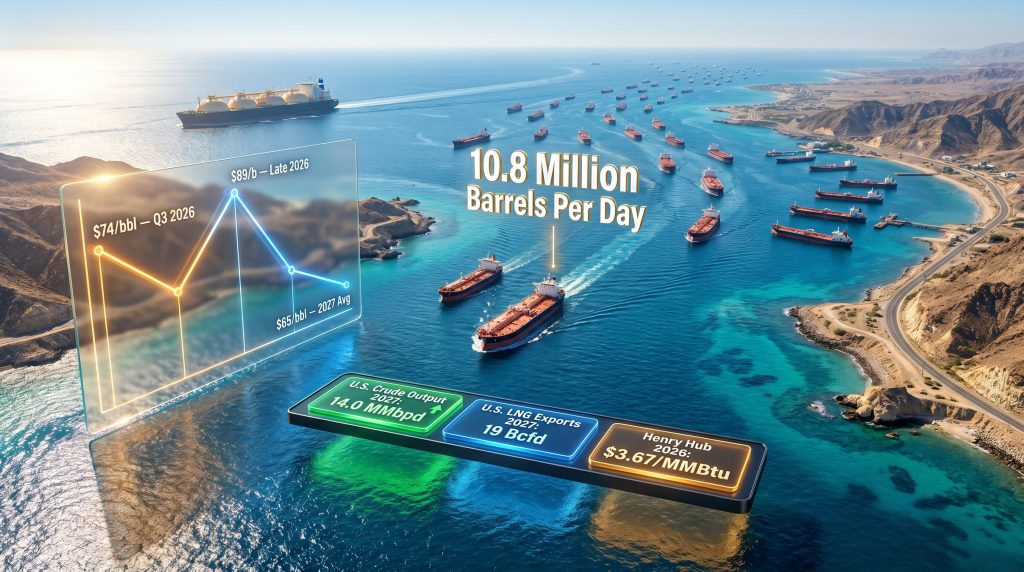
At peak disruption in May 2026, shut-in production reached 10.8 million barrels per day (b/d), a figure that dwarfs most historical precedents. The comparison below illustrates the relative scale:
| Supply Disruption Event | Peak Volume Lost (MMb/d) | Duration | Price Impact |
|---|---|---|---|
| 1973 Arab Oil Embargo | ~4.3 | ~6 months | Prices quadrupled |
| 1990-91 Gulf War | ~4.3 | ~7 months | Spiked ~$40/bbl |
| COVID-19 (2020) | ~20 (demand collapse) | 12+ months | Prices turned negative |
| Hormuz Closure (2026) | 10.8 | Months (ongoing recovery) | Elevated through 2026 |
What distinguishes the 2026 event from the COVID-19 demand collapse is the supply-side nature of the shock. Unlike 2020, when refiners were drowning in crude nobody needed, the 2026 disruption removed genuinely demanded barrels from a market already navigating post-pandemic consumption growth. The asymmetry in market response reflects this difference: prices spiked upward rather than collapsing.
What the EIA's July 2026 STEO Actually Revised
From Constrained Flows to a Phased Restoration Pathway
The June edition of the STEO was produced under conditions of active disruption. The July revision, informed by the diplomatic agreement, fundamentally reorients the agency's supply trajectory. Rather than projecting continued suppression of Persian Gulf output, the EIA now anticipates a structured recovery unfolding in two stages.
Global crude oil production and associated trade flows are projected to approach pre-conflict levels by the end of 2026. Full restoration of previously shut-in production volumes is not expected until Q1 2027, with January 2027 identified as the approximate milestone for complete recovery.
The operational reasons for this lag are numerous and interconnected:
- Well restart sequencing: Shut-in wells in carbonate reservoirs common across Persian Gulf formations require careful pressure management before resuming full production rates
- Tanker market normalisation: War-risk insurance zones take time to be formally reclassified, delaying vessel availability even after physical access is restored
- Port congestion clearance: Months of suppressed throughput create backlogs at loading terminals that cannot be cleared instantly
- Buyer confidence cycles: Refiners locked into alternative supply contracts during the disruption must renegotiate or wait for contract expiry before switching back to Persian Gulf crude
The EIA's analysis reinforces a principle often underestimated in energy markets: a diplomatic resolution marks the beginning of a supply recovery process, not the end of a price problem. Geopolitical risk premiums do not evaporate with a signed agreement.
EIA Crude Oil Price Forecasts: A Two-Stage Descent
Near-Term Pricing Through Late 2026
The EIA forecasts Brent crude averaging approximately $74 per barrel in Q3 2026, a sharp downward revision from the prior month's outlook. This figure already reflects some optimism about supply restoration but remains elevated by historical standards due to the embedded geopolitical risk premium. Furthermore, a current crude oil prices analysis suggests that risk premiums of this nature can persist well beyond the initial resolution event.
Markets pricing in re-closure risk is not irrational behaviour. Historical precedent from post-conflict zones, including the Iran-Iraq ceasefire in 1988 and the post-Gulf War period, shows that insurance markets and physical traders sustain elevated risk assessments for months after formal agreements are reached. The probability of renewed disruption before full production restoration is a legitimate pricing input, not mere speculation.
Brent pricing is expected to remain in the $89/b range in late 2026 before the steeper 2027 decline materialises, reflecting partial restoration only and continued uncertainty.
The 2027 Price Outlook
As global inventories accumulate and previously shut-in barrels return to market, the EIA projects Brent averaging $65 per barrel across 2027. This represents a meaningful structural shift driven by supply-side abundance rather than demand weakness.
| Timeframe | Brent Crude Forecast | Primary Driver |
|---|---|---|
| Q3 2026 | ~$74/bbl | Reopening announced; recovery underway |
| Late 2026 | ~$89/bbl | Risk premium persists; partial restoration only |
| Full Year 2027 | ~$65/bbl (avg) | Inventory build; full production restored |
U.S. Crude Oil Production: Structural Growth in a Shifting Price Environment
Output Trajectory Through 2027
The EIA forecasts U.S. crude oil production rising steadily from 13.6 MMbpd in 2025 to 13.8 MMbpd in 2026 and 14.0 MMbpd in 2027. This incremental growth of roughly 200,000 b/d per year reflects the underlying productivity gains embedded in American shale operations rather than a price-driven investment surge. However, the trade war impact on oil prices adds an additional layer of complexity to the investment calculus facing producers.
| Year | U.S. Crude Oil Production (MMbpd) | Year-on-Year Change |
|---|---|---|
| 2025 | 13.6 | Baseline |
| 2026 (Forecast) | 13.8 | +0.2 MMbpd |
| 2027 (Forecast) | 14.0 | +0.2 MMbpd |
Why U.S. Production Grows Even as Prices Fall
A common misreading of shale economics assumes that falling crude prices will halt U.S. production growth. The EIA's forecast challenges this assumption for several interconnected reasons:
- Drilled-but-uncompleted (DUC) well inventories represent production capacity that can be brought online at relatively low incremental cost, sustaining near-term output even when new drilling investment slows
- Breakeven cost compression across the Permian Basin and other core formations has structurally reduced the price threshold at which new wells remain economical
- Existing infrastructure commitments in midstream pipeline capacity create producer incentives to maintain throughput volumes regardless of short-term price movements
- Hedging programmes at major independent operators lock in revenue at pre-decline prices, insulating near-term production decisions from spot market volatility
The EIA's $65/bbl Brent outlook for 2027 remains above the all-in breakeven for most Tier 1 Permian locations, meaning the growth trajectory is not fundamentally threatened by the projected price decline.
U.S. Natural Gas and LNG: Record Production Meets Expanding Export Capacity
Henry Hub Price Stability
Record domestic natural gas production in the United States is forecast to keep Henry Hub spot prices relatively contained. Reviewing the U.S. natural gas prices forecast reveals a broader pattern consistent with the EIA's expectation of $3.67/MMBtu in 2026, easing further to $3.49/MMBtu in 2027. This moderation is supply-driven, with production growth outpacing even elevated domestic consumption across power generation and industrial sectors.
The LNG Export Expansion Story
Perhaps the most structurally significant element of the EIA's natural gas outlook is the projected expansion of U.S. LNG exports from 15 billion cubic feet per day (Bcfd) in 2025 to 19 Bcfd by 2027, representing a 27% volume increase over two years. In addition, the LNG supply outlook points to sustained international appetite for diversified sources well beyond the current disruption cycle.
This growth is driven primarily by new liquefaction capacity additions coming online across the Gulf Coast. The Hormuz disruption reinforced a dynamic already underway in global gas markets: importing nations accelerated their efforts to diversify away from Middle Eastern supply dependencies, and American LNG became an increasingly attractive alternative both for security-of-supply reasons and on price competitiveness grounds.
| Metric | 2025 | 2026 (Forecast) | 2027 (Forecast) |
|---|---|---|---|
| Henry Hub Price ($/MMBtu) | Baseline | $3.67 | $3.49 |
| U.S. LNG Exports (Bcfd) | 15 | Growing | 19 |
The next major ASX story will hit our subscribers first
What Consumers Should Realistically Expect at the Pump
The Downstream Transmission Lag
Retail fuel prices do not move in lockstep with crude benchmarks. Refinery throughput margins, blending cost structures, regional distribution logistics, and seasonal demand patterns all introduce timing delays between crude price declines and pump price relief. Refiners also operate on procurement cycles tied to crude delivery schedules weeks or months in advance.
The EIA projects average U.S. retail gasoline prices of approximately $3.60 per gallon during the second half of 2026. This figure remains elevated relative to pre-conflict norms and reflects the partial nature of supply restoration during that period.
Consumers anticipating immediate fuel price relief following the Strait of Hormuz agreement are likely to be disappointed in the near term. The physical mechanics of supply chain restoration mean that meaningful price reductions at the retail level are most probable in early 2027, aligned with the EIA's projected timeline for complete production recovery.
Regional variation will also shape individual consumer experiences, with states relying on Gulf Coast refining infrastructure potentially seeing faster relief than those dependent on landlocked or import-reliant supply chains.
EIA vs. IEA: Where the Two Agencies Disagree
Both the EIA and the International Energy Agency's oil market report acknowledge that supply recovery will be phased rather than instantaneous. However, their 2027 outlooks diverge in important ways that carry material implications for oil market pricing.
The IEA projects a significant global supply surplus emerging in 2027, with supply growth potentially reaching 8 million b/d against demand expansion of only 2 million b/d. This 6 MMb/d gap between supply and demand growth, if realised, would represent one of the most pronounced inventory build cycles in modern market history, with potentially sharper downside price consequences than the EIA's $65/bbl baseline suggests.
The EIA adopts a more measured position, emphasising production recovery lags and the persistence of geopolitical risk premiums into early 2027. The agency's framework implies that the surplus, while real, will materialise more gradually than the IEA scenario implies.
| Dimension | EIA Position | IEA Position |
|---|---|---|
| 2027 Brent Price | ~$65/bbl average | Downside risk from supply surplus |
| Supply Recovery Pace | Gradual; full restoration Jan 2027 | Faster; surplus risk emerging |
| Supply Growth Estimate | Measured, lag-adjusted | +8 MMb/d potential |
| Demand Growth Estimate | Moderate | +2 MMb/d |
| Consumer Relief Timing | Early 2027 | Potentially earlier if surplus materialises |
The divergence between these two authoritative bodies underscores an important reality for market participants: forecasting post-conflict supply recovery involves genuine uncertainty, and the range of plausible outcomes is wider than any single agency projection implies.
Broader Macro Implications: What the Hormuz Crisis Revealed
Concentration Risk and the Case for Supply Diversification
One of the less-discussed consequences of the 2026 disruption is the renewed focus it has placed on the fundamental architecture of global oil supply chains. Routing approximately one-fifth of world oil trade through a single 21-nautical-mile passage represents a concentration risk that had been acknowledged theoretically for decades but never stress-tested at this scale in modern markets.
The crisis has accelerated policy discussions in several consuming nations around:
- Strategic petroleum reserve (SPR) adequacy and replenishment strategies
- Alternative pipeline corridor investments, including those bypassing Gulf waterways
- Long-term supply diversification toward non-Hormuz-dependent production regions including the United States, Canada, Brazil, Guyana, and West Africa
- Insurance market reform to better price war-risk coverage for chokepoint exposure
The OPEC+ Response Dilemma
As Persian Gulf production restores and the EIA's projected inventory build materialises through 2027, OPEC+ member nations will face a familiar but intensified dilemma. The OPEC influence on oil markets has historically shaped how the cartel responds when member nations face fiscal pressure — and a $65/bbl Brent environment tests the budget breakeven requirements of several producers. The cartel's internal cohesion on this question historically weakens under such conditions, making the production restraint versus market share trade-off particularly acute.
Scenario: A Secondary Disruption Before Full Restoration
Markets with only partial inventory recovery are structurally more vulnerable to secondary shock events than fully supplied markets. If a renewed disruption occurred before January 2027, the price response could be considerably more severe than what preceded the June 2026 agreement, simply because strategic reserve buffers and inventory cushions remain thinner during the recovery phase. This asymmetric risk argues for maintaining elevated SPR holdings through the full restoration window rather than drawing them down in response to the initial price decline.
Key Forecast Data at a Glance
| Metric | EIA Forecast |
|---|---|
| Global production restoration (near pre-conflict) | End of 2026 |
| Full production restoration | January 2027 |
| Brent crude Q3 2026 | ~$74/bbl |
| Brent crude late 2026 | ~$89/bbl |
| Brent crude 2027 average | ~$65/bbl |
| U.S. crude production 2026 | 13.8 MMbpd |
| U.S. crude production 2027 | 14.0 MMbpd |
| Henry Hub spot price 2026 | $3.67/MMBtu |
| Henry Hub spot price 2027 | $3.49/MMBtu |
| U.S. LNG exports 2027 | 19 Bcfd |
| U.S. retail gasoline H2 2026 | ~$3.60/gallon |
| Peak shut-in production (May 2026) | 10.8 MMb/d |
Frequently Asked Questions
When Will Global Oil Production Return to Pre-Conflict Levels?
The EIA projects that global crude oil production and trade flows will approach pre-conflict levels by the end of 2026, with complete restoration of previously curtailed volumes expected by January 2027.
What Is the EIA's Brent Crude Price Forecast for 2027?
The EIA forecasts Brent crude averaging approximately $65 per barrel across 2027, reflecting progressive inventory accumulation as shut-in production returns to market. This is consistent with the EIA oil production forecast after Strait of Hormuz reopening dynamics playing out across a multi-quarter timeline.
Will Gasoline Prices Drop Immediately After the Strait Reopens?
No. Retail gasoline prices in the United States are expected to average around $3.60 per gallon in the second half of 2026. Meaningful consumer-level relief is most probable in early 2027 once production restoration is substantially complete.
How Much Production Was Removed During the Hormuz Disruption?
At peak disruption in May 2026, approximately 10.8 million barrels per day were removed from global supply, making this the largest recorded oil supply disruption by volume in history.
How Do the EIA and IEA Forecasts Differ?
While both agencies project phased recovery, the IEA anticipates a more pronounced 2027 supply surplus, with supply growth potentially reaching 8 MMb/d against demand growth of only 2 MMb/d. The EIA takes a more conservative recovery timeline, placing greater weight on operational lags and persistent risk premiums.
What Is the EIA's Forecast for U.S. LNG Exports?
U.S. LNG exports are projected to grow from 15 Bcfd in 2025 to 19 Bcfd by 2027, a 27% expansion driven by new liquefaction capacity and sustained international demand for diversified gas supply sources.
Disclaimer: This article contains forward-looking forecasts sourced from the EIA's July 2026 Short-Term Energy Outlook and related agency publications. All price projections, production estimates, and timeline references are subject to revision based on evolving geopolitical conditions, demand outcomes, and production decisions by major oil-producing nations. Nothing in this article constitutes financial or investment advice.
Want to Identify the Next Major Commodity Discovery Before the Broader Market Does?
While energy markets navigate the complex lag between diplomatic agreements and physical supply relief, Discovery Alert's proprietary Discovery IQ model delivers real-time alerts on significant ASX mineral discoveries across oil, gas, and 30+ other commodities — instantly translating complex data into actionable investment insights. Explore historic discovery returns on Discovery Alert's dedicated discoveries page and begin your 14-day free trial today to position yourself ahead of the market.